
A compelling biotech grant application makes reviewers confident by leading with a tight, hypothesis-driven Specific Aims page, a milestone-driven Research Strategy, and a budget that maps directly to those aims. Reviewers form their opinion of your entire proposal from a single page, and the Specific Aims page is the most critical element of an NIH application for exactly that reason.
Before you touch anything else in your draft, run through this:
- Rewrite your Specific Aims headline so it states the gap and your hypothesis in one sentence, not a topic label.
- Add one go/no-go milestone per aim so reviewers see a concrete decision point instead of an open-ended plan.
- Map every budget line to a named aim so the finance section reads as execution logic, not overhead.
- Cut any sentence over 20 words in your Approach section. Reviewers skim; long sentences lose them.
- Confirm your biosketch reflects the actual project role, not a generic CV pull.
Pro Tip: Print your Specific Aims page alone, hand it to a colleague outside your subfield, and give them 60 seconds. If they can't repeat your hypothesis and your first measurable outcome back to you, revise it again.
Before submission, your principal investigator, your lead scientist, and whoever owns operational delivery (contract labs, regulatory timelines, manufacturing) should all sign off. Skipping that last check is how feasibility gaps sneak past the person who wrote the science and into the hands of a reviewer.
Key Takeaways
A compelling biotech grant application succeeds when the Specific Aims page, Research Strategy, and budget all point reviewers toward the same clear, measurable story.
| Point | Details |
|---|---|
| Specific Aims decide the outcome | Reviewers form their first impression here, so draft it early and revise it repeatedly. |
| Milestones need numbers | Go/no-go criteria with explicit thresholds read as rigor; vague monitoring language reads as risk. |
| Budget must map to aims | Every line item should trace to a named aim, or reviewers flag it as disconnected. |
| Mechanism fit prevents triage | Match project stage to NIH, NSF SBIR, or ARPA-H expectations before you draft, not after. |
| Operational gaps undermine feasibility | Haiphai helps biotech teams close SOP, data pipeline, and regulatory readiness gaps that otherwise weaken a proposal's feasibility section. |
Table of Contents
- Why Biotech Grant Applications Differ From Other Proposals
- Specific Aims: Build the One Page That Makes Reviewers Advocate for You
- Structuring the Research Strategy So Reviewers Trust the Approach
- Proving Significance, Innovation, and Feasibility Together
- Presenting Your Team, Environment, and Letters of Support
- Building a Budget and Timeline Reviewers Can Trust
- Writing Tactics That Keep Time-Pressured Reviewers on Your Side
- Matching Your Application to the Right Funder
- What Reviewers Look For and the Red Flags That Sink Applications
- Operational Readiness: How Execution Gaps Show Up to Reviewers
- Articulating IP and Commercialization Plans Reviewers Will Believe
- Handling Ethics and Regulatory Compliance Without Slowing the Narrative
- Writing a Biosketch That Signals Biotech Leadership
- Showing Multidisciplinary Collaboration and Industry Partnerships
- A Note on Persistence
- An Adjacent Option: Closing Operational Gaps Before You Apply
- Sources
- FAQ
Why Biotech Grant Applications Differ From Other Proposals
Biotech reviewers carry a different mental checklist than reviewers in most other fields. A basic-science proposal gets judged mostly on mechanistic insight. A translational proposal has to answer: does this de-risk toward a product? An SBIR/STTR proposal has to prove commercial viability alongside scientific merit, and NSF's Biological Technologies program will return noncompliant proposals without review if the stage doesn't match the solicitation.
- Basic science: judged on novelty and mechanism.
- Translational: judged on path to clinical or manufacturing relevance.
- SBIR/STTR: judged on commercialization plan and technical readiness level.
Reviewers skim Specific Aims, figures, and the budget justification first, in that order. Match your project stage to the mechanism: NIH R01s fit hypothesis-driven discovery, NSF SBIR fits commercially bound technology development, ARPA-H fits high-risk platform bets, and disease-specific foundations often fit earlier, riskier work than federal agencies will touch.
Specific Aims: Build the One Page That Makes Reviewers Advocate for You
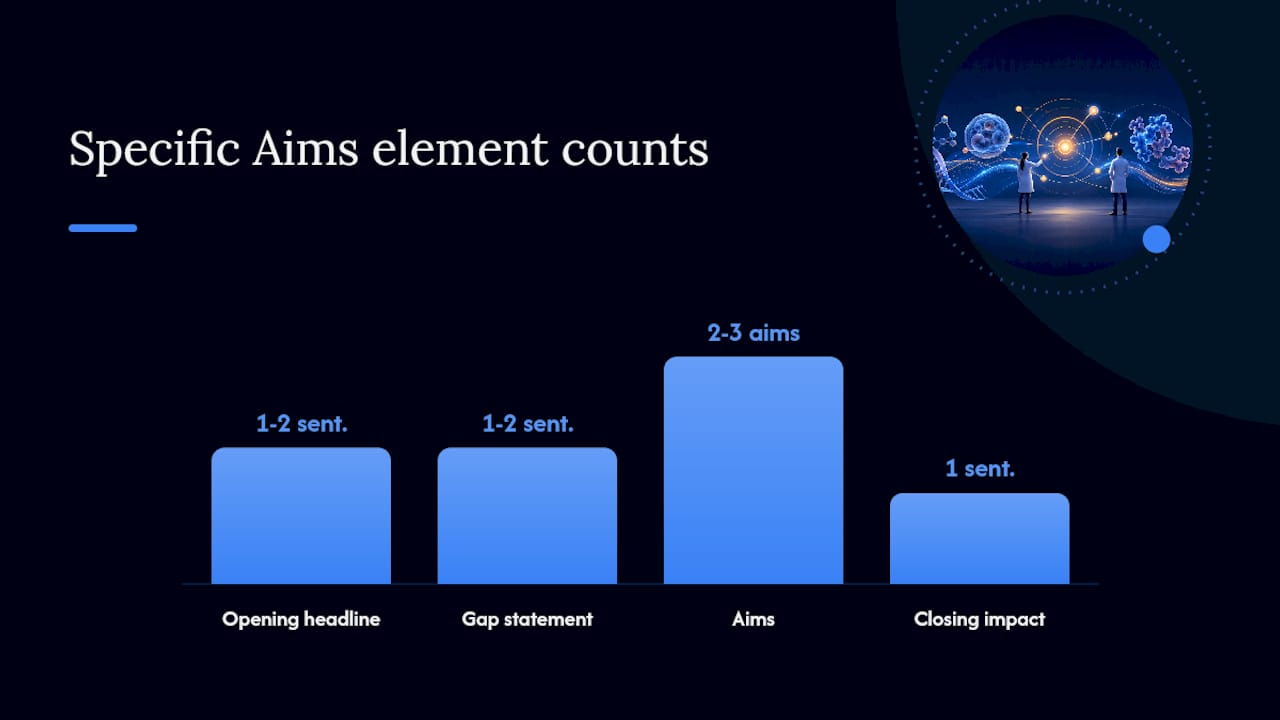
Your Specific Aims page has one job: give a reviewer everything they need to argue for your proposal in a study section discussion they may not lead. Treat it as a self-contained pitch, not a summary of what follows.
A working template looks like this:
- Opening headline stating the problem and its stakes in one or two sentences.
- Gap statement naming exactly what's unknown or unsolved, in one to two sentences.
- Two to three aims, each with a measurable outcome and an explicit hypothesis.
- Closing impact sentence connecting the aims back to the stated problem.
Strong aim statements read like this: "Aim 1: Determine whether knockdown of Protein X reduces tumor invasion significantly in relevant models, testing the hypothesis that X drives a specific invasion pathway." Compare that to a vague version: "Aim 1: Investigate the role of Protein X in cancer progression." The first gives a reviewer a number, a model system, and a falsifiable hypothesis. The second gives them nothing to evaluate.
- Do: "Complete dose-ranging in two animal models by month 9, establishing a maximum tolerated dose."
- Don't: "Optimize dosing strategies across relevant models."
- Do: "Aim 2 will fail informatively if compound stability drops below 48 hours, triggering the reformulation contingency in Aim 3."
- Don't: "We will explore alternative formulations as needed."
Keep it to one page, use one figure only if the funding announcement explicitly allows it, and reserve white space for a reviewer's own annotations. Pro Tip: Draft your Specific Aims first, before your Research Strategy. Writing the aims early forces you to know your endpoints before you write the methods that get you there, which is exactly what NIH's own application advice recommends.
Structuring the Research Strategy So Reviewers Trust the Approach
Your Research Strategy is where reviewers test whether the science actually holds up, and peer-review analyses consistently find the Approach section carries the most weight in funding decisions among the five NIH review criteria. Structure each aim identically so a reviewer can find what they need without hunting:
- Overview — one paragraph stating what the aim tests.
- Rationale — why this approach, backed by your preliminary data.
- Experiments — methods, sample sizes, and controls.
- Milestones — the deliverable that proves the aim succeeded.
- Alternatives and pitfalls — what you'll do if the primary approach stalls.
Go/no-go points need a number attached, not a feeling. A vague "we will monitor progress closely" gives them nothing.
- Map each experiment to a specific month: "Months 1 to 4: complete assay validation and generate n=3 replicate datasets."
- Build in one buffer period per aim for troubleshooting, since biotech timelines slip more often than physics ones.
- Present contingencies as evidence of foresight, not doubt. State the trigger condition and the fallback plan in the same sentence so it reads as planning, not hedging.
Sequencing your riskiest experiment first, rather than last, is a habit worth borrowing from biotech workstream prioritization strategies built for internal R&D planning. It works just as well inside a grant timeline.
Proving Significance, Innovation, and Feasibility Together
Significance, innovation, and preliminary data aren't three separate boxes to check. They're one argument: this problem matters, this approach is genuinely new, and you already have evidence it can work.
Frame significance around what actually moves biotech reviewers: clinical impact, manufacturing scalability, or platform value across multiple indications. A sentence like "This platform could reduce antibody development timelines from 18 months to 6 across any target class" does more work than restating that a disease is serious.
For innovation, name the specific gap your approach fills without overclaiming. "This is the first application of X technique to Y biological system" is defensible if true. "This groundbreaking approach will transform the field" is the kind of language reviewers discount on sight.
- Choose preliminary data that reduces risk on your riskiest assumption, not data that's easiest to generate.
- Present it as a figure with clear axis labels and an n= value, not a paragraph of prose.
- Include sample sizes, controls, and blinding status wherever applicable. Missing these is one of the fastest ways to lose a rigor score.
Reviewers spend limited time per application, which is why NIH explicitly recommends figures over paragraphs to summarize key preliminary data. A dense, well-labeled figure often does more persuasive work than a page of text.
Presenting Your Team, Environment, and Letters of Support
Reviewers don't just fund science, they fund a team's ability to execute it. Your biosketch and team description should show complementary skills: someone who owns the science, someone who understands regulatory pathway, and someone who can speak to commercialization if the mechanism calls for it. Team composition shapes funding outcomes far more than most first-time applicants expect.
A strong letter of support states:
- The specific role the collaborator or facility will play.
- A concrete commitment (equipment access, sample sharing, staff time) rather than vague enthusiasm.
- Evidence of a prior working relationship, if one exists.
If you're outsourcing a function like GLP toxicology or regulatory strategy, name the consultant and their relevant track record directly in the narrative. A named, credentialed advisor reads as a de-risked gap; an unnamed "we will engage a contract lab as needed" reads as an open question.
Building a Budget and Timeline Reviewers Can Trust
Every budget line should trace back to a specific aim. A reviewer who can't connect your reagent costs to an experiment in Aim 2 will flag it, regardless of how reasonable the total looks.
| Aim | Deliverable | Month | Budget Line |
|---|---|---|---|
| Aim 1 | Assay validation complete, n=3 | Month 4 | Reagents, contract assay services |
| Aim 2 | In vivo proof-of-concept dataset | Month 9 | Animal costs, core facility fees |
| Aim 3 | Regulatory strategy memo | Month 12 | Regulatory consulting |
A few rules of thumb worth internalizing: assay and reagent costs should reflect actual vendor quotes, not round-number estimates. Animal costs vary widely by species and housing duration, so get a per diem quote from your institution's facility before submission. Contract lab costs should include turnaround time in your milestone math, not just dollars.
- Justify personnel effort as a percentage tied to actual deliverables, not a flat "10% effort" placeholder repeated for every person.
- Name each subcontractor's specific deliverable, and cross-reference it against the letters of support.
Realistic budgeting like this pairs well with a resource allocation framework that ties personnel time to milestone output rather than headcount alone.
Writing Tactics That Keep Time-Pressured Reviewers on Your Side
Reviewers read dozens of applications in a short window, and NIH's own guidance calls for active voice, concise sentences, and clear topic sentences for exactly that reason. Keep sentences concise where possible. Open every paragraph with its conclusion, not its setup.
- Write your topic sentence first, then support it. Never bury the point in sentence three.
- Use short paragraphs. Four to six sentences is a natural ceiling for a reviewer skimming under time pressure.
- Label every figure with a one-line takeaway, not just a caption describing the axes.
- Every figure should answer a question a reviewer is already asking: does this work, and how confident should I be?
- Bold or underline your key numbers sparingly. Overuse defeats the purpose.
- Route your draft through at least one pre-reader outside your immediate lab before submission.
Pro Tip: Read your Research Strategy out loud. Any sentence you stumble over on a first read is a sentence a tired reviewer will stumble over too. A genomics reporting guide on writing clarity for time-pressured clinical reviewers makes a similar case for lab reports: dense, well-labeled information beats verbose explanation every time.
Matching Your Application to the Right Funder
Stage mismatch is one of the fastest ways to get triaged out before a reviewer even reads your science. Discovery-stage work belongs at NIH R01 or R21 mechanisms. Platform technology with commercial legs fits NSF SBIR. High-risk, high-reward biotech bets increasingly fit ARPA-H, which sometimes requires a staged submission process, such as BIOGAMI's solution summary followed by a full proposal roughly six weeks later.
| Mechanism | Typical Stage | Core Priority |
|---|---|---|
| NIH R01/R21 | Discovery to early translational | Scientific rigor, mechanism |
| NSF SBIR | Commercially bound technology | Technical readiness, market pull |
| ARPA-H | High-risk platform bets | Transformative potential, teaming |
Before you submit, call the Program Officer. Ask whether your project scope fits the current solicitation, whether they've seen similar proposals succeed or fail, and whether a letter of intent is expected. Keep the call to three questions and follow up by email summarizing what you heard. Early Program Officer outreach and a coordinated pipeline of mechanisms materially improve funding odds, and applicants who treat funder fit as more important than funder prestige tend to build stronger, more diversified pipelines over a 12 to 18 month calendar. A non-dilutive funding guide can help map which mechanisms fit your current stage before you invest weeks drafting the wrong one.
What Reviewers Look For and the Red Flags That Sink Applications
The most common reviewer complaints are predictable, and every one of them has a fix.
- Vague aims with no measurable endpoint. Fix: attach a number to every outcome.
- Budget that doesn't map to aims. Fix: trace every line item back to a named aim.
- Missing controls or sample sizes. Fix: state n= and control conditions explicitly in every figure.
- Overclaiming innovation. Fix: name the specific prior gap you're filling instead of using superlatives.
- Team gaps left unaddressed. Fix: name a named advisor or consultant for any missing function.
- No contingency plan. Fix: state a trigger condition and fallback for your riskiest experiment.
- Formatting violations (margins, fonts, page limits). Fix: check the solicitation's formatting rules line by line before submission.
- Incomplete biosketch. Fix: confirm every required field is filled and current.
Run a final pass checking page limits, aim-to-budget alignment, and biosketch completeness the day before submission, not the morning of. If you're resubmitting after a summary statement, address every specific critique in order. Reviewers notice when a resubmission dodges the hardest comment.
Pro Tip: Keep a running list of every critique you've received across past submissions. Patterns in reviewer feedback tell you more about your writing habits than any single summary statement ever will.
Operational Readiness: How Execution Gaps Show Up to Reviewers
Reviewers can tell when a team's science is ahead of its operations. A proposal that says "we will establish SOPs as needed" reads differently than one that says "our validated SOP for cell line authentication is already in use across two ongoing studies." The second signals you can execute on day one of the award period.
Before submission, check for:
- A documented data pipeline showing how results move from bench to analysis to report.
- Written SOPs for your core assays, not tribal knowledge held by one postdoc.
- Signed or drafted contract lab agreements, not verbal commitments.
- A stated regulatory strategy, even a preliminary one, for any product-track proposal.
- A one-paragraph IP position confirming freedom to operate.
Teams that fix these operational gaps before applying tend to submit tighter feasibility sections, because the gaps that usually surface as vague hedging in a draft are the same gaps that stall a project after funding.
Haiphai works with biotech teams to map these operational bottlenecks directly, often reclaiming significant time on the path to approval by fixing exactly the execution gaps that make reviewers nervous.
Articulating IP and Commercialization Plans Reviewers Will Believe
For any SBIR, STTR, or translational proposal, reviewers want to see that you understand the difference between "we have a patent" and "we have freedom to operate." State your IP position in plain terms: what's filed, what's pending, and whether you've cleared a freedom-to-operate search for your core claims. Vague language like "we have strong IP protection" without specifics reads as a gap, not a strength.

Your commercialization plan needs three things to be credible: a realistic addressable market framed around a specific indication or use case, a clear-eyed view of the regulatory pathway (510(k), PMA, BLA, or equivalent), and a plausible go-to-market partner or licensing strategy. Don't claim you'll build a full commercial organization if your team has no commercial experience. Instead, name the type of partner you'd pursue and why your data package would be attractive to them.
Reviewers evaluating SBIR and STTR applications specifically look for evidence that you understand your technology readiness level and what has to happen to move up one level within the award period. If your current TRL is 3, don't write a commercialization plan that assumes TRL 7. Match your claims to your actual data. A competitive approval advantages guide is useful here for framing how operational and regulatory positioning translate into commercial credibility, since reviewers increasingly weigh execution readiness alongside novelty.
If you have existing licensing discussions or a letter of interest from an industry partner, include it. Nothing de-risks a commercialization narrative faster than evidence someone outside your lab already wants what you're building.
Handling Ethics and Regulatory Compliance Without Slowing the Narrative
Every biotech proposal touching human subjects, animal models, or biosafety needs its compliance story told clearly and early, not buried in an appendix. Reviewers read regulatory awareness as a proxy for overall project maturity. If your project requires an Institutional Review Board or Institutional Animal Care and Use Committee approval, state your current status: approved, pending, or not yet submitted, with a realistic timeline for when it will be in place.
For proposals involving gene editing, novel biologics, or dual-use research of concern, name the specific regulatory framework you're operating under and how you plan to stay inside it. Vague reassurance ("we will comply with all applicable regulations") tells a reviewer nothing they can evaluate. Specificity does: "All CRISPR work will follow our institution's Institutional Biosafety Committee protocol #XXXX, currently active through 2027."
Don't treat the ethics and regulatory section as a formality to get through quickly. Reviewers who work in translational biotech have seen projects stall for a year over an IRB approval nobody planned for. Address it directly:
- State your current approval status for every required committee or board.
- Name the specific regulation or guidance document governing your work.
- Include a realistic timeline showing when full approval will be in place relative to your first experiment.
- If you're using human biological samples, state your consent and data-privacy framework explicitly.
Treat this section as evidence of operational maturity, not paperwork. A well-handled regulatory section can make a promising but early-stage project feel executable, while a vague one can make even excellent science look unready.
Writing a Biosketch That Signals Biotech Leadership
Your biosketch is not a CV. It's an argument that you, specifically, are positioned to lead this exact project. Open with a two or three sentence personal statement connecting your specific expertise to the proposal's central risk, not a generic career summary.
If you've led a technology through a prior translational milestone, whether that's IND-enabling studies, a successful SBIR Phase I, or a licensing deal, state it in one sentence with a concrete outcome attached. "Led IND-enabling toxicology studies resulting in FDA clearance to proceed to Phase I" carries far more weight than "extensive experience in drug development."
For biotech specifically, reviewers look for evidence of complementary leadership: can you speak credibly to the science, and do you understand the regulatory and commercial context your work sits inside? If you're a bench scientist without commercialization experience, don't overreach. Instead, make sure your team description elsewhere in the application names a co-investigator or advisor who covers that gap.
List your most relevant publications and prior funded projects, not your longest ones. A reviewer skimming your biosketch in 90 seconds should immediately see the through-line between your past work and this proposal's central hypothesis. If you've held a prior award of any size, from any mechanism, and delivered on its aims, say so explicitly. Demonstrated stewardship of prior funding is one of the strongest signals of execution risk reduction a reviewer can find.
Showing Multidisciplinary Collaboration and Industry Partnerships
Biotech reviewers increasingly expect to see a proposal that spans disciplines, because most translational problems don't yield to a single specialty. If your project needs a computational biologist, a process chemist, and a regulatory strategist, name all three and show how their roles interlock rather than run in parallel.
Industry partnerships carry particular weight for SBIR, STTR, and ARPA-H mechanisms. A letter from a contract manufacturer confirming scale-up feasibility, or from a potential commercial partner confirming interest in your data package, tells reviewers your project has a path beyond the grant period. Name the partner, state their specific contribution, and reference any prior collaboration history that makes the relationship credible rather than aspirational.
Academic-industry partnerships also help address a common reviewer concern: that university-based teams lack a realistic path to manufacturing or market. If your collaborator brings that capability, make it visible in your Research Strategy, not just your letters of support. A pipeline acceleration strategy built around multidisciplinary handoffs, where one team's output becomes another's input on a defined timeline, gives reviewers a concrete picture of how the collaboration actually functions day to day, rather than a list of names attached to a project.
A Note on Persistence
Most rejected applications aren't bad science. They're good science described vaguely, with milestones too soft to evaluate and a budget disconnected from the plan. Every experienced applicant I've studied has a drawer full of summary statements that stung before they funded.
Schedule a Program Officer call before your next draft, not after you've finished writing.
An Adjacent Option: Closing Operational Gaps Before You Apply
Some teams need a stronger Specific Aims page. Others need help finding the right mechanism. But plenty of biotech teams have strong science and a real gap in operational bandwidth: no documented SOPs, no clear data pipeline, no contract lab agreements ready to reference. That gap shows up in a draft as vague feasibility language, and reviewers notice.
Haiphai works as an embedded operational partner for biotech teams facing exactly that problem. Rather than handing you another software tool, Haiphai starts from your funding goals and maps backward to find the specific bottlenecks slowing you down, whether that's regulatory drafting, clinical site activation, or the SOP gaps that make a Research Strategy read as unfinished. The diagnostic engagement identifies those gaps, designs milestones around them, and builds an integration plan tailored to your team rather than a generic template. Clients have reclaimed up to 18 months of operational time on their path to approval. If your science is ready but your operations aren't, visit the Haiphai landing page to request a diagnostic conversation before your next submission cycle.
Sources
- Advice on Application Sections | Grants & Funding
- Elements of successful NIH grant applications
- Biological Technologies Grant – Apply Today | NSF SBIR
- The $1B Non-Dilutive Funding Playbook: What Health and Bio Founders Need to Know Now That SBIR Is Back - Grant Engine
Use funded sample applications as structural templates only. Study their organization and pacing, never copy their wording.
FAQ
Can I use ChatGPT to write a grant?
You can use AI tools to draft outlines, tighten sentences, or check readability, but the science, hypotheses, and data must come from your own team. Reviewers can spot generic language quickly, and funding agencies expect the intellectual content to be yours.
What are the 5 R's of grant writing?
Definitions vary across institutions, but most versions emphasize being relevant to the funder's priorities, rigorous in method, realistic in scope and budget, readable for time-pressured reviewers, and reviewed by pre-readers before submission.
What should I avoid saying in a grant application?
Avoid vague superlatives like "groundbreaking" or "revolutionary" without specific evidence, avoid unmeasurable goals like "optimize" or "explore," and avoid glossing over risk with phrases like "we anticipate no issues."
How can I increase my chances of getting a grant?
Draft your Specific Aims early, map your budget to your aims line by line, and contact your Program Officer before submitting to confirm fit with the solicitation. Teams that also close operational gaps, like missing SOPs or contract lab agreements, tend to submit stronger feasibility sections, which is where a partner like Haiphai fits for teams short on execution bandwidth.