
Team composition is the single most scrutinized variable in a biotech funding decision, functioning as a direct signal of execution capability and capital efficiency. Investors do not fund science alone. They fund the team's ability to move science through regulatory, clinical, and commercial milestones on a defined timeline. According to RNA Advisors, team composition is a capital allocation decision, not an HR function. Understanding why team composition affects biotech funding means understanding how your org chart communicates risk to every investor who reads your deck.
Why team composition affects biotech funding: the investor's lens
Investors do not evaluate team quality in isolation. The concept that matters most is integrated conviction, the combined strength of your team and your scientific thesis working together. A 2026 analysis of 162 VC deal memos found that conviction predicts investment enthusiasm with a correlation of r=0.598, while team quality alone scored r=0.328 across general deals and r=0.503 in healthcare. That gap is significant. It tells you that a brilliant team attached to a weak thesis, or a strong thesis led by an inexperienced team, both underperform in funding outcomes.
The underlying principle here is Founder-Problem Fit, a concept from VC screening that asks whether this specific team is uniquely positioned to solve this specific problem. A neuroscientist-led team pursuing a CNS indication carries more conviction than a generalist management team with the same asset. Investors read the org chart as a proxy for how deeply the founders understand the problem they are solving.
"The team must not just be capable. It must be the right team for this particular science, at this particular stage, with this particular set of risks." This is the standard investors apply when evaluating biotech leadership.
Investors also watch how teams handle adversity. Leadership resilience under pressure, particularly the ability to translate negative Phase 2 data into a credible forward narrative, is a direct input into funding decisions. Teams that can bridge scientific complexity and business clarity signal lower execution risk.
What team roles are critical at each funding stage?

Stage-appropriate team composition is one of the clearest signals of organizational maturity. Series A investors require a fully staffed executive team or a credible plan to fill all roles within 90 days. Missing a Chief Medical Officer with FDA fluency before an IND filing is a near-disqualifier in 2026. That is not a soft preference. It is a hard threshold.
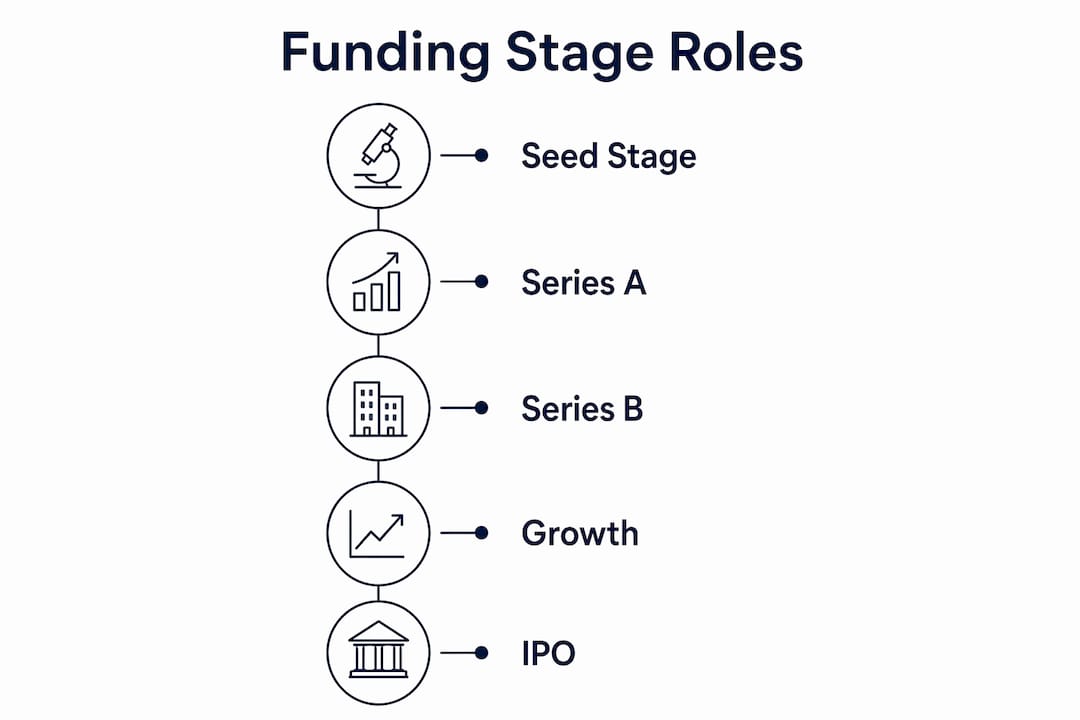
The table below maps the roles investors expect at each major funding stage.
| Development Stage | Critical Roles | Risk if Missing |
|---|---|---|
| Pre-Seed / Seed | CSO, CEO, Fractional CFO | No scientific credibility or financial governance |
| Series A | CEO, CMO, CSO, Head of Regulatory | Execution risk on IND filing and clinical design |
| Series B | Full C-suite, VP Clinical Ops, Commercial Lead | Inability to scale trials and prepare for commercialization |
| Late Stage / IPO | CFO, Chief Commercial Officer, Medical Affairs | Valuation discount and investor confidence gap |
The risk of hiring the wrong talent at the wrong stage is concrete. A seed-stage company that brings on a commercial-focused CEO before proof-of-concept data is ready will struggle to communicate scientific credibility. A Series A company without a CMO who has direct FDA experience signals that the team does not understand what the next 18 months actually require.
Pro Tip: Use fractional leadership roles, particularly a fractional CFO, during early stages. Fractional CFOs deliver more strategic value than junior full-time hires because they bring specialized capital and compliance knowledge without the full-time burn rate.
Biotech organizations also face a structural inflection point as they grow. R&D slowdowns frequently occur when companies transition from informal to structured leadership, typically between 30 and 150 employees. Failing to evolve the leadership architecture during this window causes cultural fragmentation and productivity loss, both of which investors can detect in diligence.
How does team culture influence investor confidence?
Organizational culture is not a soft metric. High-trust R&D cultures achieve up to 30% higher productivity through leadership habits that encourage early, candid knowledge sharing. That productivity gain directly affects burn rate and capital efficiency, two numbers every investor models carefully.
The mechanism is straightforward. When leadership creates permission to act on early, uncertain data, teams move faster through decision points. Flattened hierarchies and trust-based communication reduce the internal friction that slows programs down. In biotech, where every month of delay carries a real dollar cost, this is a material operational advantage.
| Culture Factor | Impact on R&D Performance | Investor Signal |
|---|---|---|
| Early knowledge sharing | Faster decision cycles | Lower execution risk |
| Flattened hierarchy | Reduced internal friction | Operational maturity |
| Transparent leadership | Fewer surprises in diligence | Higher trust in management |
| Adaptive communication | Faster response to data changes | Resilience under pressure |
Investors pick up on culture through reference checks, team interviews, and the way founders talk about their people. A CEO who cannot articulate how decisions get made, or who deflects questions about team dynamics, raises a flag. A CEO who describes specific cultural practices and ties them to program speed signals that the organization is well-managed.
Pro Tip: Before your next funding round, document two or three specific examples of how your team made a fast decision on uncertain data. Concrete stories about team decision-making speed are more persuasive than general claims about your culture.
How should biotech executives align team composition with funding milestones?
Proactive team planning, aligned to the scientific roadmap rather than reactive gap-filling, is one of the clearest competitive advantages a biotech executive can build. Reactive hiring delays programs and adds cost. Forward planning signals organizational maturity to investors.
Here is a practical framework for aligning team architecture with funding milestones:
-
Map your scientific inflection points first. Identify the three to five data readouts or regulatory submissions that define your next 24 months. Each one requires specific leadership capabilities. Build your hiring plan backward from those events, not forward from your current gaps.
-
Audit your current team against the next milestone. Ask explicitly: does the team we have today have the skills to execute the next inflection point? If the answer is no, that gap is a funding risk, not just an operational one. Address it before investors find it in diligence.
-
Use fractional roles to fill strategic gaps without burning runway. A fractional CMO or regulatory advisor can provide the credibility and domain knowledge investors require at Series A without the cost of a full-time hire. This is especially valuable when you are 12–18 months from needing that role full-time.
-
Plan leadership transitions before they become urgent. The CEO who is right for seed stage is often not the right CEO for Series B. Recognizing this early and planning for it, whether through coaching, a co-founder structure, or a planned transition, signals self-awareness that investors respect.
-
Treat your org chart as a living document tied to strategy. Static org charts disconnected from scientific strategy are one of the most common causes of funding failure in mid-stage biotech. Review your team architecture every six months against your updated scientific roadmap.
The underlying principle is organizational self-awareness. Investors fund teams that know what they do not know and have a plan to address it. That quality is rare, and it shows up clearly in how a leadership team talks about their own composition.
Key takeaways
Team composition in biotech is a capital allocation decision that directly determines funding outcomes, not a secondary HR consideration.
| Point | Details |
|---|---|
| Integrated conviction drives funding | Team quality combined with thesis alignment predicts investment enthusiasm far better than team quality alone. |
| Stage-appropriate roles are non-negotiable | Missing a CMO with FDA experience before IND filing is a near-disqualifier at Series A in 2026. |
| Culture affects capital efficiency | High-trust R&D cultures achieve up to 30% higher productivity, directly reducing burn rate and improving investor confidence. |
| Fractional leaders add early-stage value | Fractional CFOs and CMOs provide strategic credibility without the full-time cost, preserving runway for science. |
| Proactive hiring signals maturity | Aligning hires to scientific inflection points, rather than reacting to gaps, is one of the strongest organizational signals investors evaluate. |
The org chart is your first pitch deck
I have watched founders spend months perfecting their scientific narrative and then walk into a Series A meeting with a team that does not match the story they are telling. The science is compelling. The org chart says otherwise. That disconnect is almost always fatal.
The mistake I see most often is treating team composition as something you fix after you raise money. Founders think: "We'll hire the CMO once we close." Investors think: "If they don't have a CMO, they don't understand what closing this round actually requires." Both parties are talking past each other, and the deal dies.
What actually works is treating your org chart as a strategic argument. Every role you have filled, and every role you have deliberately chosen to fill with a fractional leader rather than a full-time hire, should tell a coherent story about how you are allocating capital against scientific risk. That story should be as rehearsed as your pipeline slide.
The teams that raise well are not always the ones with the most impressive credentials. They are the ones who can explain, clearly and specifically, why this team is the right team for this problem at this stage. That is Founder-Problem Fit in practice. It is also the difference between a term sheet and a polite pass.
— John
How Haiphai helps biotech teams build investor-ready organizations
Securing funding requires more than a strong scientific thesis. It requires an organization that can execute against milestones without burning runway on misaligned hires or reactive restructuring.
Haiphai is built for biotech leadership teams that want to align their organizational architecture with their scientific and funding roadmap. Rather than applying generic software to complex life sciences problems, Haiphai works backward from your strategic goals to identify where team gaps and process bottlenecks are creating execution risk. Clients have reclaimed up to 18 months of operational time on their path to approval. That time directly affects valuation and funding readiness. If your team composition is a question mark in your next investor meeting, Haiphai can help you turn it into a competitive advantage.
FAQ
What is integrated conviction in biotech VC screening?
Integrated conviction is the combined strength of a team's capabilities and the scientific thesis they are pursuing. A 2026 analysis found it predicts investment enthusiasm with a correlation of r=0.598, significantly higher than team quality evaluated alone.
Which team roles matter most at series a?
Series A investors expect a CEO, CMO, CSO, and a credible regulatory lead. Missing a CMO with FDA experience before IND filing is treated as a near-disqualifier in 2026 funding rounds.
How does team culture affect biotech funding outcomes?
High-trust R&D cultures achieve up to 30% higher productivity, which reduces burn rate and improves capital efficiency. Investors read strong team culture as evidence of lower execution risk and more predictable program timelines.
When should a biotech company use fractional leadership?
Fractional leaders, particularly CFOs and CMOs, are most valuable at seed and Series A stages. They provide the domain expertise and strategic credibility investors require without the full-time cost that would compress runway before key data readouts.
How often should biotech executives review their org chart?
Review your team architecture every six months against your updated scientific roadmap. Static org charts disconnected from strategy are a documented cause of funding failure in mid-stage biotech companies.