
Biotech non-dilutive funding sources are capital programs that require no equity issuance, letting founders finance research and development without surrendering ownership. The U.S. federal government alone makes over $50 billion available annually for biotech research, with NIH SBIR/STTR, ARPA-H, and CDMRP representing the largest single programs. For early-stage founders, these sources do more than fill a budget gap. They validate technology, de-risk regulatory milestones, and build negotiating leverage before a priced venture round ever opens.
What are the main biotech non-dilutive funding sources?
Non-dilutive capital falls into five broad categories. Each works differently, fits different company stages, and carries its own administrative requirements. Knowing which type matches your current position saves months of misdirected effort.
1. NIH SBIR and STTR grants
The Small Business Innovation Research (SBIR) and Small Business Technology Transfer (STTR) programs are the most widely used non-dilutive funding vehicles in U.S. biotech. Total SBIR/STTR funding across all 11 participating agencies reaches $6.3 billion, with NIH contributing roughly $1.5 billion of that. Phase I awards typically fund feasibility studies, while Phase II awards support full R&D projects. The programs require that the company be majority U.S.-owned and employ fewer than 500 people, making them purpose-built for startups.

2. ARPA-H awards
The Advanced Research Projects Agency for Health (ARPA-H) launched with a $1.5 billion annual budget focused on high-risk, high-reward biomedical breakthroughs. Unlike traditional NIH grants, ARPA-H uses program managers who actively shape projects rather than passively review proposals. ARPA-H can issue awards within roughly three months, which counters the common belief that government funding always moves slowly. Startups with platform technologies or novel delivery mechanisms are strong candidates.
3. CDMRP and Department of Defense programs
The Congressionally Directed Medical Research Programs (CDMRP) distribute approximately $1.3 billion annually across disease-specific research portfolios. Many founders overlook the Department of Defense entirely, but DoD dual-use funding covers biotech applications with both military and civilian relevance, including infectious disease, traumatic brain injury, and advanced prosthetics. BARDA, the Biomedical Advanced Research and Development Authority, adds another channel for pandemic preparedness and medical countermeasure development. These programs reward founders who frame their science around a specific mission rather than general innovation.
4. R&D tax credits
R&D tax credits convert qualifying research expenses into cash refunds, even when the company is operating at a loss. Most developed countries offer some form of research tax credit, and in the United States the federal R&D credit under IRC Section 41 can be applied against payroll taxes for qualifying startups. This makes the credit immediately useful rather than deferred to a profitable year. The cash-flow benefit is real and often underestimated by founders focused exclusively on grants.
Pro Tip: File an R&D tax credit study in your first year of operations, not after your first profitable quarter. The credit applies retroactively to qualifying expenses, and many early-stage biotech companies leave significant cash on the table by waiting.
5. Revenue-based financing and venture debt
Revenue-based financing and venture debt are non-dilutive in the sense that they do not require equity issuance, though they do carry repayment obligations. Venture debt typically comes with minor warrant coverage, generally under 1% equity, which is far less dilutive than a standard priced round. Revenue-based financing ties repayment to a percentage of monthly revenue, making it more forgiving during slow periods. Both instruments work best for companies that have cleared early clinical milestones and can demonstrate a credible path to revenue.
6. Strategic corporate partnerships and collaborations
Large pharmaceutical and medical device companies regularly fund biotech research through sponsored research agreements, licensing deals, and co-development partnerships. The $1.3 billion strategic financing that Blackstone Life Sciences provided to Apogee Therapeutics illustrates how large-scale non-dilutive collaborations can fund Phase 3 development without a traditional equity raise. These deals require a differentiated asset and a clear commercial rationale for the partner. Founders who treat partnership conversations as pure business development, rather than funding requests, tend to close better terms.
7. Foundation and patient advocacy grants
Disease-specific foundations and patient advocacy organizations fund research that aligns with their mission, often with less competition than federal programs. Organizations focused on rare diseases, pediatric cancers, and neurodegenerative conditions regularly issue grants in the $50,000–$500,000 range. Rejection by one funder for scientific reasons does not preclude acceptance by another aligned to a different mission. Founders who map their pipeline to multiple disease communities often stack several foundation awards before approaching institutional investors.
How to research and identify the right opportunities
Finding the right funding source requires a structured process, not a broad search. Follow these steps to match your project to the most relevant programs.
-
Verify eligibility first. SBIR/STTR programs require U.S. majority ownership and fewer than 500 employees. ARPA-H and CDMRP have their own criteria. Confirm your company qualifies before investing time in a proposal.
-
Search NIH RePORTER and USA Spending. NIH RePORTER and USA Spending databases show exactly which projects received funding, at what amounts, and from which program officers. Study funded abstracts in your therapeutic area to understand what language and framing wins awards.
-
Align your milestones with funder missions. Each program funds specific outcomes. ARPA-H wants transformative platform approaches. CDMRP wants disease-specific impact. Frame your proposal around the funder's stated goals, not your internal roadmap.
-
Identify your value inflection points. Funders want to see what changes after their money is spent. Define the specific data package or regulatory milestone your award will generate, and make that the center of your proposal narrative.
-
Explore overlooked sources. DoD dual-use programs, BARDA, and disease-specific foundations represent significant capital that most founders never pursue. Persistence across multiple programs compounds over time.
Pro Tip: Read the abstracts of the five most recent funded projects in your NIH RePORTER search before writing a single word of your proposal. The language patterns in those abstracts tell you exactly how program officers think about the problem you are solving.
What advantages does non-dilutive funding give biotech startups?
The equity preservation argument is obvious. The less obvious advantages are what make non-dilutive capital genuinely powerful.
Third-party validation. A competitive federal grant is an independent scientific review of your technology. VC investors treat non-dilutive awards as evidence of technical credibility, assuming the funded work aligns with your core product. That validation is worth more than the dollar amount on the award letter.
Milestone de-risking. Each grant funds a specific regulatory or scientific milestone. IND-enabling studies, biomarker validation, and manufacturing scale-up are all fundable through non-dilutive programs. Completing those milestones with non-dilutive capital means you enter your Series A with a cleaner data package and a stronger negotiating position.
Stacking awards for scale. Founders can stack awards from multiple programs, reaching multi-million-dollar non-dilutive capital totals before a priced round. A Phase I SBIR, a foundation grant, and an R&D tax credit refund can collectively fund 12–18 months of research without touching the cap table.
"Early and deliberate deployment of non-dilutive capital signals high-quality technology and builds negotiation leverage with venture investors later. Founders who exhaust non-dilutive options first enter VC conversations from a position of strength, not desperation."
Speed is not the barrier founders assume. Programs like ARPA-H and Wellcome Leap can move from application to award in approximately three months. That timeline is competitive with many angel and seed rounds, which routinely take 90–120 days to close.
Comparing non-dilutive funding types for biotech startups
Different funding types suit different company stages and capital needs. The table below maps key criteria to help you choose.
| Funding type | Typical amount | Speed to award | Equity impact | Best fit stage |
|---|---|---|---|---|
| SBIR/STTR grants | $300K–$2M+ | 6–12 months | Zero | Pre-seed to Series A |
| ARPA-H awards | $1M–$50M+ | ~3 months | Zero | Seed to Series B |
| CDMRP/DoD grants | $500K–$5M | 6–9 months | Zero | Pre-seed to Series A |
| R&D tax credits | Variable | Quarterly/annual | Zero | All stages |
| Venture debt | $1M–$20M | 4–8 weeks | Under 1% warrant | Post-revenue or post-Series A |
| Foundation grants | $50K–$500K | 3–6 months | Zero | Pre-seed to seed |
| Strategic partnerships | $10M–$1B+ | 6–18 months | Zero to minor | Series A and beyond |
Pro Tip: Do not treat these sources as mutually exclusive. A SBIR Phase I award, an R&D tax credit refund, and a foundation grant can run concurrently. Map your 18-month research calendar to funding cycles and apply to multiple programs in parallel.
Situational fit matters as much as the dollar amount. A pre-seed company with a novel platform and no revenue should prioritize SBIR Phase I and foundation grants. A post-Series A company with clinical data should pursue ARPA-H, CDMRP, and strategic partnerships. Venture debt belongs at the stage where repayment is credible, not aspirational.
For founders who want to understand how operational efficiency affects funding readiness, the 50-person biotech operating model article at Haiphai covers how lean teams can compete for the same capital as much larger organizations.
Key Takeaways
Non-dilutive funding is the most underused source of biotech capital, and founders who deploy it early preserve equity, validate technology, and enter VC conversations with measurable leverage.
| Point | Details |
|---|---|
| Federal programs dominate scale | NIH SBIR/STTR, ARPA-H, and CDMRP collectively represent billions in annual biotech funding. |
| Stack awards for real capital | Combining grants, tax credits, and foundation awards can fund 12–18 months of R&D without equity dilution. |
| Speed is not a barrier | ARPA-H and similar programs can issue awards in roughly three months, rivaling equity financing timelines. |
| Validation multiplies value | A competitive grant award signals technical credibility to VC investors and strengthens your Series A position. |
| Overlooked sources add up | DoD dual-use programs, BARDA, and patient advocacy grants represent significant capital most founders never pursue. |
Why founders underestimate non-dilutive funding every time
I have watched founders spend six months preparing a Series A deck while ignoring a SBIR Phase II application that would have funded the exact same milestones they were pitching to investors. The mental model is wrong. Non-dilutive funding is not a consolation prize for companies that cannot raise venture capital. It is a parallel track that makes your venture capital raise better.
The founders who use it most effectively treat each grant as a chapter in a regulatory and scientific story. An IND-enabling study funded by SBIR Phase I becomes a documented milestone. A CDMRP award for a disease-specific indication becomes proof of external scientific consensus. By the time those founders sit across from a Series A investor, they have a timeline of third-party validations, not just a pitch deck.
The other mistake I see constantly is geographic and institutional tunnel vision. Founders apply to NIH and stop there. The DoD funds dual-use biotech research. BARDA funds medical countermeasures. Wellcome Leap funds platform biology. Patient advocacy organizations fund disease-specific work with less competition and faster cycles than federal programs. The AI in regulatory affairs work Haiphai has documented shows how operational efficiency directly affects how fast a team can prepare and submit high-quality proposals across multiple programs simultaneously.
The founders who win the most non-dilutive capital are not the ones with the best science. They are the ones who treat proposal writing as a core competency and apply with the same rigor they bring to their lab work.
— John
How Haiphai helps biotech teams fund and execute faster
Securing non-dilutive capital is only half the equation. The other half is executing the milestones those awards are meant to fund, on time and within budget.
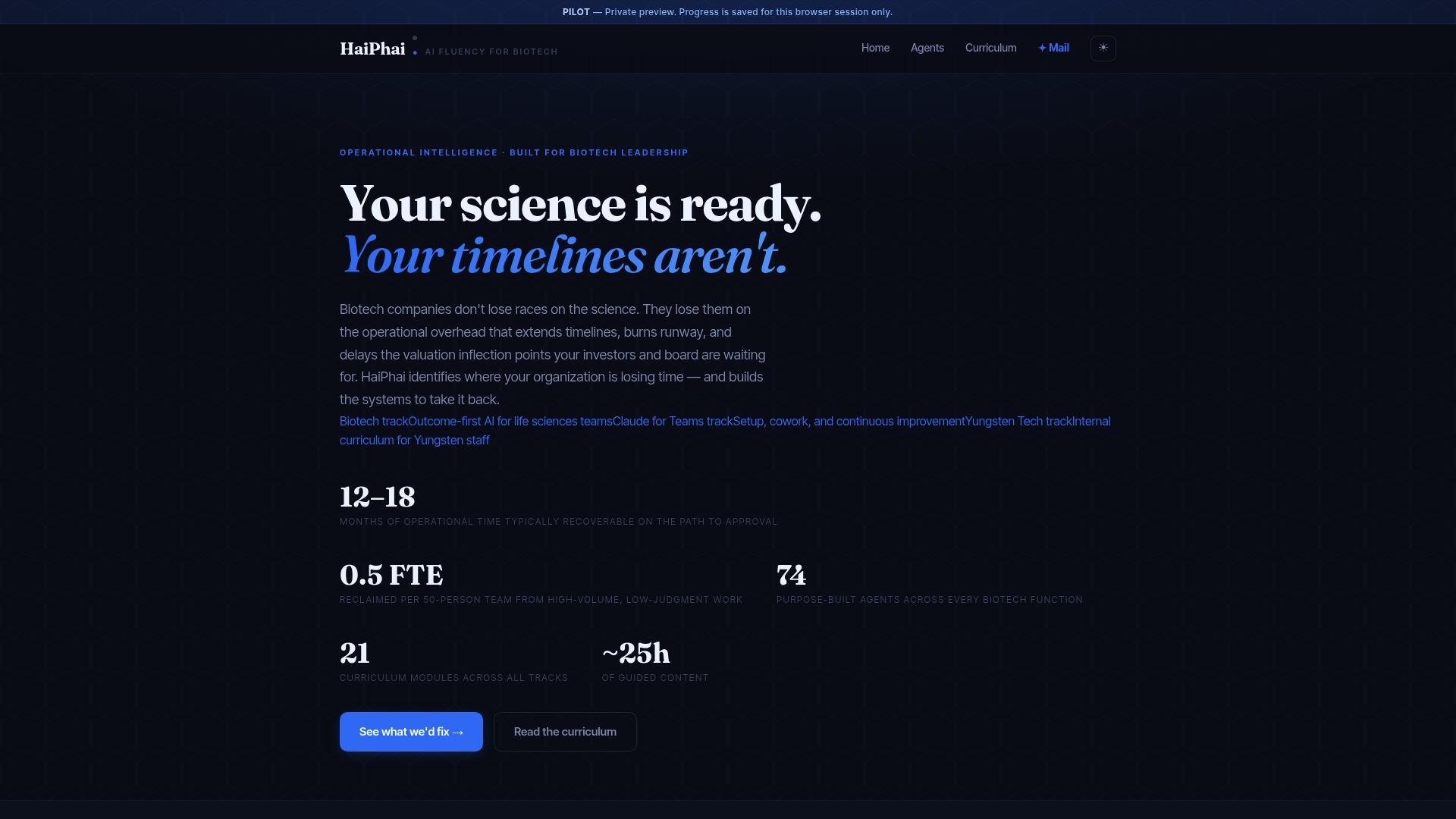
Haiphai works as an operational partner for biotech startups, starting from your regulatory and funding goals and working backward to identify where your process is losing time. Teams using Haiphai's AI-driven approach to regulatory drafting and clinical site activation have reclaimed up to 18 months of operational time on the path to approval. That kind of efficiency directly affects your funding readiness, your valuation, and your ability to hit the milestones that unlock the next award. Explore Haiphai's solutions to see how the platform fits your current stage and funding strategy.
FAQ
What is biotech non-dilutive funding?
Biotech non-dilutive funding is capital provided to a company without requiring the issuance of equity, meaning founders retain full ownership. Sources include government grants, R&D tax credits, venture debt, and strategic partnerships.
How much non-dilutive funding is available for biotech startups in the U.S.?
The U.S. federal government makes over $50 billion available annually for biotech research, with NIH SBIR/STTR, ARPA-H, and CDMRP among the largest individual programs. Founders can stack multiple awards to reach multi-million-dollar totals before a priced round.
How long does it take to receive a non-dilutive grant?
Timelines vary by program. Traditional NIH SBIR awards take 6–12 months from application to funding, while ARPA-H and similar mission-driven programs can issue awards in approximately three months.
Can non-dilutive funding help with future venture capital raises?
Competitive grant awards provide independent scientific validation that VC investors treat as a credibility signal. Founders who exhaust non-dilutive options early enter venture conversations with stronger data packages and better negotiating leverage.
What are the most overlooked biotech non-dilutive funding sources?
DoD dual-use programs, BARDA, Wellcome Leap, and disease-specific patient advocacy organizations are consistently underutilized. These sources carry less competition than NIH programs and often move faster through the award process.