
Bridge financing in biotech is short-term capital designed to extend a company's runway to a specific milestone or the next priced equity round, typically structured as convertible notes or SAFEs. Unlike software startups that can raise on revenue traction alone, biotech companies face clinical timelines measured in years, not quarters. That gap between funding rounds creates a structural need for interim capital that most other industries simply do not encounter at the same scale or frequency.
What is bridge financing in biotech?
Bridge financing in biotech is defined as short-term, milestone-tied capital that carries a company from its current cash position to a defined inflection point. That inflection point is almost always a clinical data readout, a regulatory filing, or the close of the next priced equity round. The California Life Sciences glossary confirms that bridge rounds use convertible instruments, deferring valuation until the next financing event rather than forcing a premature price negotiation.
The standard industry terms for these instruments are convertible notes and SAFEs (Simple Agreements for Future Equity). Both defer the valuation question. Both convert into equity at the next qualifying round. The key difference is that a convertible note carries an interest rate and a maturity date, while a SAFE has neither. In biotech, convertible notes remain more common because institutional investors expect the structure and legal clarity they provide.

Bridge financing is not a rescue mechanism. Used correctly, it is a deliberate financing strategy that buys time to reach a milestone that materially improves the company's valuation story before the next institutional raise.
How is a biotech bridge round structured?
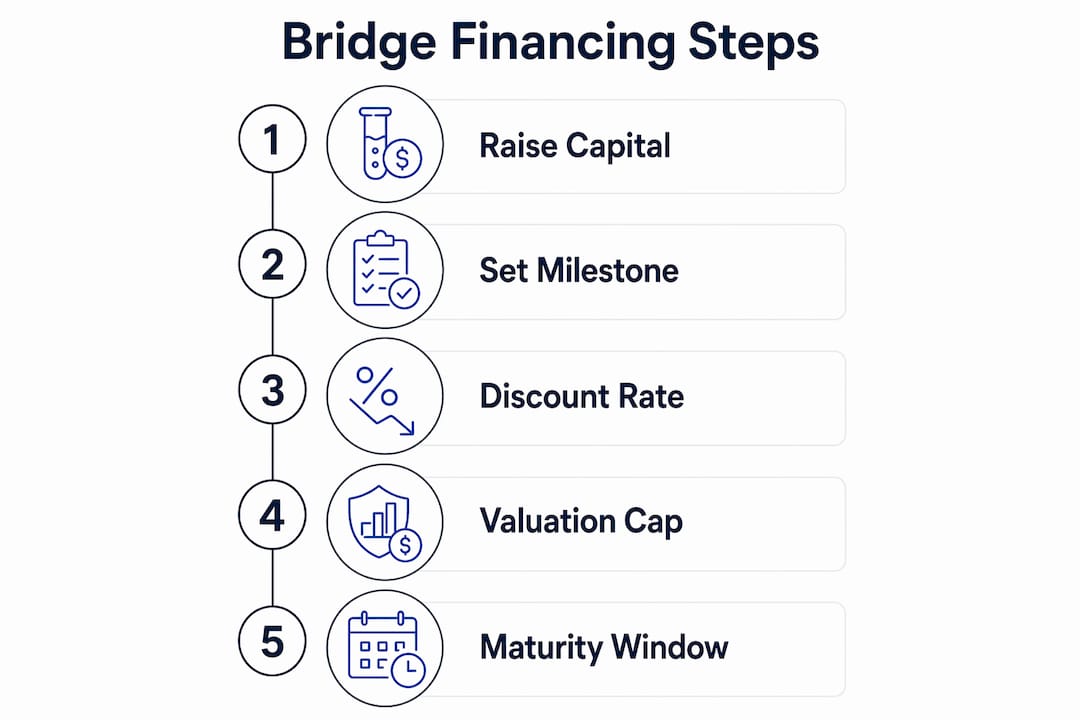
The economics of a biotech bridge round are straightforward once you understand three variables: discount rate, valuation cap, and maturity window.
Discount rate compensates bridge investors for taking on early risk. Typical discounts run 15%–25%, meaning bridge investors convert their notes into equity at a price 15%–25% below whatever price the next round sets. That discount is the investor's reward for committing capital before the milestone is achieved.
Valuation cap sets a ceiling on the conversion price regardless of how high the next round values the company. If your Series B prices at a $200M valuation but your bridge note has a $100M cap, bridge investors convert at the $100M price. This protects early bridge investors if the company's value jumps significantly before conversion.
Maturity window defines how long the note runs before it must convert or be repaid. Typical maturity windows are 12–24 months, aligned with the milestone timeline. A bridge tied to Phase 1 completion should mature around the expected data readout date, not before.
A real-world example illustrates these terms clearly. Apollomics announced a $2M convertible note that converts at a 20% discount with 0% interest. That structure is clean and investor-friendly. The zero interest rate reduces cash burn pressure, and the 20% discount gives investors meaningful upside without requiring a valuation negotiation today.
| Term | Typical Range | Purpose |
|---|---|---|
| Discount rate | 15%–25% | Compensates investors for interim risk |
| Valuation cap | Negotiated | Protects investors if valuation surges |
| Maturity window | 12–24 months | Aligns note life with milestone timing |
| Bridge size | $1M–$5M | Funds 3–6 months of runway |
Pro Tip: Negotiate the valuation cap and discount rate as a package. A higher cap paired with a lower discount can be more founder-friendly than a low cap with a steep discount, depending on your expected next-round valuation.
Well-structured bridge notes include automatic conversion at a discount or valuation cap tied to a specified next round, with alternate provisions if qualifying financing does not occur by maturity. Always define what counts as a "qualifying financing" in the note terms. Ambiguity here creates friction at the next round.
Why do biotech companies need bridge capital?
Biotech companies rely on bridge financing because clinical development timelines routinely run 12–18 months between institutional equity rounds. That timeline is not a failure of execution. It is the nature of drug development. Phase 1 trials, IND filings, and manufacturing scale-up all consume capital on schedules that do not align neatly with investor appetite cycles.
Software companies can raise a Series A on a product demo and early user numbers. A biotech company raising a Series A typically needs preclinical proof-of-concept, a clear regulatory path, and ideally some Phase 1 safety data. Generating that data takes time and money. Bridge capital fills that gap.
The risks are real, though. The most dangerous outcome in biotech financing is the "bridge to nowhere." This occurs when a company raises bridge capital without a clear, defensible milestone that will materially improve its next-round story. Bridges should not postpone fundamental shifts like revenue growth or pivots. If the bridge capital does not enable a specific, measurable outcome that changes investor perception, it only delays an inevitable down round or shutdown.
Common legitimate uses of bridge capital in biotech include:
- Completing Phase 1 enrollment to generate initial safety and tolerability data
- Funding a manufacturing run to support an IND filing or regulatory submission
- Extending runway to a pre-specified clinical data readout that anchors the Series B narrative
- Covering operational costs while a larger licensing or partnership deal closes
Pro Tip: Define the milestone before you raise the bridge. Write it into the term sheet as a use-of-proceeds statement. This disciplines your spending and signals to investors that you have a clear plan, not just a cash problem.
Venture debt and credit facilities serve as complementary tools alongside convertible bridges. Cartesian Therapeutics secured a $150M credit facility from K2 HealthVentures, while TuHURA Biosciences arranged a $50M credit facility with a 5-year maturity. These structures preserve equity while providing milestone-based tranche draws. They require precise cash flow management because they introduce fixed repayment obligations tied to trial timelines.
Bridge financing vs. other biotech funding options
Choosing between a bridge round, a priced equity round, and venture debt requires understanding what each instrument costs you in dilution, time, and operational complexity.
A priced equity round sets a valuation today. If your data is strong, that valuation reflects your current position fairly. If your data is incomplete, you risk pricing at a discount to where you would be in six months. Raising a priced round before a key milestone can permanently anchor your cap table at a lower valuation than the science warrants.
A convertible bridge defers that valuation conversation. You raise capital now, hit the milestone, and then negotiate valuation from a stronger position. The cost is the discount and cap you give bridge investors. That cost is almost always lower than the dilution from a premature priced round.
Venture debt and credit facilities are non-dilutive in the equity sense but introduce fixed repayment obligations. Credit facilities require different risk and cash flow management compared to convertible bridges. They work best when you have a clear revenue event or partnership payment on the horizon that will service the debt.
| Funding Type | Dilution | Time to Close | Best Use Case | | --- | --- | --- --- | --- | | Convertible bridge | Moderate (deferred) | 4–8 weeks | Pre-milestone runway extension | | Priced equity round | High (immediate) | 3–6 months | Post-milestone institutional raise | | Venture debt | Low (non-dilutive equity) | 6–12 weeks | Companies with near-term cash inflows | | Credit facility | Low (non-dilutive equity) | 8–16 weeks | Milestone-based tranche draws |
A bridge is a structured interim solution to reach milestones, not a valuation delay tactic. Investors who understand biotech recognize the difference. Those who do not will treat your bridge as a signal of distress rather than strategy. Your job is to frame the bridge correctly from the first conversation.
Pro Tip: If existing investors are leading your bridge, that is a positive signal to new investors. If you are raising a bridge entirely from new investors because existing ones passed, treat that as a warning sign worth examining before you proceed.
How to use bridge financing effectively
Effective bridge financing requires discipline at every stage: before you raise, during the raise, and after the capital is in the bank.
-
Define the milestone precisely. The single most important diligence question in any bridge deal is identifying the exact milestone the capital enables that materially improves the next round's quality and valuation. Write that milestone down. Make it measurable. "Complete Phase 1 enrollment of 30 patients" is a milestone. "Advance the program" is not.
-
Raise early. Raise bridge capital before your runway drops below six months. Raising from a position of strength gives you negotiating leverage on discount rates and caps. Raising in desperation forces you to accept terms that create friction at the next round.
-
Protect your cap table. Aggressive bridge pricing can jeopardize cap tables, leading to friction at next rounds. Model the dilution impact of multiple bridge scenarios before you agree to terms. Know your red lines on discount rate and cap before the first term sheet arrives.
-
Manage investor signaling. Every bridge round sends a signal to the market. Frame the bridge as a deliberate strategy tied to a specific milestone, not as a response to a failed Series B process. Your narrative controls how future investors interpret the round.
-
Consider pairing with a credit facility. Bridges and credit facilities complement each other in managing biotech financing runway. A convertible note covers the equity-sensitive milestone work. A credit facility with milestone-based tranche draws covers longer-duration operational costs. Using both reduces the total equity dilution from bridge financing alone.
New labs entering the market should also consider LIMS implementation from launch as part of their operational runway strategy. Operational efficiency directly affects how far bridge capital stretches.
Key takeaways
Bridge financing in biotech is most effective when it is tied to a specific, measurable milestone that materially improves the company's valuation before the next institutional equity round.
| Point | Details |
|---|---|
| Definition and structure | Bridge financing uses convertible notes or SAFEs with 15%–25% discounts and 12–24 month maturity windows. |
| Milestone discipline | Define the exact milestone the bridge enables before raising; vague use-of-proceeds leads to "bridges to nowhere." |
| Raise timing | Start the bridge process before runway drops below six months to preserve negotiating leverage. |
| Cap table protection | Model dilution across multiple bridge scenarios before agreeing to discount rates and valuation caps. |
| Complement with credit facilities | Pairing a convertible bridge with a milestone-based credit facility reduces total equity dilution. |
Bridge financing pitfalls i've seen founders miss
I have watched biotech founders treat bridge financing as a last resort rather than a planned tool, and the pattern is consistent. By the time they start the bridge process, they have less than three months of runway, no clear milestone narrative, and existing investors who are hesitant. That combination forces them to accept steep discounts and aggressive caps that haunt the cap table for years.
The market conditions in 2026 make this worse. Institutional biotech investors are more selective than they were in 2021. A bridge that signals distress rather than strategy will not just fail to attract new investors. It will cause existing investors to reassess their follow-on commitments.
The founders who use bridge financing well treat it as a precision instrument. They raise six to nine months before they need to. They tie the bridge explicitly to a Phase 1 readout or a regulatory filing that changes the company's risk profile. They negotiate terms that facilitate the next equity round rather than create hurdles. Bridge terms should facilitate the next equity round, not create obstacles that increase future funding difficulty.
My advice to any biotech executive considering a bridge: start with the milestone, not the capital amount. Ask yourself what specific data or regulatory outcome will make your Series B story materially stronger. Then work backward to determine how much capital you need and when you need it. That sequence produces better terms, better investor relationships, and better outcomes.
— John
How Haiphai helps biotech teams maximize every funding window
Raising bridge capital is only half the equation. The other half is making sure the capital does what you raised it to do: reach the milestone on time and on budget.

Haiphai works as an operational partner for biotech teams, starting from your strategic milestones and identifying the process bottlenecks that extend timelines and drain capital. By integrating AI into regulatory drafting and clinical site activation, Haiphai clients reclaim up to 18 months of operational time on the path to approval. That time directly translates to funding efficiency. Every month you save is a month of bridge capital you do not need to raise. Explore how Haiphai's AI platform helps biotech leaders align operations with their financing strategy.
FAQ
What is bridge financing in biotech?
Bridge financing in biotech is short-term capital, typically structured as convertible notes or SAFEs, that extends a company's runway to a specific clinical milestone or the next priced equity round. It defers valuation until the next qualifying financing event.
How much do biotech bridge rounds typically raise?
Bridge rounds commonly raise $1M–$5M and buy roughly 3–6 months of runway, depending on the milestone timeline and burn rate.
What discount rate is standard in a biotech bridge note?
Standard discount rates in biotech bridge notes run 15%–25%, compensating investors for the risk of committing capital before a milestone is achieved. Valuation caps are often negotiated alongside the discount to protect investors if the company's value increases significantly.
When should a biotech company avoid bridge financing?
A biotech company should avoid bridge financing when there is no clear, measurable milestone the capital will enable. Without a defined inflection point, the bridge delays an inevitable down round rather than improving the company's funding position.
How does bridge financing differ from venture debt in biotech?
Bridge financing uses convertible instruments that convert to equity at the next round, while venture debt introduces fixed repayment obligations and covenants. Venture debt is better suited to companies with near-term cash inflows; bridge financing fits pre-milestone runway extension.