
Biotech program prioritization is the disciplined process of ranking and selecting research and development programs to maximize portfolio value under capital constraints. The industry term for this practice is portfolio prioritization, and it sits at the center of every effective R&D governance model. Teams that apply structured criteria, including risk-adjusted net present value (rNPV) and the Profitability Index (PI), make faster, more defensible decisions than those relying on intuition or political influence. With 59.77% of organizations reporting that market volatility significantly impacts prioritization outcomes, the cost of an ad hoc approach has never been higher.
What is biotech program prioritization, and why does it matter?
Biotech program prioritization is defined as the evidence-based ranking of R&D programs to direct capital, talent, and time toward the highest-value opportunities in a constrained pipeline. The process is not a one-time annual exercise. Prioritization is continuous, involving sequencing initiatives by capacity and enforcing stop-work decisions as conditions change.
The importance of program prioritization becomes clear when you consider what happens without it. Teams spread resources across too many programs, each receiving just enough funding to survive but not enough to advance decisively. The result is a portfolio of slow-moving projects that consume cash without generating the data readouts that attract investors or support regulatory submissions.
Effective prioritization forces a choice. It requires leadership to rank programs against each other, not just against an abstract standard, and to commit capital accordingly. That discipline separates high-performing biotech organizations from those that drift toward portfolio bloat.
What financial and scientific criteria form the foundation for prioritizing biotech programs?
The two most widely used financial metrics in biotechnology project selection are rNPV and the Profitability Index. Each serves a distinct purpose in the ranking process.
Risk-adjusted net present value (rNPV) discounts a program's projected cash flows by both time and the probability of technical and regulatory success. A higher rNPV signals greater expected value, but the number alone does not tell you how efficiently capital is being deployed.
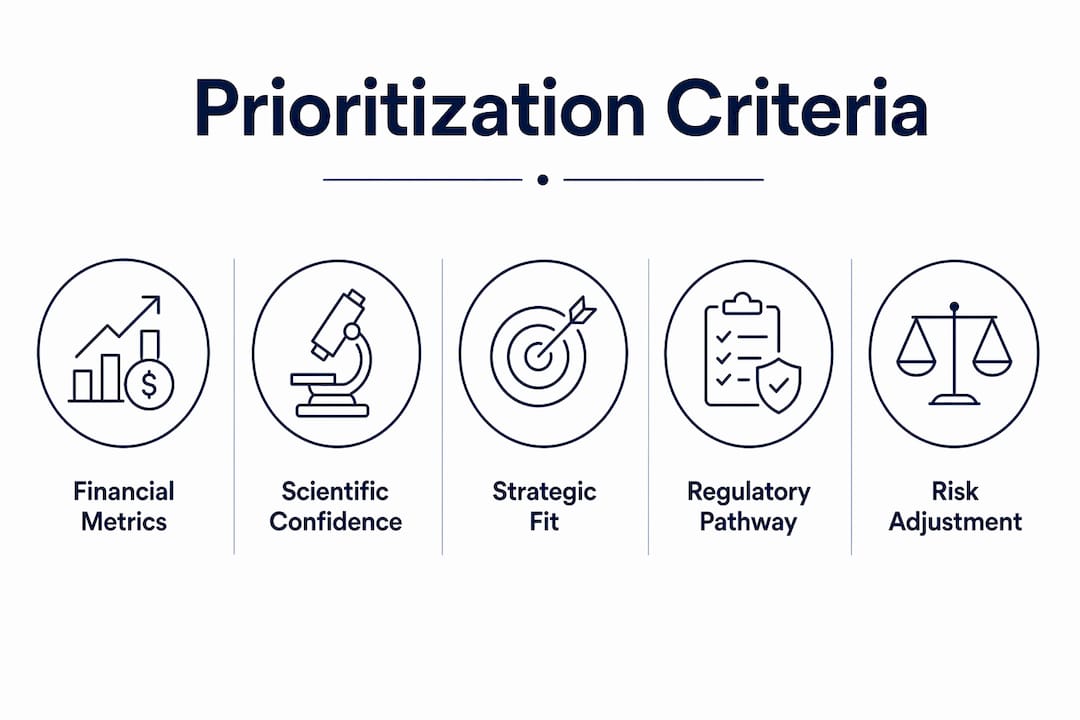
The Profitability Index (PI) solves that problem. A PI greater than 1.0 indicates value creation per dollar invested, making it the preferred ranking tool in resource-constrained environments. Two programs with similar rNPV scores can have very different PIs if one requires three times the investment to reach the same milestone.
Beyond the numbers, biotech project evaluation requires four additional layers of assessment:
- Scientific rationale and confidence: Does the mechanism of action have strong preclinical or clinical validation? Is the hypothesis falsifiable within a reasonable timeframe?
- Clinical differentiation: Does the program address an unmet need, or does it enter a crowded indication with marginal improvement over existing therapies?
- Regulatory pathway clarity: Has the team mapped the FDA or EMA pathway, including any accelerated designation opportunities?
- Execution resource requirements: What specialized capabilities, manufacturing capacity, or clinical infrastructure does the program demand?
Strategic fit ties these layers together. A program with a strong PI and clear regulatory pathway still ranks lower if it requires capabilities the organization does not have and cannot acquire quickly.
Pro Tip: Run sensitivity analyses on your rNPV inputs before any portfolio review. Changing the probability of success by 10 percentage points often flips the ranking order, which tells you exactly where scientific uncertainty is driving your capital decisions.
How do modern governance models improve prioritization outcomes in biotech R&D?
The core problem in biotech program management is not a lack of data. Failure in biotech prioritization is a decision system issue, where successful CEOs use repeatable governance to create decision compression layers that trigger evidence-based choices at program inflection points. The data exists. The governance to act on it often does not.

Ad hoc prioritization produces predictable failures. Decisions get made informally before the formal review meeting, turning governance forums into approval ceremonies rather than genuine deliberations. This is the pre-decision meeting problem, and it is more common than most organizations admit.
Structured governance addresses this through four mechanisms:
- Separation of data from advocacy. The team presenting program data should not be the same team arguing for its continuation. Separating these roles removes the incentive to shade results.
- Clear decision rights. Every portfolio review must specify who has the authority to terminate, accelerate, or redirect a program. Ambiguity defaults to inaction.
- Decision compression. Reviews should be designed to produce a decision, not a recommendation for further study. Each meeting should end with a ranked list and a capital allocation.
- Inflection-aligned cadence. Governance reviews should occur when programs reach scientific decision points, not on a fixed quarterly calendar that may have no relationship to when meaningful data arrives.
Effective CEOs treat prioritization as a governance discipline. They create a decision compression layer that triggers clear, evidence-based choices at program inflection points. The cadence of review follows the science, not the calendar.
AI-driven pairwise comparison platforms create auditable, defensible decisions by replacing subjective scoring with structured head-to-head comparisons. This approach also generates a record of the reasoning behind each ranking, which matters when leadership changes or when investors ask how capital allocation decisions were made.
What are the common pitfalls in biotech program prioritization, and how can they be mitigated?
The most damaging pitfall is not a flawed model. Portfolio prioritization without termination authority degrades into an advisory tool. When governance forums lack the explicit mandate to cancel programs, they produce ranked lists that nobody acts on.
Several other failure modes appear consistently across biotech organizations:
- The sunk cost trap. Teams continue funding programs because of past investment rather than forward-looking value. Programs with large sunk costs but poor forward outlook should be terminated or out-licensed. The financial model should make this visible, not obscure it.
- Scientific excitement overriding financial rigor. A novel mechanism generates enthusiasm that inflates probability-of-success estimates. The PI calculation corrects for this if the inputs are honest.
- Opaque scoring. When team members cannot see how programs were ranked or what assumptions drove the scores, trust in the process collapses. High-performing portfolios rely on ranking transparency to drive confidence and execution.
- Model worship. Financial models are starting points, not verdicts. Practitioners find that purely financial ranking misaligns with scientific reality. The model should start conversations that challenge internal biases, not end them.
Mitigation requires two things that are harder than they sound: leadership courage and process design. Courage means being willing to terminate a program that a respected scientist champions. Process design means building the governance structure so that termination is a normal, expected outcome rather than a failure.
Pro Tip: Document every deviation from your financial model's recommendation. If the governance team overrides the PI ranking, write down why. Patterns in those deviations reveal your organization's real decision-making biases.
How can biotech organizations implement an inflection-aligned prioritization model?
Inflection-aligned portfolio management is the practice of scheduling capital allocation decisions to coincide with the moments when scientific uncertainty resolves. Modern biopharma is shifting to inflection-aligned models that align decision governance with scientific decision points for dynamic capital allocation. This shift changes the entire rhythm of portfolio management.
The pivotal decision moments in a typical program lifecycle include:
| Program Stage | Key Inflection Point | Decision Triggered |
|---|---|---|
| Preclinical | Proof-of-concept data | Advance to IND or terminate |
| Phase 1 | Safety and PK readout | Dose selection and Phase 2 design |
| Phase 2a | Early efficacy signal | Full Phase 2 or out-license |
| Phase 2b | Pivotal trial design | Phase 3 investment or partnership |
| Phase 3 | Interim analysis | Continue, modify, or stop |
Transitioning to this model requires four steps:
- Map your portfolio's inflection points. For each active program, identify the next data readout that will materially change the program's value or viability.
- Tie capital tranches to those readouts. Release funding in stages that expire at each inflection point, requiring a fresh decision to continue.
- Redesign your governance calendar. Replace fixed quarterly reviews with event-driven reviews triggered by data availability.
- Build a reallocation mechanism. When a program terminates or stalls, the freed capital needs a defined path to the next-highest-ranked program within weeks, not quarters.
Capital discipline is a survival necessity in this model. Prioritization optimizes resource deployment toward the next data readouts most attractive to investors, rather than sustaining all projects at a maintenance level. The organizations that execute this well treat freed capital as an asset to be redeployed, not a budget line to be surrendered.
The uncomfortable truth about prioritization that most teams avoid
Most biotech teams I have worked with have the right frameworks on paper. They use rNPV, they have a portfolio review committee, and they run PI calculations before every governance meeting. The problem is almost never the model. The problem is that nobody wants to be the person who kills a program.
I have seen governance forums where the ranked list was clear, the PI scores were unambiguous, and the bottom two programs had no credible path forward. The meeting still ended without a termination decision because the program leads were in the room and the committee lacked the authority, or the will, to act. That is not a prioritization failure. That is a leadership failure dressed up as a process failure.
The fix I have found most effective is separating the people who present data from the people who make decisions, as described in the pre-decision meeting problem literature. When the program lead is not in the room during the ranking discussion, the conversation changes immediately. The data speaks without an advocate, and the committee can evaluate it honestly.
AI-augmented pairwise comparison tools help here too. When every committee member independently ranks program pairs before the meeting, you surface genuine disagreements rather than manufactured consensus. The AI augmentation approach does not replace judgment. It makes judgment visible and auditable.
The other thing I would tell any biotech leadership team: prioritization without termination authority is theater. If your governance forum cannot cancel a program, it is not a governance forum. It is a status update meeting with a better agenda.
— John
How Haiphai supports biotech program prioritization decisions
Biotech teams that have built the right financial models and governance structures still face one persistent gap: translating ranked lists into decisions that stick.
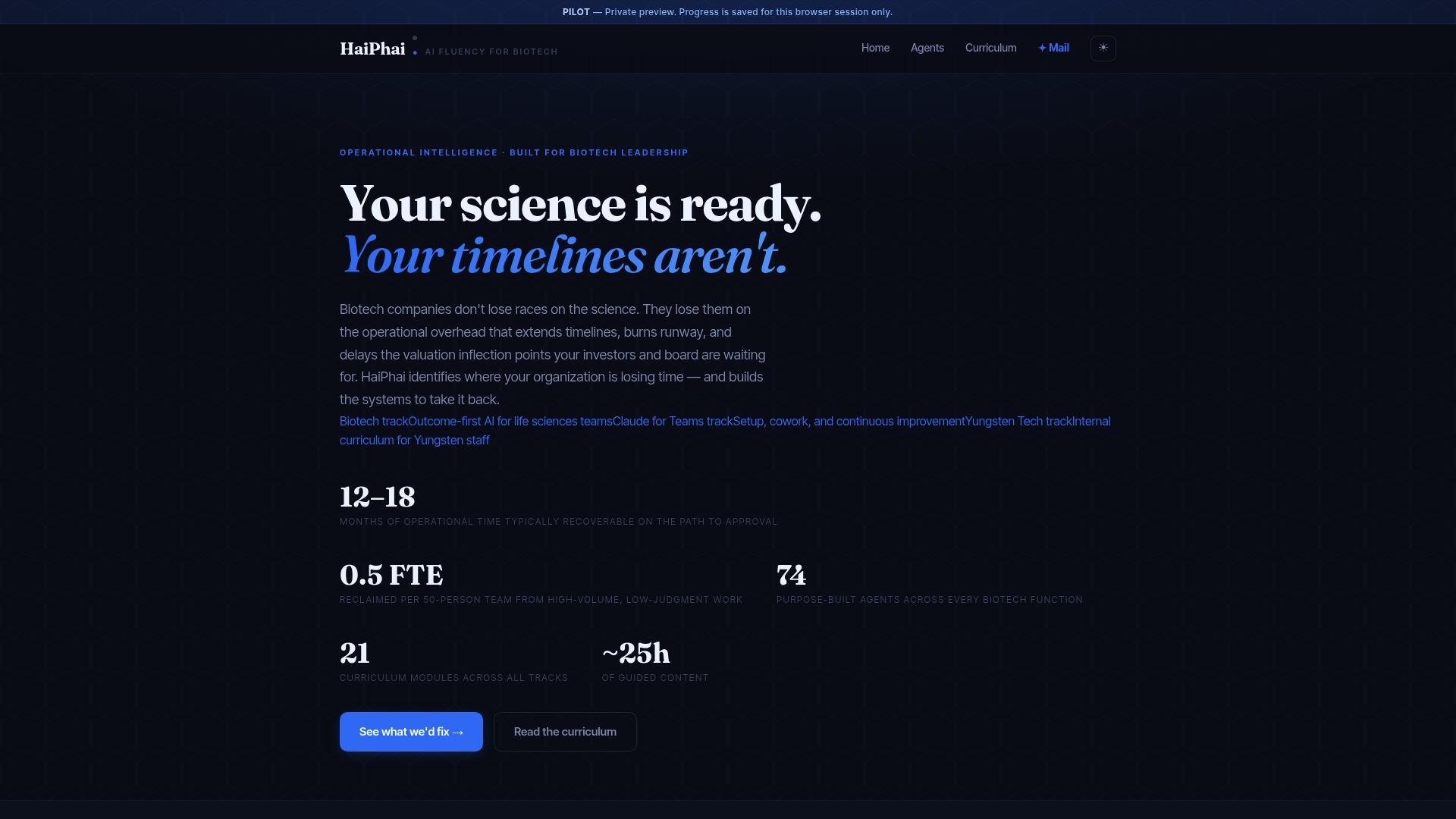
Haiphai works as an operational partner for life sciences teams, starting from your portfolio goals and identifying where decision bottlenecks are costing you time and capital. The Haiphai solutions platform integrates AI-driven decision support directly into your governance workflows, including pairwise program comparisons that produce auditable rankings your leadership team can act on. Teams working with Haiphai have reclaimed up to 18 months of operational time on the path to approval. Explore Haiphai's services to see how the approach applies to your pipeline.
Key takeaways
Biotech program prioritization requires financial rigor, governance authority, and inflection-aligned decision timing to convert ranked lists into capital allocation that actually moves programs forward.
| Point | Details |
|---|---|
| Use PI alongside rNPV | A PI above 1.0 ranks programs by capital efficiency, not just absolute value. |
| Align reviews to inflection points | Schedule governance decisions when scientific data arrives, not on a fixed calendar. |
| Enforce termination authority | Governance forums without stop-work power become status meetings, not decision systems. |
| Separate data from advocacy | Remove program leads from ranking discussions to eliminate bias in scoring. |
| Treat freed capital as an asset | Reallocate terminated program budgets within weeks to maintain portfolio momentum. |
FAQ
What is biotech program prioritization?
Biotech program prioritization is the structured process of ranking R&D programs by financial value, scientific confidence, and strategic fit to direct limited capital toward the highest-impact opportunities. It uses metrics like rNPV and the Profitability Index to make those rankings defensible and auditable.
How does the Profitability Index differ from NPV in biotech?
The Profitability Index measures value created per dollar invested, making it more useful than NPV alone when capital is constrained. A program with a lower NPV but a higher PI often deserves priority because it delivers more return per unit of investment.
Why do biotech prioritization processes fail?
The most common failure is governance forums that lack termination authority, turning ranked lists into recommendations nobody acts on. The pre-decision meeting problem, where decisions are made informally before formal reviews, compounds this by reducing governance to a rubber stamp.
What is inflection-aligned portfolio management?
Inflection-aligned portfolio management schedules capital allocation decisions to coincide with scientific data readouts rather than fixed calendar intervals. This approach ensures that funding decisions reflect current evidence rather than outdated assumptions from the last quarterly review.
How does AI improve biotech program prioritization?
AI-driven pairwise comparison tools replace subjective scoring with structured head-to-head program rankings that generate an auditable decision record. This approach surfaces genuine disagreements among committee members and removes the influence of advocacy from the ranking process.