
Biotech competitive approval advantages are defined as the strategic, operational, and regulatory capabilities that allow a company to reach market faster, protect commercial value, and outposition rivals during the approval process. The FDA's standard New Drug Application review takes 6–10 months after submission. That window is where competitive positioning is won or lost. Companies that combine accelerated pathway selection, structured competitive intelligence, and tight Chemistry, Manufacturing, and Controls (CMC) execution consistently outperform those relying on science alone. This guide breaks down the specific strategies biotech leaders are using in 2026 to build durable regulatory advantages.
1. What are the top regulatory pathways that give biotech companies an approval speed edge?
Regulatory pathway selection is the single highest-leverage decision in the biotech approval process. Choosing the wrong path does not just slow you down. It can fund your competitor's market entry instead.
The FDA's standard NDA and BLA review process runs 6–10 months post-submission. That timeline assumes a complete, well-organized package with no major deficiencies. Most teams underestimate how much pre-submission work determines that outcome.

The FDA's accelerated approval program allows market access based on surrogate endpoints rather than confirmed clinical outcomes. This is a genuine speed advantage for oncology and rare disease programs. The risk is real, though. If confirmatory trials fail post-approval, the FDA can withdraw the product. Teams that use accelerated approval without a fully resourced post-marketing study plan are taking on regulatory liability, not just regulatory speed.
The 505(b)(2) pathway is underused as a commercial strategy tool. It allows sponsors to rely on existing safety and efficacy data while building new intellectual property protections around reformulations or new indications. Done correctly, it creates branded pricing power and market exclusivity that the standard pathway cannot deliver.
- Accelerated Approval: Fastest access, surrogate endpoint basis, post-marketing study required
- 505(b)(2): Protects commercial value, builds IP exclusivity, requires strong differentiation rationale
- Breakthrough Therapy Designation: Intensive FDA guidance, faster review, best for serious conditions with preliminary evidence
- Fast Track Designation: Rolling review eligibility, frequent FDA contact, broad eligibility criteria
Pro Tip: Request a Type B pre-NDA meeting with the FDA at least 12 months before your planned submission. The feedback you receive on your data package will eliminate the most common deficiency letters before they happen.
2. How early competitive intelligence shapes faster biotech approvals
Competitive intelligence in biotech is not a market research exercise. It is a risk reduction tool that directly affects approval timelines and valuation.
Structured competitive intelligence models five distinct risk dimensions: market, geographic, regulatory, capital, and ecosystem. Each dimension can independently delay or derail an approval. Teams that model only market competition miss the regulatory divergence risks that cause the most expensive surprises.
Geographic regulatory divergence is a specific and underappreciated threat. A program optimized for FDA approval may face significant redesign requirements for the European Medicines Agency or Japan's PMDA. Those redesigns cost time and capital. Mapping divergence early, before Phase 2 design is locked, is far cheaper than retrofitting a global dossier.
Scenario-based planning tied to competitive intelligence also improves fundraising. Investors and partners respond to teams that can articulate what happens to their timeline and valuation under three or four realistic regulatory scenarios. That level of preparation signals operational maturity.
- Map all five risk dimensions before Phase 2 design is finalized
- Identify geographic regulatory divergence points and their cost implications
- Build three regulatory scenarios: base case, delayed approval, and accelerated pathway
- Link each scenario to valuation and funding milestones
- Update the intelligence model at every major data readout
Pro Tip: Patent filings from competitors reveal pipeline direction 18–24 months before clinical disclosures. Build a patent monitoring cadence into your quarterly intelligence review to catch competitive moves before they become public.
3. What CMC and R&D benchmarking strategies protect your approval timeline
CMC failures are the most common cause of avoidable Phase 3 delays. Poor CMC strategy and failure to anticipate regional regulatory divergence cause measurable valuation loss before a product ever reaches a pivotal trial. This is an operational problem, not a scientific one.
A strong CMC program starts with manufacturing process characterization early enough to support the regulatory package. Teams that treat CMC as a late-stage activity consistently face complete response letters citing manufacturing deficiencies. Those letters add 6–12 months to approval timelines and trigger investor concern.
Patent data analysis benchmarks R&D strength before clinical data is available. Patent signals precede clinical disclosures by years. A team that monitors competitor patent filings can identify white space in the IP landscape, anticipate freedom-to-operate risks, and position its own filing strategy to maximize exclusivity at approval.
The speed of your iterative lab-to-data feedback loop also matters more than most executives realize. Biological expertise and rapid iteration are now the primary competitive differentiators. AI software is baseline infrastructure. The teams that win are the ones that can run more high-quality experiments per quarter and extract better decisions from each result.
- Characterize your manufacturing process by end of Phase 2, not during Phase 3
- Conduct freedom-to-operate analysis before IND submission, not at NDA filing
- Use patent landscape mapping to identify differentiation opportunities before clinical design is locked
- Select your regulatory pathway based on commercial and IP strategy, not just speed to approval
4. How emerging regulations and digital tools are reshaping global approval dynamics
The regulatory environment for biotech is changing faster in 2026 than at any point in the past decade. Teams that treat regulatory frameworks as static are already behind.
The EU's Biotech Act targets a reduction in multinational clinical trial approval timelines from approximately 75 to 47 days. That 28-day reduction compresses the European development timeline meaningfully. It also changes the competitive calculus for companies deciding whether to run parallel US and EU trials or sequence them.
Regulatory sandboxes and public-private funding models in the EU support SMEs and scale-ups testing emerging biotech technologies in controlled environments. These programs reduce the cost of early regulatory engagement and give smaller companies access to guidance that was previously available only to large pharma. For a 50-person biotech, that access is a genuine competitive equalizer.
AI integration into regulatory processes is accelerating. AI augmentation in regulatory affairs now covers document drafting, gap analysis, and submission formatting. These applications reduce the labor cost of regulatory preparation and shorten the time from data lock to submission-ready package.
- Monitor EU Biotech Act implementation timelines and adjust trial design accordingly
- Evaluate regulatory sandbox eligibility for early-stage programs in the EU
- Integrate AI tools into regulatory drafting workflows to compress submission preparation time
- Assess supplementary protection certificate requirements for regional manufacturing decisions
5. What strategic best practices should biotech leaders adopt right now
The companies building durable competitive approval advantages in 2026 share one characteristic. They treat regulatory strategy as a core business function, not a compliance obligation.
U.S. biotech's competitive edge increasingly depends on operational speed and manufacturing efficiency, not solely on scientific breakthroughs. That shift means the gap between a well-run and a poorly-run regulatory program is now measured in valuation points, not just months.
Early engagement with regulatory authorities is the highest-return activity most biotech teams underinvest in. Pre-submission meetings, Type A and Type B interactions, and participation in FDA pilot programs all shape the submission requirements before the dossier is built. Teams that engage early write better submissions. Teams that engage late rewrite them.
Embedding evidence strategy across regulatory and payer requirements simultaneously is the other major gap. A product that clears FDA review but cannot demonstrate value to payers faces a different kind of market failure. Building the evidence package to satisfy both audiences from the start avoids that outcome.
- Engage FDA and EMA early through formal pre-submission meetings
- Align evidence strategy to both regulatory and payer requirements from Phase 2
- Use AI augmentation tools for patent analytics and regulatory gap analysis
- Balance speed with differentiation to avoid commoditization at launch
- Match operational capabilities to the geographic and regulatory markets you are actually targeting
Pro Tip: Smaller biotech teams can compete at enterprise scale by concentrating operational resources on the two or three regulatory activities that most directly affect their submission timeline. Spreading thin across every workstream is the most common mistake in resource-constrained programs.
Key takeaways
Biotech competitive approval advantages require integrating regulatory pathway selection, structured competitive intelligence, and tight CMC execution from the earliest stages of development.
| Point | Details |
|---|---|
| Pathway selection drives commercial value | Choose FDA pathways based on IP and commercial strategy, not just approval speed. |
| CMC failures are the most preventable delay | Characterize manufacturing processes by end of Phase 2 to avoid complete response letters. |
| Competitive intelligence must be multi-dimensional | Model market, geographic, regulatory, capital, and ecosystem risks simultaneously. |
| EU regulatory reforms change the global calculus | The EU Biotech Act's 28-day timeline reduction reshapes parallel trial strategy decisions. |
| Operational speed now outweighs AI tool adoption | Biological expertise and rapid iterative lab cycles are the primary competitive differentiators. |
The capability gap nobody talks about
The biotech teams I see struggle most are not the ones with weak science. They are the ones with strong science and weak regulatory operations. The science gets them to Phase 2. The operational gaps stop them at the finish line.
The most common mistake I observe is treating regulatory strategy as something you finalize after the data is in. By that point, the pathway decision is effectively made for you by the data you have. The teams that win make the pathway decision early, then design the clinical program to support it. That sequence is backwards from how most organizations actually work.
Competitive intelligence is the other area where I see consistent underinvestment. Executives want a competitive landscape slide for the board deck. What they actually need is a living model that connects competitor patent filings, regulatory actions, and funding events to their own timeline and valuation. Those are very different things.
The regulatory environment in 2026 rewards preparation over reaction. The EU Biotech Act changes, FDA pilot programs, and AI-assisted submission tools all favor teams that engage early and adapt fast. The companies that build that capability now will not just approve products faster. They will own better market positions when they do.
— John
Haiphai: built for biotech teams that cannot afford to lose time
Biotech leaders who reach approval faster do not get there by working harder. They get there by eliminating the operational bottlenecks that slow every team down.
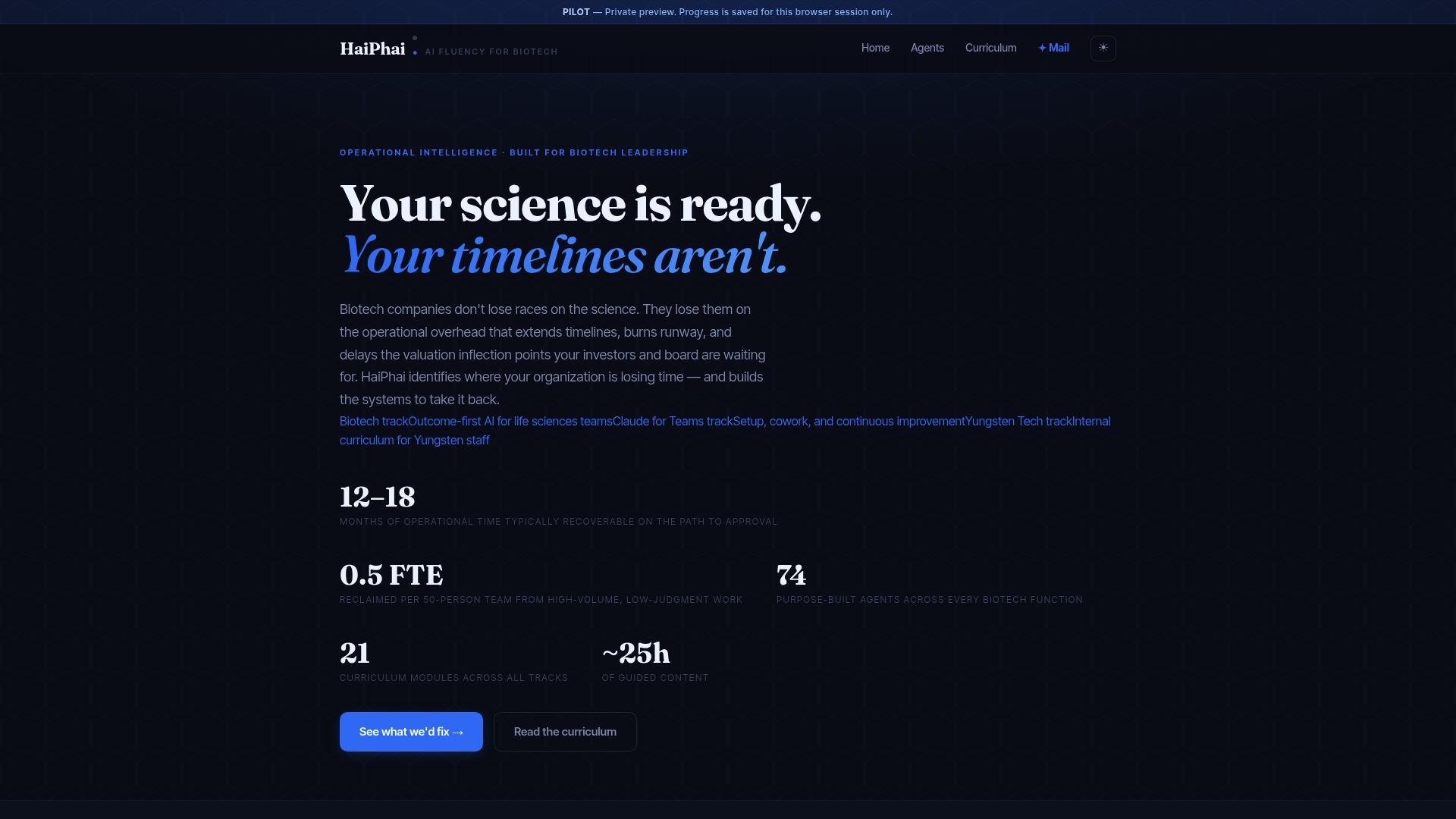
Haiphai works as an operational partner, not a software vendor. The process starts from your strategic goals and works backward to identify where your timeline is leaking. From regulatory drafting to clinical site activation, Haiphai integrates AI to compress the work that consumes months without adding scientific value. Clients reclaim up to 18 months of operational time on the path to approval. Explore Haiphai's solutions to see where your program can move faster.
FAQ
What are biotech competitive approval advantages?
Biotech competitive approval advantages are the regulatory, operational, and strategic capabilities that allow a company to reach market faster and with stronger commercial positioning than rivals. They include accelerated pathway selection, CMC execution quality, and structured competitive intelligence.
Which FDA pathway offers the strongest competitive edge in biotech?
The 505(b)(2) pathway offers the strongest long-term commercial advantage by combining faster approval with IP protections and branded pricing power. Accelerated approval provides the fastest market access but requires robust post-marketing study planning to manage withdrawal risk.
How does competitive intelligence reduce biotech approval delays?
Structured competitive intelligence models market, geographic, regulatory, capital, and ecosystem risks simultaneously. Teams that map these dimensions before Phase 2 design is locked avoid the regulatory divergence surprises that cause the most expensive timeline setbacks.
What role does CMC strategy play in regulatory approval speed?
CMC strategy directly determines whether a submission passes review without a complete response letter. Poor CMC preparation is one of the most common causes of avoidable Phase 3 and approval delays, adding 6–12 months to timelines and triggering investor concern.
How is the EU Biotech Act changing global approval competition?
The EU Biotech Act targets a reduction in multinational clinical trial approval timelines from approximately 75 to 47 days. That 28-day compression changes the competitive calculus for companies deciding whether to run parallel US and EU trials or sequence them by region.