
Prioritize site activation, contract and budget negotiations, and protocol redesign first. Those three workstreams sit directly on the critical path to first patient in (FPI), and fixing them before layering in AI is what separates programs that reclaim months from programs that spend money and stay stuck. An ICON survey found that 55% of sites report site selection to full activation takes five months or longer, and 66% experience contract and budget delays often or always. Haiphai clients working through a structured redesign have reclaimed up to 18 months on their path to approval.
Your 48–72 hour next step: run a bottleneck quick-scan across your active programs. Assign one pilot sponsor to own the output. The scan should surface:
- Which workstreams are currently on the critical path vs. parallel
- Where handoffs stall (legal, finance, site ops, regulatory)
- Which delays are process failures vs. data or staffing gaps
- Which workstreams have enough data maturity to support an AI pilot now
Key Takeaways
Prioritizing site activation, contracting, and protocol redesign first, then sequencing AI pilots from low-risk CLM to advanced agentic tools, is the fastest path to reclaiming months on a U.S. biotech program's critical path.
| Point | Details |
|---|---|
| Prioritize three workstreams first | Site activation, contract and budget negotiations, and protocol redesign sit directly on the critical path to FPI. |
| Score before you pilot | Use a four-criteria matrix (time-to-value, regulatory exposure, data availability, cross-functional dependence) to rank workstreams before committing resources. |
| Sequence AI from low to high risk | Start with CLM and site-activation RPA; move to agentic protocol optimization only after foundational pilots prove out. |
| Measure with a baseline and control | Set KPI baselines before deployment and use a matched historical control to attribute impact credibly. |
| Haiphai as operational partner | Haiphai's diagnostic-first model maps bottlenecks, designs zero-based workflows, and has helped clients reclaim up to 18 months on approval pathways. |
Table of Contents
- What are the best biotech workstream prioritization strategies?
- Which operational workstreams unlock the most time?
- How do you map AI tools to each workstream?
- What does a 90–180 day pilot roadmap look like?
- What governance controls does U.S. clinical AI require?
- How do you measure ROI and set KPI targets?
- What risks should stop or reset a rollout?
- An operational partner's perspective on sequencing
- Haiphai's operational partnership model
- Sources
- FAQ
What are the best biotech workstream prioritization strategies?
The most reliable framework pairs a zero-based redesign principle with a simple impact-versus-feasibility scoring matrix. Industry experts warn that bolting AI onto legacy processes produces marginal gains at best. Start from a blank sheet: what would this workstream look like if you designed it today, with AI as the primary driver and humans reserved for judgment calls?
Score each candidate workstream on four criteria, weighted for biotech:
- Time-to-value (30%): Can this workstream show measurable improvement within 90 days?
- Regulatory exposure (25%): Does failure here create an FDA deficiency or audit risk?
- Data availability (25%): Is clean, structured data accessible to train or run an AI tool?
- Cross-functional dependence (20%): How many teams must align before a pilot can start?
Place each workstream in a 2×2 matrix: high impact / high feasibility goes first; high impact / low feasibility gets a pre-pilot data-readiness sprint; low impact / high feasibility is optional; low impact / low feasibility gets dropped entirely.
Pro Tip: Deprioritize any workstream where the primary bottleneck is a policy or legal constraint rather than a process inefficiency. AI cannot fix a contract clause that requires legal renegotiation. Fix the policy first, then automate.
Which operational workstreams unlock the most time?
Ranked by consistent impact across U.S. biotech programs:
-
Site activation and start-up. Friends of Cancer Research data show U.S. median first-site activation at 124 days after final protocol approval, with scaling to 75% of planned sites lagging markedly behind ex-U.S. regions. Budget negotiations, redundant local reviews, and site resource limits drive that gap. Central IRB adoption and parallel review models are the fastest structural fixes.
-
Contract and budget negotiations (CLM). Applied Clinical Trials reports that AI-enabled Contract Lifecycle Management can cut cycle times roughly 33%, with investigator onboarding reduced by up to 50% in some oncology programs.
-
Protocol design and enrichment. Overly complex eligibility criteria drive pre-selection decline rates that have increased notably in recent years. Leaner protocols with AI-assisted feasibility modeling reduce amendments and site burden before a single patient is screened.
-
Central IRB and parallel review enablement. Sequential site-by-site IRB review is one of the most avoidable delays in U.S. trial start-up. Centralizing review and running regulatory and site contracting in parallel can compress activation timelines by weeks.
-
IND coordination and CMC handoffs. Centralized documentation and pre-IND engagement with FDA reduce deficiency cycles and prevent the CMC-to-clinical handoff from becoming a silent schedule killer.
Statistic: A majority of sites experience contract and budget delays frequently, highlighting why CLM is the highest-ROI AI pilot for most early-stage biotech programs.
Research frameworks like ClinicalReTrial show that agentic AI can iteratively redesign protocols in simulation, improving 83.3% of evaluated protocols with measurable predicted success-probability gains. EmulatRx demonstrates a multi-agent system that extracts and standardizes real-world evidence from EHRs and refines protocols using reinforcement learning from human feedback. Both are retrospective and require safety validation before production use, but they illustrate where AI in biotech execution is heading.
How do you map AI tools to each workstream?
| Workstream | AI Lever | Expected Benefit | Primary Risk | Mitigation |
|---|---|---|---|---|
| Contracting & budgets | CLM (GenAI drafting + workflow automation) | ~33% cycle-time reduction | Clause hallucination | Human legal review gate |
| Site activation | RPA + GenAI document prep | Faster package assembly, fewer back-and-forths | Site system incompatibility | Standardize templates first |
| Protocol design | Agentic optimization (ClinicalReTrial model) | Fewer amendments, higher predicted success rate | Retrospective-only validation | Pilot in simulation; human sign-off required |
| IRB and regulatory review | GenAI drafting + parallel workflow tools | Compressed review timelines | Regulatory non-acceptance | Pre-submission FDA engagement |
| RWE/EHR cohort design | Multi-agent extraction (EmulatRx model) | Automated cohort creation, faster feasibility | Data quality and privacy | HIPAA-compliant pipelines, audit trails |
| IND/CMC coordination | Centralized doc management + RPA | Fewer deficiency cycles | Version control failures | Single source of truth, versioning controls |
Pro Tip: Start with CLM or site-activation RPA before attempting agentic protocol optimization. The former has clear inputs, measurable outputs, and low regulatory risk. The latter requires simulation infrastructure and safety validation that most teams are not ready for in a first pilot. Sequence biotech process automation from low-risk to high-complexity.
What does a 90–180 day pilot roadmap look like?
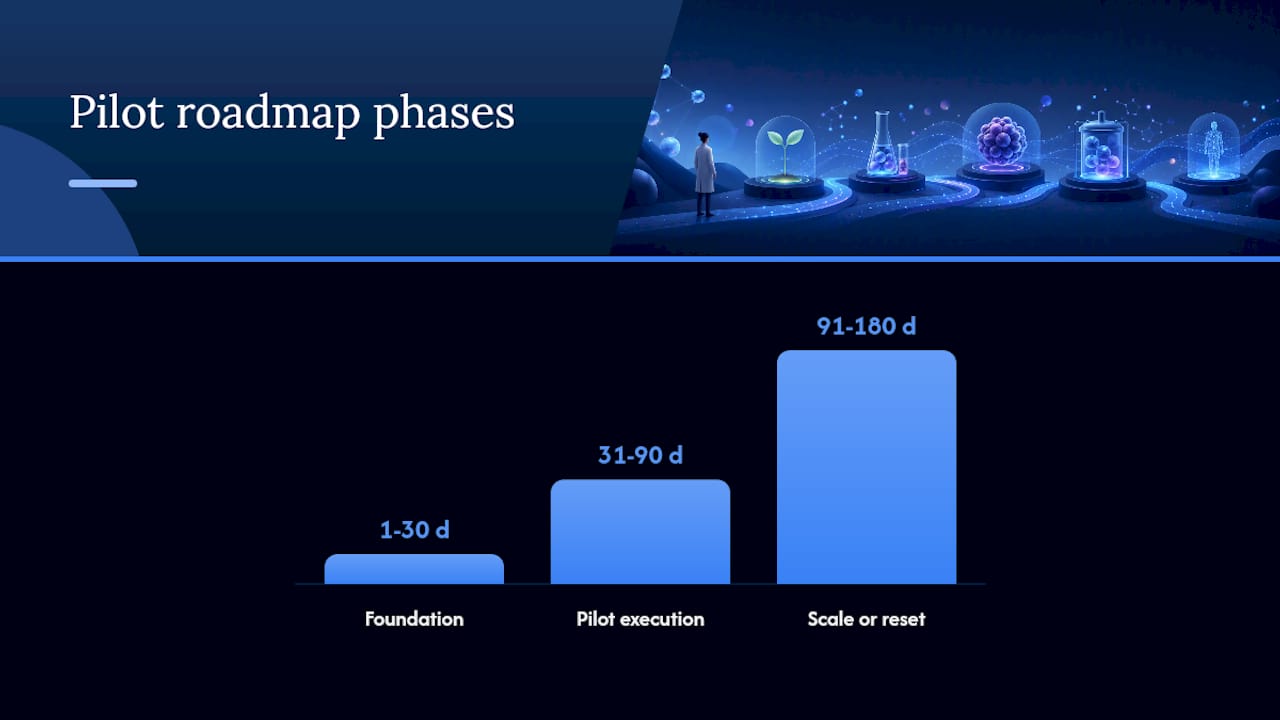
Zero-based redesign follows five steps: map the current state in detail, identify where value is actually created versus where work is just passed around, design the new AI-centric workflow from scratch, run a time-boxed pilot, then iterate based on real data.
Days 1–30: Foundation
- Complete current-state process map for the target workstream (CLM or site activation recommended)
- Confirm data readiness: clean, structured, accessible
- Secure legal and regulatory sign-off on pilot scope
- Assign RACI: one accountable executive, one clinical ops lead, one IT/data owner
- Define entry KPIs and set baseline measurements
Days 31–90: Pilot execution
- Deploy AI tool in a controlled environment (one indication, two to three sites)
- Weekly check-ins against KPIs; document every exception
- Human-in-the-loop approval at each decision node
- Exit gate: KPIs trending in the right direction, no safety or compliance flags
Days 91–180: Scale or reset
- If exit gate passed: expand to full site cohort, add second workstream
- If exit gate failed: forensic review before any expansion (see risks section)
- Board/CRO briefing template: "We piloted [workstream] AI on [indication] across [N] sites over 90 days. Baseline [metric] was [X]. Post-pilot [metric] is [Y]. We are [expanding / resetting] based on [evidence]."
Pro Tip: Aligning AI tools to clinical goals before the pilot starts is not optional. A tool that solves the wrong problem efficiently is still a failed pilot.
What governance controls does U.S. clinical AI require?
The FDA's evolving guidance on clinical decision support and AI in regulated processes sets a clear expectation: systems must be explainable, locally validated, and continuously monitored. Virtual care research reinforces that even well-designed digital workflows require training, validation, and ongoing evaluation before clinical reliance.
Minimum governance checklist for any AI-enabled workstream:
- Model validation: Validate on your own data, not just vendor benchmarks
- Explainability: Every AI-driven decision must produce a readable audit log
- Human-in-the-loop: No automated output reaches a site, regulator, or patient record without human sign-off
- Drift detection: Set a monitoring cadence (monthly minimum) to catch model degradation
- HIPAA guardrails: All EHR or patient-adjacent data must flow through compliant pipelines
- Versioning and audit trails: Every model version, every output, every override is logged
- Central IRB coordination: Parallel review requires a designated IRB liaison and a standardized submission package
Pro Tip: Assign a single accountable executive (Head of Clinical Ops or equivalent) as the compliance owner for every AI pilot. Build a compliance gate into each pilot exit review. Without one named owner, governance diffuses and audit trails go incomplete.
How do you measure ROI and set KPI targets?
Worked example: A program with 20 planned sites and a 120-day average contract cycle time saves roughly 40 days per site if CLM cuts that to 80 days. At 20 sites, that is 800 site-days reclaimed. Compressed across a program, that translates to 2–3 months off FPI lag, which in a funding-sensitive biotech directly affects valuation and next-round timing.
To attribute impact credibly, set a pre-pilot baseline window of 6–12 months, run the pilot on a defined cohort, and compare against a matched historical control. Haiphai clients have reclaimed up to 18 months on their approval pathway using this structured approach.
- Set baseline KPIs before any tool is deployed
- Define the attribution window and control group in writing
- Report at 30, 60, and 90 days against baseline
- Adjust targets only if the baseline measurement was wrong, not because results are disappointing
What risks should stop or reset a rollout?
- Poor data quality: If the AI tool's input data has >15% missing or inconsistent fields, pause and clean before proceeding
- Regulatory pushback: Any FDA or IRB objection to an AI-generated output triggers an immediate human review and a process hold
- Stakeholder resistance: Site attrition rate increasing post-pilot is a leading indicator of adoption failure, not a lagging one
- Cost overruns: A >30% budget overrun against pilot scope triggers a scope review before any further spend
- Model drift: >20% degradation in prediction accuracy on safety-relevant outputs triggers a revert-to-human flow and a model audit
For each red flag: pause the automated flow, run a forensic review of the last 30 outputs, identify the root cause, and document the remediation before restarting. Never expand a pilot that has hit a red flag without a written root-cause analysis and a governance sign-off.
Pro Tip: *Over-select sites for your pilot.
An operational partner's perspective on sequencing
The most common mistake Haiphai sees is a biotech team that has already bought a tool before mapping the process. They have a CLM platform, a site portal, and a regulatory drafting assistant, and none of them talk to each other. The zero-based approach forces a different sequence: start from the outcome (FPI date, approval date), work backward to identify what is actually blocking it, and only then select the tool that addresses that specific constraint.
The 90–180 day pilot cadence is not arbitrary. It is long enough to generate real data and short enough to kill a failing pilot before it becomes a sunk cost. Site-centricity matters throughout: the workstreams that matter most are the ones sites experience directly, because site attrition is the fastest way to lose months you cannot recover.
Haiphai's operational partnership model
Haiphai starts where most vendors stop: with a diagnostic that maps your actual bottlenecks before recommending a single tool. The engagement covers zero-based workflow redesign, AI-enabled pilot deployment across clinical and regulatory workstreams, governance and compliance monitoring, and ongoing performance tracking.
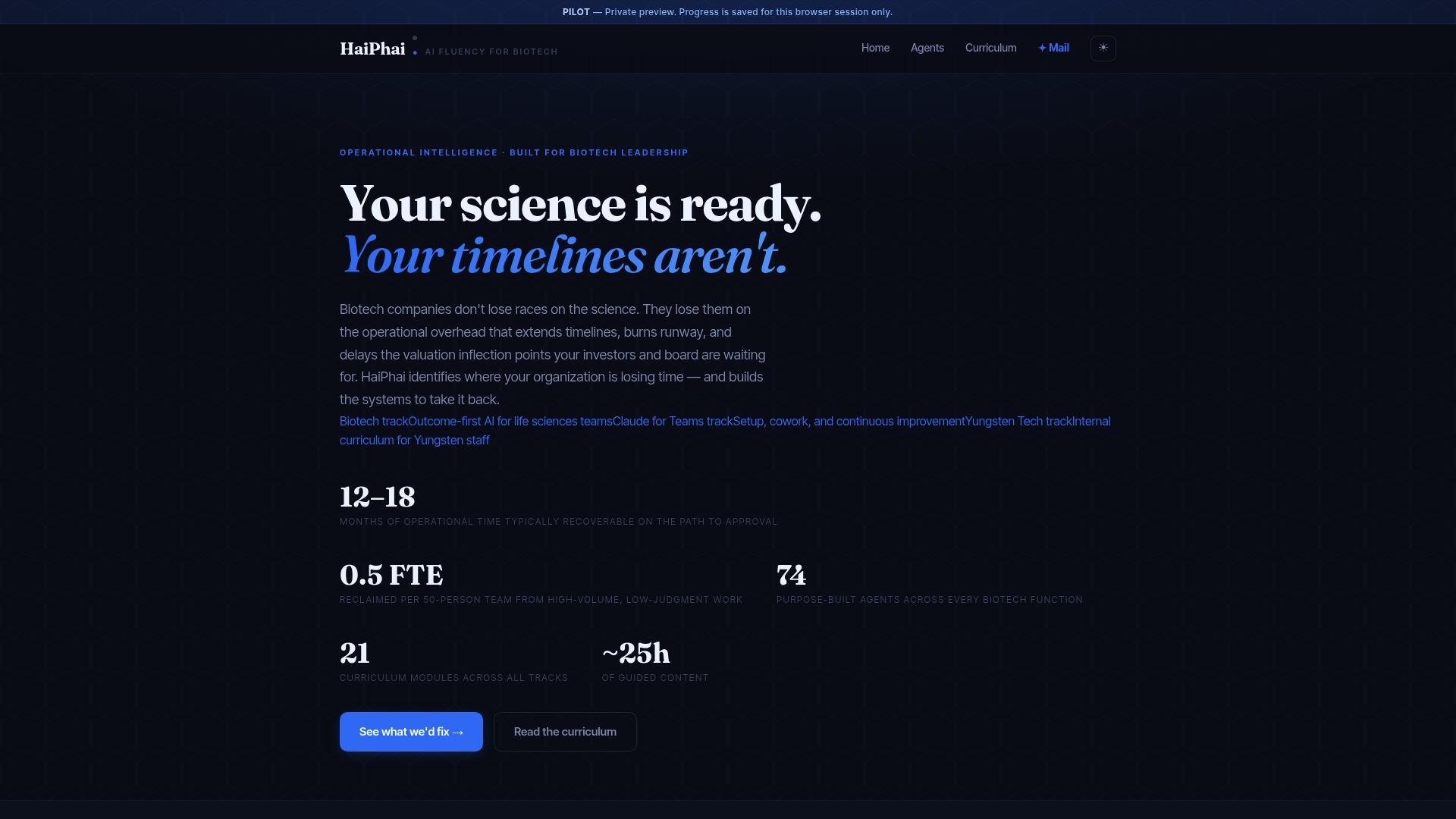
Clients reclaim up to 18 months on their approval pathway. A pilot engagement includes bottleneck diagnostic, workstream prioritization scoring, AI tool selection and integration, RACI setup, KPI baseline and tracking, and a 90-day exit review. The model is built for biotech teams that need results on a funding timeline, not a multi-year implementation.
See what a structured engagement looks like at Haiphai's solutions page, or review client proof points and trust signals before your next board meeting.
Sources
- How Biotech Startups Scale Clinical Trial Operations with Proven Platforms | Applied Clinical Trials Online
- AI’s promise hinges on redesigning workflows | Clinical Research News
- Data-driven insights: Fast to start, slow to scale — U.S. oncology trial start-up in a global context
- ClinicalReTrial (agentic trial redesign) — arXiv preprint
FAQ
What workstreams should biotech teams prioritize first?
Site activation, contract and budget negotiations, and protocol redesign are the three workstreams most consistently on the critical path to FPI. Fixing these before adding AI tools produces the fastest timeline gains.
How does zero-based workflow redesign differ from standard process improvement?
Zero-based redesign starts from a blank sheet, designing the workflow as if AI were the primary driver from day one, rather than adding automation to an existing process. Experts cite this as the critical factor in realizing AI's value in clinical operations.
What ROI can a CLM pilot realistically deliver?
How long does a biotech AI pilot typically take?
A well-structured pilot runs 90–180 days: 30 days for foundation and baseline setting, 60 days of controlled execution, and a final phase for scale or reset decisions based on KPI data.
How does Haiphai approach workstream prioritization for a new client?
Haiphai begins with a diagnostic that maps actual bottlenecks before recommending any tool, then applies a zero-based redesign to the highest-impact workstreams, with clients reclaiming up to 18 months on their approval pathway.