
TL;DR:
- AI-driven biotech workflow optimization shortens approval timelines and reclaims executive time. It relies on predictive process control, data standardization, and cross-functional collaboration to deliver measurable improvements. Tailored solutions starting from strategic goals enable biotech companies to gain up to 18 months in approval speed.
AI-driven executive biotech workflow optimization is the practice of applying AI tools and structured process frameworks to reduce operational timelines, automate routine decisions, and align daily execution with strategic goals. The payoff is concrete: biotech executives who implement these systems can reclaim significant operational time weekly, and Haiphai clients have shaved up to 18 months off approval timelines, directly improving company valuation and funding readiness.
Two capabilities define the difference between a marginal improvement and a genuine operational shift. First, AI executive operating systems replace manual inbox management, meeting prep, and delegation tracking with automated, context-aware workflows. Second, predictive process control in manufacturing replaces reactive firefighting with early anomaly detection and automated adjustments. Together, these capabilities move biotech operations from constant catch-up to deliberate forward motion.
Key areas where AI-driven workflow optimization delivers measurable results:
- Executive time reclamation: Automating inbox triage, meeting briefs, and delegation routing frees leaders to focus on decisions that require their judgment.
- Predictive manufacturing control: Shifting from reactive monitoring to continuous process oversight reduces batch variability and quality deviations.
- Data standardization: Eliminating silos between R&D, process development, and manufacturing accelerates tech transfer and regulatory readiness.
- Cross-functional alignment: Shared real-time dashboards and unified KPIs reduce decision latency across teams.
Table of Contents
- Key principles for executive biotech workflow optimization
- How AI executive operating systems reclaim your time
- How Haiphai tailors workflow optimization to your strategic goals
- How to measure impact and sustain continuous improvement
- Haiphai turns operational inefficiency into a competitive advantage
- Key Takeaways
- FAQ
Key principles for executive biotech workflow optimization
Distinguish discovery workflows from process development workflows
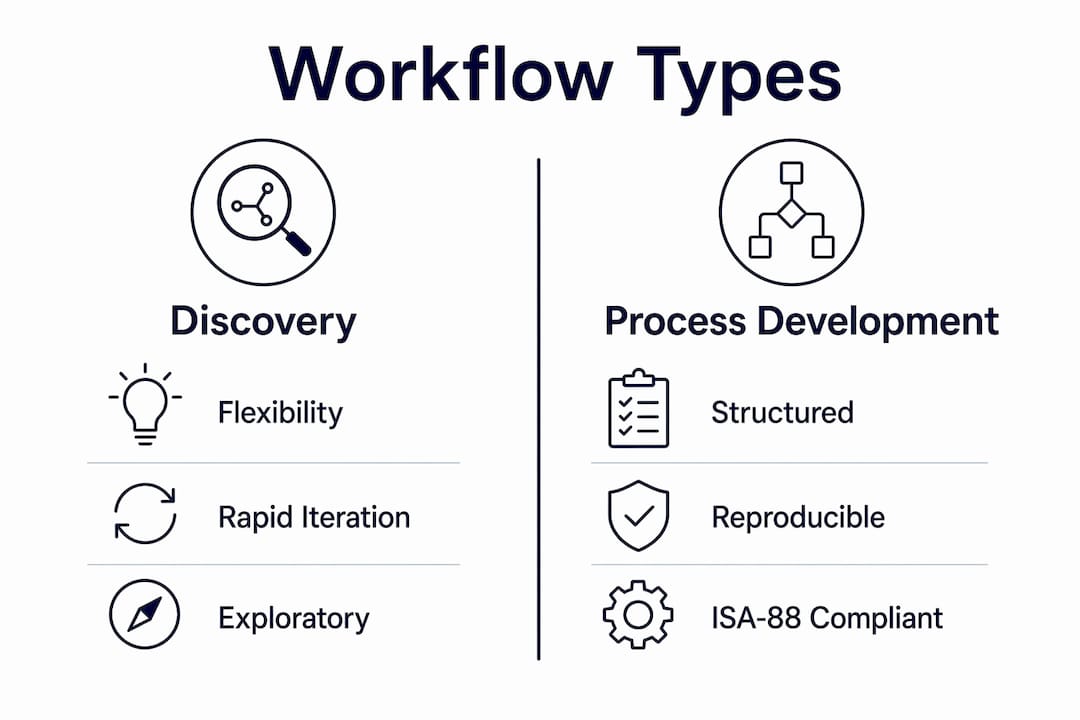
Not all biotech workflows operate under the same rules. Discovery and process development require fundamentally different data architectures. Discovery workflows need flexibility: scientists iterate rapidly, protocols change, and data structures evolve. Process development workflows, by contrast, require rigid structure. ISA-88/ASM-compatible data models enforce consistency across batch records, experimental conditions, and tech transfer packages. Mixing these two modes under a single undifferentiated system is one of the most common sources of downstream delays.
Move from reactive monitoring to predictive process control
Reactive monitoring means you find out about a quality deviation after it happens. Predictive process control means your system flags drift before it compromises a batch. WuXi Biologics' PatroLab platform demonstrates this shift in practice: by increasing batch data density up to 1,000 times through high-frequency PAT measurements, the platform enables earlier out-of-trend detection, stronger process capability indices, and faster deviation investigations. The underlying principle applies broadly: more data, collected continuously, feeds better predictive models.
Standardize data models to eliminate tech transfer delays
Data silos are the single biggest source of delays during tech transfer. When process parameters live in spreadsheets, batch records exist in disconnected systems, and analytical data requires manual reformatting before it can be analyzed, every handoff between teams adds weeks. Adopting ISA-88-compatible data models early in process development reduces ambiguity, cuts manual errors, and makes AI-driven analytics possible at scale.
Build cross-functional collaboration into the workflow architecture
R&D, manufacturing, and executive teams often operate on different data views of the same process. Integrated platforms that surface shared real-time dashboards across these functions reduce the time teams spend re-asking "where did we land on that?" and accelerate root cause analysis when deviations occur.
Treat change management as a technical requirement
AI adoption fails most often not because the technology is wrong, but because the organization was not prepared for it. Executives who treat change management as an afterthought consistently underestimate the time required to train teams, update SOPs, and establish new accountability structures. Successful implementations build change management into the project plan from day one, with clear owners, defined milestones, and feedback loops that surface resistance early.
Anchor every commitment to its source
Biotech projects suffer from what practitioners call "commitment drift": milestone commitments lose their original context as they pass through meetings, memos, and status updates. The result is that by the time a deadline slips, no one can trace back to the original agreement. Audit trail discipline that pins every commitment to its source document or meeting prevents this drift and creates the accountability structure that AI tools can then surface automatically.
Prioritize data quality before AI model deployment
Poor data quality is the leading cause of AI model failures in bioprocess manufacturing. Before deploying any predictive model, executives need to audit the completeness, consistency, and structure of their process data. A machine learning model trained on inconsistent batch records will produce unreliable predictions regardless of algorithmic sophistication. Data infrastructure investment is not a prerequisite that can be deferred.
How AI executive operating systems reclaim your time
The core function of an AI executive operating system is to handle the work that consumes executive attention without requiring executive judgment. Inbox triage, meeting brief generation, delegation routing, and KPI monitoring all fall into this category. When these tasks run automatically, executives recover hours that were previously spent on coordination rather than decision-making.
Practically, these systems integrate with the tools your organization already uses: Slack, Google Workspace, Outlook, project management boards, and CRM platforms. The AI pulls context from these sources continuously, so when you walk into a 1:1, the brief already contains your direct report's open commitments, what slipped since the last meeting, and the questions you are likely to get asked. You do not have to reconstruct that context yourself.
The more sophisticated capability is surfacing "deltas" between commitments and actual progress. An AI system that integrates communication threads, sprint data, and meeting notes can tell you that six of nine Q1 commitments shipped, two slipped, and one was quietly redefined without making it into the last memo. That kind of unbiased, current-state visibility is what separates an AI operating system from a simple task manager.
Pro Tip: Start AI executive OS integration with a single high-friction workflow, such as weekly status reporting or pre-meeting brief generation, before expanding to inbox triage and delegation routing. Early wins build team confidence and surface integration gaps before they affect critical processes.
The AI augmentation model works best when executives define their priorities, delegation patterns, and communication preferences explicitly at setup. Systems trained on your actual playbooks, tone, and decision rules produce far more useful outputs than generic configurations.
How Haiphai tailors workflow optimization to your strategic goals
Most AI workflow tools start with features and ask you to fit your operations around them. Haiphai works in the opposite direction. The process begins with your strategic goals, then traces backward through your operations to identify where bottlenecks are actually costing you time and money.
This distinction matters because the bottleneck in one biotech organization is rarely the same as in another. A company approaching its first IND filing faces different friction points than one managing a Phase III trial or preparing for commercial manufacturing. Generic software cannot distinguish between these contexts. Haiphai's approach, as an operational partner for life sciences teams, is to map the specific gaps between where you are and where you need to be, then build AI integration around those gaps.
"Clients can reclaim up to 18 months of operational time on their path to approval. That time directly affects company valuation and the terms of your next funding round. The question is not whether AI can help, but where it will have the highest impact for your specific situation." — Haiphai
The areas where Haiphai's approach consistently produces the largest gains include regulatory drafting, clinical site activation, and cross-functional reporting. These processes share a common characteristic: they are documentation-heavy, involve multiple teams, and have historically depended on manual coordination. AI integration in these areas does not replace the expertise of your team. It removes the coordination overhead so that expertise can be applied where it counts. For a deeper look at how this plays out in regulatory contexts, the AI in regulatory affairs analysis covers the specific workflow changes in detail.
How to measure impact and sustain continuous improvement
Measurement without the right metrics produces false confidence. For biotech workflow optimization, the KPIs that actually reflect operational health are:
- Cycle time per process stage: How long does each stage take from initiation to completion? Reductions here translate directly to timeline compression.
- Batch success rate and CpK: Process capability indices reveal whether manufacturing consistency is improving or just holding steady.
- Decision latency: How long does it take from when a decision is needed to when it is made? AI operating systems reduce this by surfacing the right information before the meeting, not after.
- Deviation investigation cycle time: Faster root cause analysis means less production disruption and stronger regulatory readiness.
- Funding and valuation milestones: Operational efficiency improvements that compress approval timelines have a direct effect on the terms and timing of funding rounds.
Data governance is the foundation that makes these metrics trustworthy. AI models are only as reliable as the data they consume. Executives need to establish clear ownership of data quality, define what "clean" means for each data type, and build audit trails that satisfy both internal governance and regulatory requirements. The compliance standards that govern AI integration in biotech are not optional considerations; they shape what data architectures are permissible and what audit trail requirements apply.
Continuous improvement requires feedback loops, not just dashboards. Teams need structured processes for reviewing what the AI got right, what it missed, and what new bottlenecks have emerged as old ones were resolved. Quarterly process reviews with defined owners and documented outcomes are the minimum viable governance structure for sustaining gains over time.
Haiphai turns operational inefficiency into a competitive advantage
Eighteen months taken off an approval timeline is not an incremental gain. It is the difference between leading a funding round on your terms and scrambling to close one under pressure.
Haiphai works with biotech executives who know their operations have inefficiencies but need a partner to identify exactly where AI integration will produce the highest return. The engagement starts with your strategic goals, not a software demo. From there, Haiphai maps your current workflows, identifies the specific bottlenecks costing you time and capital, and builds AI solutions tailored to your organizational context.
If you are preparing for an IND filing, managing a Phase II or III trial, or approaching commercial manufacturing, the operational decisions you make now will determine your timeline and your valuation. See how Haiphai's biotech sector expertise applies to your specific stage, or reach out directly to start the conversation.
Key Takeaways
AI-driven executive biotech workflow optimization reduces approval timelines, reclaims executive time, and improves funding outcomes when built around your specific strategic goals rather than generic software.
| Point | Details |
|---|---|
| Reclaim executive time | AI operating systems automate inbox triage, meeting briefs, and delegation routing, freeing over 20 hours weekly. |
| Predictive over reactive | Shifting to predictive process control reduces batch variability and accelerates deviation investigations in manufacturing. |
| Data standardization first | ISA-88-compatible data models eliminate tech transfer delays and make AI analytics reliable across R&D and manufacturing. |
| Measure the right KPIs | Track cycle time, batch success rate, decision latency, and deviation cycle time to verify real operational gains. |
| Haiphai's approach | Haiphai starts from your strategic goals to identify bottlenecks, enabling clients to reclaim up to 18 months on approval timelines. |
FAQ
How much time can AI save a biotech executive each week?
AI executive operating systems that automate inbox management, delegation routing, and meeting preparation can reclaim over 20 hours per week for executives currently managing these tasks manually.
What is the difference between discovery and process development workflows in biotech?
Discovery workflows require flexibility for rapid iteration, while process development workflows need structured, ISA-88-compatible data models to support batch execution, tech transfer, and regulatory compliance.
How does Haiphai differ from standard workflow software?
Haiphai acts as an operational partner rather than a software vendor, starting from your strategic goals to identify specific bottlenecks before building tailored AI solutions, enabling clients to reclaim up to 18 months on approval timelines.
What KPIs should biotech executives track for workflow optimization?
The most relevant metrics are cycle time per process stage, batch success rate, decision latency, and deviation investigation cycle time, as these directly reflect operational health and regulatory readiness.
Why does data quality matter so much for AI in biotech manufacturing?
Poor data quality is the leading cause of AI model failures in bioprocess manufacturing. Reliable predictive models require complete, consistent, and structured process data collected through high-frequency PAT measurements and standardized data architectures.