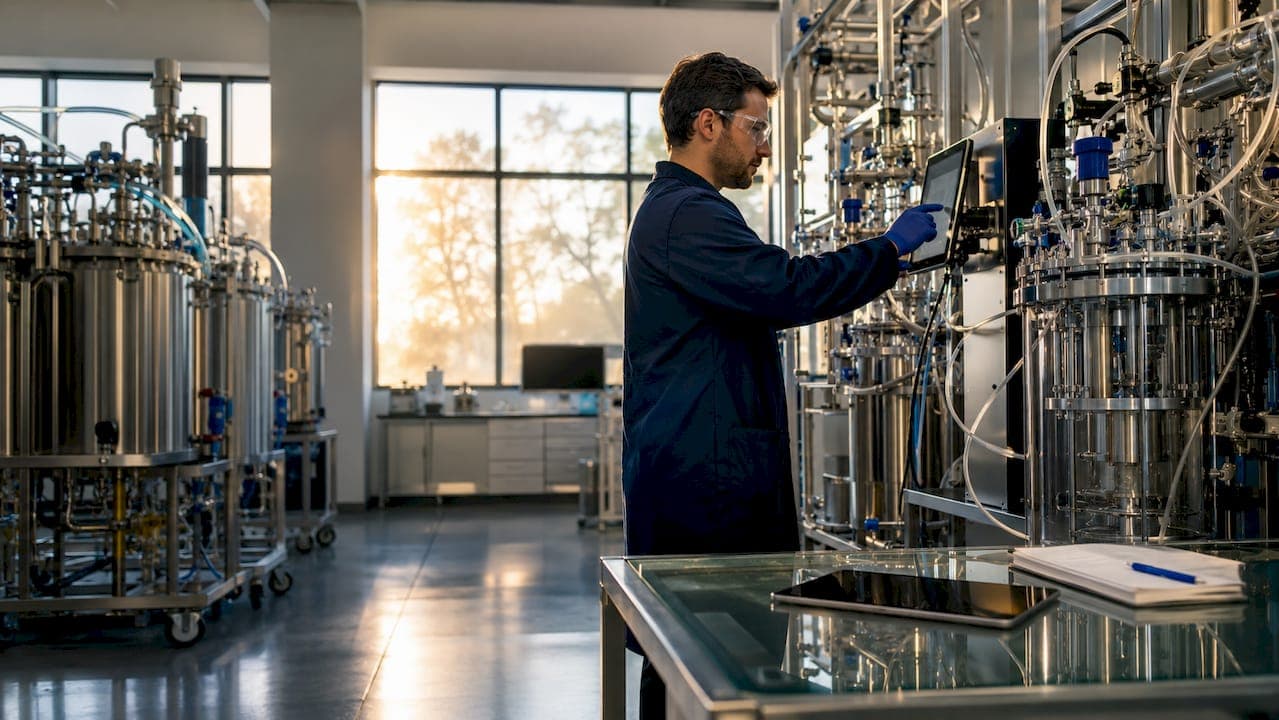
Biotech process automation is the technology-enabled replacement of manual laboratory and manufacturing tasks with systems that monitor, control, and execute workflows with minimal human intervention. The strongest biotech process automation examples today span robotic liquid handling by Hamilton Robotics and Tecan, predictive bioprocessing platforms like PatroLab, and integrated control systems such as Emerson's DeltaV. Facilities using advanced automation at Levels 3 and 4 reduce costs by 20–40% and improve yields by 10–15%. That gap between manual and automated operations is the single most compelling argument for accelerating adoption in your facility.
1. What are key biotech process automation examples in upstream manufacturing?
Upstream bioprocessing is where automation delivers the most visible gains. Automated bioreactor control uses PID loops and SCADA systems to hold dissolved oxygen, pH, and temperature within tight tolerances throughout a culture run. Without that control, operators manually adjust feed rates and gas flows, introducing variability that compounds across batches.
Process Analytical Technology (PAT) takes this further. Real-time sensors measure critical quality attributes (CQAs) including glucose, lactate, and cell density continuously, feeding data directly into control loops. The result is tighter batch consistency and a shorter path to real-time release testing.
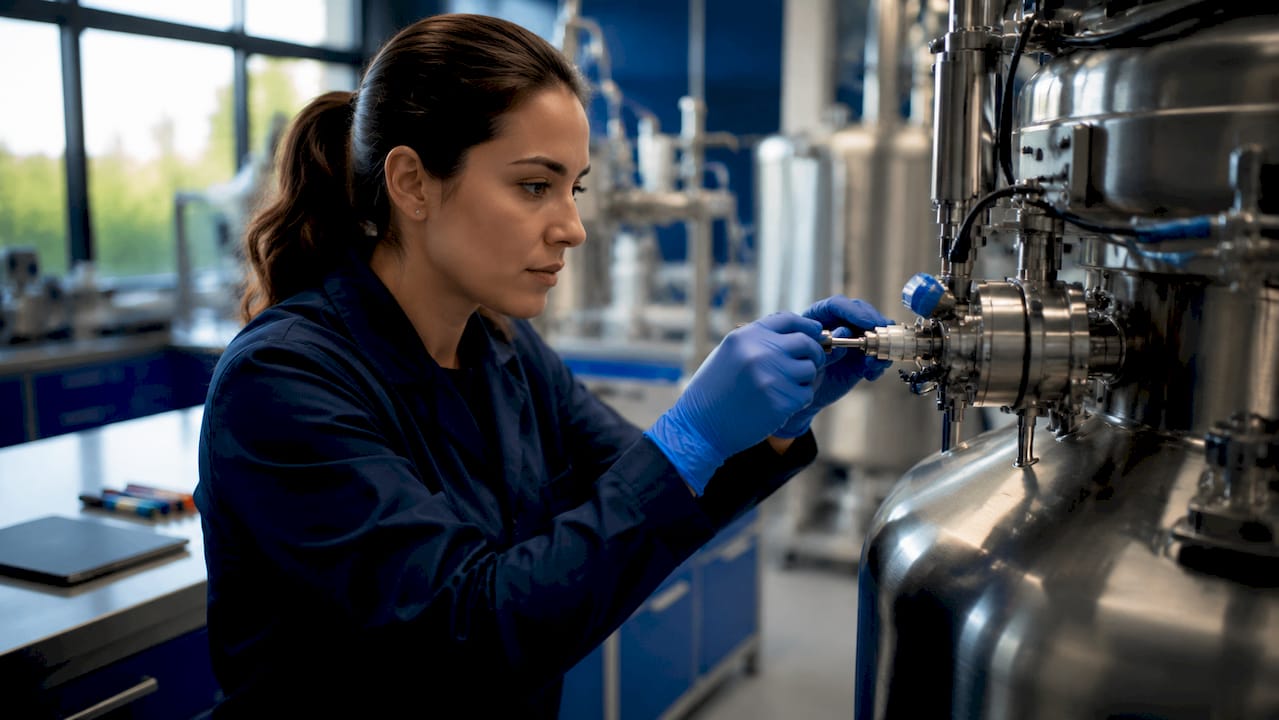
Digital twins represent the next level. These models integrate mechanistic equations with live sensor data to predict process drift before it becomes a deviation. Platforms like PatroLab from WuXi Biologics increase batch data density by up to 1,000x, which means drift is caught hours earlier than traditional offline sampling allows.
Robotic cell culture systems from companies like Hamilton Robotics handle autonomous passage scheduling, media exchange, and viability checks. This removes one of the most labor-intensive and error-prone steps in early bioprocess development.
- Automated PID and SCADA control holds CQAs within specification continuously
- PAT sensors feed glucose, lactate, and cell density data into real-time control loops
- Digital twins predict process drift before deviations occur
- Robotic platforms execute cell culture passages and monitoring autonomously
Pro Tip: Map your current manual intervention points before selecting automation hardware. Automating a poorly designed sampling schedule just makes bad data arrive faster.
2. What are prominent examples of automation in downstream processing and quality control?
Downstream processing is the bottleneck most biotech teams underestimate. Automated chromatography systems from vendors like ÄKTA (Cytiva) handle column packing, equilibration, gradient elution, and fraction collection without operator input between steps. This removes the human variability that causes column-to-column performance differences.
Closed-loop cleaning and sterilization (CIP/SIP) is one of the clearest biotech workflow automation wins. Automated systems execute validated cleaning sequences, record every parameter, and generate audit-ready logs. Automation improves visibility into water, energy, and chemical usage while preventing process upsets through predictive maintenance alerts.
Mass spectrometry sample loading automation, integrated with a Laboratory Information Management System (LIMS), eliminates manual data transcription between instruments and records. That single change removes a major source of transcription errors in QC workflows.
Electronic batch records (EBRs) replace paper-based documentation with real-time data capture. EBRs feed directly into continuous process verification programs, giving quality teams a live view of batch conformance rather than a retrospective paper review.
- Automated chromatography systems remove operator variability in column performance
- CIP/SIP automation generates audit-ready logs for every cleaning cycle
- LIMS-integrated mass spectrometry eliminates manual data transcription
- Electronic batch records support real-time quality review and continuous verification
3. How do digital platforms and AI enhance biotech workflow automation?
AI does not replace traditional automation. It coordinates it. Nearly 80% of biopharma leadership acknowledge the urgency of adopting digital technologies aggressively, including advanced analytics and electronic batch records. The pressure is real and the gap between leaders and laggards is widening.
Agentic AI systems represent the most significant shift in how biotech teams operate. These systems coordinate multi-step tasks with contextual awareness, pulling data from instruments, triggering downstream workflows, and flagging exceptions for human review. Scientists shift from executing tasks to interpreting results.
PatroLab combines PAT, predictive modeling, and automated control in one platform. It supports real-time release testing by providing continuous, high-density process data that regulators can audit. That is a direct path to shorter batch release cycles.
Machine learning models running on top of digital twin frameworks detect early process drift that statistical process control charts miss. The practical benefit is fewer out-of-specification batches and lower investigation costs.
"Future biopharma workflows will emphasize co-intelligent AI agents coordinating data and routine tasks, enabling scientists to focus on high-level decision-making."
One critical risk: "black box" AI systems that obscure their decision logic can delay regulatory approval. Maintaining human-in-the-loop oversight is not optional. It is the mechanism that keeps automated decisions auditable and defensible to agencies like the FDA.
- Agentic AI coordinates instrument data, workflow triggers, and exception handling
- PatroLab supports real-time release testing through continuous high-density data
- Machine learning on digital twins detects drift earlier than traditional SPC
- Human-in-the-loop oversight preserves auditability for regulatory submissions
4. What are applications of automation in clinical and regulatory biotech workflows?
Regulatory affairs teams carry a disproportionate manual burden. Robotic process automation (RPA) tools handle repetitive tasks including document formatting, data entry into submission portals, and eCTD structure validation. RPA fills integration gaps between legacy systems and modern platforms, improving throughput while organizations plan longer-term migrations.
Automated monitoring tools scan regulatory agency websites, track submission deadlines, and flag label changes or new guidance documents. Teams that rely on manual tracking miss updates. Automated systems do not.
Pharmacovigilance workflows benefit from automated consistency checks on incoming adverse event reports. Systems route cases by severity, flag duplicates, and pre-populate MedDRA coding suggestions. This cuts the time from case receipt to initial assessment significantly.
The role of workflow automation in life sciences extends to clinical site activation. Automated document routing, signature tracking, and site readiness checklists reduce the time between protocol approval and first patient enrolled. That compression directly affects trial timelines and company valuation.
- RPA automates eCTD document formatting and submission portal data entry
- Regulatory monitoring tools track agency websites and deadline calendars automatically
- Pharmacovigilance systems route adverse event cases and pre-populate coding fields
- Clinical site activation workflows use automated document routing and signature tracking
Pro Tip: Before deploying RPA in regulatory affairs, audit your document templates first. Automating inconsistent templates produces inconsistent submissions at higher speed.
For teams exploring how AI fits into regulatory operations specifically, Haiphai's AI in regulatory affairs analysis covers the practical augmentation story in detail.
5. How do automation maturity models inform best practices for biotech process automation?
The bioprocess automation maturity ladder runs from Level 0 (fully manual) to Level 4 (autonomous). Most commercial facilities sit between Levels 1 and 2. Advancing to Levels 3–4 cuts operator labor per bioreactor from approximately 1.0 full-time equivalent to under 0.1, and improves yields by 10–20%. That is not incremental improvement. It is a structural change in operating economics.
| Maturity level | Control technology | Typical batch failure rate |
|---|---|---|
| Level 0 (manual) | None | 8–15% |
| Level 1 (basic) | PID control | 5–8% |
| Level 2 (supervised) | SCADA/DCS | 3–5% |
| Level 3 (advanced) | Model Predictive Control (MPC) | 1–3% |
| Level 4 (autonomous) | Digital twins + AI | Below 1% |
The table makes one thing clear: each maturity step reduces failure rates, but the jump from Level 2 to Level 3 is where the economics shift decisively.
The most common mistake teams make is skipping operational design. Automating inefficient workflows only digitizes bad processes at higher speed. Standardize and simplify before you deploy technology. That principle applies whether you are implementing SCADA or an AI agent.
Key takeaways
Biotech process automation delivers measurable gains only when technology is matched to standardized workflows and governed by human oversight at every critical decision point.
| Point | Details |
|---|---|
| Upstream automation drives yield | Automated bioreactor control and PAT sensors improve batch consistency and reduce deviation rates below 1% at Level 4. |
| Downstream automation closes the QC gap | CIP/SIP automation and LIMS-integrated mass spectrometry eliminate manual errors and generate audit-ready records. |
| AI coordination multiplies automation value | Agentic AI systems connect instruments, data, and workflows, freeing scientists for interpretation rather than execution. |
| Regulatory RPA reduces submission errors | RPA tools handle eCTD formatting and adverse event routing, cutting manual errors in compliance-critical tasks. |
| Standardize before you automate | Deploying technology on broken workflows produces bad data faster. Operational redesign precedes successful automation. |
What I have learned from watching biotech teams automate
The teams that get automation right treat it as an operations problem first and a technology problem second. I have seen facilities invest in SCADA upgrades and digital twin platforms while their upstream sampling schedules were still designed around a 2010 manual process. The technology performed exactly as specified. The results were still poor because the underlying workflow was the constraint.
The maturity model framing is useful, but it can mislead teams into thinking the path is linear and purely technical. The real work is organizational. Who owns the process definition? Who validates the automated decision logic? Who reviews the exception queue when the AI flags a deviation at 2 a.m.? Those questions are not answered by selecting the right control system.
I am also skeptical of any automation roadmap that does not explicitly address regulatory acceptance from day one. Black-box AI decisions in a GMP environment are a liability, not an asset. The FDA expects you to explain every automated decision that affects product quality. Build that explainability into the system architecture before you go live, not after your first inspection.
The most practical advice I can offer: pick one high-friction, well-understood process, automate it thoroughly, measure the outcome, and use that result to build internal credibility for the next phase. Trying to automate everything simultaneously produces digital silos and frustrated teams. Early holistic planning prevents those silos, but it requires someone with authority to enforce cross-functional coordination from the start.
— John
How Haiphai helps biotech teams move from examples to execution
Knowing the examples is the easy part. Translating them into working systems inside your specific regulatory and operational environment is where most teams stall.
Haiphai works as an operational partner, not a software vendor. The process starts from your strategic goals and works backward to identify where manual workflows are creating timeline risk and cost drag. Whether the bottleneck is regulatory drafting, clinical site activation, or upstream process control, Haiphai integrates AI and automation tools that fit your existing technology stack. Clients reclaim up to 18 months of operational time on their path to approval. Explore what that looks like for your program at Haiphai Solutions or review the full range of Haiphai's services.
FAQ
What is biotech process automation?
Biotech process automation is the use of control systems, robotics, and AI to execute laboratory and manufacturing workflows with minimal manual intervention. Examples include automated bioreactor control, robotic liquid handling, and RPA-driven regulatory document processing.
What are the biggest benefits of biotech automation?
Facilities at advanced automation levels reduce costs by 20–40%, improve yields by 10–15%, and hold batch failure rates below 1%. Regulatory workflows gain faster submission cycles and fewer manual transcription errors.
How does AI differ from traditional biotech automation?
Traditional automation executes predefined steps. AI systems, particularly agentic AI, coordinate multi-step tasks with contextual awareness, detect process drift earlier, and route exceptions to human reviewers for decision-making.
What is the role of RPA in regulatory biotech workflows?
RPA handles repetitive tasks like eCTD document formatting, submission portal data entry, and adverse event case routing. It fills integration gaps between legacy and modern systems without requiring full platform replacement.
Where should a biotech team start with process automation?
Start by standardizing and simplifying your highest-friction manual workflow before deploying any technology. Automating a broken process only produces bad outcomes faster. Operational redesign precedes successful technology deployment.