
Clinical goal alignment is defined as the process of configuring, governing, and continuously monitoring AI systems so they reliably advance specific patient care and research objectives within regulated environments. For biotech executives and clinical research professionals, the failure to align AI tools with clinical goals produces a predictable outcome: technically capable systems that generate compliance risk, erode clinician trust, and miss the patient-centered outcomes they were purchased to support. Platforms like Microsoft Copilot and AI assistants like Nigel demonstrate that alignment is not a procurement checkbox. It is a lifecycle discipline that spans selection, deployment, and ongoing governance.
How to align AI tools with clinical goals: the governance foundation
Before any AI tool touches a clinical workflow or trial dataset, the organizational conditions for alignment must exist. Yale's 2026 framework operationalizes clinical goal alignment through three governance phases: pre-deployment, implementation, and post-deployment. Each phase requires structured evaluation against four principles: strategic alignment, ethics, usefulness, and financial performance. This is the industry standard for what alignment governance looks like in practice.
The prerequisite structure includes:
- A multidisciplinary AI governance committee that includes clinical leadership, compliance officers, data governance leads, and at minimum one IRB representative when AI affects research protocols or patient data.
- Formalized evaluation criteria mapped to institutional clinical priorities, not vendor marketing materials.
- Security assessments that define explicit limits on protected health information (PHI) use before any tool is piloted.
- A documented approval pathway that distinguishes clinical decision-support tools from administrative AI tools, since each carries different regulatory exposure.
Pro Tip: Treat your governance committee as a standing body, not a one-time procurement panel. Yale's model shows that alignment requires iterative checkpoints embedded throughout the AI lifecycle, not a single sign-off at purchase.
The IRB's role is frequently underestimated. When an AI tool influences how research data is collected, coded, or interpreted, IRB involvement is not optional. Governance committees that skip this step create downstream compliance exposure that surfaces during audits, not during pilots.

How do you validate that an AI tool is clinically aligned before deployment?
Validation before deployment is where most organizations make their first critical error. They benchmark AI tools on technical accuracy metrics, such as sensitivity and specificity, without first confirming that the tool uses clinically meaningful features and optimizes for patient-centered outcomes. The ABCDEFG clinician evaluation framework addresses this directly: clinical relevance is a prerequisite to technical benchmarking, not a secondary consideration.
A structured pre-deployment validation process covers these steps:
- Confirm the AI model uses features that clinicians recognize as clinically meaningful, not proxy variables that correlate statistically but carry no causal weight in patient care.
- Verify that the tool's optimization target aligns with your trial's primary endpoint or care pathway objective. A tool optimized for throughput will not serve a protocol designed around safety monitoring.
- Assess transparency. Tools that expose decision factors through methods like SHAP values allow clinical teams to interrogate outputs rather than accept them blindly.
- Conduct external validation on a dataset representative of your patient population and trial sites. Internal validation on vendor data is insufficient for regulated environments.
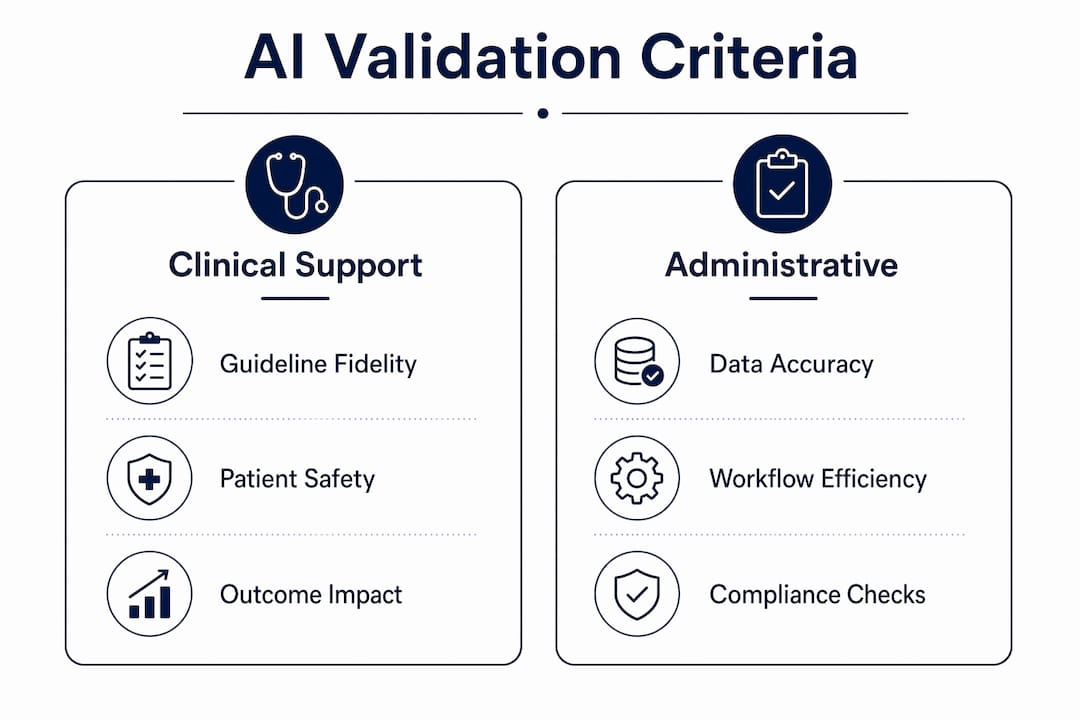
- Distinguish between clinical decision-support AI and administrative AI. The former requires clinical guideline fidelity; the latter requires workflow compatibility and auditability.
The Nigel AI assistant, developed in partnership with the American Gastroenterological Association, illustrates what guideline fidelity looks like in practice. Nigel embeds AGA guidelines using the GRADE evidence framework and provides transparent citations with every recommendation. This design choice directly addresses the trust gap that undermines AI adoption in clinical settings.
| Validation criterion | Clinical decision-support AI | Administrative AI |
|---|---|---|
| Guideline fidelity | Required (e.g., GRADE framework) | Not applicable |
| SHAP or explainability output | Strongly recommended | Optional |
| IRB review | Required if affecting research data | Situational |
| External dataset validation | Required | Recommended |
| PHI handling assessment | Required | Required |
Pro Tip: Do not accept a vendor's internal validation study as sufficient evidence of clinical alignment. Require external validation data on a population that matches your trial demographics before any deployment decision.
What are best practices for integrating aligned AI tools into clinical trial operations?
Operationalizing alignment means translating high-level clinical goals into executable, AI-assisted care pathways with defined human oversight at every handoff point. This is where governance documents become operational protocols.
The following practices define effective integration:
- Map clinical goals to workflow touchpoints. Every AI-assisted step in a trial workflow should trace back to a specific clinical objective. If the connection cannot be articulated, the tool is not aligned. It is deployed.
- Build human-AI handoff protocols. Define precisely when a clinician must review, override, or escalate an AI output. Platforms like Viz.ai Agent Studio support this by standardizing workflow deployment across multi-site environments, reducing the variability that creates compliance gaps.
- Design for traceability from day one. Corti's Diagnostic Entity Extractor Agent demonstrates the standard: it codes strictly what is documented, flags missing data, and supports pre-bill validation and retrospective audit workflows. This is not a feature. It is a compliance architecture.
- Log lifecycle events. Every AI-assisted decision, override, and escalation should be logged with timestamps and user identifiers. This log becomes your audit trail and your evidence base for ongoing alignment reviews.
- Coordinate across sites and teams. Multi-site clinical trials require standardized AI configurations and governance checkpoints at each site. A tool aligned at your lead site may behave differently at a partner site with different EHR systems or documentation practices.
The following table maps common clinical trial functions to their AI integration requirements:
| Trial function | AI tool type | Key integration requirement |
|---|---|---|
| Site activation documentation | Administrative AI | Auditability, PHI limits |
| Adverse event coding | Clinical decision-support AI | Guideline fidelity, traceability |
| Protocol deviation detection | Monitoring AI | Real-time alerting, human review trigger |
| Regulatory document drafting | Administrative AI | Version control, audit trail |
| Patient eligibility screening | Clinical decision-support AI | External validation, IRB review |
How do you monitor and sustain clinical alignment after deployment?
FDA regulatory clearance is the minimum threshold for deploying a clinical AI tool. Real-world alignment requires a continuous monitoring infrastructure that most organizations have not built. Post-deployment monitoring is where alignment either holds or drifts, and drift is rarely visible until it produces a compliance event or a patient safety signal.
A sustainable monitoring program follows this sequence:
- Establish KPI dashboards that track AI tool usage, output acceptance rates, override frequency, and downstream outcome metrics. If clinicians are overriding an AI recommendation at a rate above 30%, the tool is misaligned with clinical practice regardless of its technical performance.
- Run regular alignment audits against current clinical guidelines. Guidelines change. An AI tool calibrated to a 2024 protocol may be misaligned with a 2026 update. The Composo Align Platform addresses this directly by using domain-specific scoring anchored to clinical guidelines and SOPs, reducing expert evaluation time while maintaining alignment accuracy.
- Conduct ethical impact assessments. UNESCO's AI ethics framework mandates auditability and due diligence to uphold human rights. In clinical research, this means reviewing whether AI outputs introduce or amplify bias across patient subgroups.
- Create structured feedback loops. Clinicians and compliance teams should have a defined channel to flag alignment concerns. Informal feedback gets lost. Structured feedback becomes data.
- Review governance committee findings quarterly. Alignment is not self-sustaining. It requires scheduled human review of the monitoring data and the authority to pause or reconfigure tools that show drift.
Pro Tip: Set your override rate threshold before deployment, not after. A pre-defined override threshold gives your governance committee an objective trigger for intervention rather than relying on subjective clinical concern.
Common pitfalls that break clinical AI alignment
The failure modes in clinical AI alignment are consistent across organizations and predictable enough to prevent with deliberate governance design.
- Treating deployment as the finish line. The most common failure is stopping governance activity after go-live. Lifecycle monitoring with human-AI handoff logging is not optional. It is the mechanism that keeps alignment intact as clinical environments evolve.
- Prioritizing technical accuracy over clinical relevance. A model with 94% accuracy on a benchmark dataset may be measuring the wrong thing entirely. The ABCDEFG framework exists precisely because technical performance and clinical alignment are not the same measurement.
- Accepting vendor claims without local validation. Vendors optimize for general performance. Your trial has specific patient populations, site configurations, and protocol requirements. Local validation against your actual context is non-negotiable.
- Skipping traceability design. Tools that cannot produce an audit trail are not compliant tools. UNESCO's traceability requirements and FDA expectations both demand that AI-assisted decisions be reconstructable after the fact.
- Excluding ethics review from the governance process. When AI affects research data or patient care decisions, ethical impact assessment is a governance requirement, not a philosophical exercise.
The organizations that sustain AI alignment are the ones that treat it as a clinical quality function, not an IT function. Governance without clinical ownership is documentation without accountability.
Key takeaways
Effective clinical AI alignment requires lifecycle governance, clinical guideline fidelity, and continuous post-deployment monitoring across every trial function and site.
| Point | Details |
|---|---|
| Governance precedes deployment | Build a multidisciplinary committee with clinical, compliance, and IRB representation before selecting any tool. |
| Clinical relevance before technical metrics | Validate that AI tools use clinically meaningful features and align with patient-centered endpoints, not just benchmark scores. |
| Traceability is a compliance requirement | Design audit trails and human-AI handoff logs into every AI-assisted workflow from the start. |
| Post-deployment monitoring is mandatory | Track override rates, run guideline audits, and conduct ethical impact assessments on a defined schedule. |
| Local validation overrides vendor claims | Test every tool against your patient population, site configuration, and protocol before full deployment. |
What I've learned about AI alignment that most frameworks miss
I have reviewed a significant number of AI governance frameworks across clinical research and biotech settings, and the pattern is consistent. Organizations invest heavily in the selection phase and almost nothing in the post-deployment phase. The governance committee convenes, the tool gets approved, and then the committee dissolves. Six months later, the tool is running on an outdated guideline version, the override rate has climbed to 40%, and no one has a clear owner for the problem.
The deeper issue is that AI adoption in clinical research is frequently treated as a technology purchase rather than a clinical transformation. Biotech executives sign contracts with AI vendors the same way they procure lab equipment. But lab equipment does not make clinical recommendations that drift over time. AI tools do. The governance model has to match that reality.
What I find genuinely promising is the emergence of purpose-built alignment evaluation engines like Composo and the design philosophy behind tools like Corti's documentation agents. These are products built by teams that understand that compliance is not a feature you add. It is an architecture you design from the beginning. That thinking needs to move upstream into how biotech organizations structure their AI strategy before they ever open a vendor conversation.
The biotech leaders who will maximize AI value over the next five years are the ones who appoint clinical champions for AI governance, not IT leads. Explainability, local control, and audit readiness are not technical requirements. They are clinical quality standards, and they belong in the same governance culture as GCP and ICH guidelines.
— John
How Haiphai helps biotech teams build aligned AI programs
Clinical research teams that want to align AI tools with trial goals need more than a vendor selection checklist. They need an operational partner that starts from their strategic objectives and works backward to identify where AI can close the gap.
Haiphai is built for exactly this context. The team works with biotech and life sciences organizations to map clinical and regulatory goals to specific AI use cases, identify governance gaps before deployment, and build the monitoring infrastructure that keeps alignment intact through the full trial lifecycle. Clients have reclaimed up to 18 months of operational time on their path to approval by replacing ad hoc AI adoption with structured, goal-first integration. If your organization is ready to move from AI experimentation to AI fluency for biotech, Haiphai is the place to start.
FAQ
What does it mean to align AI tools with clinical goals?
Clinical goal alignment means configuring and governing AI systems so their outputs reliably advance specific patient care and research objectives. Yale's framework defines this as a lifecycle process spanning pre-deployment evaluation, implementation, and post-deployment monitoring.
How do you validate clinical AI alignment before deployment?
The ABCDEFG clinician framework recommends verifying that AI tools use clinically meaningful features and optimize patient-centered outcomes before reviewing technical accuracy metrics. External validation on a representative patient population is required for regulated environments.
What governance structure does clinical AI alignment require?
A multidisciplinary committee including clinical leadership, compliance officers, and IRB representation is the baseline. Yale's four-principle framework covering strategic alignment, ethics, usefulness, and financial performance provides the evaluation structure for each governance phase.
Is FDA clearance sufficient for clinical AI alignment?
No. FDA clearance is the regulatory minimum. According to npj Digital Medicine, real-world alignment requires local governance, continuous monitoring, and clinical leadership involvement in deployment decisions beyond what regulatory approval covers.
How do you sustain AI alignment after go-live?
Sustained alignment requires KPI dashboards tracking override rates and outcome metrics, regular guideline audits using tools like the Composo Align Platform, structured clinician feedback loops, and quarterly governance committee reviews of monitoring data.