
AI in biotech execution is defined as the application of machine learning, predictive modeling, and automation to accelerate and improve every stage of drug development, from molecular design through manufacturing. The role of AI in biotech execution has moved well beyond theoretical promise. Over $10 billion in AI-focused drug discovery partnerships have formed since january 2024, signaling that the field has reached structural commitment. For biotech professionals and researchers, the practical question is no longer whether AI belongs in your workflows. It is how to deploy it where it creates the most measurable impact.
How AI accelerates drug discovery and molecular design
AI's most documented contribution to biotech is compressing the front end of drug discovery. Traditional hit identification cycles take months and produce low-affinity candidates. AI methods now change both the speed and the quality of that output.

The clearest proof point is Neural Iterative Selection-Expansion, or NISE. This protein design method achieved 100% and 83% success rates on two distinct targets, with nearly 10,000-fold improved binding affinity compared to baseline compounds. That kind of improvement does not come from incremental refinement. It reflects a fundamentally different approach to searching chemical and protein space.
AI also reshapes vaccine design. An AI-designed vaccine trial demonstrated feasibility for broad viral family protection, with 39 participants in an initial study and approximately 200 enrolled in a second study, both announced in june 2026. The implication is that AI can generate candidate structures that human researchers would not have prioritized through conventional methods.
Specialized models accelerate early-stage research further. The EDEN model, developed by Basecamp Research, reduces pathogen research timelines from weeks to minutes through conversational workflows. Researchers can now query candidate prioritization in real time rather than waiting for batch analysis.
Key capabilities AI brings to molecular design:
- Binding affinity prediction: Models trained on structural and sequence data rank candidates before any wet-lab synthesis.
- De novo compound generation: Generative models propose novel molecular structures that satisfy defined pharmacological constraints.
- Multi-parameter optimization: AI simultaneously balances potency, selectivity, and ADMET properties, reducing the number of synthesis-test cycles.
- Hit expansion: Methods like NISE iterate on confirmed binders to improve affinity without losing selectivity.
Pro Tip: Before deploying any AI model for compound prioritization, validate it against a retrospective dataset from your own therapeutic area. Generic benchmarks rarely reflect the chemical space relevant to your program.
How does AI improve clinical trial execution?
Clinical trial execution is where operational inefficiencies cost the most. Protocol amendments, slow site activation, and poor enrollment forecasting each add months and millions to development timelines. AI addresses all three, though the gains arrive incrementally.
Initial operational improvements in clinical trials are piecemeal, focusing on best-in-class AI modules for discrete tasks rather than enterprise-wide transformation. This is not a limitation. It is the correct sequencing. Teams that try to replace every system at once create compliance risk and adoption failure.
The most mature AI applications in clinical operations follow this order of deployment:
- Protocol authoring assistance: AI drafts inclusion and exclusion criteria, endpoint definitions, and statistical analysis plans based on prior approved protocols and regulatory guidance. This cuts authoring time and reduces amendment risk.
- Synthetic control arms: Machine learning models construct comparator arms from real-world data and historical trial records, enabling single-arm studies to meet regulatory evidence standards in certain indications.
- Predictive enrollment modeling: AI analyzes site performance history, patient registry data, and geographic demographics to forecast enrollment rates before a single site is activated.
- Site activation prioritization: Models rank sites by predicted speed to first patient, allowing teams to concentrate activation resources on high-performing locations.
- Real-time monitoring: AI flags protocol deviations and data anomalies as they occur, replacing periodic manual data review with continuous signal detection.
The AI augmentation model that works in clinical operations treats each of these as a replaceable workflow module, not a bolt-on feature. Teams that approach it this way see compounding efficiency gains as each module matures.
AI applications in bioprocessing and manufacturing
Bioprocessing is where AI's impact on consistency and yield becomes most tangible. Upstream and downstream processes involve hundreds of interdependent variables. Human operators cannot monitor all of them simultaneously. AI process control systems can.
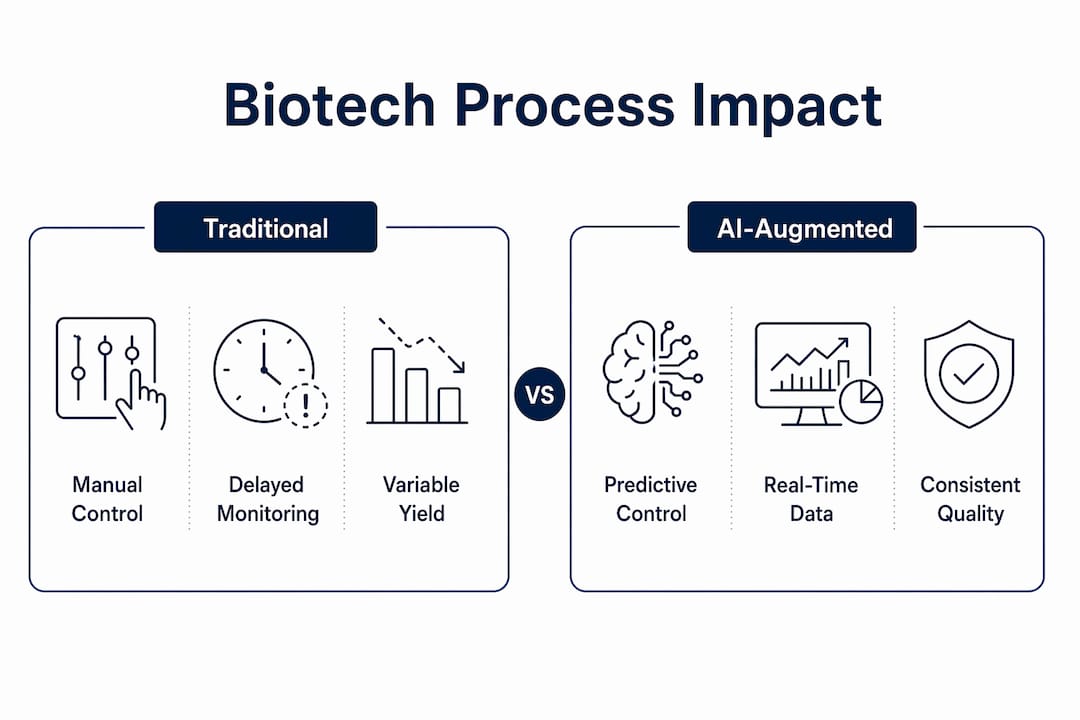
Predictive process control uses real-time sensor data from bioreactors, chromatography systems, and filtration units to anticipate deviations before they affect product quality. Traditional manufacturing relies on fixed setpoints and reactive adjustments. AI-augmented manufacturing adjusts parameters continuously based on predicted outcomes.
| Process area | Traditional approach | AI-augmented approach |
|---|---|---|
| Bioreactor control | Fixed dissolved oxygen and pH setpoints | Dynamic adjustment based on cell growth prediction |
| Yield forecasting | End-of-batch analysis | Continuous in-process yield modeling |
| Quality monitoring | Periodic offline sampling | Real-time spectroscopic analysis with anomaly detection |
| Batch release | Manual data review | Automated data integrity checks with flagged exceptions |
Integration with laboratory information management systems (LIMS) and manufacturing execution systems (MES) is the technical prerequisite for this kind of AI deployment. AI-native software embedded into lab and clinical systems maintains data integrity and compliance in a way that standalone AI tools cannot. The data must flow without manual transcription for the models to function reliably.
Pro Tip: Map your current data flows between LIMS, MES, and quality systems before selecting any AI process control tool. Gaps in data connectivity will limit model performance regardless of the algorithm's quality.
What are the biggest challenges in AI integration for biotech?
AI integration in biotech fails most often not because of the technology but because of organizational and regulatory gaps. Understanding these gaps before deployment is what separates teams that scale AI from those that run perpetual pilots.
Regulatory acceptance requires reproducible evidence and transparent model outputs. The FDA and EMA expect sponsors to explain how an AI model reached a conclusion, particularly when that model influences a clinical or manufacturing decision. Black-box models that perform well in internal validation often stall at regulatory submission because the documentation trail is insufficient.
The biotech CIO role has evolved to include both AI evangelism and cross-functional integration. That dual responsibility matters because AI adoption requires buy-in from research, clinical operations, regulatory affairs, and manufacturing simultaneously. A CIO who can only speak to IT infrastructure will not move the organization.
Key challenges biotech teams face when integrating AI:
- Data quality and standardization: AI models require clean, consistently labeled data. Most biotech organizations have fragmented data across legacy systems, spreadsheets, and paper records.
- Model validation for regulatory submission: Internal validation metrics are not sufficient. Teams need prospective validation plans that satisfy 21 CFR Part 11 and Annex 11 requirements.
- Change management: Researchers and clinicians often resist AI tools that alter established workflows. Phased deployment with visible early wins reduces this resistance.
- Vendor dependency risk: Relying on a single AI platform for multiple critical workflows creates concentration risk. Best-in-class module selection distributes that risk.
- IP and data sharing: AI models trained on proprietary compound libraries or patient data require clear data governance frameworks before any external collaboration.
Teams that treat AI as a workflow replacement, not just a productivity layer, resolve most of these challenges structurally. The goal is to eliminate the manual step entirely, not to make it faster.
Key Takeaways
AI in biotech execution delivers the greatest value when deployed as a workflow replacement across discovery, clinical operations, and manufacturing, not as a productivity add-on.
| Point | Details |
|---|---|
| NISE sets a new benchmark | Neural Iterative Selection-Expansion achieved up to 100% success rates with 10,000-fold affinity gains on validated targets. |
| Clinical AI gains are incremental | Deploy AI modules for protocol authoring, enrollment forecasting, and site activation in sequence, not all at once. |
| Manufacturing needs embedded AI | AI process control requires direct integration with LIMS and MES systems to maintain data integrity and regulatory compliance. |
| Regulatory transparency is non-negotiable | AI models used in clinical or manufacturing decisions must produce reproducible, auditable outputs to satisfy FDA and EMA standards. |
| Investor focus has shifted | Venture firms now prioritize biologically validated, asset-centric AI applications over broad platform claims. |
Why AI in biotech is a workflow problem, not a technology problem
I have watched biotech teams spend significant resources on AI tools that never moved past the pilot phase. The pattern is consistent. The technology works. The integration does not.
The organizations that get real value from AI are the ones that start with a broken workflow and ask which part AI can own entirely. They are not asking how AI can assist a researcher. They are asking which researcher tasks AI can replace so that researcher can focus on judgment calls that require human expertise.
Investor expectations have shifted in exactly this direction. Venture firms now demand biologically validated, asset-centric AI applications that solve specific clinical bottlenecks. That shift reflects hard-won experience with AI companies that built impressive platforms but could not point to a single approved drug or a single shortened trial. The market has corrected.
The uncomfortable truth is that most biotech organizations are not ready for AI at the workflow level because their data infrastructure is not ready. AI models are only as good as the data they train on. A team that has not standardized its assay data, its clinical data, or its manufacturing records will not get meaningful output from even the best model.
The practical path forward is to fix the data problem first, deploy AI in one discrete workflow, measure the outcome rigorously, and then expand. That is slower than the pitch decks suggest. It is also the only approach that produces results that hold up under regulatory scrutiny and investor due diligence.
— John
How Haiphai supports AI-driven biotech execution
Biotech teams that recognize the gap between AI potential and operational reality need more than software. They need a partner who starts from the clinical or regulatory goal and works backward to identify where AI can replace a bottleneck.
Haiphai works with life sciences teams to identify the specific workflows, from regulatory drafting to clinical site activation, where AI integration produces measurable time savings. Clients have reclaimed up to 18 months of operational time on the path to approval. Haiphai's AI solutions for biotech are built around your program's goals, not a generic platform. If your team is ready to move from AI interest to AI execution, Haiphai's services provide the operational partnership to make that transition work.
FAQ
What is the role of AI in biotech execution?
AI in biotech execution accelerates and improves drug discovery, clinical trial operations, and manufacturing by replacing manual workflows with predictive models and automation. The core value is speed and consistency across all development stages.
How does AI improve clinical trial efficiency?
AI improves clinical trial efficiency through protocol authoring assistance, predictive enrollment modeling, and real-time data monitoring. Initial gains are incremental, focused on discrete task modules rather than full system replacement.
What AI methods are used in drug discovery?
Methods like Neural Iterative Selection-Expansion (NISE), generative molecular design, and multi-parameter optimization models are the primary AI tools in drug discovery. NISE has demonstrated up to 100% success rates on protein binder targets with near 10,000-fold affinity improvements.
What are the main barriers to AI adoption in biotech?
The main barriers are data quality gaps, regulatory requirements for model transparency, and organizational resistance to workflow change. Teams that address data infrastructure before deploying AI models see significantly better outcomes.
How do investors evaluate AI in biotech companies?
Venture firms now prioritize biologically validated, asset-centric AI applications that solve specific clinical problems over broad platform claims. The focus has shifted from technology capability to demonstrated impact on drug development timelines.