
Biotech pipeline acceleration strategies are methods that compress drug development timelines by integrating AI-driven platforms, aligning cross-functional teams early, and replacing sequential handoffs with concurrent workflows. The industry standard development cycle runs close to a decade. AI-driven platforms now cut that to roughly five years by shrinking the preclinical phase alone from 5–7 years down to 2–3 years. For biotech executives managing capital-constrained pipelines, every month recovered translates directly into valuation headroom and funding leverage. The strategies below reflect what leading organizations actually do in 2026 to move faster without sacrificing regulatory quality.
1. What are the top biotech pipeline acceleration strategies?
The most impactful acceleration methods share one trait: they attack multiple bottlenecks at once rather than fixing one stage at a time. Teams that apply integrated approaches consistently outperform those that patch individual problems.
The core strategies are:
- AI-driven drug discovery platforms that compress preclinical work from years to months
- Concurrent cross-functional workflows that run manufacturing, clinical, and regulatory planning in parallel
- Data-driven portfolio valuation that directs capital to the highest-probability assets
- Next-generation CDMO partnerships that own the full DNA-to-GMP chain
- Federated data analysis that queries distributed datasets without centralizing sensitive raw data
Pro Tip: Map your critical path before selecting any tool or partner. Acceleration applied to a non-bottleneck stage produces no net gain.
2. How AI technologies specifically accelerate biotech pipelines
AI is the single biggest lever available to biotech teams right now. Its impact runs from target identification through IND filing, and the time savings are measurable.

Integrated AI platforms compress total drug development time from roughly ten years to roughly five. That is not a marginal improvement. It changes the financial model of an entire program.
Specific AI applications that drive this compression include:
- Automated authoring architectures that ingest raw multi-omics and toxicology data during discovery and build submission-ready regulatory documents before IND filing. This eliminates months of documentation debt that typically accumulates at the end of preclinical work.
- AI-enabled federated queries that give teams real-time pipeline visibility across distributed datasets without requiring data centralization. Regulatory compliance stays intact while decision speed increases.
- Predictive clinical planning tools that model enrollment rates, site performance, and protocol feasibility before a single patient is recruited. Haiphai's work in clinical trial enrollment shows how AI closes the gap between protocol design and actual recruitment timelines.
Pro Tip: Do not treat AI as a documentation tool alone. Its highest value is in early-stage decision support, where a wrong call costs the most time.
The AI augmentation model is now the standard frame for biotech leaders who want speed without replacing scientific judgment. AI handles data processing and pattern recognition. Scientists handle interpretation and strategy.
3. Why cross-functional alignment is the real driver of speed
Speed comes from predictability, not from pushing harder at the end of a program. Early alignment across manufacturing, clinical, and regulatory teams reduces the costly late-stage resets that destroy timelines.
Most delays in drug development do not originate from science. They originate from handoff failures between functions that were never synchronized. A clinical team that learns about a manufacturing constraint at Phase II has already lost six to twelve months.
Practical steps to build cross-functional alignment:
- Map the critical path across all four functions (discovery, manufacturing, clinical, regulatory) at program initiation, not at IND filing.
- Include CMC and regulatory representatives in discovery-stage reviews so that formulation and documentation constraints surface before they become blockers.
- Adopt integrated CDMO models that own the full development chain. Next-generation CDMO partnerships have cut DNA-to-GMP timelines for complex bispecific molecules from 22–24 months down to as little as 8.5 months.
- Run concurrent workstreams rather than sequential handoffs. Integrated concurrent workflows consistently outperform linear stage-gate models on total elapsed time.
The organizations that execute consistently are not necessarily the ones with the most resources. They are the ones that designed their workflows to remove waiting time between functions.
4. How to manage pipeline portfolio and valuation to support acceleration
Capital allocation is an acceleration strategy. Teams that direct resources to the highest-probability assets move faster because they are not spreading bandwidth across programs that will not reach the market.
Advanced risk-adjusted valuation models now use up to 94 data input points across 12 domains to generate real-time asset valuations within a multi-asset pipeline. That level of granularity changes how executives prioritize. Instead of relying on stage-gate intuition, teams can rank assets by probability-weighted value and adjust resource allocation quarterly.
| Valuation input category | Acceleration impact |
|---|---|
| Clinical probability of success | Identifies assets worth accelerating vs. deprioritizing |
| Regulatory pathway designation | Quantifies timeline benefit of Fast Track or Breakthrough status |
| Market size and competitive position | Weights commercial return against development cost |
| Manufacturing readiness | Flags CMC risks before they delay clinical entry |
| External partnership potential | Signals licensing or co-development opportunities |
Strategic external investment compounds this effect. Merck's $65 billion committed to external innovation since 2021 reflects a deliberate portfolio strategy: internal discovery plus disciplined external acquisition creates a pipeline that is both deep and fast-moving. Smaller biotech teams can apply the same logic at their scale by using valuation data to decide which external partnerships to pursue and which internal programs to advance.
5. What organizational and technological best practices sustain acceleration
Sustainable acceleration requires both process design and technology adoption. Neither works without the other.
The most common mistake is adding personnel without redesigning workflows. More headcount without workflow change increases coordination overhead and often slows programs down. The fix is structural, not numerical.
Best practices that sustain acceleration over time:
- Implement concurrent workstream governance with shared dashboards that give all functions visibility into the same program timeline. Waiting for weekly status meetings is a sequential-era habit.
- Automate compliance and governance checkpoints so that regulatory risk is flagged in real time rather than discovered at submission. Haiphai's AI regulatory affairs approach demonstrates how automated drafting and review cycles cut documentation timelines substantially.
- Establish federated analysis frameworks that allow queries across disparate data sources without centralizing raw data. Federated analysis addresses both compliance requirements and the latency that comes from waiting for data harmonization projects to complete.
- Build strategic partnerships to access external innovation without absorbing full development risk. A unified pipeline approach that blends internal discovery with external investment creates a sustainable acceleration environment.
Pro Tip: Audit your current handoff points before investing in new technology. The biggest time losses are usually in the gaps between systems, not inside them.
6. How Haiphai supports biotech teams in applying these strategies
Haiphai operates as an operational partner rather than a software vendor. The approach starts from a team's strategic goals and works backward to identify where bottlenecks actually live. That distinction matters because generic tools solve generic problems. Haiphai's model is built for life sciences teams that need acceleration tailored to their specific program constraints.
The practical result is that clients reclaim up to 18 months of operational time on the path to approval. That time recovery directly affects valuation and funding readiness, which are the two metrics that determine a biotech company's ability to advance its pipeline at all.
Key takeaways
Effective biotech pipeline acceleration requires concurrent workflows, AI-driven data tools, and early cross-functional alignment working together, not applied in isolation.
| Point | Details |
|---|---|
| AI compresses preclinical timelines | AI platforms cut preclinical phases from 5–7 years to 2–3 years, halving total development time. |
| Early alignment prevents late resets | Cross-functional coordination at program start eliminates the costly resets that destroy timelines. |
| Valuation models direct capital efficiently | Risk-adjusted models with up to 94 data inputs identify which assets deserve accelerated investment. |
| Concurrent workflows beat sequential handoffs | Running manufacturing, clinical, and regulatory planning in parallel consistently reduces elapsed time. |
| Federated analysis removes data bottlenecks | Querying distributed data without centralizing it speeds decisions while maintaining compliance. |
What I've learned about speed in biotech development
The word "acceleration" gets used as if it means going faster at every stage. What it actually means is removing the time that was never necessary in the first place.
Every program I have seen that ran significantly over timeline had one thing in common: functions that were making decisions in isolation and then discovering the consequences of those decisions too late. The manufacturing team that optimized a formulation without regulatory input. The clinical team that locked a protocol before CMC readiness was confirmed. These are not science failures. They are coordination failures, and they are entirely preventable.
The counterintuitive truth is that adding urgency to a poorly designed workflow makes things worse. Adding people without redesigning the process creates more meetings, more handoffs, and more opportunities for misalignment. The teams that move fastest are the ones that spent time at the start designing a workflow where waiting is not the default state.
AI tools matter enormously, but they are not a substitute for organizational design. The best AI-driven regulatory authoring system in the world cannot recover time lost because a clinical team and a manufacturing team were not talking to each other in month three of a program.
My honest recommendation: before you evaluate any acceleration technology, draw your current critical path on a whiteboard. Find the waiting time. That is where the months are hiding.
— John
Haiphai's approach to pipeline efficiency for biotech teams
Biotech teams that have mapped their bottlenecks and are ready to act have a clear next step.
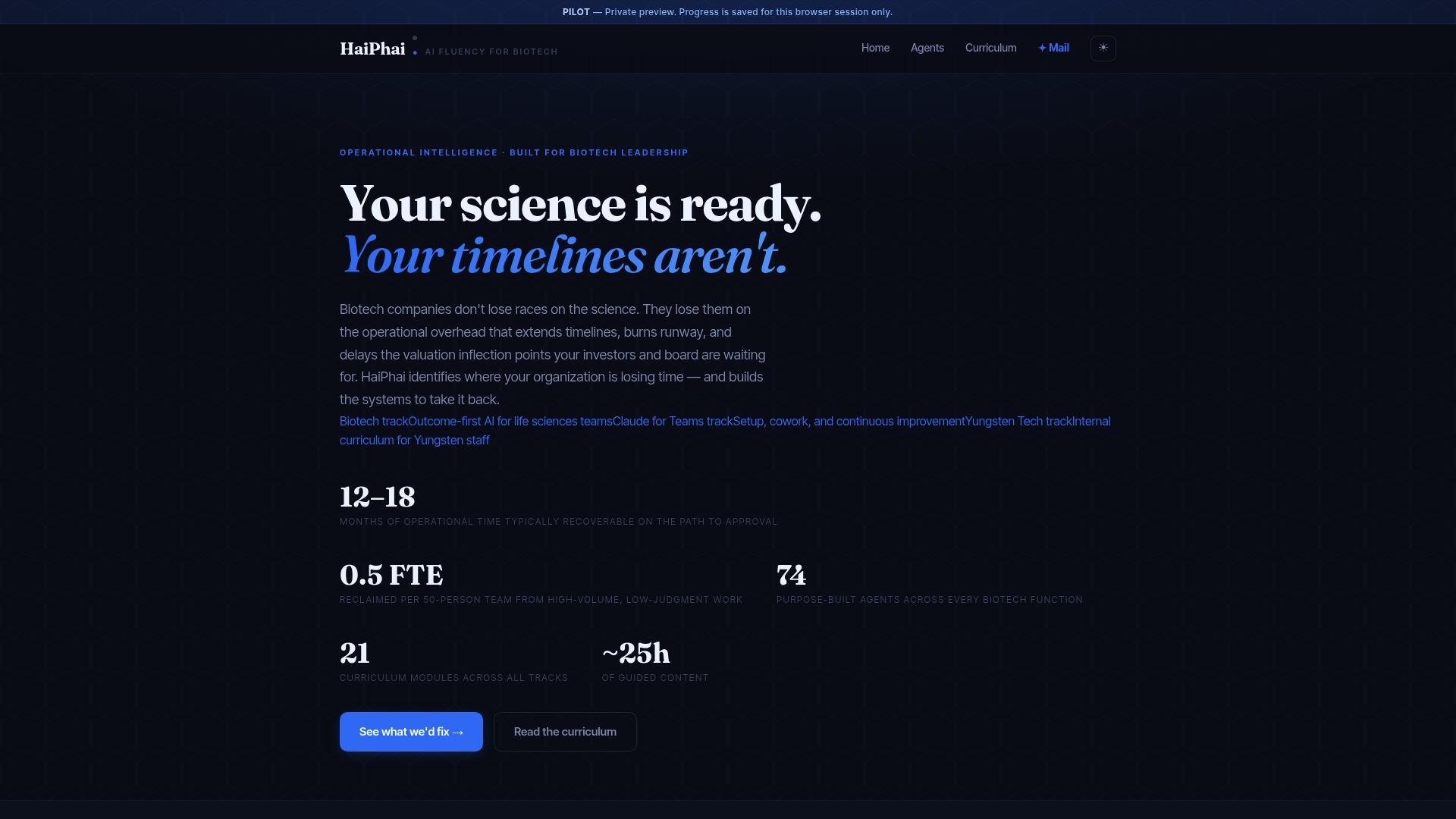
Haiphai works with life sciences teams to identify exactly where operational time is being lost and applies AI-driven tools to recover it. The focus areas include regulatory drafting, clinical site activation, and portfolio visibility, which are the three functions where delays compound fastest. Haiphai's integrated solutions are built around each client's program goals, not a fixed feature set. Teams that want to understand how the model works in practice can review Haiphai's full service offerings to see where the approach fits their current stage.
FAQ
What are biotech pipeline acceleration strategies?
Biotech pipeline acceleration strategies are methods that shorten drug development timelines by combining AI-driven platforms, concurrent cross-functional workflows, and data-driven portfolio management. The goal is to remove coordination delays and documentation bottlenecks without compromising regulatory quality.
How much time can AI realistically save in drug development?
AI-driven platforms compress preclinical timelines from 5–7 years to 2–3 years, cutting total development time from roughly ten years to roughly five. Automated regulatory authoring adds further savings by eliminating documentation delays at IND filing.
Why does cross-functional alignment matter more than adding resources?
Adding personnel without redesigning workflows increases coordination overhead and often slows programs down. Early alignment across discovery, manufacturing, clinical, and regulatory functions prevents the late-stage resets that cause the largest timeline losses.
What is federated analysis and why does it accelerate pipelines?
Federated analysis sends queries to distributed data sources rather than centralizing raw data. This approach removes harmonization delays, maintains regulatory compliance, and gives teams real-time pipeline visibility across multiple datasets simultaneously.
How does portfolio valuation support pipeline acceleration?
Risk-adjusted valuation models that use up to 94 data inputs across 12 domains help executives identify which assets have the highest probability of success. That clarity allows teams to concentrate resources on programs worth accelerating and deprioritize those that are not.