
Biotech IPO readiness is assessed against six domains: financial reporting and audit, internal controls and SOX staging, clinical and regulatory disclosure, legal and IP, governance and talent, and raise-sizing tied to cash runway. If your company passes all six, you are likely ready to begin an S-1 effort now. If two or more domains show material gaps, you are looking at a 12–24 month remediation program before filing is realistic.
Here is the quick pass/fail read across each domain:
- Financial reporting and audit: Pass requires two years of audited GAAP financials and a PCAOB-ready audit firm already engaged. Fail if your books have never been audited or you are still on cash-basis accounting.
- Internal controls and SOX: Pass requires a documented controls framework and a clear SOX 404(b) staging plan. Fail if you have no formal close calendar or no designated controls owner.
- Clinical and regulatory disclosure: Pass requires a pipeline table that reconciles with every trial narrative and data exhibit. Fail if phase descriptions, endpoints, or partnered economics are inconsistent across documents.
- Legal, IP, and cybersecurity: Pass requires clean chain-of-title on all core IP and no undisclosed material litigation. Fail if founder IP assignments are incomplete or license agreements have change-of-control provisions that have not been reviewed.
- Governance and talent: Pass requires an independent board majority, an audit committee financial expert, and a CFO with public-company experience. Fail if your board is still founder-dominated or your finance team has never closed a public-company quarter.
- Raise-sizing and cash runway: Pass requires a use-of-proceeds narrative tied to a specific next clinical milestone with 18–24 months of post-IPO runway modeled. Fail if your raise size is driven by dilution minimization rather than milestone logic.
Baker McKenzie's guide to biotech and pharma IPOs is direct: begin preparation at least 12 to 24 months before your intended listing date to build audit-ready accounting, governance, and clinical-data traceability. That window is not conservative padding. It reflects how long it actually takes to fix the gaps most biotech companies carry.
Key Takeaways
Biotech IPO readiness requires passing six assessment domains, and most early-stage companies need 12–24 months of structured remediation before a credible S-1 filing is possible.
| Point | Details |
|---|---|
| Start 12–24 months early | Baker McKenzie confirms this lead time is required to build audit-ready accounting, governance, and clinical-data traceability. |
| Six domains determine readiness | Finance and audit, controls and SOX, clinical disclosure, legal and IP, governance and talent, and raise-sizing all require a pass before filing. |
| Raise size follows milestone logic | Boards and investors expect 18–24 months of post-IPO runway; size to the delay case, not the base case. |
| Governance gaps cost you at pricing | Weak board composition and missing audit committee expertise create valuation discounts even when clinical programs are strong. |
| Haiphai accelerates the gap-close | Haiphai's embedded AI and operational partnership converts clinical and regulatory artifacts into audit-traceable documents, compressing readiness timelines. |
Table of Contents
- How is biotech IPO readiness assessed through a gap analysis?
- What does audit-ready financial reporting require for a biotech S-1?
- How do you stage SOX readiness for a biotech IPO?
- How do you build audit-traceable clinical disclosures for the S-1?
- What legal, IP, and cybersecurity items will investors and underwriters test?
- What operational and talent gaps will slow your IPO?
- How should biotech founders frame valuation and raise sizing?
- What does the 12–24 month readiness timeline actually look like?
- How does an embedded operational partner accelerate your readiness?
- Three things founders most commonly get wrong about IPO readiness
- Haiphai helps biotech teams close readiness gaps faster
- Sources
- FAQ
How is biotech IPO readiness assessed through a gap analysis?
A gap analysis is the structured method for evaluating biotech IPO readiness. It is not a checklist you hand to your CFO on a Friday afternoon. Done properly, it is a six-to-eight-week diagnostic that produces a prioritized register of findings, a remediation roadmap, and a realistic budget. The output tells you whether you are 90 days from filing or 18 months away.
Scope and who needs to be in the room
The assessment spans five workstreams: finance and accounting, legal and IP, clinical and regulatory, operations and IT, and investor relations. Each workstream needs an owner, a set of deliverables, and a clear definition of what "ready" looks like. A biotech due diligence checklist is a useful starting template for scoping the legal and clinical workstreams.
The RACI for a typical biotech readiness assessment looks like this:
- Finance and accounting: CFO owns; controller executes; external audit firm advises on GAAP and PCAOB requirements.
- Legal and IP: General counsel owns; outside securities counsel advises on S-1 structure, risk factors, and disclosure obligations.
- Clinical and regulatory: Chief Medical Officer or Head of Development owns; regulatory affairs lead executes; medical writing team supports disclosure drafting.
- Operations and IT: COO or Head of Operations owns; IT director executes; cybersecurity counsel advises.
- Investor relations: CEO and CFO own jointly; IR advisory firm supports narrative development and investor targeting.
The gap register
Every finding from the assessment goes into a gap register. Each row should capture the finding, a risk rating (high, medium, low), the workstream owner, the specific remediation steps, and the estimated completion date. High-rated findings with completion dates beyond six months before your target filing window are the ones that determine whether you go or wait.
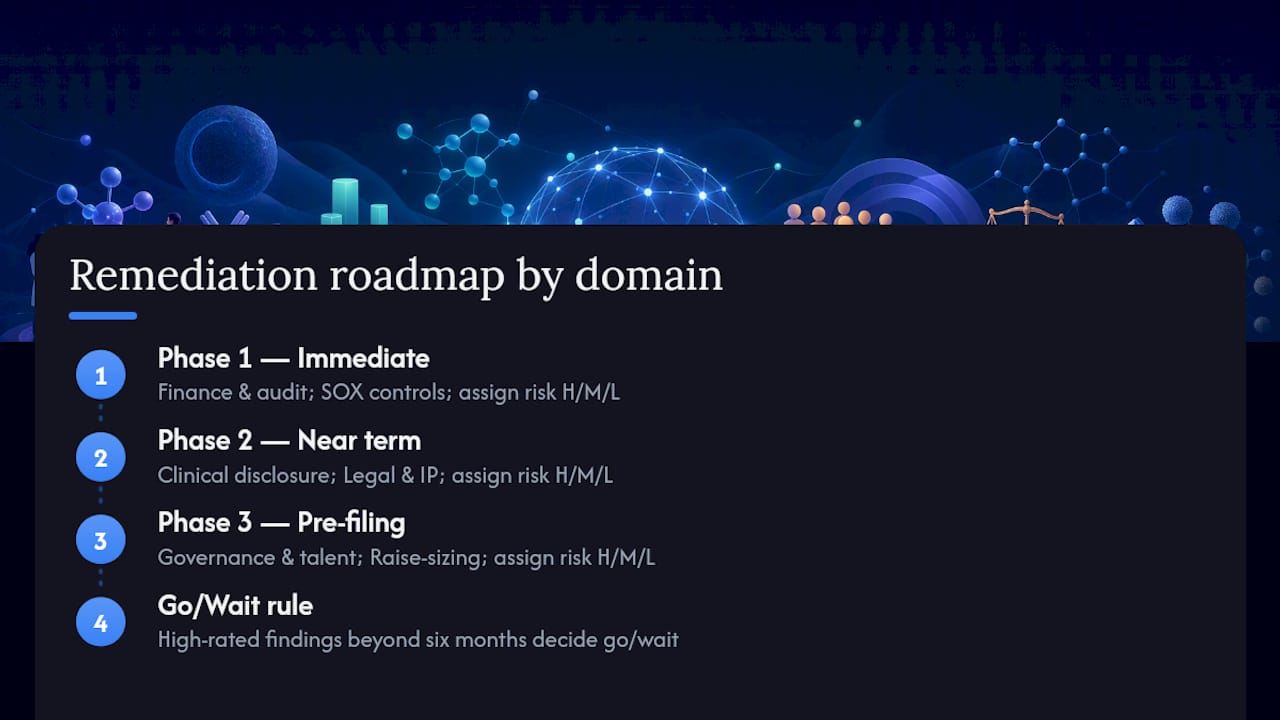
The deliverables from a well-run assessment are three things: a readiness scorecard that shows your status across all six domains, a remediation roadmap with sequenced milestones, and a budget estimate that covers internal hires, external advisers, audit fees, and technology upgrades. BDO's biotech IPO checklist frames this correctly: IPO readiness is an organizational transformation, not a filing exercise. Treat the gap register as a living project plan, not a one-time snapshot.
What does audit-ready financial reporting require for a biotech S-1?
The SEC requires at least two years of audited financial statements prepared under U.S. GAAP for a traditional S-1 registration. For most early-stage biotechs, that means your 2024 and 2025 financials need to be audited by a PCAOB-registered firm before you can file. Acquisition or disposition activity may trigger additional pro forma requirements under SEC rules.
Common PCAOB findings that slow biotech S-1s
The audit issues that most frequently delay biotech filings are not exotic. They are predictable and preventable:
- Revenue recognition under ASC 606: Collaboration agreements with milestone payments, royalties, and cost-sharing arrangements are among the most complex areas under ASC 606. If your accounting for a collaboration agreement has never been reviewed by a PCAOB auditor, assume it will require adjustment.
- Lease accounting under ASC 842: Lab and office leases that were off-balance-sheet under old standards need to be restated. Many early-stage biotechs have not completed this work.
- Research and development expense classification: The line between R&D expense and capitalized development costs is narrow and frequently challenged. Your chart of accounts needs to reflect the distinction clearly.
- Related-party transactions: Founder loans, shared-services arrangements with affiliated entities, and below-market licenses all require disclosure and often adjustment.
- Going-concern disclosures: Pre-revenue biotechs almost always trigger a going-concern analysis. The auditor's conclusion and management's mitigation plan need to be documented before the audit begins, not during it.
Close calendar and audit timeline
A realistic close calendar for a biotech targeting a 4–6 month S-1 execution window looks like this: complete the prior-year audit by the end of Q1, complete the interim review for the most recent quarter within six weeks of quarter-end, and have your chart of accounts and ERP reconciliation finalized before the audit fieldwork begins. If you are still closing your books manually in spreadsheets, that process needs to move to a system like NetSuite or Sage Intacct before the audit starts. Auditors cannot efficiently test what they cannot trace.
Pro Tip: Engage your PCAOB audit firm at least 18 months before your target filing date. The firm selection process, independence checks, and engagement letter negotiation alone can take 60–90 days. Starting late forces you into a compressed audit timeline that increases both cost and comment risk.
How do you stage SOX readiness for a biotech IPO?
SOX 404(b) requires an independent auditor attestation on internal controls over financial reporting, but that requirement does not kick in immediately for newly public companies. Under the JOBS Act, an emerging growth company (EGC) is exempt from the 404(b) auditor attestation for up to five years after its IPO, provided it stays below the large accelerated filer threshold. Most biotech IPOs qualify as EGCs, which gives you time to build controls properly rather than scrambling to pass an attestation in year one.
That said, investors and underwriters expect a credible controls framework at filing, not a promise to build one later. Crowe's analysis of what investors expect before a life sciences IPO is clear: board composition, financial expertise, and internal controls are key investor signals that directly affect valuation. Weak controls do not just create audit risk. They create pricing risk.
Controls mapping approach
Map your controls to financial statement line items and the processes that produce them. For a pre-revenue biotech, the highest-risk areas are typically: R&D expense accruals (CRO invoices, clinical site costs), cash and investment management, equity and stock-based compensation, and collaboration revenue recognition. For each area, document the control, the control owner, the frequency, and the evidence of operation.
SOX 404(b) staging checklist
The following sequence works for most life sciences companies:
- Complete a controls inventory across all financial reporting processes.
- Identify and remediate material weaknesses before filing the S-1.
- Design compensating controls for any gaps that cannot be remediated before filing.
- Disclose any remaining significant deficiencies in the S-1 risk factors with a clear remediation plan.
- Build toward 404(b) readiness in years two and three post-IPO.
Board and audit committee readiness
The audit committee needs at least one financial expert as defined by SEC rules, which means someone with direct experience preparing or auditing financial statements for a public company. Independence requirements under Nasdaq or NYSE listing standards must be met before filing. Committee charters for audit, compensation, and nominating/governance committees need to be adopted before the S-1 is filed.
A common staging trap for life sciences companies: waiting until the S-1 drafting process begins to recruit independent directors. Board searches take three to six months. Start them during the gap analysis phase, not after it.
How do you build audit-traceable clinical disclosures for the S-1?
Clinical and regulatory disclosure is where biotech S-1s most frequently draw SEC comments. The core problem is consistency: the pipeline table, the trial narratives in the body of the prospectus, and the data exhibits all need to say the same thing about the same programs. When they do not, the SEC notices, and the comment letter that follows can add weeks or months to your filing timeline.

Clinical data alignment across the pipeline table, trial narratives, and exhibits is one of the highest-risk disclosure areas that triggers SEC comments. The IPO Hub's biotech and life sciences IPO guide frames the disclosure challenge precisely: investors and the SEC scrutinize phase accuracy, partnered economics, and material setbacks closely.
Pipeline table structure and consistency checks
Your pipeline table should include, at minimum: program name, indication, development stage (phase), trial identifier (NCT number where applicable), collaboration partner and economics (if partnered), and expected next milestone. Every entry in the table needs to reconcile with the corresponding trial narrative in the body of the prospectus. If the table says Phase 2 and the narrative describes a Phase 1/2 design, that is a comment waiting to happen.
Run a consistency matrix before the S-1 goes to the printer. Map every pipeline table entry to its narrative section, its data exhibit, and any press releases or investor presentations that have been publicly filed. Discrepancies between the S-1 and prior public statements are a separate category of SEC comment risk.
PDUFA dates, CRL risk, and milestone-driven valuation
If any of your programs are in late-stage development or have a PDUFA date within the 12 months following your expected IPO, that date needs to be disclosed prominently and its valuation implications explained clearly. The Prescription Drug User Fee Act sets FDA review timelines, and investors price PDUFA dates as binary events. A Complete Response Letter (CRL) from the FDA after a PDUFA date is a material setback that must be disclosed as a risk factor with specificity, not just as a generic regulatory risk.
Checklist for clinical data disclosure in the S-1:
- Primary and key secondary endpoints, with the statistical significance threshold pre-specified
- Confidence intervals for all efficacy outcomes reported
- Safety events, including serious adverse events and discontinuation rates
- Cohort definitions and patient population characteristics
- Any post-hoc analyses clearly labeled as exploratory
- Comparison to prior data cuts or interim analyses, with any differences explained
Regulatory designations such as orphan drug, fast track, or breakthrough therapy should be disclosed with their specific implications, not just listed. A guide to biotech competitive approval advantages covers how these designations affect both regulatory timelines and investor perception.
What legal, IP, and cybersecurity items will investors and underwriters test?
Underwriters conduct legal diligence before they agree to lead your offering. The items that most frequently surface as problems are not the ones founders expect. They are the mundane administrative failures: incomplete IP assignments, unsigned collaboration agreements, and HIPAA compliance gaps in clinical data handling.
IP chain-of-title checklist
- All founder IP assignments to the company, signed and dated before any equity was issued
- University or prior-employer IP agreements reviewed and cleared, with any retained rights disclosed
- Patent ownership confirmed in USPTO records, with any discrepancies between records and internal agreements resolved
- License agreements reviewed for change-of-control provisions that could trigger termination or renegotiation at IPO
Material contracts and disclosure treatment
Any contract that is material to your business needs to be filed as an exhibit to the S-1 or summarized in the risk factors. The SEC's definition of material is broader than most founders assume. Collaboration agreements, manufacturing agreements with sole-source suppliers, and clinical trial agreements with key academic medical centers all typically qualify. If a contract has a change-of-control provision, your securities counsel needs to assess whether the IPO triggers it and whether that trigger needs to be disclosed.
- Identify all contracts with change-of-control provisions.
- Assess whether the IPO constitutes a triggering event under each contract's definition.
- Negotiate waivers or amendments before filing where possible.
- Disclose any remaining triggered provisions as risk factors.
Cybersecurity and HIPAA considerations
The SEC now requires public companies to disclose material cybersecurity incidents and to describe their cybersecurity risk management processes in annual filings. For biotech companies handling clinical trial data, HIPAA compliance is an additional layer. Your S-1 risk factors need to address both. Before filing, conduct a cybersecurity assessment and document your data governance framework. If you are handling patient data from clinical trials, confirm that your data use agreements with clinical sites and CROs are HIPAA-compliant and that your data storage and access controls meet the standard.
Litigation, regulatory inquiries, and contingent liabilities all require disclosure if they are material. Work with outside counsel to prepare a litigation schedule and assess each item against the materiality standard before the S-1 drafts begin.
What operational and talent gaps will slow your IPO?
The operational readiness question is simpler than it sounds: can your team produce accurate financial statements, SEC filings, and investor reports on a public-company schedule, under public-company scrutiny, without breaking? Most early-stage biotech teams cannot, and the gap shows up during the first mock close.
RSM's analysis of the road to IPO makes the point directly: companies frequently underestimate the full cost of going public and should prioritize assembling a multidisciplinary deal team with prior public-company experience.
Roles matrix for critical IPO functions
| Role | Key IPO Responsibility | Public-Company Experience Required |
|---|---|---|
| CFO / Controller | Financial statements, MD&A, SEC filings | Yes, ideally with prior S-1 experience |
| Head of Clinical Operations | Clinical data disclosure, CRO oversight | Yes, with trial-data reporting experience |
| Head of Regulatory Affairs | Pipeline disclosure, PDUFA tracking | Yes, with FDA interaction experience |
| IR Lead | Investor narrative, roadshow, analyst relations | Yes, with public-company IR experience |
| General Counsel | Risk factors, contract disclosure, board governance | Yes, with securities law experience |
Vendor and CRO contract red flags
- CRO agreements with no audit rights or data-access provisions: these complicate clinical data disclosure and auditor testing.
- Manufacturing agreements with sole-source suppliers and no force majeure or business continuity provisions: these require specific risk factor disclosure.
- Consulting agreements with key scientific advisers that have not been reviewed for IP assignment and conflict-of-interest provisions.
Operational playbook
Run a mock month-end close six months before your target filing date. Time it. Document every manual step. The goal is to identify where the process breaks under time pressure, not to produce a perfect set of financials. Then run it again. Practice periods that simulate public-company reporting rhythms expose bottlenecks before the SEC and your auditors do.
How should biotech founders frame valuation and raise sizing?
Biotech IPO valuation does not work the way software IPO valuation works. There is no revenue multiple to anchor to. Investors price biotech IPOs on a risk-adjusted net present value (rNPV) basis, which means they are discounting your pipeline's future cash flows by the probability of each program reaching approval and the time it will take to get there.
The practical implication: your raise size should be determined by your cash runway to the next major clinical milestone, not by how much dilution you are willing to accept. Boards and investors expect roughly 18–24 months of post-IPO runway in planning, and presenting multiple reasonable scenarios for delays strengthens the offering story.
Cash-runway calculation template
The buffer assumption is not optional. Clinical trials run late. FDA review cycles extend. A raise sized to the minimum runway needed to hit a milestone, with no buffer, will draw skepticism from institutional investors who have seen that story before.
rNPV and use-of-proceeds framing
Your use-of-proceeds section in the S-1 needs to be specific. "General corporate purposes" is not acceptable as the primary use. Tie each major use of proceeds to a specific program milestone, the expected cost to reach it, and the value inflection that milestone creates. Understanding value inflection points in biotech is central to framing this narrative credibly.
Pro Tip: Model three scenarios in your internal planning: base case (milestone on schedule), delay case (six-month slip), and adverse case (trial pause or protocol amendment). Show investors the base case in the S-1, but make sure your raise size covers the delay case. If it does not, sophisticated investors will notice and price the gap.
What does the 12–24 month readiness timeline actually look like?
A life sciences IPO typically takes 4–6 months to execute after the organizational meeting, but that clock does not start until the pre-work is done. The 12–24 months before the organizational meeting is where readiness is built or lost.
The 12–24 month readiness timeline
- Months 1–3 (Diagnostic): Complete the gap analysis. Produce the readiness scorecard, remediation roadmap, and budget. Engage audit firm and securities counsel. Begin board search for independent directors.
- Months 3–9 (Remediation): Close high-rated gaps. Complete prior-year audit. Implement close calendar and ERP upgrades. Adopt committee charters. Finalize IP chain-of-title. Run first mock close.
- Months 9–15 (Hardening): Complete interim audit reviews. Run mock SEC comment letter drill. Finalize pipeline table and consistency matrix. Conduct cybersecurity assessment. Begin IR narrative development.
- Months 15–18 (Pre-filing): Confirm EGC status and JOBS Act eligibility. Finalize use-of-proceeds and cash-runway model. Conduct confidential S-1 submission review (if using the JOBS Act's confidential filing option). Run second mock close.
- Months 18–24 (Execution): Organizational meeting. S-1 drafting. SEC comment response. Roadshow. Pricing. Listing.
What a mock SEC comment letter drill looks like
Practice periods and mock SEC comment drills reveal operational bottlenecks before the SEC does. The drill works like this: your securities counsel drafts a set of comments modeled on actual SEC comment letters issued to comparable biotech filers. Your team responds within the same timeframe the SEC allows (typically 10 business days for initial responses). The drill exposes which disclosures are weakest, which team members are slowest to respond, and where your documentation is thin.
Common delay causes and mitigations:
- Auditor capacity constraints: Your PCAOB auditor has other clients. If your close calendar slips, you may lose your audit window. Mitigation: build a 30-day buffer into every audit milestone.
- SEC comment letters on clinical disclosure: Phase accuracy and partnered economics are the most common triggers. Mitigation: run the consistency matrix before filing.
- Board recruitment delays: Independent director searches take longer than expected. Mitigation: start the search during the gap analysis phase.
- Market window closure: IPO windows close without warning. Mitigation: complete all pre-work so you can file within 30 days of a window opening.
How does an embedded operational partner accelerate your readiness?
Converting a research-stage biotech into a filing-ready public company requires more than a checklist. It requires converting clinical artifacts, regulatory correspondence, and financial records into audit-traceable documents that can withstand SEC scrutiny. That conversion work is where most teams lose time.
An embedded operational partner does something a traditional consultant does not: it maps your existing workflows, identifies where documentation breaks down, and redesigns the process so that the output is audit-traceable from the start. For regulatory drafting specifically, AI-enabled workflow redesign can compress the time required to produce consistent, cross-referenced disclosure documents. Embedded AI for biotech readiness is not about replacing your regulatory team. It is about removing the manual reconciliation steps that slow them down.
What to demand from an operational partner
- Deliverables defined upfront: a diagnostic report, a workflow redesign plan, and measurable time savings against a baseline.
- Governance model: clear ownership of each workstream, with your team retaining decision authority.
- Audit traceability: every document produced through the partner's workflows must carry a version history and source reference that an auditor can follow.
- Compliance monitoring: ongoing review of outputs against SEC, PCAOB, and FASB standards as they evolve.
Implementation phases
The engagement typically runs in four phases: diagnostic (weeks 1–6), where bottlenecks are mapped and prioritized; pilot (weeks 6–16), where redesigned workflows are tested on one or two high-priority workstreams; scale (months 4–9), where proven workflows are extended across clinical, regulatory, and financial reporting; and embedded operations (months 9 onward), where the partner operates as part of your team through filing and beyond.
Pro Tip: Demand that any operational partner you engage can show you a specific example of how their workflow redesign reduced document cycle time for a comparable biotech. A partner who cannot point to a concrete before-and-after is selling process, not results.
Three things founders most commonly get wrong about IPO readiness
The most expensive mistake is starting too late. Not by weeks. By years. Founders who begin the readiness conversation 12 months before they want to file almost always discover that their audit history is incomplete, their board is not independent, and their clinical disclosures have never been reviewed by securities counsel. Each of those gaps takes six to twelve months to fix properly. Starting at 12 months means you are already behind.
The second mistake is underinvesting in governance. Science and pipeline strength are necessary but not sufficient. Investors penalize weak governance and controls more visibly than minor scientific gaps. A board that is still founder-dominated at filing, or an audit committee without a financial expert, sends a signal that the company is not ready to operate in the public markets. That signal shows up in pricing, not just in SEC comments. Why biotech board composition drives valuation is not a theoretical argument. It is a pricing reality.
The third mistake is overstating clinical certainty in early disclosures. Founders who have lived with their data for years develop a conviction about their programs that does not always survive contact with a securities lawyer or an SEC reviewer. The S-1 is a legal document. Every efficacy claim needs to be qualified, every endpoint needs to be defined, and every comparison to prior data needs to be explained. The instinct to lead with the most optimistic read of the data is understandable. It is also the fastest way to draw a comment letter.
Three corrections you can make right now: hire a CFO with public-company experience before you think you need one, start your board search today, and have your clinical data reviewed by outside securities counsel before it goes into any investor presentation.
Haiphai helps biotech teams close readiness gaps faster
Most biotech teams reach the IPO readiness conversation with the right science and the wrong infrastructure. The clinical data exists. The regulatory history is there. But the documentation is scattered, the workflows are manual, and the gap between where the company is and where the SEC expects it to be is measured in months of remediation work.
Haiphai works as an embedded operational partner, starting from your specific readiness gaps and building backward to the workflows that close them. The engagement covers diagnostic mapping of your current bottlenecks, AI-enabled redesign of regulatory drafting and clinical data workflows, S-1 disclosure support, and ongoing compliance monitoring through filing. Clients reclaim significant operational time on the path to approval, which directly affects valuation and investor confidence. Operational transparency matters to biotech investors, and Haiphai's model is built around making that transparency auditable, not just presentable.
If your gap analysis is already done, Haiphai can move directly to pilot. If you have not started, the diagnostic is the right first step. Book a diagnostic conversation with Haiphai to map your readiness gaps and get a realistic timeline for closing them.
Sources
The following primary sources and official references are the ones worth reading while executing your readiness plan:
- Guide to IPOs for Biotech and Pharma Companies - Baker McKenzie
- Biotech IPO checklist: The road to going public & beyond - BDO
This article is general information, not a substitute for advice from a qualified financial advisor. Consult a qualified financial professional about your own circumstances before acting on anything here.
FAQ
What is an IPO readiness assessment?
An IPO readiness assessment is a structured diagnostic that evaluates a company's preparedness to file an S-1 and go public, covering financial reporting, internal controls, governance, clinical disclosure, legal and IP, and raise-sizing. The output is a gap register and remediation roadmap that tells leadership whether to file now or invest in a 12–24 month preparation program.
What is the 30-day rule for IPOs?
The 30-day rule generally refers to the quiet period restrictions that limit what a company and its underwriters can say publicly in the 30 days before and after an IPO. Under SEC rules, communications during this window are tightly controlled to prevent selective disclosure that could influence the offering price.
How are biotech IPO valuations determined?
Biotech IPOs are priced on a risk-adjusted net present value (rNPV) basis, discounting each program's projected cash flows by its probability of approval and the time required to reach it. Investors also factor in cash runway to the next major clinical milestone, with boards and investors expecting 18–24 months of post-IPO runway as a baseline.
How long does it take to prepare for a biotech IPO?
Preparation typically requires 12–24 months of pre-work to close gaps in audit history, governance, and clinical disclosure, followed by a 4–6 month execution window from organizational meeting to listing, as confirmed by both Baker McKenzie and Mondaq's life sciences capital markets guidance.
What financial statements does the SEC require for an S-1?
The SEC requires at least two years of audited financial statements prepared under U.S. GAAP, along with interim financial statements for the most recently completed quarter. Acquisition or disposition activity may trigger additional pro forma financial statement requirements under SEC rules.