
A biotech due diligence checklist is a structured evaluation framework that guides investors and executives through every critical domain of a biotech asset, from clinical data integrity to manufacturing compliance, before committing capital. The industry standard for organizing this process is the nine-folder data room, which covers company overview, financials, legal and IP, R&D and clinical, regulatory, CMC and manufacturing, operations, team and governance, and supporting materials. Each folder maps directly to a category of investment risk. Executives who skip or compress any category routinely discover material problems after term sheets are signed. This article walks through every layer of a complete biotech investment checklist, with specific checkpoints, expert audit standards, and AI tools that reduce setup time without sacrificing rigor.
1. The biotech due diligence checklist: nine essential categories
The nine-folder framework is the recognized industry standard for organizing a biotech investor data room, and every serious diligence process maps to it. Each folder is not just a filing cabinet. It is a risk domain with specific documents that either confirm or undermine the investment thesis.
- Company overview: Certificate of incorporation, cap table, shareholder agreements, and a current corporate structure chart. Missing or outdated cap tables are among the first red flags investors flag.
- Financials: Audited financial statements, burn rate analysis, financial projections, and debt schedules. Projections must tie explicitly to clinical and regulatory milestones.
- Legal and IP: Patent filings, freedom-to-operate opinions, licensing agreements, and litigation history. This folder often determines valuation ceiling.
- R&D and clinical: Protocols, investigator brochures, clinical study reports, safety databases, and biomarker data. Incomplete safety reporting here triggers immediate scrutiny.
- Regulatory: INDs, NDAs, BLAs, EMA and FDA correspondence, and meeting minutes. Gaps in regulatory correspondence are treated as program-level risks.
- CMC and manufacturing: Drug substance and drug product specifications, batch records, stability data, and supplier qualification documents.
- Operations and commercial: Go-to-market plans, partnership contracts, competitive analysis, and reimbursement strategy.
- Team and governance: Management bios, board composition, organizational charts, and key-person agreements.
- Supporting materials: Publications, conference presentations, and third-party expert reports.
AI tools like Peony can auto-index uploaded documents into this nine-folder structure in under five minutes, eliminating the manual sorting that typically consumes days of project manager time.
Pro Tip: Build your internal data room using this nine-folder structure before your first investor meeting. Investors use the same framework as a stress test, and gaps become immediately visible when the structure is shared.

2. How to conduct regulatory and clinical due diligence
Regulatory risk is now the central theme of biotech investment theses, not an auxiliary section. Investors treat FDA dynamics and timeline impacts as primary valuation drivers, which means your regulatory folder must be complete and defensible before any serious conversation begins.
The core regulatory documents to review include:
- All IND submissions and amendments, with FDA response letters
- NDA or BLA filing status and any Complete Response Letters
- EMA scientific advice letters and CHMP opinions
- FDA meeting minutes from Type A, B, and C meetings
- Risk Evaluation and Mitigation Strategies (REMS) documentation if applicable
Clinical diligence requires equal depth. Reviewers must assess protocol design for endpoint validity, statistical powering, and patient population definitions. Investigator brochures should be current and consistent with the safety database. Serious adverse event reports must be reconciled against published data. Any discrepancy between internal safety data and public disclosures is a disqualifying finding.
GCP compliance documentation, including site monitoring reports and audit findings, confirms that the clinical data is defensible in a regulatory submission. GMP compliance in manufacturing, covered separately in the CMC folder, confirms that the product can actually be made at scale.
Pro Tip: Request the complete FDA correspondence file, not just the summary. The tone and content of FDA letters often reveal program risks that executives have downplayed in their pitch materials.
3. Assessing intellectual property and manufacturing capabilities
IP and manufacturing are the two domains where avoidable investment losses are most concentrated. Both require structured, expert-led evaluation rather than document review alone.
Patent due diligence: three non-negotiable steps
A rigorous patent due diligence protocol covers three areas that generic legal reviews routinely miss:
- Full patent estate mapping: Identify every granted patent, pending application, and licensed-in right covering the compound, formulation, method of use, and manufacturing process. Gaps in coverage create freedom-to-operate exposure.
- Timeline stress testing: Overlay patent expiration dates against the projected clinical and regulatory timeline. A compound reaching NDA approval with less than five years of remaining exclusivity faces immediate generic competition pressure.
- Litigation exposure assessment: Search IPR and PGR databases at the Patent Trial and Appeal Board (PTAB) for any inter partes review petitions or post-grant review challenges filed against key patents. Active PTAB proceedings can invalidate core IP before a product ever reaches market.
Manufacturing site audits
Biopharma due diligence audits require a minimum of three full days on-site with multiple senior experts. Aseptic or complex biologics facilities demand two to three specialists covering quality assurance operations, sterility assurance, validation, and manufacturing systems. A single-day walkthrough produces an incomplete picture of contamination control practices and leadership culture.
The table below compares traditional audit approaches with structured scoring methods:
| Audit approach | Scoring method | Best use case |
|---|---|---|
| Narrative audit report | Qualitative, subjective | Early-stage exploratory review |
| Structured 1-50 scoring | Quantitative, comparable | Multi-site acquisition comparison |
| Multi-expert consensus scoring | Weighted, defensible | Late-stage investment or acquisition |
Structured scoring on a 1-50 scale improves objectivity and directly supports price negotiation. This method makes it possible to compare multiple manufacturing targets on the same criteria, which is particularly valuable when evaluating platform companies with multiple production sites.
4. Operational and team considerations in biotech diligence
Execution risk is underweighted in most biotech investment checklists. A strong clinical program with a weak operational plan or an inexperienced team will miss milestones regardless of the science.
The operational review must confirm that all requested capital maps explicitly to verifiable clinical or regulatory milestones. Vague capital allocation, such as "general corporate purposes," is a red flag that the team has not modeled the regulatory pathway in sufficient detail. Underestimating the duration of FDA review cycles or the cost of a Complete Response Letter remediation is one of the most common and costly errors in biotech financial planning.
Key items to evaluate in this domain:
- Management bios and credentials: Verify prior NDA or BLA approvals, FDA meeting experience, and relevant therapeutic area expertise. A CEO who has never taken a drug through Phase 3 carries execution risk that must be priced into the deal.
- Organizational chart and key-person risk: Identify single points of failure. If the chief medical officer or head of regulatory affairs departs, does the program stall?
- Board composition: Confirm that at least one board member has direct FDA regulatory experience or a track record of successful exits in the same therapeutic area.
- Commercial readiness: Review market sizing methodology, payer strategy, and any existing partnership or co-promotion agreements. Pre-commercial stage companies should have at least a preliminary reimbursement analysis.
Pro Tip: Ask for the operational plan as a separate document from the pitch deck. Decks summarize. Operational plans reveal whether the team has actually worked through the details of site activation, enrollment projections, and regulatory submission timelines.
5. How AI and technology solutions enhance the diligence process
Manual due diligence is slow, inconsistent, and error-prone. A single data room with 500 documents can take a project manager several days to organize and index. AI-powered platforms automate patent landscaping and molecular data extraction, reducing the risk of overlooked technical flaws and producing more consistent evaluations across deals.
The most practical AI applications in the biotech diligence process include:
- Automated document indexing: Tools like Peony sort uploaded files into the nine-folder structure in under five minutes, freeing analysts to focus on content rather than organization.
- Patent landscape analysis: AI platforms scan global patent databases, flag relevant prior art, and identify competitive IP clusters faster than manual searches.
- Molecular data extraction: Automated tools pull compound structures, assay results, and clinical endpoints from scientific literature and internal reports, reducing transcription errors.
- Security and compliance infrastructure: Data room security must comply with GxP, 21 CFR Part 11, HIPAA, and GDPR standards. Features like dynamic watermarking, audit trails, and screenshot protection are not optional for biotech transactions involving sensitive clinical and IP data.
"AI-powered diligence improves accuracy and speed but cannot fully replace expert judgment, especially for complex manufacturing audits requiring multi-expert teams." — GMP Bridge
The right posture is to use AI for document management, initial screening, and IP landscaping, while reserving expert judgment for manufacturing audits, regulatory strategy assessment, and clinical data interpretation. Combining both produces faster and more defensible investment decisions.
For teams managing laboratory compound documentation, standardized folder-level checklists for research data and clinical trial materials are a practical complement to AI indexing tools.
Key takeaways
A complete biotech due diligence checklist covers nine structured categories, and missing any single domain creates material investment risk that surfaces after capital is deployed.
| Point | Details |
|---|---|
| Use the nine-folder framework | Organize every data room around the nine standard categories to match investor expectations and expose gaps early. |
| Treat regulatory risk as central | FDA correspondence, IND status, and timeline modeling belong at the core of the investment thesis, not in an appendix. |
| Require three-day manufacturing audits | Single-day site visits miss contamination control and leadership culture risks that only emerge over extended on-site review. |
| Apply structured patent stress tests | Map patent expiration against clinical timelines and check PTAB for active IPR proceedings before finalizing valuation. |
| Combine AI tools with expert judgment | Use AI for document indexing and patent landscaping; reserve multi-expert teams for manufacturing and clinical data review. |
What I've learned from watching diligence go wrong
Most diligence failures I've observed share a common pattern: executives treat the checklist as a documentation exercise rather than a risk discovery process. They collect the documents, organize the folders, and present a complete data room. What they don't do is stress-test the assumptions embedded in those documents.
The regulatory folder is where this gap is most dangerous. A company can have every FDA letter filed and indexed, and still have a fatal flaw in the program if the team hasn't modeled what a Complete Response Letter would cost in time and capital. Biotech CEOs should conduct internal diligence before seeking investment, precisely because investors use the checklist as a stress test focused heavily on regulatory risks. If you haven't stress-tested your own program, an experienced investor will do it for you, and the findings will surface at the worst possible moment in the negotiation.
The second pattern I've seen consistently is underinvestment in manufacturing diligence. Executives who have never run a GMP facility tend to treat the CMC folder as a compliance checkbox. Experienced investors treat it as a program risk assessment. A manufacturing site that cannot scale to commercial volumes, or that carries unresolved FDA observations, can kill a deal that looked strong on clinical data alone.
My recommendation: run your own internal diligence using the nine-folder framework at least six months before your next funding round. Use a structured scoring system for manufacturing and IP, bring in external experts for the site audit, and map every dollar of your capital ask to a specific regulatory or clinical milestone. The investors who matter will run exactly this process. You should know the answers before they ask the questions.
— John
How Haiphai accelerates your biotech due diligence workflow
Organizing a complete biotech investor data room while managing active clinical programs is one of the most time-intensive tasks a biotech executive faces. Haiphai acts as an operational partner, starting from your strategic goals and working backward to identify where document management, regulatory drafting, and clinical site activation are creating bottlenecks.
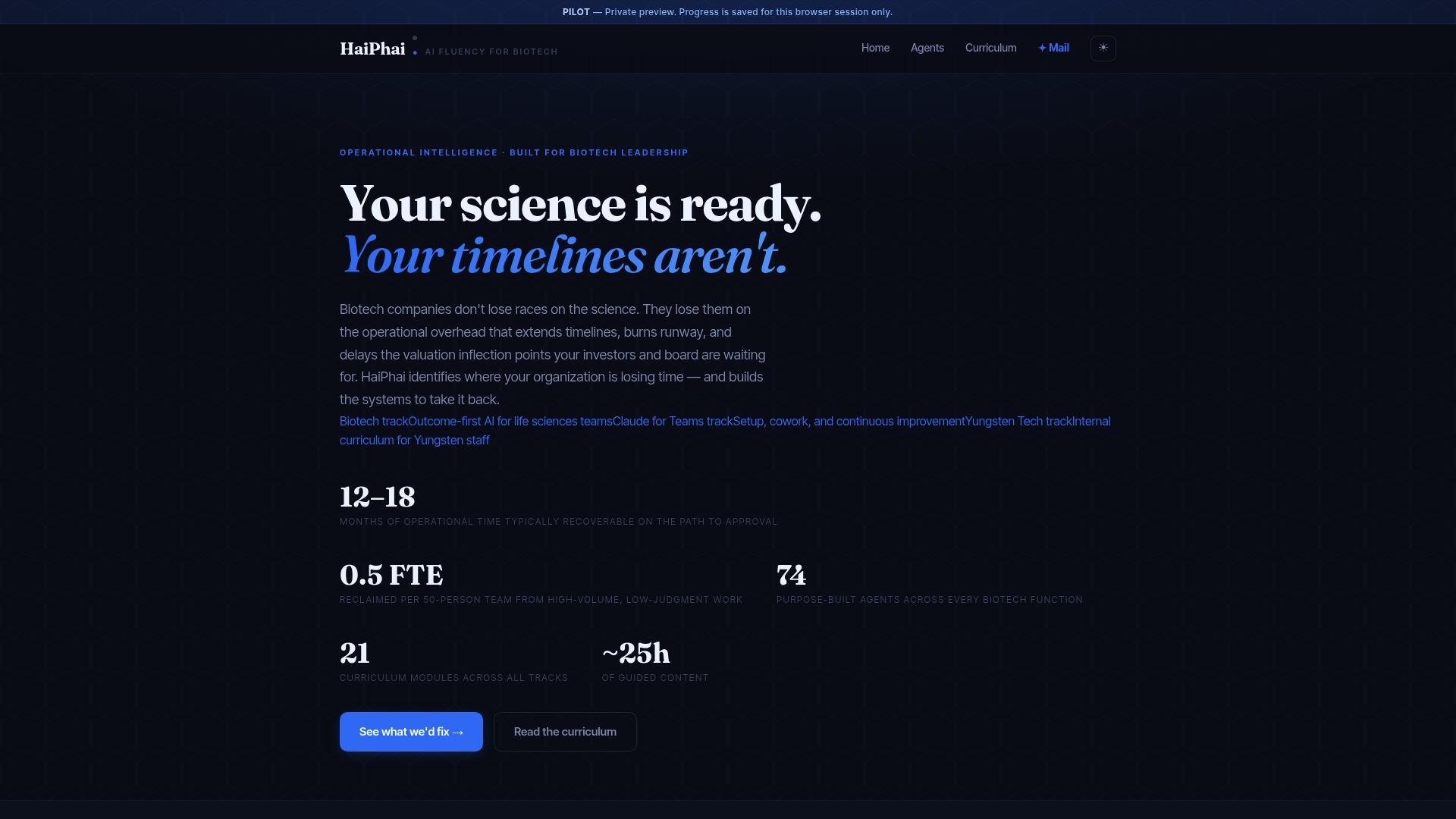
Haiphai's AI-powered platform integrates directly with your existing workflows to automate document indexing, organize clinical and regulatory files to industry standards, and maintain the security compliance required for GxP and 21 CFR Part 11 environments. Teams using Haiphai have reclaimed up to 18 months of operational time on the path to approval. For biotech executives preparing for a funding round or acquisition, that time translates directly into valuation. Learn how Haiphai's AI platform can reduce your diligence preparation time and strengthen your investor-ready data room.
For teams evaluating secure research portal solutions, understanding the compliance and access control requirements specific to biotech due diligence is a practical starting point.
FAQ
What is a biotech due diligence checklist?
A biotech due diligence checklist is a structured framework covering nine categories: company overview, financials, legal and IP, R&D and clinical, regulatory, CMC and manufacturing, operations, team, and supporting materials. It guides investors and executives through every risk domain before capital is committed.
How long does the biotech due diligence process take?
The timeline varies by deal complexity, but manufacturing site audits alone require a minimum of three days on-site with multiple senior experts. Full investment diligence for a clinical-stage asset typically runs four to eight weeks.
What are the biggest red flags in biotech due diligence?
The most common red flags include gaps in FDA correspondence, capital requests not tied to specific milestones, unresolved manufacturing observations, and patent timelines that don't support the projected commercial window.
How does AI improve the biotech diligence process?
AI platforms automate patent landscaping and document indexing, reducing setup time and the risk of overlooked technical flaws. AI tools work best in combination with expert judgment for manufacturing and clinical data review.
What documents belong in the regulatory folder of a biotech data room?
The regulatory folder should contain all IND submissions and amendments, NDA or BLA filings, FDA and EMA meeting minutes, Complete Response Letters, and any REMS documentation. Missing FDA correspondence is treated as a program-level risk by experienced investors.