
An embedded AI operational partnership is the fastest, highest-confidence route for an early-stage biotech to reclaim development time and reach Series A readiness. Not a software subscription. Not a point tool for regulatory drafting. A partnership that starts from your strategic milestones, maps every operational bottleneck between you and those milestones, and then governs AI-enabled workflows that close the gap.
Three proof pillars support that claim:
- Measurable time reclaimed: Haiphai clients report reclaiming up to 18 months of operational time on the path to approval, a figure that moves rNPV inputs in ways VCs notice immediately.
- Regulator-aligned governance: Workflows are designed to meet ICH E6 (R2) expectations for audit trails, document control, and validation, so nothing you build in the pilot becomes a liability at inspection.
- Investor-facing KPIs from Day 1: The 4–8 week diagnostic produces a prioritized pilot scope and a KPI package your board and lead investors can evaluate, including site activation cycle time, protocol amendment rate, and time-to-IND baselines with target ranges.
Commission the diagnostic before your runway drops below 18 months. That is the immediate next step.
Key Takeaways
An embedded AI operational partnership, not off-the-shelf software, is the fastest route to Series A readiness because it governs the workflows that directly move your investor-facing KPIs.
| Point | Details |
|---|---|
| Commission the diagnostic now | A 4–8 week diagnostic produces a KPI baseline and pilot scope before runway pressure forces reactive decisions. |
| Site contracting is the fastest win | US site contract execution averages 7.9 months; automation can cut this to under 8 weeks. |
| rNPV sensitivity table is required | Present 3-, 6-, and 12-month timeline-shift scenarios to VCs; most Series A decks omit this table. |
| Governance controls are non-negotiable | Every AI-enabled workflow touching submission documents needs an ICH E6 (R2)-aligned audit trail and model validation plan. |
| Haiphai delivers the full arc | Diagnostic, governed pilot, and ongoing partnership with client-owned models and up to 18 months reclaimed on the path to approval. |
Table of Contents
- What makes embedded AI the right approach for Series A readiness?
- What does a concrete Series A readiness roadmap look like?
- Where does embedded AI save the most time?
- How do you evaluate and choose an embedded AI operational partner?
- What does the implementation playbook look like phase by phase?
- How do you quantify ROI and present it to investors?
- What compliance and data governance controls do you need?
- What does a Haiphai engagement actually deliver?
- What should senior ops leaders decide this quarter?
- Haiphai's diagnostic offer for biotech teams
- Sources
- FAQ
What makes embedded AI the right approach for Series A readiness?
"Embedded AI operational partnership" means something specific here: a structured engagement where an external ops team runs a diagnostic of your workflows, builds AI-enabled processes tailored to your program, governs those processes with validated pipelines and audit trails, and holds accountability for measurable outcomes. It is not a license to a platform you configure yourself.
The contrast with off-the-shelf tools matters in regulated settings. Generic AI tools carry integration friction, unvalidated models, and no audit trail that survives an FDA inspection or a Series A due-diligence review. Early-stage biotechs frequently lack procurement and sourcing maturity, which compounds the problem: teams that buy point tools without operational governance end up with fragmented IND files that require a 6–9 month rebuild before they are audit-ready. That is "submission debt," and it is a silent timeline killer.
Investors care about predictable milestones, auditable evidence chains, and low protocol amendment rates. An embedded partner delivers all three. A SaaS tool delivers none of them without a governance layer you have to build yourself.
Pro Tip: Commission your ops partner before you select your CRO. Sourcing and contracting delays are among the most capital-destructive inefficiencies in early-phase development, and an embedded partner prevents them from compounding.
What does a concrete Series A readiness roadmap look like?
The roadmap below runs from diagnostic to Series A data inflection. Timelines are illustrative ranges based on industry practice.
- Weeks 1–8 (Diagnostic): Map operational bottlenecks, establish KPI baselines, and produce a prioritized pilot scope with an investor-facing KPI pack.
- Months 3–9 (IND-enabling activities): Govern CMC and nonclinical workflows. Outsourcing IND-enabling chemistry to a specialist CRO typically compresses the chemistry critical path from 12–18 months internally to roughly 6–9 months, at a cost of $1.5M–$4M versus $5M–$10M to build internal capacity. Operational planning gaps, especially in CMC and cross-functional alignment, are a common cause of early-phase delay; early regulatory engagement closes that gap.
- Months 6–14 (Site activation and first-in-human readiness): Automate site contracting, checklist assembly, and feasibility scoring. Target site activation cycle time below 90 days.
- Months 12–18 (Early clinical readouts): Lock data on schedule, reduce amendment rate to under 10%, and produce a clean evidence package for Series A.
Converting time savings to valuation: real-options and decision-tree models show that timing improvements materially change expected asset value because they shift probability-weighted cash flows forward. A 6-month compression in time-to-IND, modeled against a conservative rNPV, can produce a valuation uplift that justifies the entire diagnostic fee many times over. Build a Series A pitch around those numbers.
Where does embedded AI save the most time?
The highest-impact operational hotspots for a Series A-focused program:
- Site contracting and budget negotiation: Contract execution averaged 7.9 months for US sites and 8.7 months for non-US sites in a global trial across 57 centers in 16 countries. Automated template libraries and pre-negotiated budget frameworks cut this to weeks.
- Regulatory drafting: Manual assembly of IND sections, investigator brochures, and protocol synopses is the single largest source of submission debt. AI-governed drafting workflows with validated templates reduce first-draft cycle time by days, not hours.
- Protocol amendments: Each amendment adds 2–4 months to a timeline and signals operational immaturity to investors. Embedded AI catches protocol inconsistencies before submission.
- Site selection and feasibility: Poor site matching drives screen failure and enrollment delays. AI-enabled feasibility scoring against historical enrollment data identifies high-performing sites before contracting begins.
- DCT enablement: Decentralized trial components require cross-functional workflow alignment that most early-stage teams lack. An embedded partner governs that alignment from Day 1.
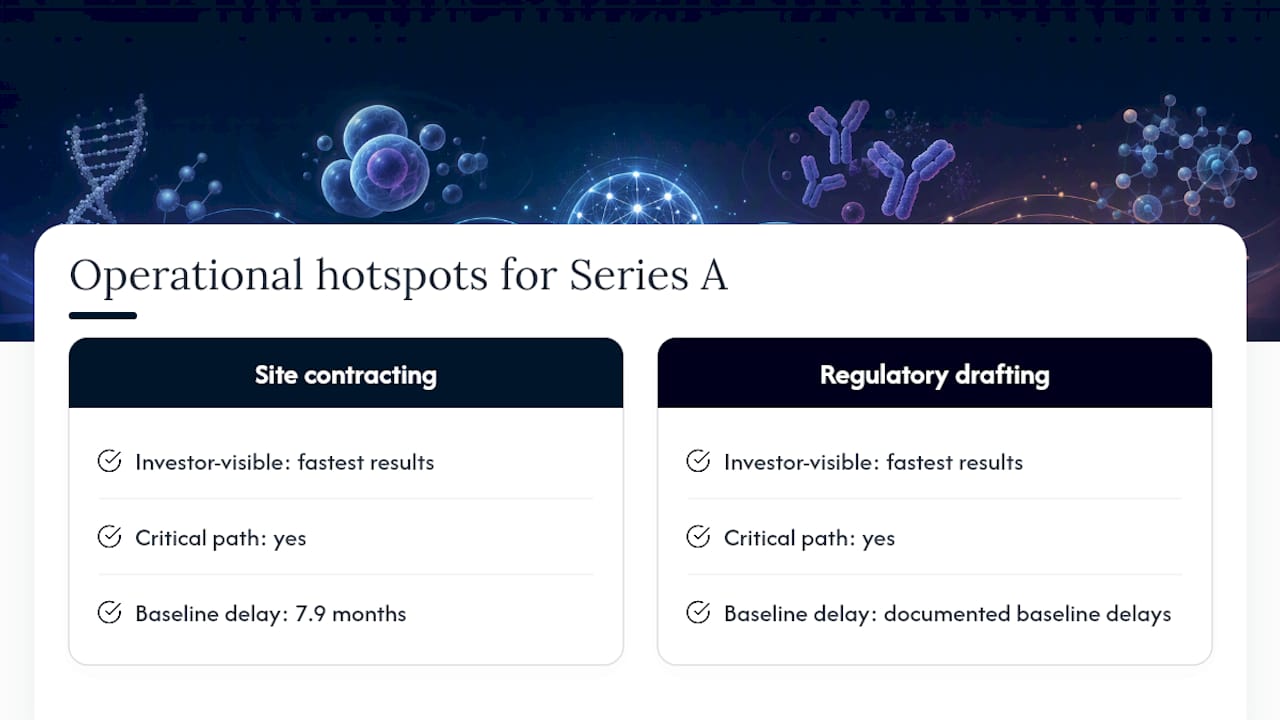
Site activation cycle times lengthened by roughly two months between 2017 and 2023; integrated automation and analytics have case-based evidence of improving on-time activation performance. For a Series A pilot, prioritize site contracting automation and regulatory drafting first. Those two hotspots sit on the critical path and produce the fastest investor-visible KPI improvements.
How do you evaluate and choose an embedded AI operational partner?
Selection checklist:
- Evidence of deployments in regulated (FDA/ICH) settings, with documented audit trails
- Validated model pipelines with a written change-control process
- Single-program accountability (one named ops lead, not a rotating team)
- Client-owned data and models at contract end, not vendor-locked IP
- Measurable outcomes from prior engagements (months reclaimed, amendment rates, site activation times)
Due-diligence questions to ask in vendor calls:
- Can you show us an audit trail from a prior regulated deployment?
- How do you validate model outputs before they touch a submission-critical document?
- Who owns the trained models and workflow configurations at contract end?
- What is your escalation path when a model produces an out-of-range output?
- How do you handle PHI and HIPAA obligations in your data pipelines?
Red flags: no audit trail, one-off scripts rather than governed pipelines, inability to name a prior client outcome with a specific metric, and any claim that their models are "pre-validated" without a written validation plan.
Contract structure: diagnostic fee (fixed scope, 4–8 weeks) → pilot SOW (90 days, defined success gates) → retainer or hosted partnership (ongoing governance and performance monitoring). Require that all data lineage, model weights, and workflow configurations transfer to you at any exit point.
What does the implementation playbook look like phase by phase?
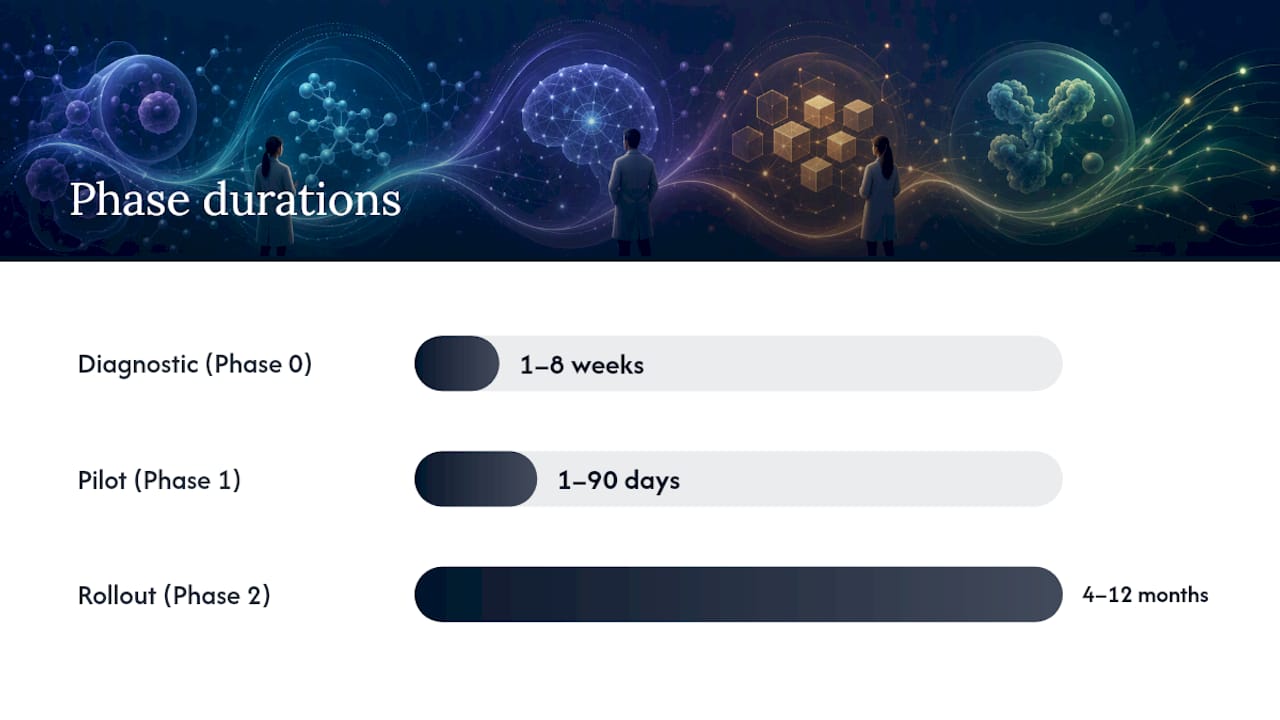
- Phase 0: Diagnostic (weeks 1–8). Map all operational workflows against your IND/first-in-human milestones. Identify the top three bottlenecks by timeline impact. Deliver a prioritized pilot scope, a KPI baseline, and an investor-facing cost/benefit estimate. Stakeholders: CMO, head of regulatory, CFO.
- Phase 1: Pilot (days 1–90). Deploy AI-enabled workflows in two hotspots (typically regulatory drafting and site contracting). Measure cycle time reduction weekly. Validate all model outputs against ICH E6 (R2) controls before any output touches a submission document. Escalation path: ops lead reviews any flagged output within 24 hours.
- Phase 2: Governed rollout (months 4–12). Extend to remaining hotspots. Establish a continuous validation cadence and a change-control log. Train internal teams on governance protocols. Update investor KPI pack quarterly.
| Phase | Owner | Investor KPI updated |
|---|---|---|
| Diagnostic | Embedded ops lead + CMO | Baseline KPI pack delivered |
| Pilot (90 days) | Embedded ops lead + regulatory director | Cycle time, amendment rate |
| Rollout (months 4–12) | Embedded ops lead + CFO | rNPV sensitivity table, time-to-milestone |
Parallel early-phase strategies can protect timelines while U.S. regulatory reviews proceed. Build that optionality into the rollout phase governance plan.
How do you quantify ROI and present it to investors?
The calculation chain is straightforward. Start with the time saved per hotspot (weeks or months). Convert that to a shift in your time-to-milestone input. Run that shift through your rNPV model. Different valuation methods produce materially different values, but real-options approaches best capture the value of timing flexibility, which is exactly what an embedded AI partner delivers.
A conservative scenario: 6 months reclaimed across site activation and regulatory drafting. Against a $200M peak-sales asset with a 15% probability of success and a 10% discount rate, a 6-month forward shift in cash flows produces a meaningful rNPV uplift. Present three scenarios (conservative: 3 months reclaimed; base: 6 months; aggressive: 12 months) in a sensitivity table. VCs expect to see that table. Most Series A decks do not include it, which is an immediate differentiation.
Investor-facing metric: An investor KPI pack should include baseline and target values for site activation cycle time, protocol amendment rate, time-to-IND, data lock latency, and a conservative rNPV sensitivity table showing valuation impact of 3–12 month timeline shifts.
For operational efficiency metrics that attract biotech investors, the KPI pack is the artifact that converts operational progress into funding momentum.
What compliance and data governance controls do you need?
Regulatory alignment checklist for any AI-enabled workflow touching submission-critical documents:
- Document control: every AI-generated output versioned and timestamped in a validated repository
- Audit trail: full lineage from input data to output document, inspectable by FDA
- Model validation plan: written, aligned to ICH E6 (R2), covering training data, performance thresholds, and revalidation triggers
- Change control: any model update triggers a documented review before deployment
- PHI handling: all pipelines processing patient-identifiable data must meet HIPAA requirements; synthetic data used for model training must be documented as such
- Access controls: role-based, with a log of every human intervention in an AI-governed workflow
Contractual warranties to require: the vendor warrants that all pipelines meet your validation plan, indemnifies you for inspection findings caused by their model outputs, and commits to a defined inspection-readiness support obligation.
Pro Tip: Require a written data governance plan before signing any pilot SOW. If a vendor cannot produce one in the sales process, they will not produce one under time pressure during a trial.
Laboratory quality control best practices apply the same governance logic to CMC workflows. The principle is identical: validated processes, documented deviations, and auditable records.
What does a Haiphai engagement actually deliver?
A mid-stage U.S. biotech engaged Haiphai with a single program in IND-enabling activities and a 14-month runway to a Series A close. The diagnostic (6 weeks) identified three critical-path bottlenecks: fragmented regulatory drafting across three file-sharing platforms, a site contracting process with no template library, and a CMC timeline misaligned to the intended first-in-human study date.
The 90-day pilot deployed AI-governed regulatory drafting workflows and a site contracting automation layer. Governance controls were aligned to ICH E6 (R2) from Day 1.
Measured outcomes from the pilot: Site contracting cycle time dropped from an average of 6.2 months to under 8 weeks. Regulatory drafting cycle time for IND sections fell by more than half. The team entered Series A diligence with a clean, audit-ready IND file and an investor KPI pack showing a projected 9-month compression in time-to-first-in-human. The company's lead investor cited operational maturity as a key factor in the term sheet.
For more on how AI adoption signals maturity to investors, see why AI adoption signals biotech startup maturity.
What should senior ops leaders decide this quarter?
Commission a diagnostic now if any one of these is true: your runway is under 18 months, your site activation cycle time exceeds 90 days, or your regulatory workspace is fragmented across unvalidated file-sharing tools. Any single trigger is sufficient.
Three decision triggers for this quarter:
- Runway pressure: Under 18 months to Series A close means every week of operational delay is a week of negotiating leverage lost.
- Slow site activation: A contracting process averaging more than 4 months is a fixable problem, not a structural one. Fix it before your first site activation, not after.
- Fragmented regulatory workspace: If your IND files live in three places and no one person can produce a clean audit trail in under 48 hours, you have submission debt that will surface at the worst possible moment.
The single prioritized next step: commission a 4–8 week diagnostic that produces a prioritized pilot scope, a KPI baseline, and an investor-facing cost/benefit estimate. That document is the artifact that moves your board from "we should look at AI" to "we have a plan."
Haiphai's diagnostic offer for biotech teams
Reclaiming 9–18 months of operational time is not a promise Haiphai makes in the abstract. It is the output of a structured diagnostic that maps your specific bottlenecks, builds a governed AI workflow for the two or three highest-impact hotspots, and produces an investor-facing KPI pack your lead investor can evaluate on the first call.
The diagnostic runs 4–8 weeks. Deliverables: a prioritized pilot scope, a KPI baseline with target ranges, a cost/benefit estimate, and a governance framework aligned to ICH E6 (R2). The pilot that follows is a fixed 90-day SOW with defined success gates. You own all data, models, and workflow configurations at every exit point.
Request a diagnostic through Haiphai's services page or review the full solution overview at Haiphai solutions. Expect a response within one business day and a scoping call within the week.
Sources
- You Just Secured $50 Million. Now On To The Hard Part: Clinical Trials
- Study on clinical trial start-up delays (PMC)
- Biotech asset valuation methods (rNPV, VC, real options) — Analysis Group
- Valuing biopharmaceutical development with decision-tree and real-options approaches (NYU Stern paper)
- Navigating IND delays: strategic options for early-phase biotech development (DrugTargetReview)
This article is general information, not a substitute for advice from a qualified financial advisor. Consult a qualified financial professional about your own circumstances before acting on anything here.
FAQ
What is an embedded AI operational partnership in biotech?
It is a structured engagement where an external ops team diagnoses your workflow bottlenecks, builds and governs AI-enabled processes tailored to your program, and holds accountability for measurable outcomes, unlike a software license you configure yourself.
How long does a Series A readiness diagnostic take?
A diagnostic typically runs 4–8 weeks and delivers a prioritized pilot scope, a KPI baseline, and an investor-facing cost/benefit estimate.
Which operational hotspots deliver the fastest Series A KPI improvements?
Site contracting automation and regulatory drafting workflows produce the fastest investor-visible results because both sit on the critical path and have documented baseline delays, with US site contract execution averaging 7.9 months before automation.
How do you convert time savings into a valuation argument for VCs?
Model the time saved as a forward shift in your time-to-milestone input, run it through an rNPV or real-options framework across three scenarios (3, 6, and 12 months reclaimed), and present the resulting valuation range in a sensitivity table.
What governance controls does an AI partner need to satisfy FDA and ICH E6 (R2)?
At minimum: a written model validation plan, a full audit trail from input to output, document version control, role-based access logs, a change-control process for model updates, and HIPAA-compliant PHI handling in all data pipelines.