
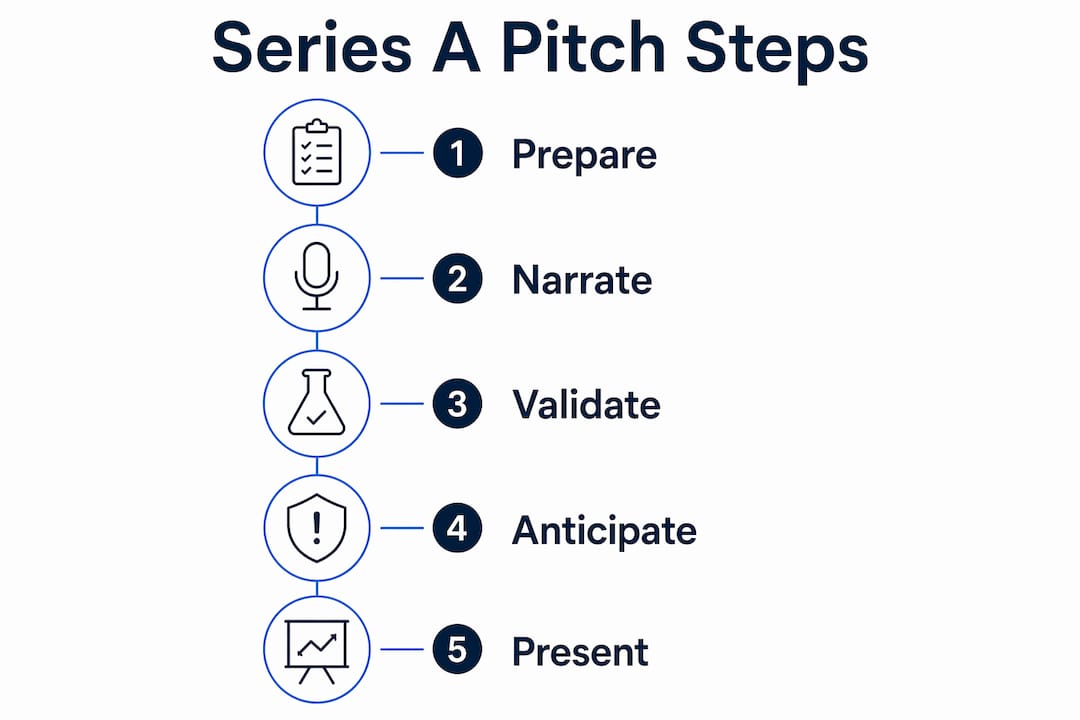
A successful biotech Series A pitch is defined by one thing: translating complex science into a clear investment narrative that shows investors exactly where their capital reduces risk and creates value. By 2026, the bar for Series A readiness has risen sharply. Investors now expect finished IND-enabling toxicology, validated regulatory pathways, and market evidence that goes well beyond preclinical proof of concept. Founders who prepare biotech Series A pitch materials without this foundation lose meetings before the first slide lands. The good news is that preparation is a process you can architect, and this guide walks you through every step.
What are the essential components of a biotech Series A pitch deck?
A biotech Series A pitch deck is a meeting-generation tool, not a scientific report. Its job is to earn a second conversation, not to answer every question an investor might ever ask. Only 58% of investors view a deck through to completion, which means your most critical information must appear early and clearly.
The right length and structure
The standard deck runs 13–15 core slides, built for a 20–30 minute presentation. Every slide earns its place by advancing the investment logic. The slides that matter most at Series A are:
- Problem statement: Lead with the clinical problem and its human and economic impact. Investors need to understand why the problem matters before they assess your technology.
- Solution: Describe your mechanism clearly, but save deep scientific detail for the appendix.
- Market opportunity: Show total addressable market with reimbursement context, not just patient population estimates.
- Regulatory pathway: Demonstrate pre-IND FDA engagement or equivalent. Investors read this slide as a proxy for execution credibility.
- Competitive differentiation: Name the clinical gap your asset fills, not just the scientific novelty.
- Milestone roadmap: Tie every development phase to a value inflection point.
- Team credentials: Show that your leadership can manage scientific risk, regulatory affairs, and capital efficiency together.
- Use of funds: Break every dollar down by named milestone, not by operating expense category.
Pro Tip: Place all heavy scientific data, financial models, and manufacturing details in an audit-ready data room. The deck opens the door; the data room closes the deal.
Science in the appendix, not the body
Detailed scientific and financial data belong in a structured data room for due diligence, not in your core slides. Founders who load slides with assay data and mechanism diagrams signal that they do not yet understand what investors are buying. Investors are buying a probability-adjusted return, not a research program.
The market validation slide deserves special attention. Commercial relevance means showing payer dynamics, competitive reimbursement rates, and patient access pathways. Lab data alone does not constitute market validation at Series A.
How to architect your investment narrative before pitching
Investment architecture is the strategic work that happens before any slide is designed. It is the process of building a coherent investment thesis, a milestone map, and a set of exit scenarios that make your capital ask feel inevitable rather than arbitrary.

Founders should begin this process 4–6 months before their first institutional investor meetings. Narrative development alone takes weeks. Rushing it produces decks that feel disconnected from the underlying science and business logic.
Four steps to build your investment architecture
-
Map milestones to value inflection points. List every development event in the next 24–36 months. Then identify which events reduce investor-perceived risk. Phase I safety readout, IND clearance, and first patient enrollment each represent distinct inflection points. Your capital ask should fund the path from your current position to the next major inflection point, not to a vague operational runway.
-
Define exit scenarios with specificity. Name the categories of potential acquirers and the strategic rationale each would have for acquiring your asset. Investors think about exits from the first meeting. Founders who have thought about it too signal commercial maturity.
-
Frame capital as a probability purchase. Investors prioritize investment logic that proves capital achieves specific risk reduction milestones rather than just funding research activities. Reframe your ask accordingly. "This $18 million funds our Phase I safety readout and IND package" is a probability purchase. "This $18 million covers 18 months of operations" is not.
-
Translate science into investor language. Every scientific claim in your narrative needs a commercial or regulatory translation. "Novel mechanism of action" becomes "first-in-class asset with no approved competitor in this indication." Practice this translation until it is automatic.
| Narrative element | Investor reads it as |
|---|---|
| IND clearance milestone | Regulatory execution credibility |
| Phase I safety readout | De-risked asset, higher valuation floor |
| Named exit acquirer categories | Commercial awareness, realistic return thesis |
| Dollar-to-milestone breakdown | Capital discipline, management quality |
Pro Tip: Record yourself explaining your investment thesis in plain language to someone outside biotech. If they cannot follow the logic in under three minutes, your narrative needs more work before you sit across from an investor.
What common mistakes should founders avoid when pitching?
The most damaging mistakes in biotech investor presentations are structural, not scientific. They reflect a mismatch between what founders find compelling and what investors need to evaluate.
- Leading with science instead of the clinical problem. Focusing first on science risks investor disengagement. Investors need to feel the weight of the unmet need before they can appreciate your solution. Open with the patient burden and the economic cost of the problem.
- Overloading slides with technical data. Dense slides signal poor communication skills, not scientific rigor. Move mechanism diagrams, preclinical data tables, and pharmacokinetic curves to the appendix.
- Generic capital requests. Linking every dollar to named inflection points shows disciplined capital efficiency. A generic operating expense ask does the opposite. It tells investors you have not thought carefully about how their money creates value.
- Underestimating the team slide. Investors evaluate leadership's ability to navigate scientific risk, regulatory processes, and capital efficiency. A team slide that lists academic credentials without showing operational and regulatory experience misses the point entirely. Show that your team has done this before, or that you have recruited people who have.
- Arriving unprepared for hard questions. Founders who stumble on regulatory strategy or competitive landscape questions lose credibility that is very difficult to recover in the same meeting.
"The pitch deck's purpose is to generate meeting requests. Detailed scientific and financial data belong in an audit-ready data room, keeping the presentation lean and focused."
Pro Tip: Have a colleague who is not a scientist read your deck cold. Every slide they find confusing is a slide that will lose an investor.
How to handle tough investor questions during your Series A pitch
Investor Q&A is where Series A pitches are won or lost. Founders who answer hard questions with confidence and specificity close more meetings than those who deliver polished slides but stumble when pressed.
Preparing robust answers to tough investor questions and placing them in a pre-built appendix is one of the highest-return preparation activities you can do. The appendix gives you a credible place to point when a question goes deep, without derailing the main presentation.
The hardest questions investors ask
-
"Why hasn't anyone else done this?" Prepare a clear answer that covers the scientific barrier that existed before your approach, the regulatory or manufacturing challenge that blocked others, and why your team is positioned to clear it now.
-
"What happens if Phase II data is inconclusive?" Investors expect contingency thinking. Name your go/no-go criteria, your alternative development paths, and the asset's value even in a partial success scenario.
-
"Who are your real competitors?" Generic answers destroy credibility here. Know the clinical stage of every competing asset, its mechanism, and its differentiation from yours.
-
"How did you arrive at this valuation?" Tie your answer to comparable transactions, milestone-adjusted probability of success, and the capital efficiency of your development plan.
-
"What does your regulatory path look like if the FDA pushes back?" Show that you have thought through alternative endpoints, adaptive trial designs, and precedent from similar programs.
The best preparation method is a structured mock Q&A with advisors who have sat on both sides of the table. Use their feedback to sharpen your answers, then build the refined versions into your appendix. Strong biotech decks include clear timelines with contingency plans and risk mitigations that answer these questions before investors even ask them.
Practice plain-language explanations of your competitive landscape. Investors are not scientists. They evaluate competitive risk through the lens of capital exposure, not mechanism novelty.
Key Takeaways
A winning biotech Series A pitch is built on a milestone-linked investment narrative, a lean deck that earns meetings, and a founder team that answers hard questions with the confidence of people who have already thought through every risk.
| Point | Details |
|---|---|
| Start architecture early | Begin building your investment narrative and milestone map 4–6 months before investor meetings. |
| Keep the deck lean | Limit your core deck to 13–15 slides and move all technical depth to a data room. |
| Link capital to milestones | Break every dollar of your ask down by named development inflection point, not operating expense. |
| Lead with the clinical problem | Open with patient burden and economic impact before describing your science or technology. |
| Prepare your appendix | Build pre-written answers to the hardest investor questions and reference them confidently in Q&A. |
What I have learned from watching founders pitch biotech Series A rounds
The founders who close Series A rounds fastest share one habit: they treat the pitch as a product, not a presentation. They iterate on it the way they iterate on their science. They test it on advisors, revise it based on feedback, and arrive at investor meetings with a version that has already survived dozens of hard questions.
The biggest gap I see is between scientific credibility and commercial storytelling. Founders with genuinely differentiated assets lose meetings because they cannot explain why their asset matters to a payer, an acquirer, or a patient population in plain language. The science is real. The story is missing.
The team slide is the most underinvested slide in most decks I have reviewed. Founders list publications and degrees when investors want to see regulatory navigation experience, capital allocation track records, and the specific operational skills that will get this asset from IND to Phase II readout without burning through the raise. If your team has gaps, name them and name your plan to fill them. Investors respect self-awareness far more than they respect an incomplete team that pretends otherwise.
Start earlier than you think you need to. Four to six months feels like a long runway until you are three weeks from your first LP meeting and your narrative still does not hold together. The founders who build their pitch around AI-augmented operations and clear milestone logic close faster and at better terms. That is not a coincidence.
— John
How Haiphai helps biotech founders get investor-ready
Preparing a Series A pitch while running a clinical-stage program is one of the hardest operational challenges in biotech. Haiphai works directly with life sciences teams to map milestones, identify operational bottlenecks, and build the kind of investor-ready narrative that holds up under due diligence.
Haiphai's approach starts from your strategic goals and works backward to identify where timelines are at risk and where capital efficiency can be demonstrated most clearly. Founders who work with Haiphai have reclaimed up to 18 months of operational time on their path to approval, a number that shows up directly in valuation conversations. Explore Haiphai's pitch preparation solutions and consulting services to see how the process works for your program.
FAQ
What is biotech pitch deck preparation?
Biotech pitch deck preparation is the process of building a 13–15 slide investor presentation that translates your science into a milestone-linked investment narrative. The goal is to generate investor meetings, not to deliver a comprehensive scientific report.
How early should I start preparing my Series A pitch?
Founders should begin investment architecture, including milestone mapping and exit scenario planning, 4–6 months before first institutional investor meetings. Narrative development takes weeks before slide design begins.
What do biotech Series A investors look for in 2026?
By 2026, Series A investors expect completed IND-enabling toxicology, pre-IND FDA engagement, and market validation that goes beyond lab data. Generic preclinical proof of concept no longer meets the threshold for institutional Series A capital.
How should I frame my capital ask in a biotech pitch?
Link every dollar to a named development milestone rather than to operating expense categories. Investors evaluate capital asks as a measure of management discipline and risk reduction logic.
What goes in the appendix of a biotech pitch deck?
The appendix should contain detailed scientific data, financial models, manufacturing information, and pre-written answers to the hardest investor questions. It keeps the core deck lean while giving you credible depth to reference during Q&A.