
AI adoption in biotech startups is a direct indicator of operational maturity, not a marketing claim. Why AI adoption signals biotech startup maturity matters to every founder raising capital in 2026, because investors now read your AI integration as a proxy for execution discipline, data strategy, and capital efficiency. The startups pulling ahead are not the ones with the best AI demo. They are the ones where AI is woven into wet-lab workflows, regulatory processes, and discovery cycles. This article breaks down exactly what that looks like and why it changes how you should build, communicate, and compete.
Why AI adoption signals biotech startup maturity in 2026
AI adoption in life sciences has crossed from differentiator to baseline expectation. The industry term for what investors now evaluate is operational maturity, and AI integration is one of its clearest visible markers. A startup that uses AI only for slide deck narratives reads as early-stage. A startup where AI drives measurable cycle compression reads as fundable.
The Pfizer and Chai Discovery partnership is the clearest recent proof point. The Chai-3 AI model doubles antibody design success rates and compresses discovery loops from months to weeks. That is not a platform demo. That is AI embedded inside a validated, commercially licensed workflow.
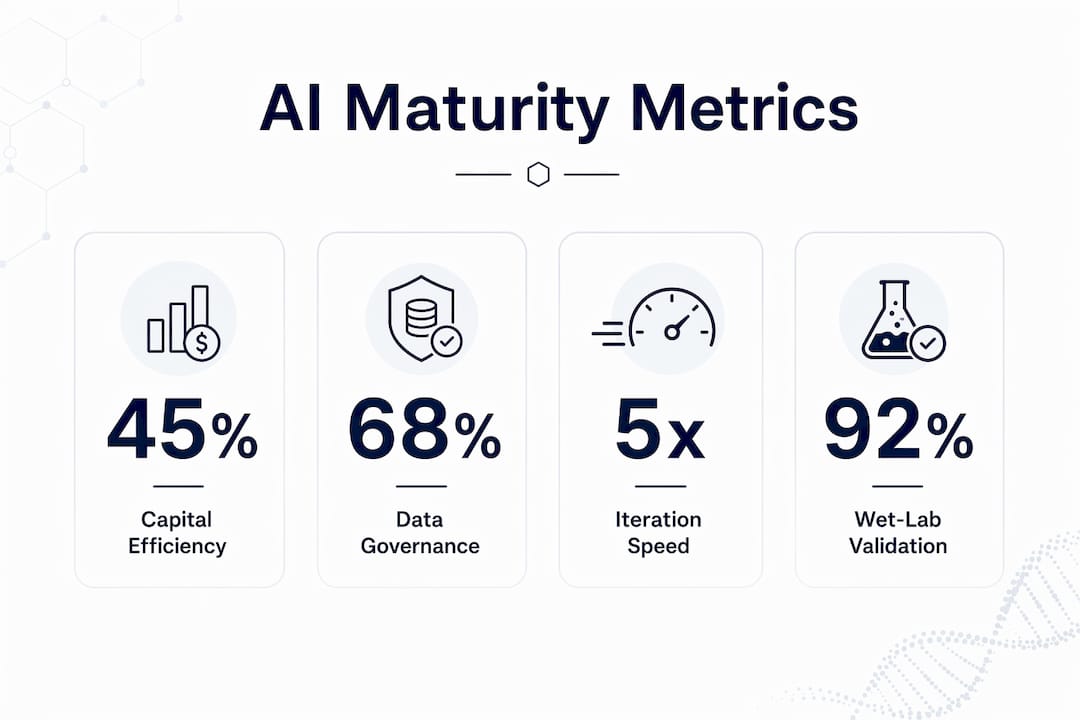
Four dimensions define AI-linked maturity in biotech startups:
- Capital efficiency. Investors now demand a verified cost-per-IND well below industry benchmarks. AI that reduces cost-per-IND trajectory is a direct risk-reduction signal.
- Closed-loop wet-lab validation. AI predictions tested in the lab, then used to retrain models, create a feedback loop that compounds over time. Startups without this loop risk losing investor confidence within 12 months.
- Proprietary data moats. Generic AI tools run on generic data. Mature startups build biology-native datasets that competitors cannot replicate.
- Workflow integration. AI embedded across R&D and operations, not siloed in one team, signals that the technology is infrastructure rather than experiment.
Pro Tip: When preparing your investor deck, map each AI use case to a specific operational metric: cycle time, cost-per-IND, or hit rate. Vague claims about "AI-powered discovery" no longer move sophisticated investors.
How does AI adoption shift investor expectations in 2026?
Investor mindset has shifted decisively. The "AI-first" narrative that attracted seed capital in 2022 and 2023 is now a liability if it is not backed by execution evidence. Investors now prioritize companies with clear biological problems and credible translational strategies over generic AI platform plays.
The shift breaks down into three concrete changes in how deals get evaluated:
- Execution speed relative to biological bottlenecks. Can your AI actually compress the timeline between hypothesis and validated hit? Investors want to see this demonstrated, not projected.
- Data defensibility. Who owns the data your AI trains on? Is it proprietary, harmonized, and biology-native? A startup that licenses third-party datasets has a weaker moat than one that generates its own.
- Transparent risk communication. Honest disclosure of AI risks improves investor trust. Founders who acknowledge where AI falls short are perceived as more mature than those who oversell.
"Investors now value defined biological problem solving over AI hype, focusing on realistic, executable development pathways." — Labiotech, 2026
The cost-per-IND metric deserves special attention. It functions as a capital efficiency yardstick that lets investors compare startups across therapeutic areas. A startup that can show a declining cost-per-IND trajectory, driven by AI-accelerated iteration, is telling a fundamentally different financial story than one projecting future savings.
External validation also matters. Partnerships with established pharma companies, like the Pfizer and Chai Discovery agreement, serve as third-party endorsements of your AI's real-world utility. They signal that your technology has cleared a rigorous commercial bar, not just an internal one.
Why AI alone no longer guarantees competitive advantage
AI commoditization is real and accelerating. AI accelerates hypothesis generation but does not replace the complexity of clinical trials and regulatory compliance. Those remain the true bottlenecks, and they are where competitive advantage now lives.
Here is what the commoditization shift means in practice:
- Discovery tools are becoming standard. Protein folding prediction, generative chemistry, and target identification tools are widely available. Using them no longer sets you apart.
- Platform proliferation erodes moats. When every startup claims an "AI platform," the term loses signal value. Investors discount it accordingly.
- Value migrates downstream. Clinical validation, trial management, and regulatory navigation are where AI-enabled startups now differentiate. These are harder to replicate than a discovery algorithm.
- Operational excellence becomes the marker. Speed and execution quality in moving from discovery to IND filing separate mature startups from the rest.
Pro Tip: Reframe your competitive narrative around clinical execution speed and regulatory pathway clarity, not discovery capability. Those are the bottlenecks AI has not yet commoditized.
AI tools have become infrastructure, meaning mature startups use them as components in a broader operational strategy. The startups that treat AI as the product will struggle. The ones that treat AI as the engine behind a validated clinical asset will win.
Scaling AI in biotech also requires integrating outputs with human-driven processes. Regulatory workflows and clinical trial management remain largely human-driven. A mature startup builds the connective tissue between AI outputs and those human processes. That integration work is unglamorous, but it is where real operational maturity shows up.
How do mature biotech startups embed AI across research and operations?
Practical AI integration in mature biotech startups follows a recognizable pattern. It starts with data infrastructure and extends through every stage of the discovery-to-validation pipeline.

Biology-native data infrastructure
68% of industry leaders cite poor data governance as the primary failure point in AI adoption. Mature companies build biology-native data infrastructure where data is contextually valid, harmonized, and collected at scale. This is not a technology problem. It is a strategic commitment to treating data as a core asset from day one.
The practical implication: every experiment should generate structured, labeled data that feeds back into your AI models. Startups that run experiments without capturing data in a reusable format are burning potential competitive advantage.
Lab automation and iteration speed
Five design-test-analyze cycles completed by AI-enabled labs versus one cycle by competitors creates a structural advantage that compounds over time. Lab workflow automation platforms make this iteration speed achievable without proportional headcount growth.
The comparison below shows how AI integration changes the operational profile of a biotech startup:
| Capability | Early-Stage Startup | Mature AI-Integrated Startup |
|---|---|---|
| Discovery cycle length | Months to years | Weeks to months |
| Data governance | Ad hoc, siloed | Biology-native, harmonized |
| Wet-lab feedback loop | Manual, slow | Automated, continuous |
| Regulatory workflow | Reactive | AI-assisted, proactive |
| Investor narrative | AI platform claims | Validated asset + cost-per-IND data |
Mature startups also invest in regulatory and compliance infrastructure that connects AI outputs to submission-ready documentation. This is where AI adoption in life sciences translates directly into timeline compression and valuation impact.
- Build your data pipeline before you scale your model library.
- Prioritize closed-loop validation: every AI prediction should have a defined wet-lab test and a data capture protocol.
- Connect AI outputs to regulatory workflows early, not as an afterthought before IND filing.
- Use external partnerships to validate AI performance against independent biological benchmarks.
Proprietary data and validated feedback loops are the assets that sustain competitive differentiation as AI discovery tools become commodities. The startups building those assets now are the ones that will be fundable and acquirable in the next cycle.
Key takeaways
AI adoption signals biotech startup maturity when it is embedded in validated workflows, proprietary data infrastructure, and measurable capital efficiency metrics, not just discovery demos.
| Point | Details |
|---|---|
| Capital efficiency is the investor yardstick | Show a declining cost-per-IND trajectory driven by AI to lower perceived risk. |
| Closed-loop validation separates mature startups | AI predictions tested in wet labs and used to retrain models signal real operational depth. |
| Data moats outlast algorithm moats | Biology-native, proprietary datasets are harder to replicate than any off-the-shelf AI tool. |
| AI commoditization shifts value downstream | Competitive advantage now lives in clinical execution and regulatory navigation, not discovery. |
| Transparent risk communication builds trust | Founders who honestly disclose AI limitations are perceived as more credible by sophisticated investors. |
The uncomfortable truth about AI maturity in biotech
I have watched founders spend 18 months building AI platforms that investors ultimately dismissed in a 20-minute meeting. The pattern is consistent. The platform is technically impressive. The data story is thin. The wet-lab validation is pending. The regulatory path is vague.
The uncomfortable truth is that AI maturity in biotech is not about the sophistication of your models. It is about the discipline of your operations. The founders who get this right are the ones who treat every experiment as a data asset, every AI output as a hypothesis to be tested, and every investor conversation as a moment to demonstrate execution credibility rather than technological ambition.
I have also seen the opposite. Startups with modest AI capabilities but exceptional data governance and tight discovery-to-IND workflows that close Series B rounds faster than their more technically sophisticated peers. The difference is always operational rigor, not algorithmic novelty.
The 2026 investor environment rewards founders who can say: "Here is our cost-per-IND. Here is how AI reduced it. Here is the wet-lab data that validates our last three predictions." That conversation is worth more than any platform demo.
Founders who want to lead in the next cycle need to stop asking "How do we add AI?" and start asking "Where does AI make our execution measurably faster and cheaper?" That reframe is the difference between a startup that uses AI and a startup that has matured through it.
— John
How Haiphai helps biotech startups build real AI maturity
Operational inefficiencies in biotech do not just slow you down. They destroy valuation and erode investor confidence at exactly the wrong moments.
Haiphai works as an operational partner for life sciences teams, starting from your strategic goals and working backward to identify where timelines are bleeding. The focus is on processes like regulatory drafting and clinical site activation, where AI integration delivers the most measurable time savings. Clients reclaim up to 18 months of operational time on their path to approval. That kind of timeline compression directly impacts your funding position and company valuation. If you are ready to move from AI experimentation to AI fluency for biotech, Haiphai is built for exactly that transition.
FAQ
What does AI adoption signal to biotech investors?
AI adoption signals operational maturity when it is backed by wet-lab validation, proprietary data, and a measurable cost-per-IND trajectory. Investors treat it as a proxy for execution discipline, not just technological ambition.
How does AI impact biotech startup valuation?
AI that compresses discovery cycles and reduces cost-per-IND directly improves valuation by lowering development risk and demonstrating capital efficiency. Startups with validated AI-driven workflows attract higher valuations than those with AI platform claims alone.
What are the key maturity indicators for biotech startups using AI?
The four core indicators are capital efficiency, closed-loop wet-lab validation, biology-native data infrastructure, and AI integration across both R&D and operational workflows. A startup that demonstrates all four is positioned as a mature, fundable asset.
Why is AI alone no longer a competitive moat in biotech?
AI commoditization means discovery tools are now widely available, shifting competitive advantage to clinical execution, trial management, and regulatory navigation. Proprietary data and validated feedback loops are the durable moats.
How can biotech founders communicate AI maturity to investors?
Map each AI use case to a specific operational metric such as cycle time, hit rate, or cost-per-IND, and disclose AI risks transparently. Investors perceive founders who acknowledge limitations as more credible than those who present AI as a guaranteed solution.