
TL;DR:
- Operational efficiency in biotech reflects a company's ability to execute development and commercialization milestones without wasting capital or time. Investors prioritize operational clarity and decision speed to reduce execution risk, especially before regulatory approval. Building integrated systems and governance structures early enhances valuation and attracts funding by demonstrating operational maturity.
Operational efficiency in biotech is defined as a company's ability to execute complex development, regulatory, and commercial milestones without wasting capital or time. Why operational efficiency attracts biotech investors comes down to one core fact: investors cannot afford to fund scientific promise that collapses under poor execution. Investors expect biotech companies to begin critical commercial investment 12–24 months before approval. That timeline means operational clarity must exist long before a product reaches the market. Companies that demonstrate decision velocity, governance accountability, and integrated reporting give investors a measurable signal that their capital will not be consumed by avoidable delays.

Why operational efficiency attracts biotech investors
Operational efficiency is no longer a back-office concern in life sciences. It is a primary filter investors apply when evaluating whether a biotech company can convert scientific progress into commercial returns. The industry term for this evaluation lens is execution risk, and it sits at the center of every serious due diligence process.
Operational efficiency is a core strategic asset critical to capital efficiency and commercial success. That shift in framing matters because it changes what investors look for. A company with a promising Phase III asset but fragmented operational infrastructure carries higher execution risk than a company with a mid-stage asset and a documented, cross-functional decision architecture.
The biotech investment cycle amplifies this dynamic. Capital is deployed years before revenue arrives. Every month of delay in regulatory submission, clinical site activation, or manufacturing scale-up extends the cash burn period. Investors who understand this structure prioritize companies that can demonstrate they will not lose time to internal disorganization.
How do operational bottlenecks delay biotech launches?
An operational bottleneck in biotech is any process failure that slows the movement of a program from one development stage to the next. These bottlenecks are rarely scientific. They are structural.
Operational breakdowns due to organizational design failures are often mistaken for scientific failures during scale-up. That misclassification is expensive. When a company attributes a manufacturing delay to technical complexity rather than unclear ownership or late-stage validation gaps, it misses the real fix and repeats the same failure in the next program.
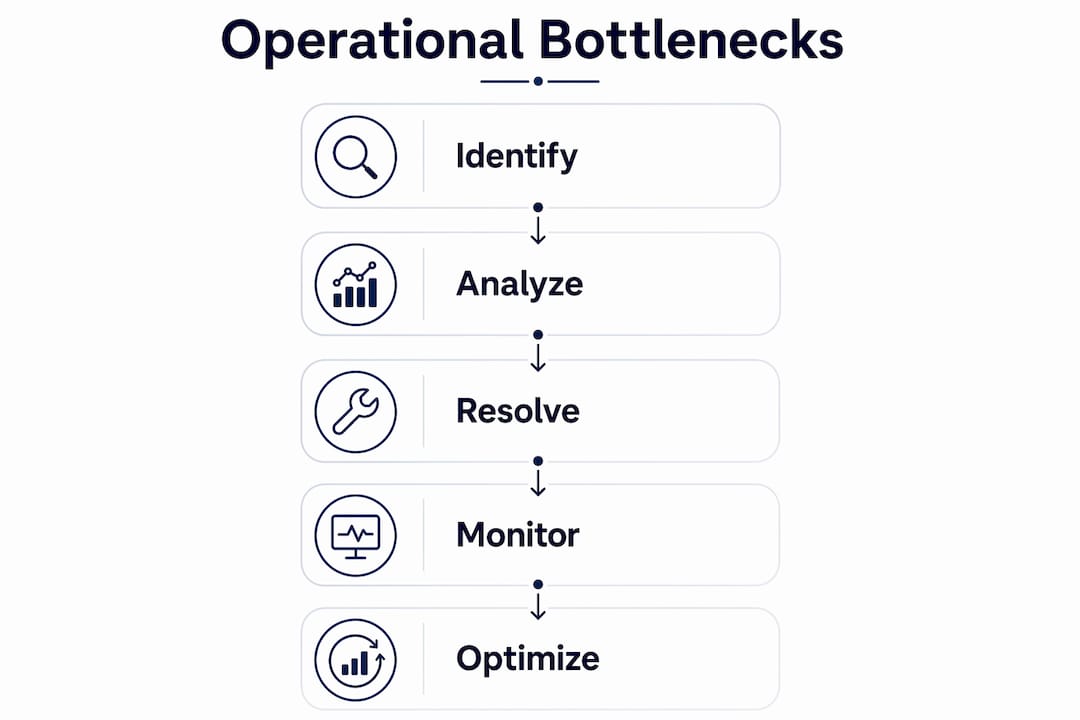
The financial consequences are direct. Poor execution during the launch window can cost a biotech company 30%–50% of its projected launch revenue. That is not a rounding error. For a product with $500 million in peak sales potential, a 40% revenue loss in year one represents a permanent gap in the company's commercial trajectory.
Common operational bottlenecks that drive these losses include:
- Validation delays: Late discovery of manufacturing process gaps that should have been identified during technology transfer
- Siloed teams: Regulatory, clinical, and commercial functions operating without shared timelines or decision triggers
- Manual reporting processes: Finance and operations teams producing burn rate and inventory data on incompatible cycles
- Unclear accountability: No single owner for cross-functional decisions, causing escalation delays at critical junctures
- Supply chain execution gaps: Accurate demand forecasts that fail because distribution and fulfillment infrastructure was not built in parallel
Pro Tip: Map your organization's decision triggers before a launch. Identify who owns each cross-functional call and what data they need to make it. That map is what investors and supply chain partners want to see.
The supply chain point deserves particular emphasis. Decision velocity and execution infrastructure matter more than forecast accuracy for successful product launches. A company can have the most sophisticated demand model in the industry and still fail at launch if its governance structure cannot translate that forecast into timely procurement and distribution decisions.
Why do investors now treat operational efficiency as a strategic asset?
The investor community's evaluation criteria shifted meaningfully after the 2021 biotech funding peak. Capital became more selective. Investors now apply a sharper filter requiring companies to combine scientific innovation with credible operational plans that go beyond capital raising. That filter did not exist at the same intensity during the zero-interest-rate era, when capital chased science regardless of execution readiness.
The practical implication for biotech management teams is significant. Operational maturity must be demonstrated before IPO discussions or commercialization planning begins. The following four capabilities now define what investors consider an operationally mature biotech:
- Integrated systems: Finance, procurement, inventory, and regulatory reporting operating from a single source of truth rather than disconnected spreadsheets
- Cross-functional ownership clarity: Documented accountability for every major decision point across scientific, regulatory, manufacturing, and commercial functions
- Real-time burn rate visibility: Leadership and investors able to access current runway data without waiting for monthly close cycles
- Documented governance forums: Scheduled, structured decision meetings with defined inputs, outputs, and escalation paths
Integrated systems replacing fragmented tools are necessary before a company can credibly pursue IPO or commercialization. The reason is straightforward: investors conducting due diligence need confidence that leadership has real-time visibility into the business. Fragmented tools produce fragmented answers, and fragmented answers destroy investor confidence.
"Operational maturity is not about having the most sophisticated technology. It is about having systems and governance structures that give leadership and investors the same clear picture of where the company stands and where it is going."
Early integration of commercial and operational planning is the single most effective way to build that picture. Companies that wait until Phase III to build their commercial infrastructure consistently face the problem of building launch capabilities entirely at risk. That means spending capital on commercial readiness while simultaneously managing clinical uncertainty, a combination that compresses runway and elevates investor concern.
What operational strategies increase biotech valuation and attract funding?
Biotech companies that attract capital in the current environment share a common operational profile. They have moved beyond ad hoc project management and built repeatable systems for decision-making, reporting, and execution. The gap between a 50-person biotech operating at scale and one that struggles to coordinate across functions is almost always an operational systems gap, not a talent gap.
The most effective biotech operational efficiency strategies include the following:
Early commercial and operational integration: Bring commercial planning into the development process at Phase II, not after Phase III readout. This allows the company to build distribution, reimbursement, and manufacturing scale-up plans in parallel with clinical execution, rather than sequentially.
Real-time financial reporting: Replace monthly close cycles with continuous burn rate and runway visibility. Investors conducting ongoing portfolio monitoring need current data. Companies that can provide it on demand signal operational maturity. Companies that cannot signal risk.
AI augmentation in regulatory affairs: AI in regulatory affairs reduces the time required for submission drafting, gap analysis, and response preparation. Regulatory delays are among the most common and most expensive operational bottlenecks in biotech. Automating the document-intensive portions of regulatory work removes a structural constraint on development speed.
Continuous processing in manufacturing: Batch manufacturing creates natural bottlenecks at every production cycle. Continuous processing technologies remove those bottlenecks by maintaining production flow, reducing validation complexity, and improving yield predictability. For investors, this translates directly into lower cost of goods and more predictable gross margin at launch.
Documented decision frameworks: Build decision architectures that specify who owns each call, what data triggers a decision, and what the escalation path looks like when consensus fails. This is not bureaucracy. It is the operational infrastructure that prevents a single delayed decision from cascading into a multi-month program setback.
Pro Tip: Investors reviewing your data room will look for evidence of decision frameworks, not just financial models. A one-page governance map showing cross-functional ownership is more persuasive than a 50-slide deck.
How can investors evaluate operational efficiency in biotech?
Assessing operational efficiency during due diligence requires a specific set of indicators. Financial models and clinical data tell part of the story. Operational structure tells the rest.
Investors and analysts should look for the following signals of operational strength:
- Decision velocity evidence: Can the management team describe how long it takes to make a cross-functional decision? Do they have examples of decisions made quickly under uncertainty?
- Launch execution infrastructure: Does the company have a documented commercial readiness plan with owners, timelines, and dependencies mapped?
- Burn rate transparency: Can leadership provide current runway data in real time, or does the answer require a finance team preparation cycle?
- Integrated reporting systems: Are finance, operations, and regulatory functions reporting from shared data, or are they reconciling separate spreadsheets before every board meeting?
- Governance forum documentation: Does the company hold structured cross-functional meetings with documented outputs and accountability tracking?
Red flags that signal operational risk include fragmented data systems, unclear ownership of commercial readiness milestones, and manual processes in functions where automation is standard practice. Early-stage biotech failures often stem from the absence of a development roadmap that connects scientific data to commercial and regulatory milestones. Investors who identify this gap early can either price it into their valuation or require a remediation plan before committing capital.
The most underrated due diligence question is also the simplest: ask the management team to walk you through the last major cross-functional decision they made. How long did it take? Who owned it? What data drove it? The quality of that answer tells you more about operational maturity than any financial model.
Key Takeaways
Operational efficiency is the primary execution risk signal that biotech investors use to distinguish fundable companies from scientifically promising but commercially fragile ones.
| Point | Details |
|---|---|
| Investor timing pressure | Commercial investment begins 12–24 months before approval, requiring operational clarity well before launch. |
| Revenue risk from poor execution | Weak execution infrastructure can eliminate 30%–50% of projected launch revenue in the first window. |
| Operational maturity before IPO | Integrated systems across finance, procurement, and regulatory functions are required before commercialization discussions. |
| Decision velocity over forecasting | Governance structures and cross-functional accountability matter more than forecast precision at launch. |
| Due diligence signal | Investors should ask management teams to describe a recent cross-functional decision to assess operational maturity directly. |
The operational clarity gap most investors still miss
I have reviewed a lot of biotech investment materials over the years, and the pattern that stands out most is not scientific risk. It is the gap between what a management team believes their operational infrastructure looks like and what it actually looks like under pressure.
Post-2021, the market corrected for valuation excess. What it has not fully corrected for is the tendency to treat operational failures as scientific ones. Investors still see companies lose programs to unclear ownership, late validation discoveries, and disconnected reporting cycles, and they still sometimes accept the scientific explanation rather than pressing on the organizational one.
The companies that sustain investor confidence through multiple funding rounds share one trait: they built operational clarity before they needed it. They did not wait for a failed launch or a missed milestone to document their governance structure. They built it as a foundation, not a response.
My practical advice for analysts doing due diligence: weight the operational section of your assessment as heavily as the clinical section. Ask for the governance map. Ask who owns the commercial readiness plan. Ask what the burn rate looks like today, not at last month's close. The answers will tell you whether the science has a real chance of becoming a product.
— John
How Haiphai helps biotech teams build investor-ready operations
Biotech companies that want to close the operational clarity gap have a concrete starting point in Haiphai. Haiphai works as an operational partner, beginning from a company's strategic goals and working backward to identify the specific bottlenecks slowing execution.
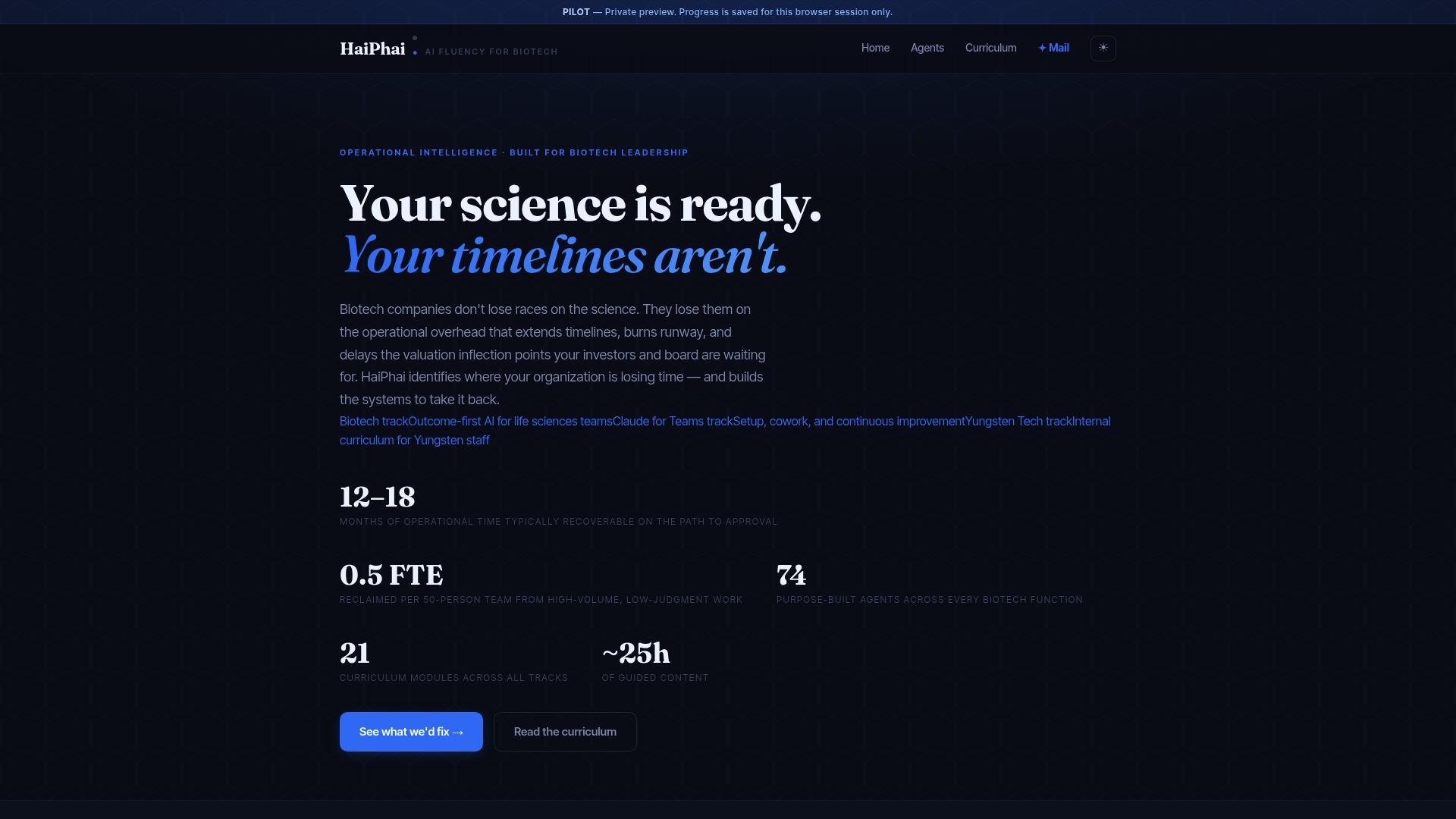
Haiphai's AI-driven approach covers regulatory drafting, clinical site activation, and real-time runway visibility, the exact functions where execution failures most often occur. Clients working with Haiphai have reclaimed up to 18 months of operational time on the path to approval. For a biotech company managing investor expectations and capital runway simultaneously, that time directly translates into valuation. Explore Haiphai's solutions to see how operational clarity becomes a fundable asset.
FAQ
Why does operational efficiency matter to biotech investors?
Operational efficiency signals that a company can execute its development and commercial plan without burning excess capital. Investors use it as a primary measure of execution risk before committing funds.
What is an operational bottleneck in biotech?
An operational bottleneck in biotech is any structural or process failure that slows program progression, such as unclear decision ownership, validation delays, or siloed teams operating without shared timelines.
How does poor execution affect biotech launch revenue?
Weak execution infrastructure can cost a biotech company 30%–50% of its projected launch revenue during the initial commercial window. That loss is rarely recoverable in the same product cycle.
What do investors look for when assessing operational maturity?
Investors look for integrated reporting systems, documented governance forums, real-time burn rate visibility, and cross-functional accountability maps. These signals indicate a company can make fast, informed decisions under pressure.
How early should biotech companies build operational infrastructure?
Commercial and operational planning should begin at Phase II, not after Phase III readout. Building infrastructure earlier prevents the costly scenario of funding commercial readiness while managing active clinical uncertainty.