
TL;DR:
- Board composition significantly influences biotech valuation by improving investor signals and reducing clinical risk. Focusing on strategic director hires and governance KPIs aligned with each clinical stage can accelerate approvals and enhance firm value. Integrating board decisions with operational execution is crucial for maximizing valuation growth.
Board composition materially drives biotech valuation by changing investor signals, reducing clinical risk, and accelerating capital access. Research directly links the presence of medical doctors and scientific experts on boards to higher price-to-book ratios and overall firm value. If you're a biotech executive who hasn't audited your board against your current clinical stage, you're leaving valuation on the table.
Three actions you can take this week:
- Run a board gap audit. Map your current directors' expertise against your stage-critical needs (scientific, regulatory, finance, commercial). Gaps are valuation gaps.
- Prioritize 1–2 targeted director hires. Depending on your stage, that means an MD or PhD scientist pre-IND, a regulatory affairs veteran heading into Phase II/III, or a capital markets specialist pre-IPO.
- Set 3 governance KPIs tied to valuation. Track time-to-IND, capital raised per round, and meeting attendance. These are the metrics investors actually notice.
Table of Contents
- What does the research say about board composition and valuation?
- Who should be on your board at each clinical stage?
- What governance trade-offs can hurt your valuation?
- How do you build a measurable board optimization framework?
- How do board decisions translate into faster approvals and higher valuation?
- Key Takeaways
- The case for treating board and operations as one system
- Haiphai accelerates what your board sets in motion
- FAQ
What does the research say about board composition and valuation?
The empirical case is clear. Scientific and financial expertise on biotech boards correlates positively with price-to-book ratios and firm value, and board human capital — scientific credentials, industry experience, and financial acumen — links to higher R&D expenditures and patent generation. Two governance theories explain why.
Agency theory frames the board as a monitoring body. Independent directors reduce information asymmetry between management and investors, and well-structured audit and compensation committees signal disciplined oversight. That signal matters to institutional investors pricing your stock.
Resource dependence theory frames the board as a resource provider. Directors open doors: fundraising relationships, licensing partners, FDA advisory contacts, and commercial co-development networks. A board member who has navigated a BLA submission or closed a $200M Series C isn't just credible on paper — they're a direct operational asset.
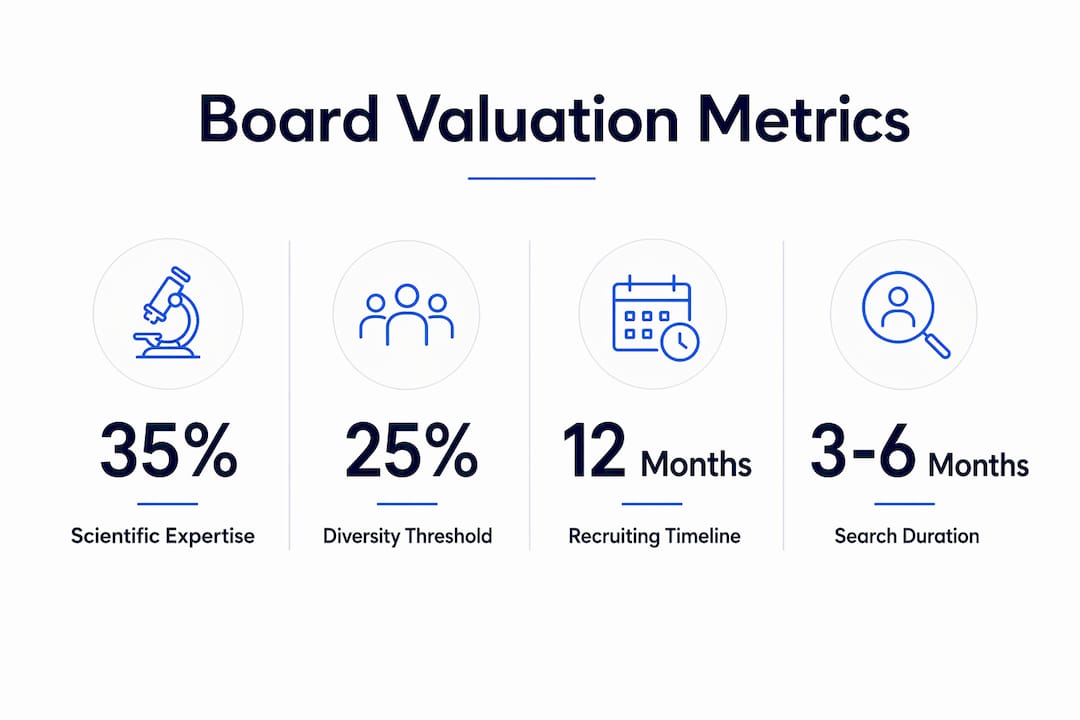
Boards that reach a critical mass of diverse members — roughly one-fifth to nearly one-third representation — show a shift from neutral or negative performance effects to measurably positive ones for firm performance.
On diversity specifically: the research identifies an inflection point. Below that threshold, heterogeneous boards can slow deliberation and create friction; above it, diverse perspectives improve decision quality and investor signaling. The interaction with high R&D spending is worth watching — diversity adds value, but it must be aligned with your operational tempo, not imposed on it.
A composite Board Structure Index (BSI) — combining independence, diversity, and power distribution — correlates with better net profit margins, particularly for larger firms. Single-point compliance metrics (e.g., "we have two independent directors") miss the picture entirely.
Who should be on your board at each clinical stage?
Board needs aren't static. The optimal mix for a preclinical-stage company looks nothing like what you need heading into a pivotal Phase III readout.

| Stage | Primary Board Roles | Why It Matters for Valuation | Key KPI |
|---|---|---|---|
| Preclinical | Scientific/clinical experts, IP/legal | Validates scientific credibility; attracts seed and Series A capital | Patent filings, R&D spend efficiency |
| IND/Phase I–II | Regulatory affairs, clinical ops | Reduces CRL risk; shortens review cycles | Time-to-IND, protocol approval speed |
| Phase III | Finance/IR, commercial strategy | Signals commercial readiness to institutional investors | Capital raised, partnering speed |
| Pre-commercial/IPO | Capital markets, commercial, legal | Directly affects IPO pricing and post-listing performance | Price-to-book proxy, IPO underpricing |
A study of 360 biotech IPOs found that accumulated public-company board experience improves IPO performance, while current heavy board appointments can actually be a liability. The distinction matters: past experience signals credibility; overcommitted directors signal risk.
Stage-specific hiring priorities include expertise such as peptide lead optimisation explained for scientists essential for early-stage scientific credibility.
- Preclinical: Lead with scientific credibility. An MD or PhD with published work in your therapeutic area validates the science before investors have clinical data to evaluate.
- IND/Phase I–III: Add a regulatory expert with FDA submission experience. Boards with this expertise produce shorter review cycles and fewer complete response letters.
- Pre-commercial: Bring in a commercial leader or payer-access specialist. Investors price in commercial probability of success well before launch.
- Pre-IPO: Geographic representation matters here. U.S.-listed companies benefit from directors with domestic institutional investor relationships; ex-U.S. directors add value when your market access strategy is global.
Pro Tip: When evaluating director candidates for early-stage boards, ask specifically about their active engagement in prior board roles — not just their titles. A director who chaired a science committee through an IND filing is worth more than one who attended quarterly meetings at a large-cap pharma.
What governance trade-offs can hurt your valuation?
Prestige is not governance. Excessive focus on reputation capital produces boards that look impressive on a pitch deck but underdeliver on active oversight. Directors sitting on multiple active public boards often lack the bandwidth for intensive engagement during critical periods — Phase III readouts, regulatory filings, or financing rounds.
Red flags to monitor during board reviews:
- Directors with more than 3–4 active public board seats during a critical clinical phase
- Homogenous industry experience with no cross-functional depth (e.g., all pharma operations, no finance or regulatory)
- Committees that exist on paper but meet infrequently or lack domain expertise
- Founder-heavy boards with no independent directors on audit or compensation committees
The founder/management balance question is real. Founders bring institutional knowledge and mission alignment, but boards without sufficient independence signal governance risk to investors and can inflate agency costs. The audit committee, in particular, needs genuine independence and financial expertise — not just a friendly face.
Heterogeneous boards can form in-group and out-group dynamics that slow decision-making. That's not an argument against diversity; it's an argument for intentional composition. Recruit for cognitive diversity — varied backgrounds, disciplines, and problem-solving styles — not just demographic checkboxes.
How do you build a measurable board optimization framework?
Treat board composition as a repeatable process, not a one-time event. Board composition should be explicitly re-assessed at every major inflection point: IND filing, pivotal Phase III readout, pre-IPO.
Step-by-step framework:
- Board gap audit. Map current directors against a stage-specific competency matrix. Identify gaps in scientific, regulatory, financial, and commercial expertise.
- Recruiting brief. Define the 2–3 non-negotiable criteria for each open seat. Use executive search firms for pre-IPO or large-board recruitment; professional networks work for early-stage.
- Onboarding and KPI assignment. Every new director gets a 90-day onboarding plan and at least one measurable KPI tied to their expertise area.
- Quarterly valuation impact review. Track governance KPIs alongside financial metrics. Dynamic, stage-sensitive KPIs outperform static compliance checklists.
| KPI | Measurement Method | Target Signal |
|---|---|---|
| Time-to-IND | Days from preclinical completion to IND filing | Shorter = regulatory expertise working |
| Capital raised per round | $ amount vs. prior round | Higher = investor network active |
| Meeting attendance rate | % of scheduled meetings attended | Below typical expectations = bandwidth problem |
| Director engagement score | Self-assessed + chair-assessed quarterly | Declining score = early warning |
| Price-to-book proxy | Quarterly market cap / book value | Trending up = governance signal landing |
Recruiting timelines run 3–6 months for a targeted search; restructuring a full board can take 12–18 months. Budget accordingly. Executive search fees for board-level placements typically run 25–35% of first-year compensation, which for a pre-IPO biotech board seat often means stock-based compensation valued in the low six figures.
How do board decisions translate into faster approvals and higher valuation?
Board expertise doesn't stay in the boardroom. A regulatory affairs director who has navigated FDA advisory committee meetings can cut months off your IND preparation. A clinical operations leader on your board can flag site activation bottlenecks before they become trial delays. These aren't soft benefits — they map directly to valuation.
Drug approvals increase valuation, and the board's scientific expertise is one of the clearest predictors of approval outcomes. For small-cap biotechs, the effect is sometimes obscured because promising approvals trigger acquisitions rather than stock appreciation — but the underlying governance-to-outcome link holds.
Haiphai clients have reclaimed up to 18 months of operational time on the path to approval by addressing the bottlenecks that board decisions create but operational teams must execute. That timeline compression translates directly to earlier revenue, lower burn, and stronger valuation at the next financing event.
Where the board should intervene vs. where the executive team owns delivery:
- Board intervenes: Regulatory strategy, partnership terms, capital allocation, clinical program prioritization
- Executive team owns: Day-to-day site activation, regulatory drafting workflows, vendor management, protocol execution
- Shared accountability: IND timelines, enrollment targets, investor communications
Operational owners need board-level air cover to move fast. When a regulatory director on your board has FDA relationships, your team's submission gets context it wouldn't otherwise have. When a finance director has LP relationships at top-tier life sciences funds, your Series C conversation starts warmer.
Key Takeaways
Board composition is one of the highest-leverage valuation levers available to a biotech executive, and the empirical research on scientific, financial, and diverse board expertise backs that claim directly.
| Point | Details |
|---|---|
| Scientific expertise drives valuation | MDs and PhDs on boards correlate with higher price-to-book ratios and firm value in biotech. |
| Stage-specific composition is critical | The right board mix for preclinical differs sharply from what you need pre-IPO or pre-commercial. |
| Diversity requires critical mass | Positive performance effects from board diversity appear at roughly one-fifth to nearly one-third representation. |
| Prestige without engagement is a liability | Overcommitted directors hurt IPO outcomes and active governance; measure bandwidth before hiring. |
| Haiphai closes the execution gap | Board-driven priorities need operational follow-through; Haiphai helps reclaim up to 18 months on the approval path. |
The case for treating board and operations as one system
The conventional wisdom treats board composition as a governance checkbox and operations as a separate execution problem. That split is where value gets lost.
Every board decision about regulatory strategy, clinical program design, or capital allocation lands on an operational team that may or may not have the tools to execute it. A regulatory expert on your board can set the right FDA engagement strategy, but if your team is still drafting IND sections manually, the strategy doesn't move the timeline. The board creates the conditions; operations determines whether those conditions produce results.
What Haiphai sees repeatedly is that the companies capturing the most valuation upside aren't just the ones with the best boards. They're the ones where board-level priorities connect directly to operational workflows — where a board decision to accelerate a Phase II enrollment target triggers an immediate operational response, not a six-month planning cycle. That connection is where the 18-month reclaim actually happens.
Boards that over-index on prestige and under-invest in operational alignment are, in effect, paying for a signal without buying the substance behind it. The research on reputation capital makes this point clearly: past experience matters, but active engagement and operational follow-through are what move the valuation needle.
Haiphai accelerates what your board sets in motion
Your board can set the right regulatory strategy, approve the right clinical design, and open the right investor conversations. What happens next depends on whether your operational team can execute without losing months to process friction.
Haiphai works as an operational partner for biotech teams, starting from your board's strategic priorities and working backward to find where time is being lost. The focus areas that matter most to boards: regulatory drafting augmentation, clinical site activation, and AI workflows tailored to your therapeutic area and stage. Clients reclaim up to 18 months on the approval path — time that translates directly into earlier financing events and stronger valuation signals.
If your board has set a direction and your team is struggling to execute at the pace the strategy demands, that's exactly the problem Haiphai is built to solve. See how Haiphai's services map to your current stage, or explore the solutions built for life sciences teams that need to move faster without adding headcount.
FAQ
How does board composition affect biotech valuation?
Boards with medical and scientific expertise correlate with higher price-to-book ratios and firm value. They also improve drug-approval outcomes, which are the most direct driver of valuation events in biotech.
What board expertise matters most at the IND stage?
Regulatory affairs experience is the highest-priority hire heading into IND. A director with FDA submission history reduces complete response letter risk and shortens review cycles.
Yes, once a critical mass is reached — roughly one-fifth to nearly one-third diverse representation, below which heterogeneous boards can slow deliberation without delivering the decision-quality benefits.
How often should a biotech board be restructured?
Board composition should be formally re-assessed at every major inflection point: IND filing, pivotal Phase III readout, and pre-IPO. Static boards optimized for one stage become a liability at the next.
How can Haiphai help execute board-driven priorities?
Haiphai acts as an operational partner that translates board-level strategy into faster regulatory and clinical workflows, helping teams reclaim up to 18 months on the approval path.