
Biotech startups lose investor interest when founders misalign with what investors actually evaluate: scientific de-risking, operational readiness, and stage-appropriate fundraising. This is not a funding climate problem. It is a preparation and positioning problem. The bar has risen sharply. Only 25–30% of biotech companies that raised seed rounds in 2020–2021 went on to close a Series A. The median time between rounds now exceeds two years. Founders who understand why biotech startups lose investor interest before they start pitching have a measurable advantage over those who learn it after a failed round.
Why biotech startups lose investor interest before the first meeting
Investor withdrawal rarely happens in the room. It happens before founders even get a meeting, because the startup is pitching at the wrong stage to the wrong fund.
The concept of "stage of investability" describes the point at which a startup's data, team, and milestones match what a specific investor class requires to write a check. Most founders treat fundraising rounds as the benchmark. Investors do not. They evaluate whether your current evidence justifies the valuation you are asking for and whether your next milestone will create a meaningful value inflection point.
Misjudging your investability stage by even one funding round can cost a startup 12–18 months of runway and trigger a punitive valuation reset. That is not a minor setback. For a pre-clinical biotech burning $200,000 per month, 18 months of wasted runway is $3.6 million in lost capital efficiency.
Investors also categorize startups as "in-between": companies with some data but no clear value inflection point. This stalls funding. The startup is too advanced for angel investors but not de-risked enough for institutional funds. Rounds sized between $2M and $10M face a related problem. They are too large for angels but too small for large funds, creating a structural gap that founders must plan around deliberately.
- Map your current data package against the specific criteria of your target investor class, not just the round label.
- Identify your next value inflection point before you start outreach. If you cannot name it clearly, investors will not fund it.
- Avoid pitching institutional Series A funds with preclinical data alone unless you have a platform with exceptional breadth.
- Treat the "in-between" diagnosis as a signal to build more data, not to pitch more investors.
Pro Tip: Build a one-page investability map that shows your current evidence, your next milestone, and the investor class that funds that specific transition. Share it internally before you share your deck externally.
Does scientific promise still close biotech rounds?
Scientific promise alone does not close rounds in 2026. Investors have shifted from funding potential to funding evidence of risk reduction. Preclinical data is frequently insufficient on its own. Investors want to see that you have already reduced the most dangerous unknowns in your program.
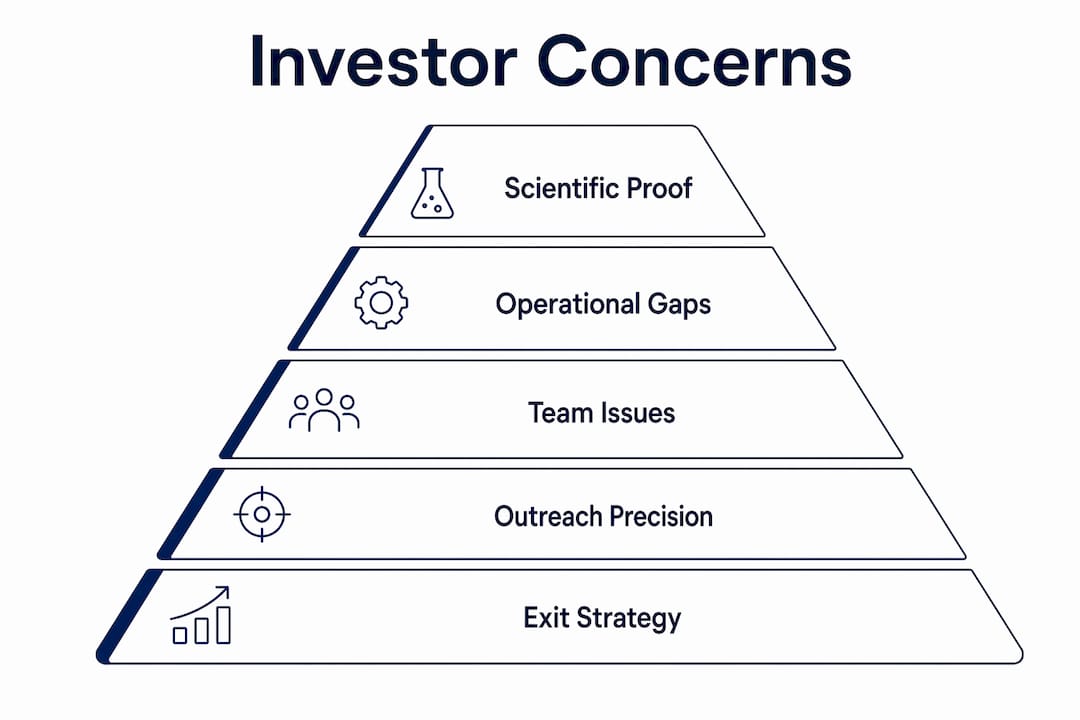
This shift changes how founders must structure their scientific narrative. The question is no longer "Is the science interesting?" The question is "What risks have you eliminated, and what is the cost and timeline to eliminate the next one?"
Here is how to reframe your scientific story for 2026 investors:
- Lead with risk reduction, not discovery. State which biological, clinical, or regulatory risks you have already addressed and what data proves it.
- Anchor every milestone to a decision point. Show investors that hitting your next milestone will either confirm or kill the program. That binary clarity builds confidence.
- Include early regulatory signals. FDA Breakthrough Therapy Designation, Orphan Drug Designation, or a pre-IND meeting outcome all signal that regulators see merit. These are not just badges. They reduce perceived risk.
- Show a credible exit path. Investors evaluate whether a strategic acquirer or public market will value your asset. Name the comparable transactions in your space and the valuation multiples they commanded.
- Address the commercial opportunity with data. Market size claims without payer analysis or patient identification strategies read as filler. Investors notice.
"Good science is the entry ticket, not the prize. The founders who close rounds are the ones who can show exactly which risks they have retired and what the next dollar buys in terms of de-risking."
Weak exit strategies are one of the most common reasons biotech startups fail to close rounds at Series A. Investors need to see a plausible path to liquidity, not just a path to approval. The FDA approval rate for VC-backed phase 1 trials sits at 14.1%. That number tells investors how much risk they are absorbing. Your job is to show them how you are managing it.
What team and operational gaps kill investor confidence?
Strong science with a weak team is one of the clearest signals investors use to pass on a deal. Leadership deficiencies such as delayed hiring of senior roles critically damage a startup's ability to execute. Investors fund teams as much as they fund programs.
The most common operational mistakes biotech founders make fall into three categories:
- Hiring too late. Waiting until you need a Chief Medical Officer or Head of Regulatory Affairs before recruiting one puts you six months behind. Investors want to see that leadership is in place before the work demands it. Hiring key roles at least six months before they are urgently needed is the standard investors expect.
- Ignoring manufacturing strategy. Founders who treat manufacturing and commercial plans as post-approval problems face valuation resets and fundraising failures. Investors scrutinize scale-up economics and manufacturing route trade-offs early. If you cannot explain your cost of goods at scale, you will lose the room.
- Cap table and governance problems. A messy cap table with too many small angels, unclear IP ownership, or missing board structure raises immediate red flags. Institutional investors will not lead a round into a governance problem they did not create.
Operational readiness also includes your regulatory affairs preparation. Founders who can demonstrate a clear regulatory pathway, including interactions with the FDA or EMA, signal to investors that the program is being managed by people who understand the full development arc, not just the science.
Pro Tip: Before your next investor meeting, ask a trusted advisor to review your cap table, IP assignments, and board composition. Fix structural problems before they become deal-breakers in due diligence.
How does investor outreach strategy affect biotech funding outcomes?
Precision in targeting investors matters more than volume of outreach. Cold outreach to biotech investors yields a response rate of approximately 3.43% in 2026. That figure means sending 100 cold emails produces roughly three responses. Most of those will not convert to meetings.

Warm introductions convert at 40–50%, compared to the 3–5% conversion rate of cold outreach. That gap is not marginal. It is the difference between closing a round and running out of money. One in five biotech founders runs out of cash before closing their seed round, which itself takes nine or more months to close.
The table below shows how outreach approach affects key fundraising outcomes:
| Outreach method | Estimated meeting conversion | Runway impact |
|---|---|---|
| Cold email | ~3–5% | High burn, low return |
| Warm introduction | ~40–50% | Efficient use of runway |
| Conference relationship | Moderate | Builds credibility over time |
| Syndicate or co-investor referral | High | Fastest path to term sheet |
Pitching a capital-intensive early-stage platform to a late-stage growth fund results in near-certain rejection. That rejection also damages the relationship for future rounds. Investor mandates are specific. A fund focused on oncology Series B deals will not fund a rare disease seed round, regardless of how strong the science is.
The practical fix is to build investor relationships 12–18 months before you need capital. Attend conferences where your target investors speak. Share milestone updates with warm contacts quarterly. Treat fundraising as a continuous relationship process, not a discrete event. Founders who understand clinical trial enrollment challenges and can speak to them fluently in investor conversations signal operational depth that cold outreach can never convey.
Key Takeaways
Biotech startups lose investor interest when they misalign on stage, team, scientific proof, and outreach precision, not because the science is weak.
| Point | Details |
|---|---|
| Stage of investability | Match your data package to the specific investor class before pitching, not just the round label. |
| Scientific de-risking | Lead with risks retired and milestones achieved, not with discovery potential alone. |
| Team and operations | Hire senior leadership at least six months early and address cap table issues before due diligence. |
| Outreach precision | Warm introductions convert at 40–50%; cold outreach converts at 3–5%. Prioritize network over volume. |
| Manufacturing strategy | Address scale-up economics and cost of goods early. Investors ask these questions before clinical approval. |
What founders consistently get wrong about investor expectations
The founders I see struggle most are not the ones with weak science. They are the ones who built their pitch around what excited them rather than what reduces investor risk. That distinction sounds simple. In practice, it is the hardest mindset shift in biotech.
The 2026 investment climate has compressed tolerance for ambiguity. Investors are not being difficult. They are responding rationally to a market where only about 25–30% of seed-stage biotechs reach Series A. They have seen too many programs with brilliant science and no execution plan. They have learned to weight team and milestones more heavily than novelty.
What I find founders rarely do is treat fundraising as a trajectory, not a transaction. The best rounds I have observed were built over 18 months of relationship development, milestone delivery, and transparent communication. The founders who closed those rounds did not just pitch. They reported. They shared setbacks honestly. They updated investors on what changed and why. That behavior builds the kind of trust that survives a failed experiment.
The other blind spot is manufacturing. Founders routinely defer commercial and manufacturing strategy until after proof of concept. Investors ask about cost of goods and scale-up routes in Series A diligence. If you cannot answer those questions, you signal that you have not thought past the science. That is a fast path to a polite pass.
Start building your investor relationships now, before you need the money. Map your investability stage honestly. Hire ahead of need. And treat every milestone as a communication opportunity, not just a scientific achievement.
— John
How Haiphai helps biotech founders meet investor expectations
Operational gaps are one of the top reasons biotech startups fail to close rounds. Haiphai works as an operational partner for life sciences teams, starting from your strategic goals and working backward to identify where timelines are slipping and where investor-critical milestones are at risk.
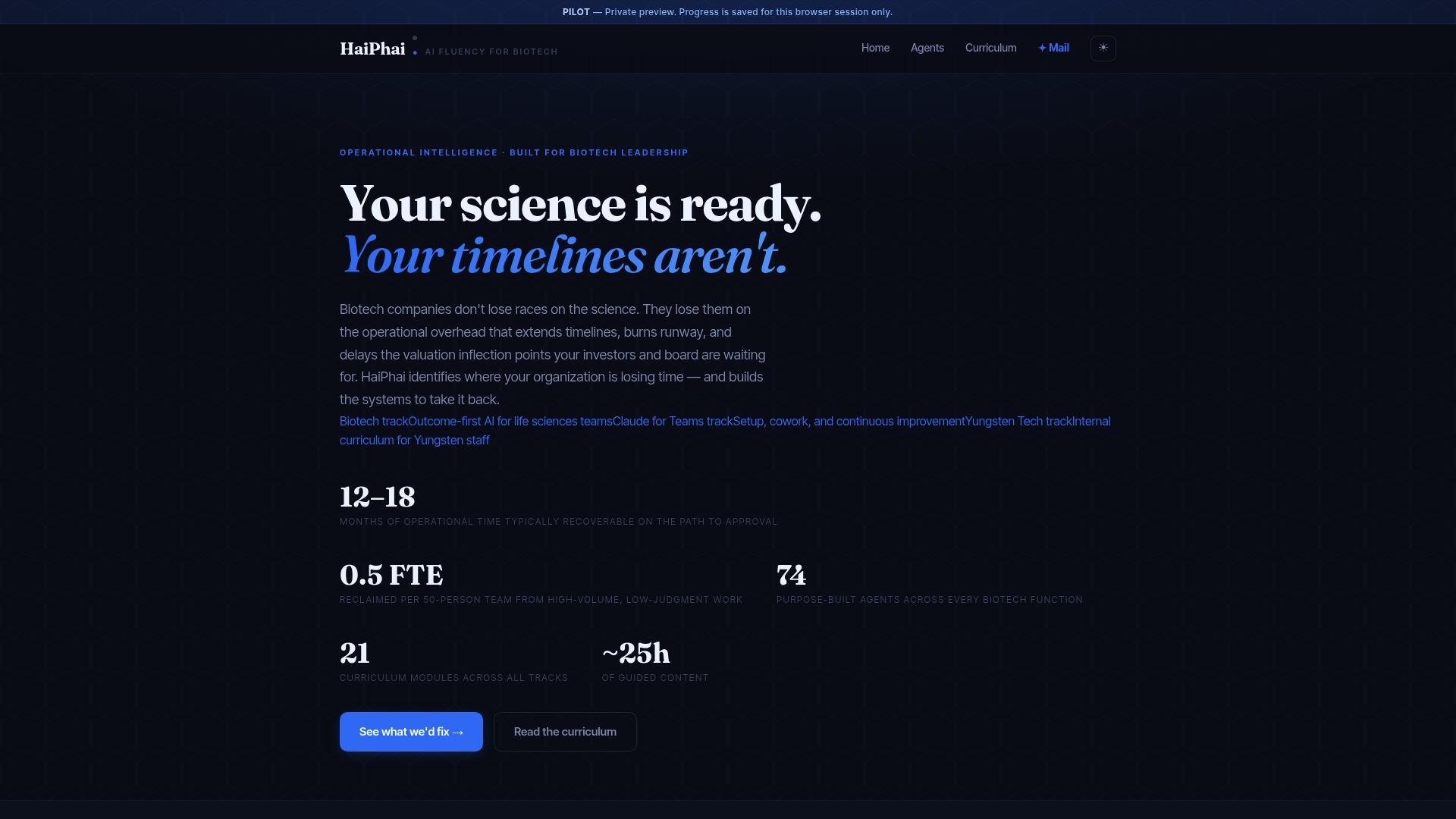
Haiphai's AI-powered approach covers regulatory drafting, clinical site activation, and milestone planning, the exact areas investors scrutinize in due diligence. Clients reclaim up to 18 months of operational time on the path to approval. That time directly affects valuation and fundraising readiness. Explore Haiphai's solutions to see how the platform maps to your specific development stage and investor timeline. You can also review the full services catalog for a detailed breakdown of where Haiphai fits your program.
FAQ
Why do biotech startups lose investor interest after initial meetings?
Investors disengage after initial meetings when startups cannot demonstrate a clear value inflection point or show that key risks have been retired. Weak team composition and unclear exit strategies are the most common deal-breakers in follow-up diligence.
What is the stage of investability in biotech fundraising?
The stage of investability is the point at which a startup's data, team, and milestones match what a specific investor class requires to commit capital. Misjudging this stage by one round can cost 12–18 months of runway and trigger a valuation reset.
How important is warm outreach versus cold outreach for biotech investors?
Warm introductions convert to meetings at 40–50%, while cold outreach converts at only 3–5%. Building investor relationships 12–18 months before a raise is the most effective way to improve funding outcomes.
Does scientific novelty still attract biotech venture capital?
Scientific novelty alone does not attract venture capital in 2026. Investors now require proof of risk reduction, including early regulatory signals, clinical milestones, and a credible commercialization plan, before committing to a round.
What operational issues most often cause biotech investor reluctance?
Delayed senior hiring, unresolved cap table problems, and the absence of a manufacturing or commercial strategy are the three operational issues that most reliably cause investor reluctance. Investors evaluate all three before leading a round.