
A biotech exit strategy is the planned method by which founders and investors convert company ownership into liquidity, typically through an acquisition, IPO, or licensing deal. Understanding how biotech exit strategy works is not optional for executives. It shapes every major decision from trial design to capital structure. 87% of biotech exits in the past decade occurred via mergers and acquisitions rather than IPOs. That single fact reframes how you should build your company from day one.
How does a biotech exit strategy work?
A biotech exit strategy works by aligning your clinical milestones, capital structure, and regulatory narrative with the requirements of a specific buyer universe. The industry term for this process is "exit planning," and it covers everything from deal structure to investor mix to IP architecture. Getting it right means you control the terms of your exit. Getting it wrong means you accept whatever offer arrives when your runway runs out.
The four primary exit routes are mergers and acquisitions (M&A), initial public offerings (IPOs), private equity buyouts, and option-to-license deals. Each route carries different timing requirements, valuation dynamics, and control implications. M&A dominates the field. IPOs remain viable but demand far more preparation and market timing. Private equity buyouts suit companies with commercial-stage assets and predictable revenue. Option-to-license structures work best for preclinical assets.

Option-to-license agreements account for about 67% of all preclinical partnerships. They give biotech startups non-dilutive capital without surrendering full ownership. That makes them a powerful tool for early-stage companies that need to extend runway while preserving optionality for a larger exit later.
Pro Tip: Match your exit route to your current clinical stage. A preclinical asset is almost never acquisition-ready. An option-to-license deal buys time and capital while you generate the Phase II data that actually triggers M&A interest.
What are the main exit pathways and how do they differ?
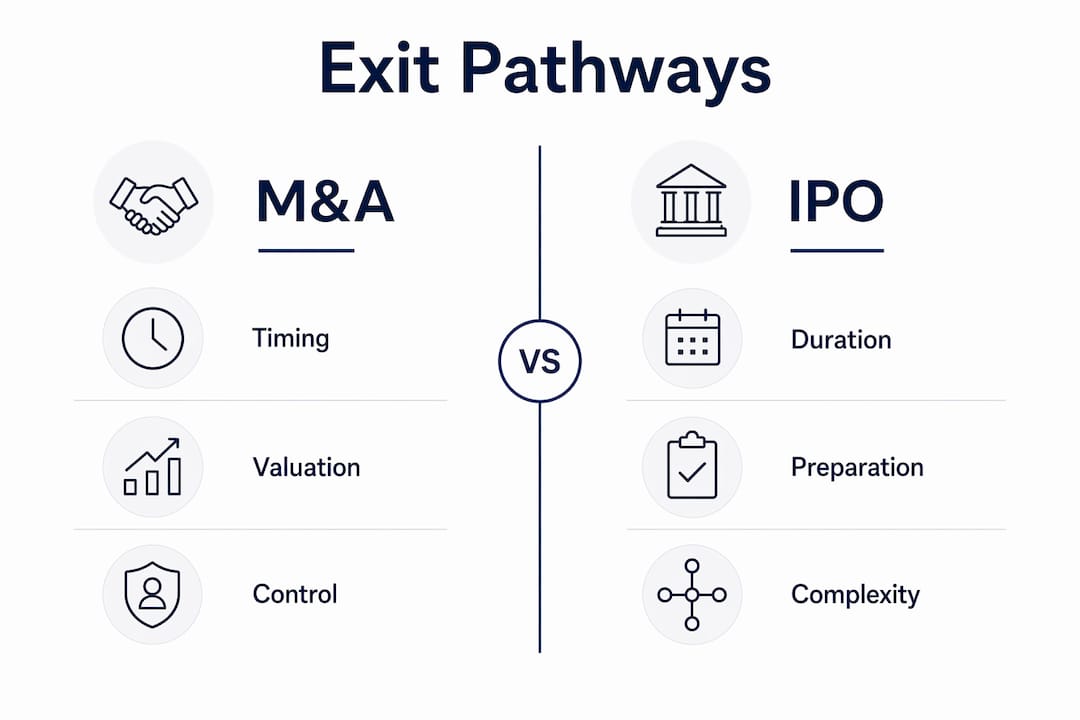
The table below compares the four primary exit routes across the dimensions that matter most to biotech executives.
| Exit type | Typical timing | Valuation driver | Control retained | Complexity |
|---|---|---|---|---|
| M&A | Phase II completion | Clinical data + IP | Low | High |
| IPO | Market window dependent | Public market sentiment | Moderate | Very high |
| Private equity buyout | Commercial stage | Revenue + pipeline | Low to moderate | High |
| Option-to-license | Preclinical to Phase I | Proof of concept | High | Moderate |
M&A is the dominant path. Median acquisitions happen upon Phase II trial completion, with valuations ranging from $400 million to $1.2 billion depending on indication and competitive landscape. Pharma acquirers pay for de-risked assets. Every clinical milestone you hit before entering negotiations adds to your leverage.
IPOs require a different kind of preparation. Biotech IPO timelines average 16–20 weeks from the organizational meeting to pricing. Confidential SEC filings let companies prepare without triggering immediate public disclosure. That flexibility matters when market windows open and close quickly. The downside is that public markets judge you on sentiment as much as science.
Private equity buyouts are less common in early-stage biotech but increasingly relevant for companies with approved products or near-commercial assets. PE buyers focus on cash flow predictability and pipeline depth rather than clinical risk. They typically require a clear path to revenue within 24–36 months of acquisition.
How do biotech exit strategy timelines and milestones affect readiness?
Biotech exit strategy timeline planning starts at company formation and runs through every funding round. The typical arc moves from seed funding through Series A and B, into Phase I and II trials, and then to an exit event. Each stage has specific milestones that either open or close exit windows.
Phase II completion is the single most important milestone for M&A readiness. Acquirers need proof of concept in humans before they commit to a nine-figure deal. A strong Phase II readout with clean safety data and a statistically meaningful efficacy signal is the trigger that brings serious buyers to the table. Companies that enter Phase II without a clear exit hypothesis often waste the data they generate.
Key biotech exit strategy timeline factors every executive must track:
- Cash runway: Companies with 24+ months of runway survived recent market downturns. Those with 11–14 months typically could not raise bridge funding and failed.
- Regulatory milestones: FDA Breakthrough Therapy designation, Fast Track status, and Special Protocol Assessments all signal de-risking to acquirers.
- Clinical data readouts: Schedule Phase II interim analyses to align with your target acquirer's annual business development calendar.
- IP expiration dates: Patent cliffs create urgency for pharma buyers. Know when your IP is most valuable to a specific acquirer.
- Market conditions: Pharma M&A activity exceeded $200 billion in 2025. Acquirers paid average premiums of 70–100% above pre-announcement stock prices. Timing your exit to active M&A cycles captures that premium.
IPO timing adds another layer of complexity. Confidential SEC filings allow biotech companies to prepare for going public while avoiding early market scrutiny. This enables timing flexibility within the formal 16–20 week window. The practical implication: start IPO preparation at least six months before you want to price, and build in contingency for market volatility.
Why must exit planning start early in biotech company strategy?
Exit planning must be a core element of early biotech company strategy, influencing clinical trial design and regulatory narrative to align with potential acquirers' needs. Most founders treat exit planning as a late-stage activity. That is a structural mistake. The decisions you make in Series A directly affect the deal terms you can negotiate three years later.
Pharma acquirers focus on IP, regulatory milestones, and manufacturing feasibility. They evaluate assets differently from venture capital firms, which prioritize total addressable market and founding team. Building your company to satisfy VC criteria alone means you may generate strong funding rounds but weak acquisition interest. The better approach is to build backwards from pharma buyers rather than VCs. That alignment produces better capital raises and more successful exits.
Investor mix also matters more than most founders realize. Strategic investors should be limited to 15–20% of any funding round. Exceeding that threshold gives strategic investors information rights and board influence that can complicate future negotiations with competing acquirers. Preserving optionality means keeping your buyer universe as wide as possible for as long as possible.
Trial design is another early lever. Endpoint selection, patient population, and comparator arms all signal to acquirers whether your data will fit their commercial strategy. A trial designed purely to satisfy FDA requirements may generate approvable data that no pharma company wants to buy. Aligning your regulatory narrative with your target acquirer's pipeline gaps from the start changes that outcome.
Pro Tip: Define your buyer universe before you design your Phase II trial. Identify three to five pharma companies with a specific pipeline gap your asset fills. Then design your endpoints to generate the data those companies need to justify an acquisition.
What factors determine biotech exit success and deal structure?
A clear definition of a specific buyer universe with strategic fit is the single most effective way to reduce exit risk. Exit risk arises when a company cannot define a credible path to liquidity that aligns with its buyer universe, value inflection points, realistic deal terms, and investor return expectations. Vague exit plans produce vague offers.
Deal structure in biotech acquisitions typically includes upfront payments, development milestones, regulatory milestones, and royalties on net sales. The upfront payment reflects the acquirer's confidence in your existing data. Milestone payments transfer risk to the acquirer while giving you participation in future value creation. Royalties matter most for assets with large commercial potential. Negotiating the right balance requires knowing your acquirer's internal hurdle rates and pipeline priorities before you enter the room.
Successful biotech exits depend on clinical data tailored to acquirers' scientific evaluation criteria, including patient populations, endpoints, and regulatory feedback. Generic data packages do not close deals. Acquirer-specific data packages do.
Practical actions for biotech executives preparing an exit:
- Map your IP landscape: Identify freedom-to-operate risks and resolve them before due diligence begins.
- Build a data room early: Organize clinical, regulatory, and financial documents at least 12 months before your target exit date.
- Track acquirer pipelines: Monitor pharma companies' annual reports and pipeline updates to identify gaps your asset fills.
- Manage your cap table: Excessive dilution or complex liquidation preferences reduce acquirer interest. Clean cap tables close faster.
- Engage a banker at the right time: Investment banks with biotech M&A experience add value in competitive processes. Engaging too early wastes fees. Engaging too late costs leverage.
Key Takeaways
A successful biotech exit requires aligning clinical milestones, IP strength, and capital structure with the specific needs of a defined pharma buyer universe from the earliest stages of company development.
| Point | Details |
|---|---|
| M&A dominates exits | 87% of biotech exits occur via M&A, typically at Phase II completion with valuations from $400M to $1.2B. |
| Runway is non-negotiable | Companies with 24+ months of cash runway survive downturns; those with 11–14 months typically fail to exit. |
| Build for pharma buyers | Design trials and regulatory narratives for pharma acquirers, not just VC milestones, to maximize deal value. |
| Limit strategic investors | Keep strategic investors below 15–20% of any round to preserve negotiating leverage and exit optionality. |
| Start planning early | Exit planning must begin at company formation and shape every clinical, regulatory, and capital decision. |
What I've learned about exit timing that most founders get wrong
The most common mistake I see is treating exit planning as a destination rather than a discipline. Founders spend years building clinical data and then scramble to prepare for an acquisition in the six months before they run out of money. That is not a negotiation. That is a fire sale.
The founders who exit well start the conversation with potential acquirers two to three years before they want to close a deal. They present at pharma business development conferences. They share early data in non-confidential formats. They build relationships with the exact people who will champion their asset internally. By the time the formal process starts, the acquirer already believes in the science.
The other lesson is about market intelligence. Most biotech executives track their own pipeline obsessively and their buyer universe sporadically. That is backwards. You need to know when a target acquirer loses a Phase III asset in your indication, because that creates urgency on their side. You need to know when they close a competing deal, because that closes a window. Continuous monitoring of your buyer universe is not optional. It is the work.
Capital structure deserves more attention than it gets. I have seen companies with genuinely strong Phase II data accept poor deal terms because their cap table was a mess and their investors needed liquidity. Clean your cap table before you need to. The time to resolve liquidation preference stacks and complex option pools is during a funding round, not during acquisition due diligence.
— John
How Haiphai supports biotech exit readiness
Operational delays cost biotech companies more than time. They compress the runway that separates a strong exit from a distressed one. Haiphai works as an operational partner for life sciences teams, starting from your exit goals and identifying the bottlenecks that slow clinical and regulatory progress.

Haiphai clients reclaim up to 18 months of operational time on the path to approval. That time directly increases company valuation and strengthens your negotiating position with acquirers. Haiphai's AI-driven solutions cover regulatory drafting, clinical site activation, and process design, all tailored to your specific pipeline and exit timeline. For biotech executives who need to reach Phase II faster and with cleaner data packages, Haiphai provides the operational infrastructure to get there. Learn more about how Haiphai supports clinical and regulatory strategy for life sciences teams.
FAQ
What is the most common biotech exit route?
M&A is the dominant exit route, accounting for 87% of biotech exits over the past decade. Most acquisitions occur at Phase II completion.
When should biotech companies start exit planning?
Exit planning should begin at company formation, not at the point of fundraising or clinical readout. Early planning shapes trial design, IP strategy, and investor mix.
How long does a biotech IPO take?
A biotech IPO takes 16–20 weeks from the organizational meeting to pricing. Confidential SEC filings allow companies to prepare without immediate public disclosure.
What deal structures are common in biotech acquisitions?
Biotech acquisitions typically combine upfront payments with development milestones, regulatory milestones, and royalties on net sales. The upfront reflects existing data quality; milestones transfer future risk to the acquirer.
How much cash runway do biotech companies need to exit successfully?
Companies need at least 24 months of cash runway to reach the value inflection milestones that trigger acquisitions. Companies with 11–14 months of runway typically cannot raise bridge funding and fail to exit on favorable terms.