
A typical biotech liquidity event lands somewhere in a multi-year band: M&A deals most often close 4–8 years after founding, while a traditional IPO requires 12–24 months of preparatory work, followed by a 16–20 week sprint from Org Meeting to pricing. Secondary transactions and structured buybacks can move faster, often executing in 3–6 months once valuation is agreed. The single most important planning implication: your runway and your advisory team need to be in place well before the window opens, not after.
Milestone windows that most affect timing:
- Clinical readiness: Phase II/III data packages drive M&A interest and IPO investor appetite; a clean data cut typically takes 6–18 months to prepare and validate.
- Audited financials: Multiple years of GAAP-audited statements are required for an S-1 registration; starting the audit relationship early is the most common timeline accelerator.
- Org Meeting to pricing: The 4–6 month execution window after the organizational meeting is where most IPO slippage happens — financial-statement prep and SEC comment cycles are the usual culprits.
- IP opinions and FTO: Freedom-to-operate analyses and patent term assessments can take 3–6 months; buyers and underwriters will ask for them.
- Advisor engagement: Investment bankers, outside counsel, and external accounting support should be engaged well in advance of a target window, not 90 days out.
Immediate recommendation: Target at least 18–24 months of runway from the point you begin exit preparation. Engage your lead banker and outside counsel no later than 12 months before your target pricing or signing date.
Key Takeaways
The most important planning insight in this guide: biotech liquidity events require 12–24 months of preparation before the active process begins, and the founders who reach favorable exits are the ones who treat operational readiness as a clinical milestone, not an afterthought.
| Point | Details |
|---|---|
| Start preparation early | Baker McKenzie recommends 12–24 months of prep before an IPO Org Meeting to build audit, governance, and IP infrastructure. |
| IPO Org Meeting to pricing | The active IPO window runs 16–20 weeks from Org Meeting to pricing; the full execution period is typically 4–6 months. |
| M&A timeline range | Most biotech M&A deals close 3–9 months after first formal approach; founding-to-exit typically spans 4–8 years for clinical-stage assets. |
| Engage advisors early | Investment bankers and outside counsel should be engaged 12–18 months before a target window, not 90 days out. |
| Haiphai operational partnership | Haiphai identifies and resolves operational bottlenecks in regulatory drafting, site activation, and audit readiness, reclaiming up to 18 months on the path to exit. |
Table of Contents
- What does a liquidity event mean for biotech stakeholders?
- What are the common exit types in biotech?
- What does the biotech liquidity event timeline look like in detail?
- What factors speed up or slow down a biotech exit?
- How should you prepare for a liquidity event?
- What should founders do in the final 90–180 days before pricing or signing?
- What are the typical holding periods for VC-backed biotech?
- Where do operational delays add months, and how do you reclaim them?
- Why dual-track preparation beats picking a lane too early
- How Haiphai helps you reach liquidity faster
- Sources
- FAQ
What does a liquidity event mean for biotech stakeholders?
A liquidity event is any transaction that converts illiquid equity in a private biotech company into cash or publicly tradable securities for shareholders. In U.S. capital-markets terms, the three primary mechanisms are an initial public offering (IPO), an acquisition or merger (M&A), and a structured secondary transaction. Each one resets the cap table, changes governance obligations, and triggers tax consequences that differ materially depending on how the company is structured and how long investors have held their shares.
For founders, a liquidity event is the moment their equity actually pays out — but the mechanics matter enormously. Liquidation preferences, participation rights, and anti-dilution provisions written into early financing rounds can dramatically reduce what common stockholders receive relative to preferred holders. Modeling those waterfall outcomes before entering any process is not optional; it is the first thing a competent M&A counsel will do.
For investors, the biotech context adds a layer of complexity that consumer or SaaS exits do not carry. Clinical-stage assets are binary in ways that software is not: a Phase III failure can collapse a valuation overnight, while a positive readout can double it. That asymmetry shapes how VCs and crossover investors time their push for a liquidity event and how aggressively they negotiate registration rights.
Stat to know: BioCentury's 32-year analysis found that half of all biotech equity raised since 1994 was raised in the last eight years alone — a structural shift that has expanded the capital available to private companies and, in turn, lengthened the time founders can afford to stay private before pursuing a liquidity event.
The U.S. regulatory environment adds its own layer. The SEC's going-public framework requires registration statements, prospectus disclosures, and ongoing Exchange Act reporting once a company crosses certain thresholds. FINRA governs the broker-dealer and funding-portal intermediaries that facilitate both public offerings and certain secondary transactions. Understanding which regulator touches which part of your exit pathway is basic operational literacy for any biotech finance team.
Practical stakeholder impacts at a glance:
- Governance: A public company or newly acquired subsidiary faces board composition requirements, audit committee independence rules, and disclosure obligations that private companies do not.
- Tax: Long-term capital gains treatment requires shares held more than 12 months; QSBS exclusions under IRC Section 1202 can shelter up to $10 million in gains for qualifying founders.
- Cash expectations: Lockup periods of 180 days post-IPO mean founders and early investors cannot immediately sell; M&A deals with earnouts can defer cash receipt by 12–36 months.
What are the common exit types in biotech?
Acquisition and M&A
Acquisitions are the most common exit for U.S. biotech companies, particularly for clinical-stage assets. Large pharma and specialty biopharma buyers typically drive the process, though financial sponsors and crossover investors occasionally lead buyouts of revenue-generating biotechs. The preparatory milestones that matter most to buyers are clinical data quality, IP position, and manufacturing scalability. A biotech due diligence checklist typically covers all three.

Timeline range: from first substantive conversation to signed definitive agreement, most biotech M&A deals close in 3–9 months. Integration, including CVR (contingent value right) milestone tracking, can extend the economic relationship for years.
Key timing drivers in biotech M&A:
- Phase of clinical development (earlier stage = longer diligence, lower certainty)
- Regulatory exclusivity remaining on lead asset
- Presence of competing bidders (accelerates timelines)
- Earnout structure complexity (can add 4–8 weeks to negotiation)
Traditional IPO
The IPO is the most process-intensive exit pathway. The SEC requires a full registration statement (S-1 or S-1/A), prospectus, and ongoing Exchange Act reporting. The organizational meeting marks the procedural start of the active IPO process; from there, Baker McKenzie's guide recommends companies have already spent 12–24 months building the audit, accounting, and governance infrastructure that underwriters and the SEC will scrutinize.
Confidential filing (under the JOBS Act) lets companies submit a draft S-1 to the SEC before going public with the filing, which can shorten the visible public window while the company addresses SEC comments privately.
Secondary transactions and buybacks
Structured secondaries — where existing investors sell shares to new investors in a private transaction — have grown significantly as a liquidity mechanism for biotech. FINRA-regulated funding portals and broker-dealers facilitate many of these transactions. Execution typically takes 3–6 months from term sheet to close, with the main variable being valuation discovery and lead-investor negotiation. Buybacks, where the company repurchases shares from early investors or employees, follow a similar timeline but require board approval and often a 409A valuation update.
SPACs had a moment as an alternative public route but have largely fallen out of favor for clinical-stage biotech given the governance complexity and investor skepticism that followed the 2021–2022 wave.
What does the biotech liquidity event timeline look like in detail?
IPO timeline: milestone by milestone
The practical IPO clock starts at the organizational meeting, but the real preparation begins 12–24 months earlier. Here is what the milestone sequence looks like:
| Phase | Typical Duration | Key Activities |
|---|---|---|
| Pre-IPO preparation | 12–24 months | Audit readiness, governance build-out, board composition, IP cleanup |
| Org Meeting to S-1 filing | 8–12 weeks | S-1 drafting, underwriter diligence, financial-statement finalization |
| SEC review and comment cycle | 4–8 weeks | SEC comments, S-1/A amendments, accounting responses |
| Roadshow and pricing | 2–3 weeks | Investor meetings, book-building, final pricing |
| Total: Org Meeting to pricing | 16–20 weeks | Per LifeSciVC cadence analysis |
| Post-IPO lockup | 180 days | Insider selling restrictions |
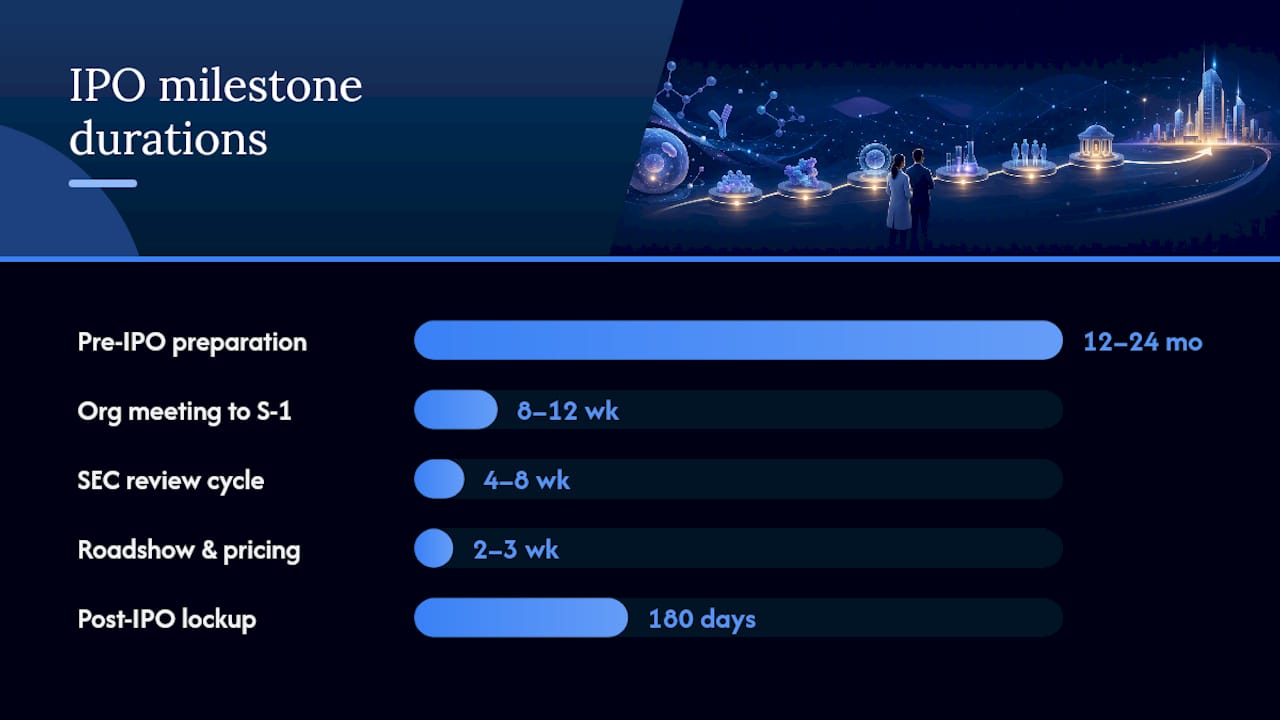
The Mondaq life sciences capital markets guide puts the full execution window at 4–6 months after the Org Meeting, with financial-statement preparation and SEC comment cycles as the most common sources of delay. Companies that enter the Org Meeting with two or three years of audited GAAP financials already in hand consistently run faster processes.
Confidential filing dynamics: Under the JOBS Act, emerging growth companies can submit a draft S-1 confidentially and work through SEC comments before the filing becomes public. This compresses the public-facing window to as little as 3–4 weeks before the roadshow, which reduces market-window risk.
M&A timeline: diligence cadence
A typical biotech M&A process from first formal approach to signed definitive agreement runs 3–9 months. Early-stage assets with limited clinical data take longer because buyers need more time to assess scientific risk. Late-stage or commercial-stage assets with clean IP and audited financials can close faster. Integration planning, regulatory filings (HSR Act pre-merger notification for larger deals), and CVR negotiation add time on top of the signing date.
Milestone checklist for M&A readiness:
- Audited financial statements (3 years preferred)
- Data room with clinical trial data, regulatory correspondence, and IP portfolio
- Freedom-to-operate opinion on lead assets
- Clean cap table with no unresolved option or warrant issues
- Board-approved fairness opinion process
- Management retention agreements in place
Secondary transactions and buybacks
Secondary transactions in private biotech typically execute in 3–6 months. The process involves identifying buyers (often crossover funds or dedicated secondary funds), agreeing on a valuation (usually anchored to the last primary round or a 409A), and obtaining any required right-of-first-refusal waivers from existing investors. Buybacks follow a similar path but add a board resolution and, for larger repurchases, a solvency analysis.
What factors speed up or slow down a biotech exit?
Clinical stage is the single biggest variable. A company with Phase III data in hand attracts a fundamentally different buyer universe than one at Phase I, and the diligence burden is proportionally lower when efficacy and safety signals are clear. Phase II/III readouts that arrive on schedule can compress an M&A timeline by months; a clinical hold or safety signal can stop a process entirely.
Internal drivers (within management control):
- Audit readiness and quality of financial statements
- Governance structure (independent board members, audit committee composition)
- IP portfolio cleanliness (no unresolved ownership disputes, FTO opinions current)
- Data room completeness and organization
- Management team stability and retention
External drivers (market and regulatory):
- Investor appetite and sector rotation (crossover funds moving in or out of biotech)
- Interest rate environment (affects IPO valuation multiples)
- Competitive pipeline activity (a rival approval can erode M&A interest quickly)
- FDA regulatory calendar (PDUFA dates, advisory committee schedules)
- Seasonal IPO windows (activity clusters around major investor conferences and in late June, per LifeSciVC's cadence analysis)
Patent status deserves specific attention. A lead asset with 8–10 years of remaining patent life commands a materially different valuation than one facing near-term expiry. Buyers and underwriters will model patent cliff scenarios; founders who have not done this analysis themselves will be caught flat-footed in diligence. The Fierce Biotech fundraising tracker shows that well-capitalized companies with strong IP positions continue to attract large rounds even in tighter markets, which directly extends their optionality on exit timing.
Pro Tip: Sequence your internal fixes before engaging the market. Resolve IP ownership issues, complete your first PCAOB-standard audit, and stabilize your CFO seat before you take the first banker call. Advisors can accelerate a prepared company; they cannot fix a structurally unready one.
How should you prepare for a liquidity event?
18 months or more before target exit
- Commission your first PCAOB-standard audit and establish a relationship with a Big Four or top-tier regional audit firm. Two to three years of clean audited financials are the baseline for any IPO or large M&A process.
- Build an independent board with at least two independent directors who have public-company or M&A experience. Underwriters and buyers both scrutinize board composition early.
- Conduct an IP audit. Map every patent, application, and license agreement. Resolve any co-inventor disputes or assignment gaps. Commission FTO opinions on your lead assets.
- Model your cap table waterfall. Run liquidation preference scenarios at multiple exit valuations. Know exactly what common stockholders receive at $200M, $500M, and $1B exits before you sit across from a banker.
- Align the board and major investors on exit objectives. Outcome Capital's commentary makes the point directly: governance and management alignment with investor timelines are material drivers of whether exits happen on schedule. Misaligned incentives are a timeline killer.
6–12 months before target exit
- Build your data room. Organize clinical trial data, regulatory correspondence, manufacturing records, and financial statements in a structured virtual data room. Buyers and underwriters will access it within days of signing an NDA.
- Run an advisor beauty parade. Interview at least three investment banks and two outside counsel firms. Selection criteria should include sector expertise, recent comparable transactions, and analyst coverage capability for IPOs.
- Begin Org Meeting preparation for IPOs. Draft the preliminary S-1 outline, identify your underwriting syndicate, and confirm your audit firm's availability for the consent process.
- For M&A targets: prepare a confidential information memorandum (CIM) and identify your top 10–15 strategic and financial buyers.
- Check liquidation preferences and clawback provisions. Some early-stage preferred rounds include participating preferred with caps; model the exact payout at your expected exit range.
Tax and financial planning notes:
- QSBS (Qualified Small Business Stock) exclusions require shares to have been held for more than five years and the company to have had gross assets under $50 million at issuance. Confirm eligibility early.
- 83(b) elections for restricted stock must be filed within 30 days of grant; missed elections cannot be retroactively fixed.
- State tax treatment of stock options and RSUs varies significantly; founders with employees in California, New York, and Massachusetts should model state tax exposure separately.
For a deeper look at the biotech VC process and how financing rounds set up exit mechanics, that resource covers the full funding-to-exit arc.
What should founders do in the final 90–180 days before pricing or signing?
The last six months before an IPO pricing or M&A signing are where value is protected or lost. Most of the strategic decisions are already made; what remains is execution discipline.
- Lock down audited financials and interim reporting. Your audit firm needs to issue a consent for the S-1; any open items in the audit will delay the filing. For M&A, buyers will request audited statements plus interim financials through the most recent quarter.
- Finalize IP opinions. FTO opinions and patent term analyses should be complete and reviewed by outside IP counsel before the data room opens to buyers or before the S-1 is filed.
- Stabilize key hires. Turnover in the CFO, CMO, or CSO seat in the 90 days before pricing is a red flag for investors and buyers alike. Retention agreements and equity refresh grants should be in place.
- Manage external communications carefully. SEC quiet-period rules restrict what you can say publicly once the S-1 is filed. Brief your communications team and all executives on what is and is not permissible. For M&A, confidentiality obligations are equally strict.
- Coordinate lockup and insider selling strategy. For IPOs, the standard 180-day lockup applies to insiders. Discuss with your counsel and bankers whether any lockup waiver requests are appropriate and when secondary sales can begin without signaling distress.
Pro Tip: Schedule your Org Meeting to land after your audit firm has completed its year-end work and issued its opinion. Trying to run the S-1 drafting process in parallel with an open audit creates avoidable delays. The LifeSciVC cadence analysis notes that audit windows create predictable "no-go" periods earlier in the calendar year; plan your Org Meeting accordingly.
What are the typical holding periods for VC-backed biotech?
Biotech VC holding periods are longer than most other sectors, and the data reflects that. Industry commentary and portfolio trackers consistently show median holding periods of several years for VC-backed biotech companies that reach a liquidity event, with the range extending to 12 or more years for platform companies that pursue multiple clinical programs before exiting.
Benchmark context: BioCentury's 32-year capital analysis documents that the surge in available biotech equity over the last eight years has allowed companies to raise larger rounds and stay private longer, which has structurally extended median holding periods compared to the pre-2015 era.
| Exit pathway | Typical founding-to-exit range | Notes |
|---|---|---|
| M&A (clinical-stage asset) | 4–8 years | Driven by Phase II/III data readiness and buyer appetite |
| M&A (commercial-stage) | 6–12 years | Longer due to revenue ramp and integration complexity |
| IPO | 8–12 years | Includes 12–24 months of pre-IPO prep plus clinical maturation |
| Secondary transaction | 3–7 years | Can provide partial liquidity without full exit |
For LP planning purposes, most biotech-focused VC funds operate on 10-year fund lives with optional 2-year extensions. The practical implication: companies that are not on a credible path to liquidity within 8–9 years of a fund's vintage year start to create LP pressure that can influence board decisions on timing. Founders who understand this dynamic can use it strategically — a well-timed dual-track process (running M&A conversations while preparing for an IPO) preserves optionality and can accelerate a decision when a fund is approaching its extension period.
For biotech portfolio timeline benchmarks across different asset classes and development stages, that resource provides additional context on how holding periods vary by therapeutic area.
Where do operational delays add months, and how do you reclaim them?
The scientific timeline in biotech is largely fixed: you cannot rush a Phase III trial. But the non-scientific components — regulatory drafting, clinical site activation, audit preparation, data-room assembly — are where months quietly disappear. Most biotech finance teams underestimate how much time these operational tasks consume until they are already in a live process.
Common bottlenecks and their typical time cost:
- Regulatory document drafting: Manual drafting and review cycles for IND amendments, briefing documents, and CMC sections routinely add 6–12 weeks per submission cycle.
- Clinical site activation: Contracting, IRB approvals, and site initiation visits for a mid-size trial can take 4–9 months; delays here push back data availability and, by extension, exit readiness.
- Audit preparation: Companies that have not maintained PCAOB-standard records often spend 3–6 months reconstructing financial documentation before an audit can even begin.
- Data-room assembly: A disorganized data room that requires retroactive document collection adds 4–8 weeks to any M&A or IPO diligence process.
Concrete interventions that compress these windows include parallelizing workstreams (running regulatory drafting and site activation simultaneously rather than sequentially), deploying governed automation for document generation and review, and bringing in expert-led playbooks that eliminate the trial-and-error cycle. Biotech asset de-risking approaches that address these operational layers can materially shorten the non-scientific path to exit readiness.
Operational partners that combine process redesign with governed automation — including AI-assisted regulatory drafting and clinical site activation — can compress non-scientific timeline components and reduce time lost to coordination friction. The mechanism is straightforward: replacing sequential, manual handoffs with parallel, governed workflows eliminates the wait time that accumulates between steps, not the steps themselves.
For supply-chain and API sourcing readiness, which is a frequently overlooked diligence item in manufacturing-stage biotechs, that resource covers the operational considerations buyers and underwriters will probe.
Why dual-track preparation beats picking a lane too early
The conventional wisdom says pick your exit pathway and commit. In practice, the founders and investors who consistently reach liquidity on their own terms run both tracks simultaneously for as long as they can afford to. Dual-track preparation — maintaining active M&A conversations while building IPO readiness — is not indecision; it is the most rational response to a market where windows open and close unpredictably.

The argument for committing early to one path is usually about management bandwidth. That concern is real but overstated when the company has a competent CFO and outside advisors managing the process. The cost of being caught flat-footed when a strategic buyer appears, or when an IPO window opens after a positive Phase III readout, is almost always higher than the cost of running parallel workstreams.
Board incentive alignment matters here too. Early-stage investors with funds approaching their extension periods will push for M&A; later crossover investors with larger positions may prefer the public-market premium of an IPO. A founder who has modeled both outcomes and can present a credible dual-track plan controls that conversation rather than being controlled by it.
How Haiphai helps you reach liquidity faster
Eighteen months of operational time is a long time to lose to process inefficiency when you are trying to hit a pricing window or close an M&A deal. Haiphai's embedded AI operational partnership is built specifically for biotech teams that need to compress the non-scientific components of their timeline without adding headcount or disrupting clinical operations.
Haiphai starts from your strategic exit goals and works backward to identify the specific bottlenecks — regulatory drafting cycles, clinical site activation delays, audit-readiness gaps — that are adding months to your path. The model combines governed workflow automation with expert-led adoption, so the time savings are real and repeatable, not a one-time fix. Clients working with Haiphai can reclaim up to 18 months of operational time on the path to approval, a direct input into maximizing company valuation before a liquidity event.
If your team is within 12–24 months of a target exit window, the time to map your operational bottlenecks is now, not after the Org Meeting. See how Haiphai works across biotech sectors and find out where your timeline can be compressed.
Sources
- SEC: Going Public - Capital Raising and Disclosure
- Guide to IPOs for biotech and pharma companies — Baker McKenzie
- Life Sciences capital markets: Preparing for your 2026 IPO — Mondaq
- A 32-year look at biotech's capital expansion — BioCentury
- FINRA: Funding portals we regulate
This article is general information, not a substitute for advice from a qualified financial advisor. Consult a qualified financial professional about your own circumstances before acting on anything here.
FAQ
What does a liquidity event mean in biotech?
A liquidity event is any transaction that converts illiquid equity in a private biotech company into cash or publicly tradable securities for shareholders. The three primary forms in the U.S. are an IPO, an acquisition, and a structured secondary transaction.
What is a typical biotech IPO timeline?
From the organizational meeting to pricing, a biotech IPO typically takes 16–20 weeks, per LifeSciVC's cadence analysis. The full execution window, including financial-statement preparation and SEC comment cycles, commonly runs 4–6 months after the Org Meeting.
What is the 30-day rule for IPOs?
The 30-day rule generally refers to the SEC's restriction on underwriters publishing research reports within 30 days before or after an IPO. It is part of the broader quiet-period framework that governs what companies and their advisors can communicate publicly during the registration process.
How long do VC-backed biotech companies typically hold before exit?
Industry benchmarks place median holding periods for VC-backed biotech in the 7–10 year range for companies that reach a liquidity event, with clinical-stage M&A exits often occurring in the 4–8 year window from founding.
When should a biotech founder start preparing for a liquidity event?
Baker McKenzie's IPO guide recommends beginning preparation 12–24 months before the target Org Meeting. For M&A, the data room, IP opinions, and audited financials should be in place at least 12 months before you expect to receive a formal approach.