
TL;DR:
- The biotech venture capital process involves multiple milestone-driven stages that require strong operational and scientific alignment. Preparing operationally early and fixing gaps in data, regulatory planning, and vendor contracts can significantly shorten timelines and improve funding success. Engaging operational partners before critical milestones helps teams reduce execution risks, accelerate development, and close rounds more effectively.
The biotech VC process is a milestone-driven sequence: pitch your science, survive deep technical and operational due diligence, negotiate a term sheet, and close. Before you do any of that, fix three things first: team credibility, defensible IP, and milestone alignment. Rounds fail most often because of valuation misalignment, a disconnect between scientific data and the investor narrative, or operational gaps that surface during diligence. A fundable biotech package reduces to six aligned elements: team, data, traction, market, IP, and valuation. If any one of those is materially out of sync, the round stalls.
Quick self-audit (under 5 minutes):
- Can you state your lead indication, primary endpoint, and regulatory path in two sentences?
- Do you have traceable raw data, documented SOPs, and a complete IP landscape analysis?
- Does your financial model tie capital tranches to specific clinical inflection points?
If any answer is no, that gap is your highest-priority fix before the first investor meeting.
Table of Contents
- How does the biotech VC process work, step by step?
- What do life-sciences VCs actually evaluate?
- What milestones and funding amounts should you expect at each stage?
- Operational moves that shorten timelines and lift valuation
- What term-sheet terms actually matter in biotech?
- What changes after the round closes?
- Key Takeaways
- The operational gap most teams ignore until it costs them a round
- Haiphai helps you close the operational gap before investors find it
- FAQ
How does the biotech VC process work, step by step?
The process runs in six stages, each with a distinct owner and a realistic time window. Most teams underestimate how long diligence actually takes.
| Stage | Primary Owner | Typical Duration |
|---|---|---|
| Deal sourcing / warm intro | Founders, advisors | Ongoing |
| Initial screening | GP / associate | a few weeks |
| Scientific & operational diligence | Internal MD/PhD + external reviewers | several months |
| Non-binding term sheet | Lead GP | a few weeks after diligence |
| Legal docs & syndication | Counsel, co-investors | several weeks |
| Close | All parties | about a week or two |

Technical due diligence is the longest and most unpredictable phase. Investors deploy internal and external MD/PhD experts to stress-test modality risk, IP defensibility, and competitive positioning before any valuation conversation begins. What used to be a 3–4 month process now routinely runs 6–9 months as scrutiny on regulatory strategy and team resilience has deepened.
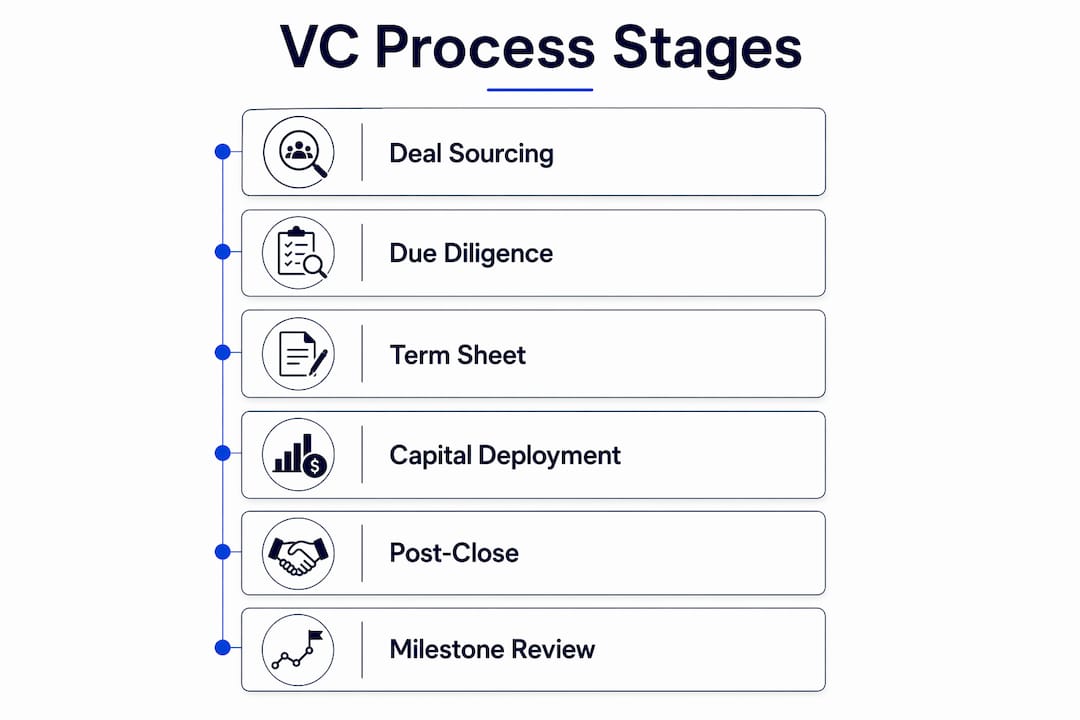
Capital is almost never released in a single tranche. Investors structure milestone-based releases tied to specific inflection points, so your internal project plan and your financing plan need to be the same document.
What do life-sciences VCs actually evaluate?
Investors work through a layered checklist. Science comes first, but operational readiness closes deals.
Science and IP:
- Reproducibility of preclinical data and provenance of key experiments
- Modality risk (small molecule, biologic, cell/gene therapy each carry different profiles)
- Freedom-to-operate analysis and patent estate breadth
- Regulatory path clarity: IND timeline, FDA meeting history, and pre-submission strategy
Operations and data room:
- CRO/CDMO selection rationale and SLA terms
- SOPs for GLP/GMP-relevant studies
- Clinical trial design documents and enrollment assumptions
- KPI tracking frameworks that investors can audit
Team and governance:
- Founder and C-suite track record in drug development
- Scientific advisory board composition (domain experts with publication and regulatory credibility)
- Board governance structure and existing investor rights
Early-stage life-sciences VCs often go beyond capital: some act as company builders, helping design trials and select CROs/CDMOs to de-risk programs operationally. That means your vendor choices are visible to investors before you think they are.
Pro Tip: Prepare two versions of your data package: a scientific deck for MD/PhD reviewers and a capital narrative for GPs. They read the same data differently. The scientific deck shows rigor; the capital narrative shows why the risk-adjusted return justifies the check size.
What milestones and funding amounts should you expect at each stage?
Biotech development spans a decade or more from discovery to approval, so staged financing is structural, not optional.
| Stage | Primary Milestone | Typical Raise | Key Valuation Driver |
|---|---|---|---|
| Seed | Target validation, platform proof | $1–5M | Founder track record, IP filing |
| Series A | IND-enabling studies complete | $15–40M | Preclinical package, regulatory path |
| Series B | Early clinical proof-of-concept | $50–100M | Phase I/II data, clinical ops readiness |
| Later rounds | Pivotal / approval readiness | Varies | Efficacy data, payer/market validation |
VC funds typically run multi-year lifecycles, and GPs commonly reserve a substantial portion of committed capital for follow-on investments. That reserve behavior shapes everything: a GP who has already deployed heavily into your competitor may not have reserves available even if they like your science. Show a credible multi-round plan so investors can model their reserve allocation against your milestones, not just your current ask.
Milestone-driven financing means capital releases when measurable inflection points are met, not on calendar dates. Align your operational plan to those gates.
Operational moves that shorten timelines and lift valuation
This is where most teams leave money on the table. The science may be strong, but slow execution compresses valuation and signals execution risk to investors.
- Regulatory drafting and pre-submission prep. Start IND-enabling documentation in parallel with studies, not after. AI-augmented regulatory drafting can compress submission timelines meaningfully.
- IND-enabling study acceleration. Map your critical path. Identify which tox or PK/PD study is the rate-limiting step and resource it first.
- CRO/CDMO selection and SLA design. Negotiate milestone-linked SLAs, not just time-and-materials contracts. Investors will read your vendor agreements during diligence.
- Clinical site activation and enrollment optimization. Site activation is frequently the longest lag between IND approval and first patient dosed. AI-driven enrollment tools can close the gap between protocol design and patient recruitment.
- IP portfolio consolidation. File continuation applications before Series A. A thin patent estate is a diligence red flag that is cheap to fix early and expensive to fix late.
- Capital-milestone alignment. Build a financing model that maps each tranche to a specific deliverable. Investors fund milestones, not timelines.
Haiphai clients working on regulatory drafting and site activation have significantly shortened operational timelines on the path to approval, a direct input to pre-raise valuation.
Pro Tip: When structuring vendor contracts, tie payment milestones to the same inflection points in your financing model. This lets investors legally and operationally link funding tranches to vendor delivery, which reduces their perceived execution risk.
First 90 days: Audit your critical path, identify the two studies blocking your IND, assign an owner to each regulatory document, and get a CRO shortlist to term-sheet stage before your next investor conversation.
What term-sheet terms actually matter in biotech?
Most founders spend too much time on valuation and too little on the terms that govern what happens when things go sideways.
- Pre-money valuation and option pool: The option pool is typically carved out pre-money, which dilutes founders before the investment closes. Model the post-money cap table before you sign.
- Liquidation preference: A 1x non-participating preference is standard. Participating preferred with a cap is negotiable; uncapped participating preferred is founder-unfriendly and worth pushing back on.
- Anti-dilution: Broad-based weighted average is market standard. Full ratchet is aggressive and signals an investor who expects a down round.
- Board composition: Lead investors typically take one board seat at Series A. Negotiate for an independent director slot you control.
- Protective provisions: Investors will require approval rights on major decisions (new equity, M&A, budget changes). Scope these narrowly.
- Pro rata rights: Preserve your right to participate in future rounds. This matters more at Series B when new investors may crowd out early supporters.
- Tranche structure: Milestone-linked tranches reduce dilution risk if you hit gates early but create governance obligations at each release.
Syndicated rounds, which are standard for Series B and beyond, add complexity: the lead sets terms, but co-investors negotiate side letters. Get your lead locked before engaging co-investors.
What changes after the round closes?
Close is not the end of the process. It is the start of a governance relationship that will determine whether you get a follow-on.
Immediate post-close items:
- Update the cap table and board composition within 30 days
- Establish a monthly KPI reporting cadence (investors expect it; do not wait to be asked)
- Set up use-of-proceeds tracking against the budget in the term sheet
- Complete legal and financial housekeeping: IP assignments, option grants, updated bylaws
Ongoing governance:
- Monthly KPI dashboard covering clinical milestones, cash runway, and vendor performance
- Milestone gating tied to tranche releases
- Investor-driven operational hires (CMO, VP Regulatory) often happen in the first 90 days post-close
- Maintain a live data room so the next diligence cycle starts from a clean baseline
First 90 days post-close checklist: Board seat filled, reporting template live, CRO SLAs reviewed, IP assignments complete, next milestone target date confirmed with the lead investor.
Key Takeaways
The biotech VC process rewards teams that fix operational gaps before the first investor meeting, not during diligence.
| Point | Details |
|---|---|
| Milestone-driven financing | Capital releases at clinical inflection points, not calendar dates; align your operational plan to those gates. |
| Diligence takes longer than expected | Scientific and operational diligence now runs 6–9 months; prepare your data room well in advance. |
| Six-factor fundability | Team, data, traction, market, IP, and valuation must all be in sync; one weak element stalls the round. |
| Term-sheet priorities | Focus on liquidation preference, anti-dilution structure, and board composition before valuation. |
| Haiphai operational partnership | Haiphai uses AI to accelerate regulatory drafting and site activation, helping teams reclaim up to 18 months before raising. |
The operational gap most teams ignore until it costs them a round
The conventional wisdom in biotech fundraising focuses on the pitch: sharpen the deck, rehearse the narrative, get warm intros. That advice is not wrong, but it addresses the last 10% of the problem. The real work happens six to twelve months before the pitch, in the operational decisions that determine whether your data package is defensible, your regulatory path is credible, and your clinical execution looks fundable.
When an operational partner scopes a pre-raise engagement, the first question is not "what does your deck say?" It is "what does your critical path look like, and where is it broken?" The two or three highest-leverage projects are almost always the same: a regulatory document that has been sitting in draft for months, a CRO SLA that does not map to your milestone schedule, or a site activation plan that assumes best-case enrollment.
Red flags that surface in a pre-raise audit:
- Missing or incomplete IND-enabling tox data with no mitigation plan
- PK/PD story that does not connect to the proposed clinical dose
- Vendor SLA gaps where delivery timelines exceed the financing milestone dates
- No documented freedom-to-operate analysis for the lead indication
- KPI framework that tracks activity (meetings, samples) rather than outcomes (data packages, submissions)
The teams that raise successfully are not always the ones with the best science. They are the ones whose operational readiness matches the quality of their data. If your science is strong but your execution story has gaps, an operational partner can close those gaps before investors find them.
Haiphai helps you close the operational gap before investors find it
Life-sciences teams with strong science but slow clinical execution face a specific problem: the data is fundable, but the operational story is not. Haiphai works as an operational partner, starting from your financing milestones and working backward to identify the bottlenecks that compress valuation and signal execution risk.
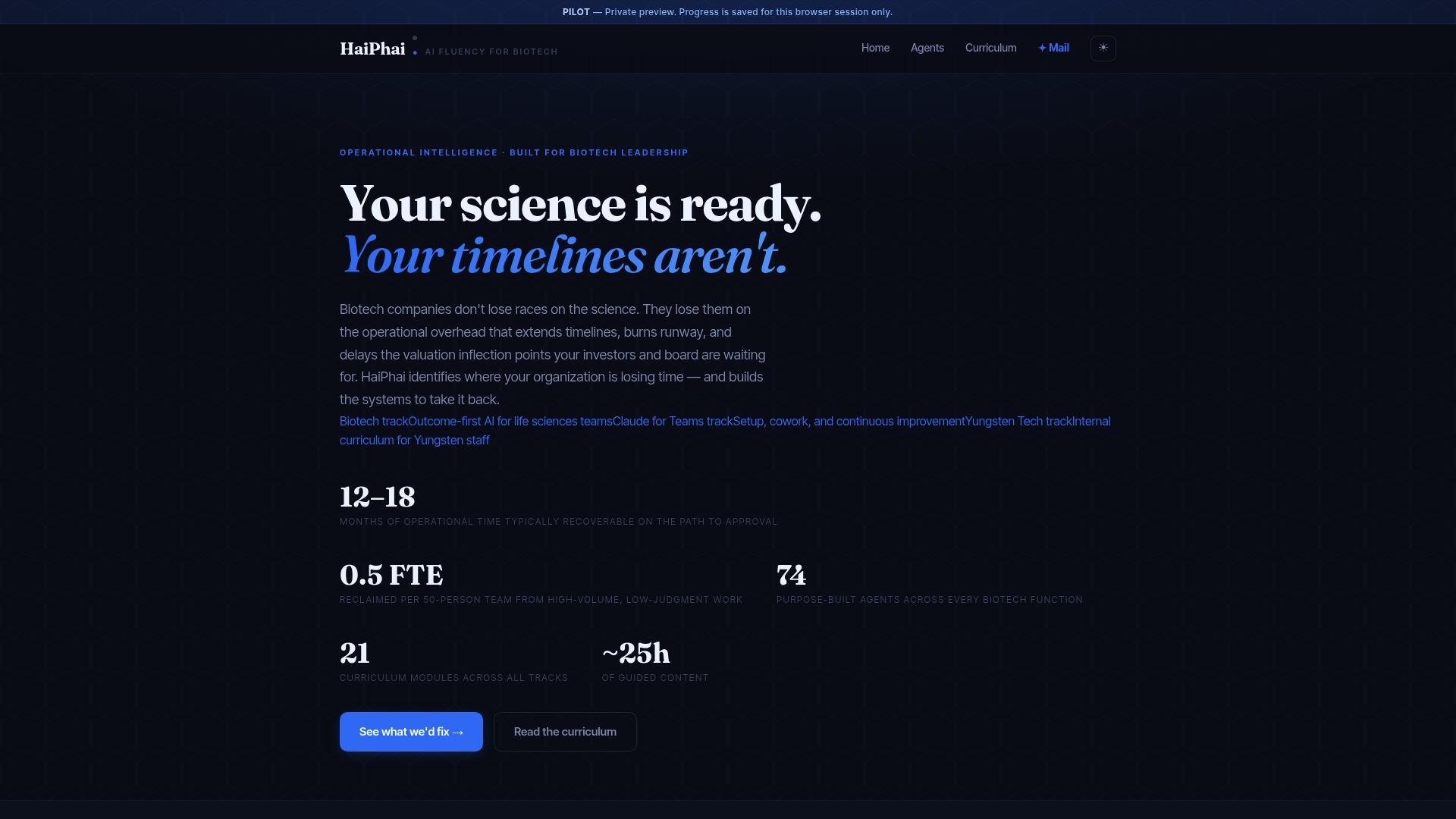
Haiphai's focus areas include AI-enabled regulatory drafting, clinical site activation, enrollment acceleration, and CRO/CDMO vendor selection. Clients have reclaimed up to 18 months of operational time on the path to approval. That time translates directly into valuation: every month you shorten between IND filing and first patient dosed is a month of cash burn you avoid and a milestone you hit before the next investor meeting.
The right time to engage is before Series A, before IND filing, or whenever you have strong scientific data but recognize that clinical execution is the rate-limiting step. Explore Haiphai's solutions or review the full services and engagement models to assess fit for your program.
FAQ
How long does the biotech VC fundraising process take?
From first investor meeting to close, the full process typically takes close to a year. Scientific and operational due diligence alone now can take many months at most institutional funds.
What is the most common reason biotech rounds fail?
Valuation misalignment and a disconnect between scientific data and the investor narrative are the two leading causes. A fundable package requires team, data, traction, market, IP, and valuation to all be in sync.
How much do biotech companies typically raise at Series A?
Series A rounds in biotech typically raise $15–40M tied to the completion of IND-enabling studies, with valuation driven primarily by the preclinical data package and regulatory path clarity.
What does a VC look for in a biotech data room?
Investors expect traceable raw data, documented SOPs, CRO/CDMO contracts with milestone-linked SLAs, IP landscape analysis, and a regulatory strategy document. Gaps in any of these extend diligence timelines.
When should a biotech team engage an operational partner like Haiphai?
The best time is before Series A or before IND filing, when scientific data is strong but clinical execution or regulatory documentation is the rate-limiting step to the next funding milestone.