
Asset de-risking in biotech is defined as the deliberate reduction of scientific, regulatory, manufacturing, and commercial risk across a drug's development lifecycle. The best biotech asset de-risking examples from 2026 show that this work starts at project inception, not at Phase 2. Standards like ICH Q9(R1) Quality Risk Management now anchor these programs, and recent accelerated approvals, including the 61-day BLA clearance of the Otarmeni AAV gene therapy, prove that early, systematic risk reduction translates directly into faster, more credible regulatory outcomes. This guide breaks down the most effective strategies by development stage so you can apply them to your own portfolio.
1. What are the most impactful early-stage de-risking strategies?
Cross-functional integration from day one is the single most effective early-stage move. Bringing science, clinical, regulatory, and CMC teams together at project inception forces hard questions about manufacturability and regulatory fit before resources are committed. Early cross-functional teams and AI usage to answer regulatory and market questions first raise success probability well before Phase 1.
Out-licensing preclinical or early clinical assets is a proven method for sharing financial exposure while validating scientific value. The AbbVie and RemeGen deal in march 2026 is a clear example: a major pharma partner absorbs downstream development cost while the originator captures upfront and milestone payments. This structure lets smaller biotechs recycle capital into their next asset rather than betting everything on a single program.

Platform technology adoption reduces manufacturing risk by reusing validated processes across multiple assets. When a company builds on an established expression system or delivery vehicle, it avoids the time and cost of custom CMC development for each new molecule. That reuse also creates a defensible regulatory narrative, since agencies have already reviewed the platform's safety profile.
Quality Risk Management per ICH Q9(R1) provides the formal structure that ties these activities together. Applying a unified risk register across discovery, preclinical, clinical, and CMC functions prevents each team from managing risk in isolation. The register becomes the single source of truth for go/no-go decisions at every stage gate.
Pro Tip: Assign a named risk owner to each category in your register. Without ownership, risk items accumulate without resolution and siloes persist regardless of how well the register is designed.
2. How does regulatory strategy speed up asset de-risking?
Dossier pressure-testing before filing is the most direct way to remove regulatory uncertainty. Teams that simulate agency review, identify gaps in CMC data packages, and resolve off-target characterization questions before submission dramatically reduce the chance of a Complete Response Letter. The 61-day accelerated BLA approval of Otarmeni gene therapy in april 2026 is the clearest recent proof that this approach works at the highest level of regulatory complexity.
Rolling Biologics License Applications (BLAs) offer another path for novel modalities. By submitting completed sections as they are finalized, sponsors give reviewers more time with the data and reduce the information density of the final package. This is particularly relevant for in vivo CRISPR programs, where the regulatory precedent set by Otarmeni now informs how teams construct dossier-level off-target characterizations for upcoming advanced modalities.
Early engagement with the FDA and EMA is not optional for high-risk modalities. Pre-IND meetings, Type B meetings, and Scientific Advice procedures let you align on endpoints, biomarker strategies, and manufacturing standards before you generate the data. Surprises at filing are almost always the result of assumptions made without agency input.
Regulatory strategy is not a late-stage activity. The teams that treat FDA and EMA engagement as a discovery-phase tool consistently file stronger dossiers and face fewer post-submission questions.
Pro Tip: Request a pre-IND meeting specifically to discuss your CMC strategy, not just your clinical protocol. CMC gaps are the most common source of BLA delays, and agencies will tell you what they need if you ask early enough.
3. What operational risk management practices protect biotech assets?
Lifecycle-aware governance links risk categories from discovery through commercialization into a single decision-making framework. Assigning specific process owners to each risk category within a unified taxonomy prevents the siloed assessments that cause late-stage surprises. Leadership that treats risk management as a strategic function, rather than a compliance exercise, gains measurably better operational maturity and investor confidence.
The following practices define a lifecycle-aware risk program:
- Build a unified risk register that spans CMC, clinical, regulatory, and commercial functions.
- Assign a named owner to each risk category with authority to escalate and resolve.
- Time insurance solutions, including Directors and Officers (D&O) and Errors and Omissions (E&O) coverage, to development milestones rather than calendar years.
- Include payer mix, reimbursement dynamics, and international Health Technology Assessment (HTA) requirements as formal risk categories from the start.
- Link capital allocation decisions and talent retention plans directly to asset risk status.
Failing to account for payer mix and HTA requirements is a major oversight that causes costly late-stage failures. A drug that clears FDA review but cannot achieve reimbursement in key markets has not been de-risked. Specialized insurance and regulatory teams help identify these non-traditional risk vectors before they become existential.
Pro Tip: Use your risk register to guide hiring decisions. If your CMC risk score is elevated, that is the signal to bring in a senior CMC leader, not to wait until a manufacturing failure forces the hire.
4. How do licensing deals function as de-risking examples?
Out-licensing is a financial de-risking tool, not a sign of weakness. Preclinical and early clinical asset licensing has accelerated sharply in 2026, particularly among Chinese biotech firms that have built strong biology platforms and now seek global partners to share development cost. The structure of these deals matters as much as the headline value.
Milestone-based payment structures distribute risk across time. A deal with a modest upfront payment and large clinical and regulatory milestones aligns partner incentives with asset performance. Short-term risk sharing through co-development agreements lets both parties exit if early data disappoint, rather than locking capital into a failing program.
The choice between multiple small deals and fewer large deals reflects different risk philosophies:
| Deal structure | Risk profile | Best suited for |
|---|---|---|
| Multiple small deals | Diversified exposure, lower upside per asset | Platforms with many early-stage assets |
| Fewer large deals | Concentrated risk, higher milestone potential | Late-stage assets with strong clinical data |
| Co-development agreements | Shared cost and decision rights | Novel modalities with regulatory uncertainty |
Geopolitical and compliance risk in cross-border partnerships deserves explicit treatment in any deal structure. Export controls, data localization requirements, and manufacturing jurisdiction rules can all affect whether a licensed asset can be developed and commercialized as planned. These factors belong in the risk register before term sheets are signed.
5. Which methods reduce manufacturing and clinical trial risk?
Platform technologies with existing FDA Master Files are the fastest path to reduced CMC risk. Using established Master Files means the agency has already reviewed the core manufacturing process, so your submission focuses on asset-specific data rather than platform validation. This approach cuts development timelines and reduces the probability of a manufacturing-related clinical hold.
Clinical trial design choices carry as much risk as manufacturing decisions. Incorporating validated biomarkers as primary or secondary endpoints anchors decision-making in objective data rather than clinical judgment alone. Real-time data monitoring allows protocol amendments before enrollment failures become irreversible. AI-enabled patient recruitment tools now close the gap between protocol design and actual site performance, reducing the timeline drag that kills otherwise viable programs.
Supply chain and product logistics risk is underweighted in most de-risking programs. Cold chain failures, single-source raw material dependencies, and customs delays can all halt a clinical program at critical moments. Building redundancy into supply agreements and qualifying backup suppliers before Phase 3 is a manufacturing risk practice that pays for itself many times over.
Investor confidence now hinges on early demonstration of regulatory and market risk mitigation, not just biological promise. The distinction between platform-level and asset-level de-risking matters here. Investors value clinical-stage milestones more than platform announcements, so your risk reduction work needs to produce asset-specific data that translates into credible development narratives.
Key Takeaways
The most effective biotech asset de-risking programs integrate cross-functional governance, regulatory pressure-testing, and platform leverage from project inception rather than applying them reactively at later stages.
| Point | Details |
|---|---|
| Start de-risking at inception | Cross-functional teams from day one prevent costly late-stage surprises in CMC and regulatory strategy. |
| Pressure-test dossiers early | Pre-submission gap analysis reduces Complete Response Letters and supports accelerated review timelines. |
| Assign risk ownership | Named owners for each risk category in a unified register prevent siloed decision-making across functions. |
| Use licensing to share exposure | Milestone-based out-licensing distributes financial risk while validating asset value with external partners. |
| Include commercial risk from the start | Payer mix, HTA requirements, and reimbursement dynamics belong in the risk register alongside CMC and clinical risks. |
The governance gap most biotech teams still haven't closed
Most biotech teams I work with have a risk register. Very few have a risk governance structure that actually changes decisions. The register exists, gets updated before board meetings, and then sits dormant until the next crisis. That is not risk management. That is documentation.
The shift I have seen work is treating risk governance the same way you treat a clinical development plan: it has owners, timelines, escalation paths, and consequences for inaction. When a CMC risk item sits unresolved for two quarters, that is a leadership failure, not a process failure. The lifecycle-aware governance model that links risk categories to capital allocation and hiring decisions is the version that actually protects assets.
The other gap I see consistently is the commercial blind spot. Teams spend enormous energy on regulatory and manufacturing risk, then get blindsided by payer dynamics or HTA rejections in key markets. A drug that cannot achieve reimbursement has not been de-risked. Adding a commercial risk lane to your register, with a named owner and milestone-linked reviews, closes that gap before it becomes expensive.
AI is changing the speed at which risk intelligence can be generated and acted on. AI in regulatory affairs is already producing faster dossier gap analyses and more consistent CMC narratives. The teams that embed these tools into their risk workflows now will have a structural advantage in the next funding cycle. The ones that wait will be explaining delays to investors who have already seen what is possible.
— John
How Haiphai supports biotech asset protection
Haiphai works with biotech teams that need to move faster without adding headcount. The focus is on the operational bottlenecks that extend timelines and drain capital, including regulatory drafting, clinical site activation, and cross-functional alignment gaps.
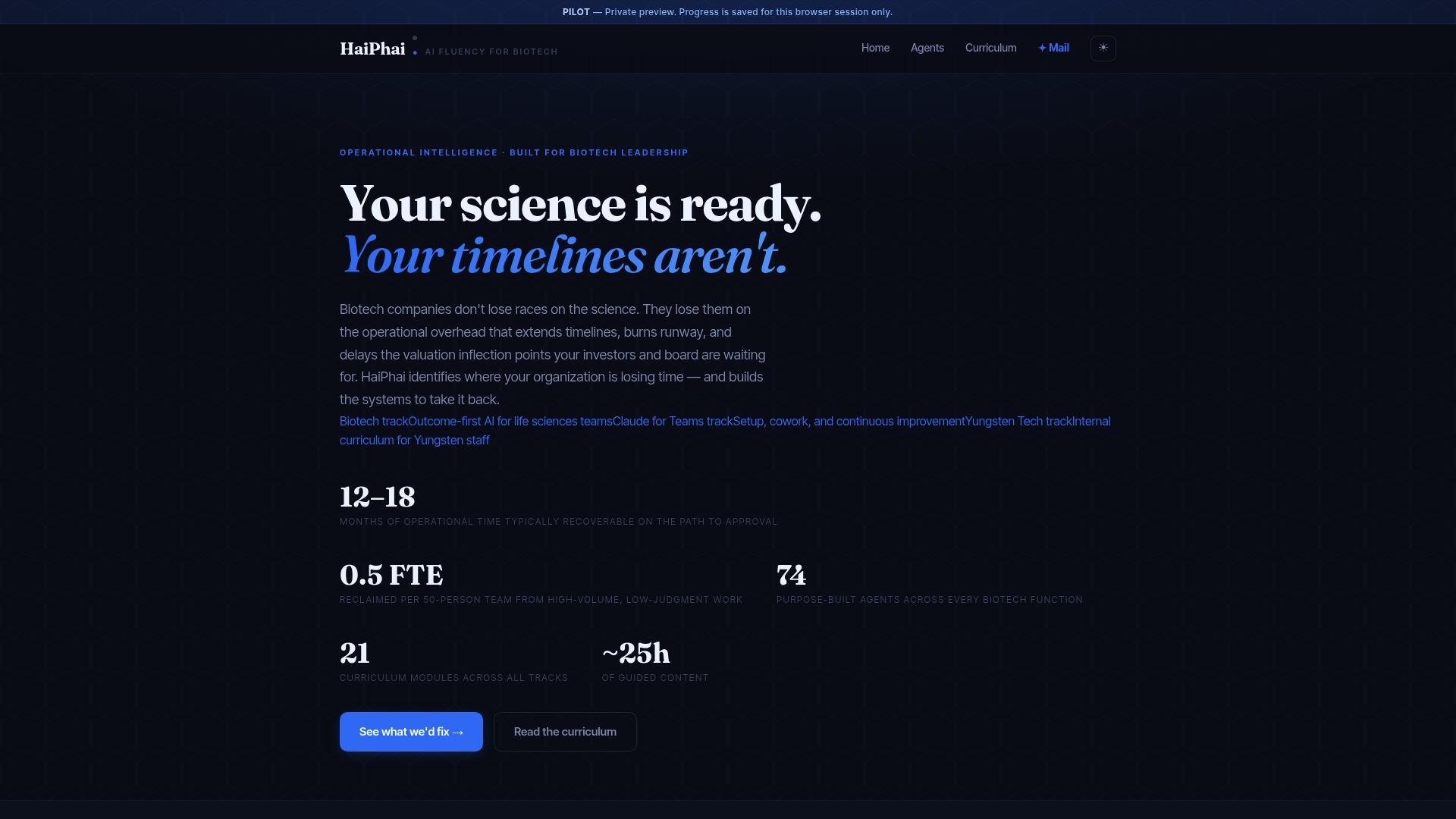
Haiphai's AI-driven solutions for biotech teams address the specific risk vectors covered in this article: dossier pressure-testing, regulatory strategy support, and real-time decision intelligence across CMC and clinical functions. Teams working with Haiphai have reclaimed up to 18 months of operational time on the path to approval. That time directly affects valuation and funding outcomes. If your de-risking program has gaps in regulatory or operational execution, Haiphai's tailored services are built to close them.
FAQ
What is biotech asset de-risking?
Biotech asset de-risking is the systematic reduction of scientific, regulatory, manufacturing, and commercial risk across a drug's development lifecycle. It uses tools like ICH Q9(R1) Quality Risk Management, dossier pressure-testing, and out-licensing to improve the probability of approval and commercial success.
What is a real example of asset de-risking in biotech?
The accelerated BLA approval of Otarmeni AAV gene therapy in 61 days in april 2026 is a direct result of dossier pressure-testing and early regulatory alignment. That approval demonstrates how pre-submission gap analysis translates into faster, cleaner regulatory outcomes.
How does out-licensing reduce biotech investment risk?
Out-licensing transfers a portion of development cost and risk to a partner in exchange for upfront payments and milestones. Milestone-based structures align partner incentives with asset performance and allow both parties to exit if early data do not support continued investment.
Why do biotech de-risking programs fail?
Most programs fail because risk registers exist without governance structures that force decisions. Without named owners, escalation paths, and links to capital allocation, risk items accumulate without resolution and late-stage surprises become inevitable.
How does AI improve biotech risk management?
AI tools accelerate dossier gap analysis, improve patient recruitment modeling, and generate real-time decision support across CMC and clinical functions. These capabilities let teams identify and resolve risk items faster than traditional manual review processes allow.