
A biotech term sheet is a non-binding 5-10 page document that summarizes the proposed economic and governance terms between a life sciences company and its investors or licensing partners, serving as the blueprint for all definitive legal agreements that follow. Every funding round and licensing deal in biotech begins here. Founders who treat the term sheet as a formality rather than a strategic document consistently leave value on the table. This guide breaks down how a biotech term sheet works, what each clause actually means for your company, and how to negotiate from a position of knowledge rather than reaction.
How a biotech term sheet works: structure and purpose
A term sheet is not a contract. It is a structured summary of proposed deal terms that both parties agree to use as the foundation for drafting binding agreements. In biotech, this distinction matters because the definitive documents, whether a Stock Purchase Agreement, License Agreement, or Co-Development Contract, are where the legal teeth live. The term sheet is where the commercial logic gets established.
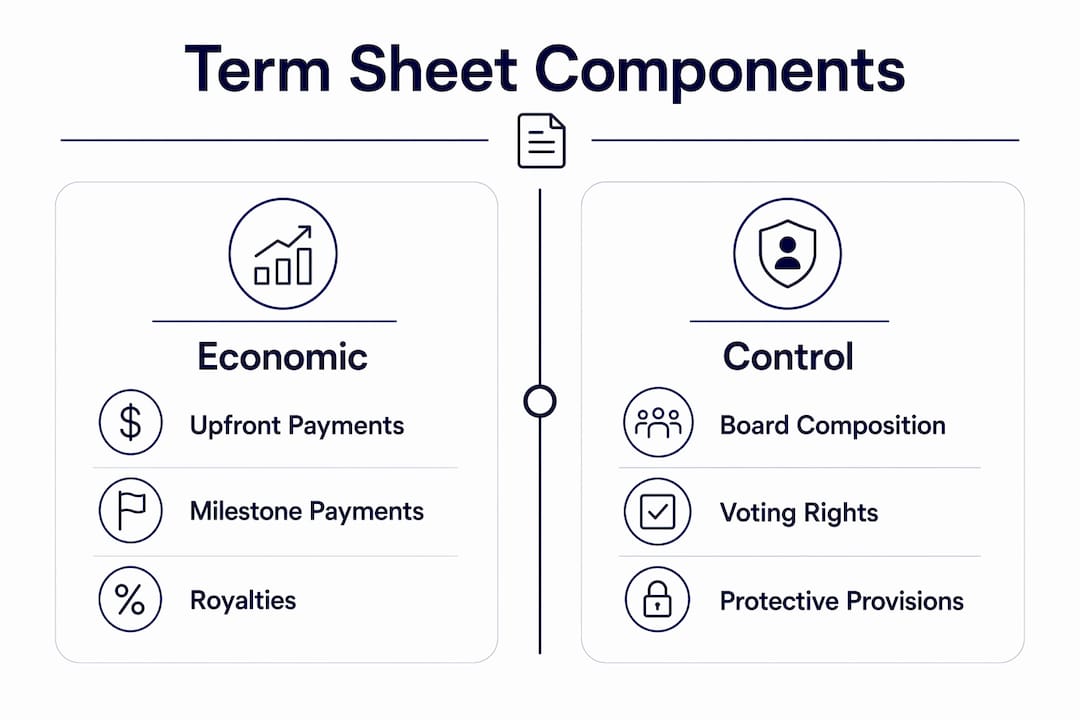
The document typically covers two categories of terms: economic and control. Economic terms define how money flows. Control terms define who makes decisions. Both categories carry long-term consequences that extend well beyond the closing date. Founders who understand this structure before entering negotiations hold a measurable advantage over those who encounter it for the first time across the table from a professional business development team.

Term sheets in biotech serve a second function beyond deal structure. They signal seriousness. A signed term sheet from a credible investor or pharma partner tells your board, your scientific advisors, and your next set of potential partners that your asset has been independently validated. That signal has real value in a sector where reputation and momentum matter as much as data.
What are the core components of a biotech term sheet?
The components of a biotech term sheet divide cleanly into economic terms and control terms, though the two categories interact in ways that can shift the overall value of a deal significantly.
Economic terms
Economic terms define the financial structure of the deal. In licensing agreements, these include upfront payments, development milestone payments, commercial milestone payments, and tiered royalties on net sales. In investment term sheets, economic terms cover pre-money valuation, investment amount, post-money ownership percentage, and liquidation preferences.
| Term Type | Component | Standard Range or Structure |
|---|---|---|
| Economic | Upfront payment | $100M to $700M in large 2026 deals |
| Economic | Development milestones | Triggered by IND, Phase I, Phase II, NDA filing |
| Economic | Commercial milestones | Triggered by approval and net sales thresholds |
| Economic | Royalties | Tiered, typically 8-20% of net sales |
| Control | Board seats | 1-2 investor seats standard in Series A/B |
| Control | Protective provisions | Veto rights on major decisions |
| Control | Liquidation preference | 1x non-participating is standard; participating preferred is more aggressive |
| Control | Anti-dilution | Weighted average is standard; full ratchet is rare but punishing |
Control terms
Control terms govern who has authority over key company decisions. Board composition, voting rights, and protective provisions all fall here. Protective provisions act as veto rights on decisions such as issuing new equity, selling the company, or taking on debt. Founders often underestimate how much these clauses constrain future flexibility, particularly when a company needs to pivot its clinical strategy or raise a bridge round under pressure.
Most term sheets also include a no-shop or exclusivity clause, which prevents the company from soliciting competing offers for a defined period, typically 30 to 60 days. Confidentiality provisions are standard and usually binding even when the rest of the term sheet is not.
How do biotech investment term sheets differ from licensing term sheets?
These are two distinct documents serving two distinct purposes, and conflating them is one of the most common mistakes early-stage biotech founders make.
A biotech investment term sheet governs equity financing. Its primary focus is valuation, ownership dilution, investor rights, and governance. The key economic question is: at what price and on what terms does the investor receive equity in the company? The key control question is: what decisions require investor approval going forward?
A biotech licensing term sheet governs the transfer of intellectual property rights from one party to another, typically from a startup to a larger pharma or biotech company. Its primary economic focus is the payment structure: upfront, milestones, and royalties. Its control focus is the scope of the license, including field of use, territory, exclusivity, and sublicensing rights.
The differences in practice are significant:
- Investment term sheets reference pre-money valuation, cap tables, and pro-rata rights. Licensing term sheets reference licensed patents, field definitions, and diligence obligations.
- Investment term sheets include anti-dilution provisions and pay-to-play mechanisms. Licensing term sheets include development diligence requirements and termination rights.
- Biotech investment term sheets define liquidation preferences that determine payout order in an exit. Licensing term sheets define royalty tiers that determine revenue share over a product's commercial life.
- A licensing deal can exist alongside an equity investment, particularly in co-development structures where the partner both licenses the asset and takes an equity stake.
Understanding which type of term sheet you are negotiating determines which terms deserve the most scrutiny and which advisors you need in the room.
Key economic terms: valuation, milestones, and royalties explained
The economic terms in a biotech term sheet are where deal value is created or destroyed. Most founders anchor on the headline total deal value, which is a mistake. Probability-weighted expected value places far greater importance on upfront payments and near-term development milestones because distant commercial milestones carry substantial execution risk. A $1 billion deal with $50 million upfront and $950 million in sales milestones is worth far less in expected value terms than a $600 million deal with $200 million upfront and $400 million in development milestones.
Upfront payments in large 2026 licensing deals range from $100 million to $700 million, depending on clinical stage, asset differentiation, and competitive interest. Earlier-stage assets command lower upfronts but can negotiate higher milestone values if the data package is compelling.
Milestone payments split into two categories. Development milestones trigger on clinical and regulatory events: IND acceptance, Phase I completion, Phase II data readout, NDA or BLA filing, and regulatory approval. Commercial milestones trigger when the product reaches defined net sales thresholds after launch. Development milestones are more predictable and should be weighted heavily in negotiation.
Royalties are typically tiered based on annual net sales. A standard structure might apply a 10% royalty on the first $500 million in net sales, 13% on the next $500 million, and 16% above $1 billion. The definition of "net sales" and the deductions allowed against it are negotiating points that can shift effective royalty rates by several percentage points.
In investment term sheets, liquidation preferences determine payout order in an acquisition or wind-down. A 1x non-participating preference returns invested capital to investors before founders receive proceeds, but does not allow investors to also participate in the remaining distribution. Participating preferred is more aggressive: investors get their capital back and then share in remaining proceeds alongside common stockholders. The difference can mean millions of dollars to founders in a mid-sized exit.
Pro Tip: Before entering any term sheet negotiation, calculate your probability-weighted expected value for each economic scenario. Assign realistic probabilities to each milestone based on historical clinical success rates for your indication, then compare total expected values across competing offers rather than headline totals.
Understanding control terms and founder protections
Control terms receive less attention than economic terms during negotiation, but they determine how much authority founders retain over the company's direction after the deal closes.
Board composition is the most consequential control term in an investment deal. A standard Series A might give investors one or two board seats out of five total. Founders who give up board majority at Series A often find themselves unable to block decisions at Series B when additional investor seats are added. Negotiate for an independent director seat that founders and investors jointly select, rather than allowing investors to designate all non-founder seats.
Protective provisions function as investor veto rights. Common triggers include issuing new equity classes, selling or merging the company, taking on debt above a defined threshold, and amending the certificate of incorporation. These provisions are standard and reasonable in moderation. The risk is in the scope. Broadly drafted protective provisions can require investor consent for routine operational decisions.
Anti-dilution and pay-to-play provisions require careful attention because they can materially affect ownership and future fundraising. Weighted-average anti-dilution is the market standard and is fair to both sides. Full-ratchet anti-dilution is punishing to founders and should be rejected. Pay-to-play provisions require existing investors to participate in future rounds or lose their preferred status, which can create pressure during difficult fundraising environments.
Drag-along rights allow a majority of shareholders to force all shareholders to approve a sale of the company. These are standard but should include a minimum price threshold below which the drag-along cannot be triggered, protecting founders from being forced into a low-value exit.
Pro Tip: Triage your negotiation focus in this order: economic terms first, veto rights second, administrative process terms third. Founders who spend negotiating capital on cosmetic language changes in process sections while accepting aggressive participating preferred structures consistently underperform on actual deal value.
Strategies for negotiating a biotech term sheet effectively
Effective negotiation of a biotech term sheet requires preparation before the first conversation, not during it.
-
Run a structured competitive process. Engaging 3 to 5 qualified partners simultaneously can increase deal value by 30 to 50% compared to bilateral negotiations. Set a clear timeline of 4 to 6 weeks for term sheet submissions so all parties move in parallel.
-
Establish walk-away positions before you start. Founders who lack predetermined negotiation ranges are structurally disadvantaged against professional BD teams who close deals every quarter. Know your minimum acceptable upfront, your floor on royalty rates, and your limit on protective provisions before the first term sheet arrives.
-
Translate science into an executable development path. Licensing deals fail more often due to misaligned economic models or non-executable development plans than due to scientific shortcomings. Partners need to see a credible path from current data to regulatory approval, not just strong preclinical results.
-
Engage biotech-specific legal counsel. FDA and intellectual property considerations create negotiation complexities that general corporate lawyers are not equipped to handle. Milestone triggers tied to regulatory filings, proprietary manufacturing protocols, and IP assignment clauses all require specialized expertise.
-
Protect your reputation in competitive processes. Pharma BD teams prioritize credibility. Manufactured auctions with uninterested parties damage your standing in a sector where the same BD executives move between companies and remember how deals were run.
"The founders who get the best term sheets are the ones who walk in knowing exactly what they will and will not accept. Preparation is the only leverage that cannot be taken away from you."
Key takeaways
A biotech term sheet works by establishing the economic and control framework that governs all subsequent definitive agreements, making it the single most important document in any funding or licensing negotiation.
| Point | Details |
|---|---|
| Term sheet purpose | A non-binding 5-10 page document that sets economic and control terms for definitive agreements. |
| Prioritize upfront cash | Probability-weighted value favors upfront payments and near-term milestones over distant sales targets. |
| Investment vs. licensing | Investment term sheets govern equity and governance; licensing term sheets govern IP rights and payment structure. |
| Control terms matter | Protective provisions and board composition determine founder authority long after the deal closes. |
| Competitive process pays | Running 3 to 5 parallel negotiations can increase final deal value by 30 to 50%. |
What I've learned from watching founders negotiate term sheets
The most consistent mistake I see biotech founders make is treating the term sheet as a document to be reviewed rather than a negotiation to be led. By the time a term sheet arrives, the partner has already decided they want the deal. That is the moment of maximum leverage, and most founders spend it asking their general counsel to redline language rather than pushing on economics.
The second pattern I see repeatedly: founders over-index on headline deal value and under-index on deal structure. A $500 million deal with $400 million in Phase III and commercial milestones is, in probability-adjusted terms, often worth less than a $300 million deal with $150 million upfront and $150 million in Phase I and Phase II milestones. The math is not complicated, but it requires founders to think like investors rather than scientists.
The competitive process advice is real, but it comes with a caveat. Pharma BD teams talk to each other. Running a process with parties who have no genuine interest in your asset will get back to the partners who do. The goal is a credible process with genuinely interested parties, not a manufactured auction. Credibility is a long-term asset in this industry.
One more thing: the speed of a negotiation tells you something about the partner's conviction. A partner who moves quickly on economics but stalls on control terms is signaling where their real priorities are. Pay attention to what they push back on hardest. That is where the actual value is concentrated.
— John
How Haiphai helps biotech teams navigate complex deal structures
Understanding how a biotech term sheet works is one thing. Executing on that knowledge under time pressure, with multiple partners in parallel, while managing clinical operations and regulatory timelines, is another challenge entirely. Haiphai acts as an operational partner for life sciences teams, working backward from your strategic goals to identify where process bottlenecks are costing you time and negotiating leverage. Clients working with Haiphai have reclaimed up to 18 months of operational time on the path to approval, a direct input into company valuation and deal terms. When your data package is ready faster and your regulatory filings are cleaner, your term sheet position improves.
FAQ
What is a biotech term sheet?
A biotech term sheet is a non-binding document, typically 5 to 10 pages, that outlines the proposed economic and control terms for a funding or licensing deal. It serves as the blueprint for all definitive legal agreements that follow.
What are the main components of a biotech term sheet?
The core components include economic terms such as upfront payments, milestone payments, royalties, and valuation, alongside control terms such as board composition, protective provisions, anti-dilution rights, and liquidation preferences.
How do investment and licensing term sheets differ in biotech?
Investment term sheets focus on equity valuation, ownership dilution, and investor governance rights. Licensing term sheets focus on IP rights, field of use, payment structures including upfront and milestones, and royalty tiers on net sales.
How should founders prioritize term sheet negotiations?
Founders should address economic terms first, then veto rights and protective provisions, then administrative process terms. Upfront payments and near-term milestones carry higher probability-weighted value than distant commercial milestones and deserve the most negotiating focus.
Why does a competitive process improve biotech term sheet outcomes?
Engaging 3 to 5 qualified partners simultaneously creates genuine competitive tension that can increase final deal value by 30 to 50%. The key is running the process with credible, genuinely interested parties to protect your reputation with pharma BD teams.