
A site feasibility assessment determines whether a specific research site can meet a study's enrollment, timeline, budget, and data-quality requirements. It ends in one of three calls: go, conditional go, or no-go. The two axes that decide the outcome fastest are patient availability at that location and whether the investigator's team has the staff and systems to run the protocol without slipping.
TL;DR:
- Verifying a site's past enrollment performance is crucial, as inflated capacity claims often do not match actual recruitment on similar trials.
- Electronic health record tools can provide quick estimates of patient pools but require careful validation against previous site enrollment data.
- A comprehensive feasibility assessment should include protocol fit, patient population validation, investigator capacity, infrastructure, regulatory timelines, budget, and risk planning, all evaluated through a structured process.
- Effective scoring and gating before activation help prevent delays caused by sites that appear strong on paper but underperform in practice.
- Utilizing AI in workflows can shorten startup times by improving enrollment forecasting, streamlining regulatory drafting, and enabling proactive risk management.
Table of Contents
- What Does a Site Feasibility Assessment Actually Cover?
- Core Domains To Evaluate: A Sponsor-Ready Feasibility Checklist
- How Do You Run a Site Feasibility Assessment Step by Step?
- Common Feasibility Red Flags Sponsors Miss
- Using Data Tools To Validate Patient Availability
- Turning Feasibility Data Into a Defensible Shortlist
- How AI Shortens the Path From Feasibility to Activation
- Prioritizing Feasibility Under Time Pressure
- HaiPhai: An Operational Partner To Speed Up Site Activation
- Sources
- FAQ
What Does a Site Feasibility Assessment Actually Cover?
A feasibility assessment is a structured evaluation of whether a candidate site can execute a specific protocol, not a generic capability check. It goes far beyond the one-page questionnaire many sites fill out from memory. A feasibility playbook from UNC Clinical Research defines it as the systematic process of confirming a site can deliver the trial within its projected budget and timeline while protecting participant safety and data integrity.
That means the assessment connects directly to enrollment math, activation timing, and safety oversight. It's not a form. It's a diagnostic. On the sponsor side, clinical operations leads, feasibility managers, and sometimes biostatisticians weigh in. On the site side, the principal investigator, sub investigators, the research coordinator, and often a pharmacy or lab lead all need to answer questions before a site earns a "go."
Core Domains To Evaluate: A Sponsor-Ready Feasibility Checklist
- Protocol fit: Do the inclusion and exclusion criteria match the site's actual patient population, or will half the "eligible" patients get screened out on labs alone?
- Patient pool validation: Can the site produce real numbers (chart pulls, registry counts, prior enrollment on similar protocols) rather than a verbal estimate?
- Investigator and team capacity: How many active protocols is this PI currently running, and does the coordinator have bandwidth for another study's visit schedule?
- Infrastructure and data readiness: Does the site have the equipment, storage, and electronic data capture systems the protocol requires, including compatible eCOA vendor support?
- Regulatory and ethics timelines: What's the site's average IRB turnaround, and has it worked with this specific IRB or a central one before?
- Budget and resource allocation: Do payment terms and per-visit costs align with the sponsor's resource allocation model?
- Risk and contingency planning: What happens if the primary investigator leaves mid-study, or the projected patient pool falls 30% short?
Skipping any one of these domains is how sponsors end up with a site that looks strong on paper and stalls six weeks after activation.
How Do You Run a Site Feasibility Assessment Step by Step?
A feasibility process only works if it's repeatable across every candidate site and every program. Treat it as a five-stage pipeline, not a one-time survey.
- Build the questionnaire around the protocol's critical path. Skip generic questions. Ask specifically about the inclusion criteria that will actually bottleneck enrollment, and the procedures (imaging, specialized labs, infusion capacity) that are hardest to staff.
- Request pre-screen counts or EHR pulls. Ask sites to run a query against their own records or a registry, mapped directly to your inclusion and exclusion criteria, not a loose approximation.
- Triage responses before committing resources. Flag inconsistent answers or vague patient estimates for a deeper look; reserve site visits for sites that pass the remote check.
- Score and apply decision gates. Convert answers into a weighted score and compare against your non-negotiable minimums.
- Document findings and required mitigations. Before activation, write down every condition attached to a "conditional go," from added coordinator support to a shortened screening window.
Each stage should produce a paper trail. If a site later underperforms, that documentation tells you whether the miss was predictable.
Common Feasibility Red Flags Sponsors Miss
Most feasibility failures trace back to a handful of repeat offenders: inflated patient estimates, coordinator turnover mid-study, sites juggling competing trials for the same population, and IRB or contracting delays that eat weeks before the first patient is even screened.
The clearest warning sign is a mismatch between a site's claimed eligible patient count and its actual enrollment history on similar protocols. If a site says it can identify 200 eligible patients but enrolled only 4 on a comparable study last year, that gap needs an explanation before you move forward, not after.
- Investigator or coordinator has left (or is likely to leave) within the study window.
- Site is simultaneously recruiting for a competing trial with overlapping criteria.
- IRB approval history shows a pattern of multi-month delays.
- Budget negotiations stall over per-patient costs that don't match the region's norm.
Pro Tip: Ask for the site's actual enrollment numbers on its two most recent comparable trials, not its projected capacity. Past performance predicts future enrollment far more reliably than an optimistic verbal estimate.
When a red flag shows up but the site is otherwise strong, mitigation options include requiring a validated prescreen registry before activation, offering conditional activation with a 60 day enrollment checkpoint, supplying temporary enrollment support staff, or renegotiating the budget line specifically tied to patient recruitment costs.
Using Data Tools To Validate Patient Availability
Electronic health record queries, disease registries, and network-level tools like TriNetX give sponsors a fast read on how many patients in a given system match a protocol's basic criteria. These tools are useful for narrowing a shortlist, but UNC's feasibility guidance is blunt about their limits: raw counts routinely overstate the real enrollable population.
A good data request specifies a look-back window (12 to 24 months is typical), maps every inclusion and exclusion criterion individually rather than as a bundle, and asks for the query logic itself, not just a final number. Any count above what the site's own past enrollment history supports needs chart-level or investigator sign-off before it goes into a projection.
- Request the underlying query logic, not just a summary count.
- Cross-check EHR output against the site's enrollment on similar past protocols.
- Apply a conservative conversion rate rather than the raw eligible count.
- Require investigator validation before a number enters your enrollment model.
Turning Feasibility Data Into a Defensible Shortlist
Scoring only works if the categories and weights are set before data collection starts, not adjusted afterward to fit a favorite site.
Layer decision gates on top of the score. Some criteria should be pass/fail regardless of overall score: no active IRB in good standing, an inexperienced or unavailable PI, or a validated patient pool below the study's minimum threshold. A decision-tree framework from the MRCT Center is a useful structure for mapping these gates visually.
- Classify each site as primary, backup, or conditional based on score and gate results.
- Require a signed feasibility questionnaire, prescreen data, and IRB history before any site clears activation.
- Keep a risk register tied to key risk indicators for every conditional site.
- Revisit backup site status every 4 to 6 weeks during startup, not just once at the shortlist stage.
How AI Shortens the Path From Feasibility to Activation
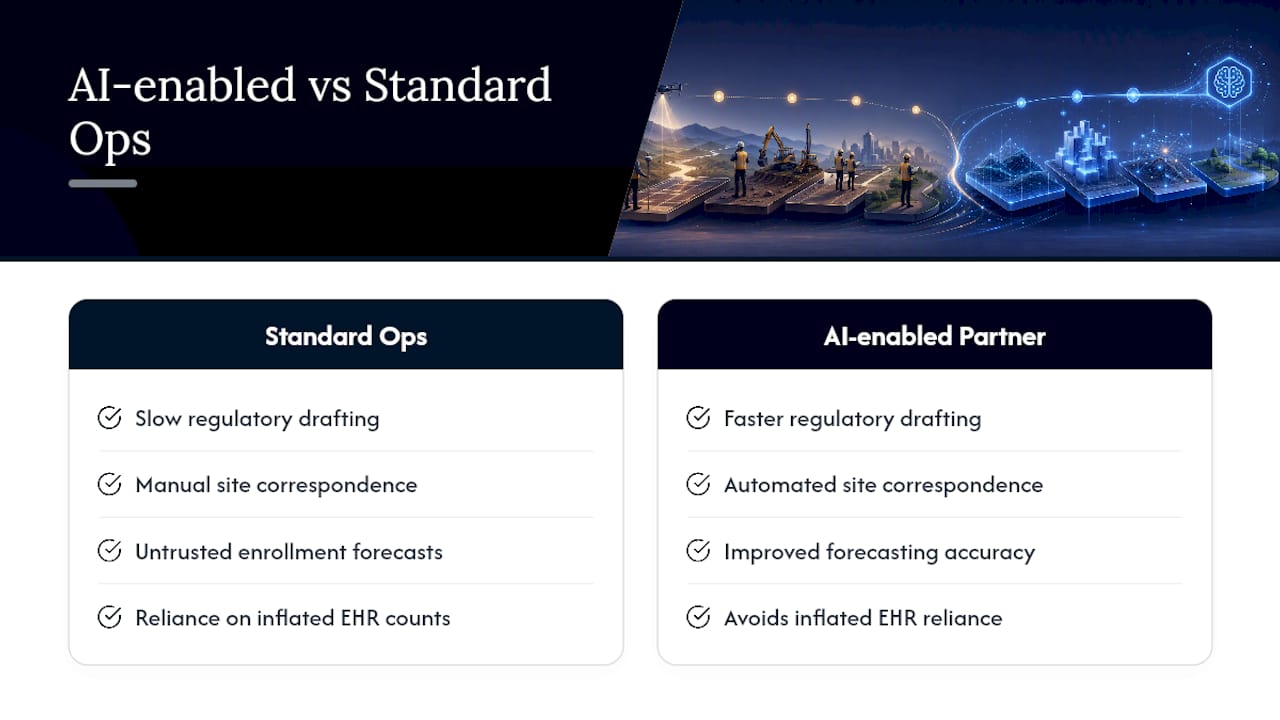
Most activation delays trace back to the same operational gaps: slow regulatory drafting, manual site correspondence, and enrollment forecasts nobody trusts. An operational partner that starts from the trial's actual goals and works backward tends to catch these bottlenecks earlier than a standard vendor relationship. AI can be integrated directly into regulatory drafting and site activation workflows, which can reduce startup delays and improve enrollment forecasting accuracy, helping sponsors avoid reliance on inflated EHR counts alone.
Prioritizing Feasibility Under Time Pressure
When timelines are tight, run patient pool validation and investigator track record first. Everything else can be conditional. I'd accept a conditional activation over a delayed one if the gap is staffing, not patient availability. My triage order: validated enrollment history, current PI caseload, IRB turnaround, then budget.
— John
HaiPhai: An Operational Partner To Speed Up Site Activation
Sponsors already juggling protocol design, regulatory submissions, and site negotiations rarely have spare bandwidth to also rebuild their feasibility process from scratch. An operational partner can embed directly into your team to diagnose where activation stalls, whether in regulatory drafting, site correspondence, or enrollment forecasting, and rebuild that specific workflow with AI tailored to your protocol.
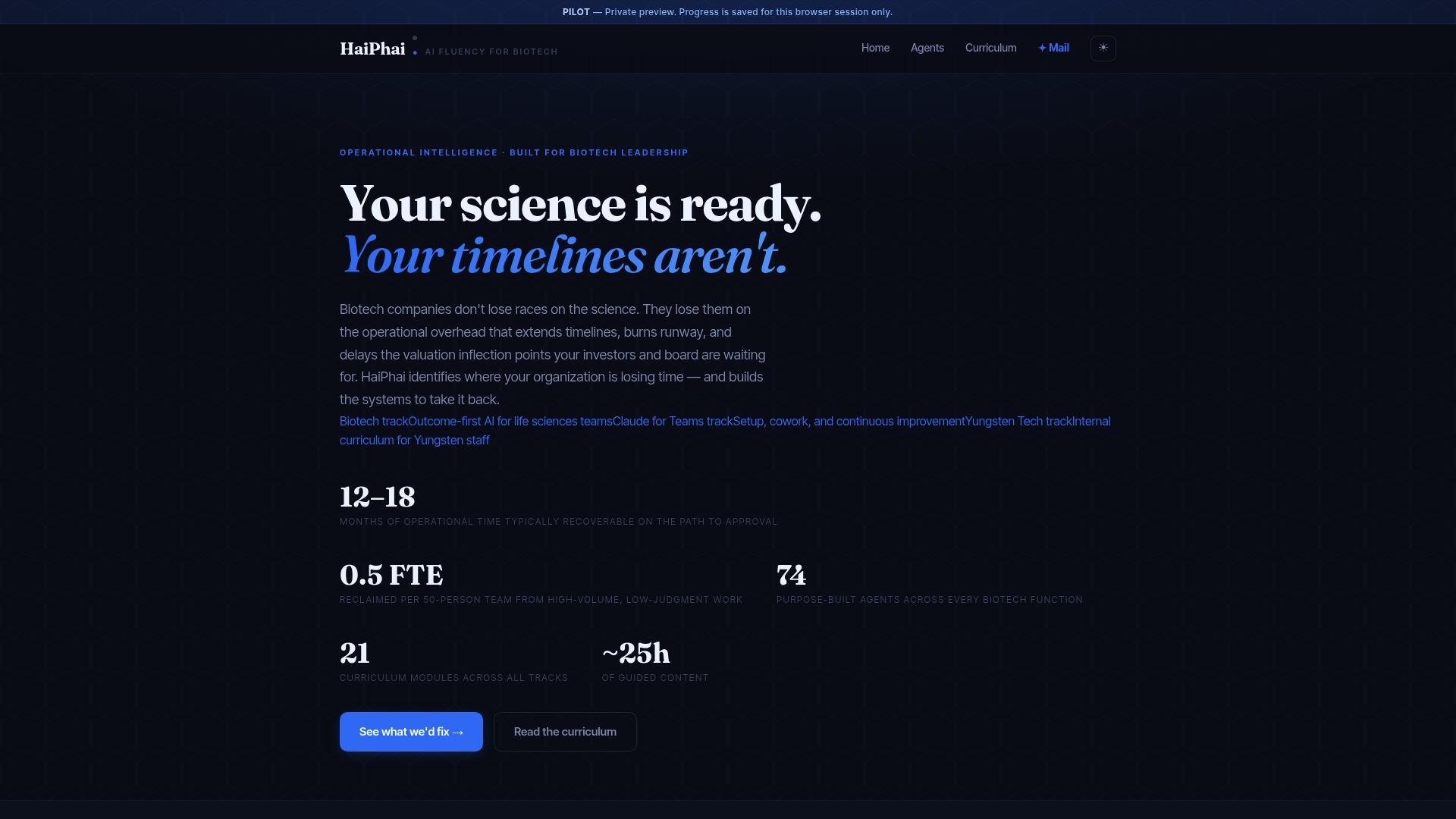
An initial engagement typically starts with a diagnostic review of where your current site activation timeline is losing weeks, followed by a scoped plan to close that gap. Sponsors working across biotech and life sciences can see how the model fits their program on the sector pages, and review governance and compliance details on the trust page before booking a diagnostic call.
FAQ
What Is a Site Feasibility Assessment?
It's a structured evaluation of whether a specific research site can deliver a trial's enrollment, timeline, budget, and data-quality requirements, ending in a go, conditional go, or no-go decision.
What Is Included in a Feasibility Assessment?
A complete assessment covers protocol fit, validated patient population data, investigator and team capacity, infrastructure readiness, regulatory and ethics timelines, budget fit, and a documented risk and contingency plan.
How Do You Do a Feasibility Assessment?
Build a protocol-specific questionnaire, request validated patient-count data, triage and confirm answers through remote checks or site visits, score results against decision gates, and document findings before activation. Operational partners like Haiphai can compress this workflow by automating parts of the drafting and validation steps.
What Is a Site Feasibility Questionnaire?
It's the data collection tool sponsors send candidate sites, typically covering patient population estimates, staff availability, prior trial experience, infrastructure, and regulatory history, and it forms the raw input for the scoring model.