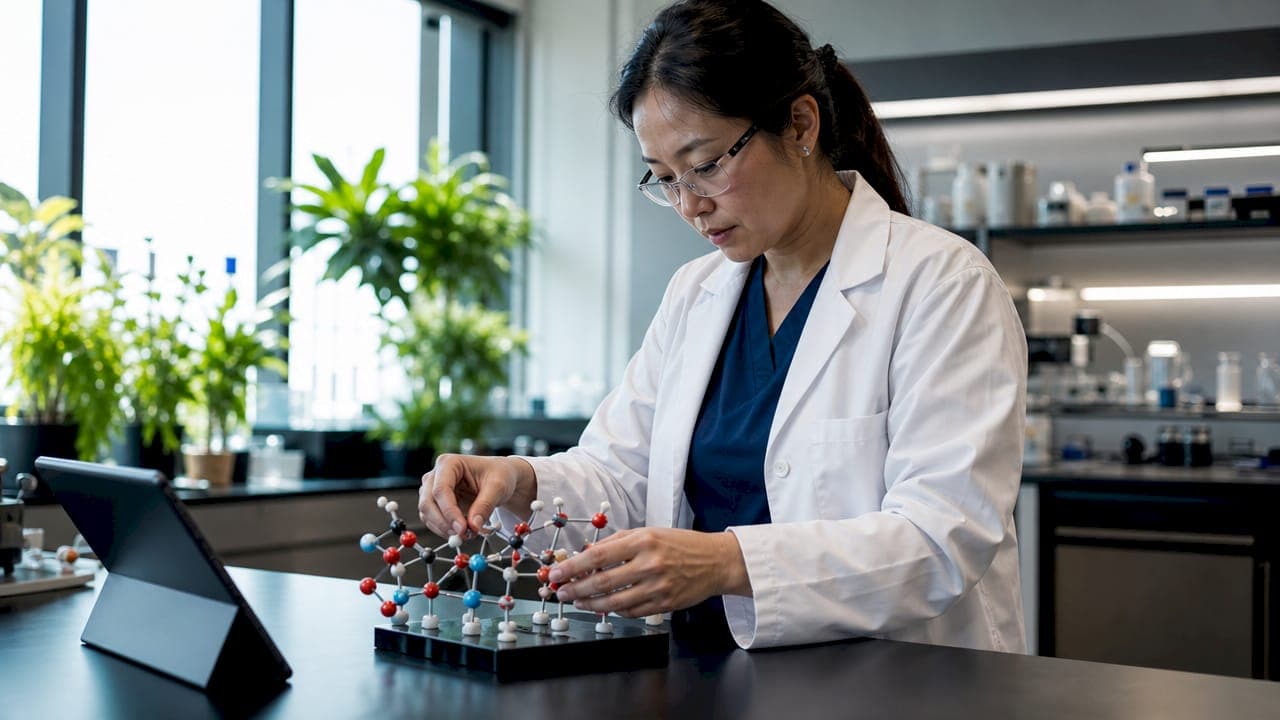
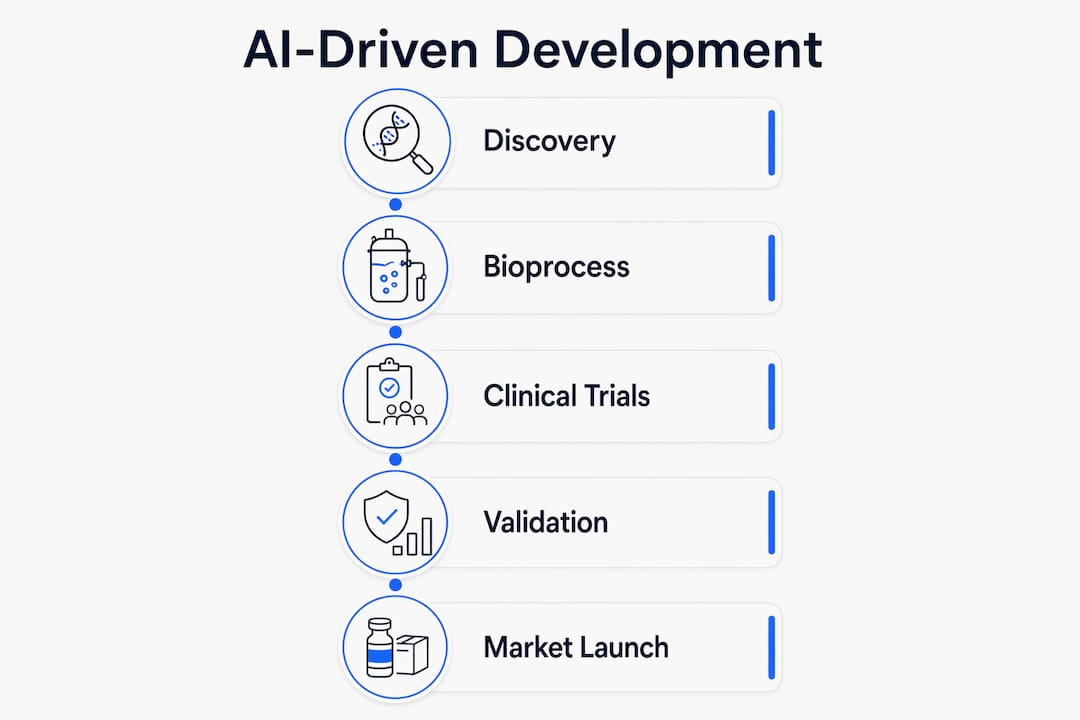
AI reduces biotech development cycles by compressing target-to-IND timelines from a historical 5–7 years down to 3–4 years with AI-native platforms. This compression is not a single-point improvement. AI accelerates drug discovery, cuts experimental runs in bioprocess development, and shortens clinical trial enrollment simultaneously. The compounding effect across all three phases is why AI in biotech development has shifted from a competitive advantage to an operational necessity. For biotech teams managing tight runways and investor timelines, understanding exactly where AI creates speed is the difference between a program that reaches approval and one that runs out of funding first.
Why AI reduces biotech development cycles at the discovery stage
Early drug discovery is where AI delivers its most dramatic speed gains. Target identification and molecule design have been compressed from 18–24 months to 6–12 months at leading pharmaceutical companies. That is a reduction of up to 50% in the most time-intensive phase of development.
The mechanism behind this acceleration is generative AI and machine learning applied to molecular design. Traditional medicinal chemistry relies on iterative synthesis and testing cycles that take weeks per round. Generative AI models can propose thousands of candidate molecules in hours, ranked by predicted binding affinity, selectivity, and ADMET properties. Teams then run wet-lab validation on a filtered shortlist rather than a broad, undirected pool.

This shift changes the nature of scientific work. Chemists spend less time generating candidates and more time interpreting results and refining hypotheses. The AI-driven design loop also learns from each experimental round, improving its predictions as more lab data feeds back into the model.
Key applications in AI-driven early discovery include:
- Generative molecular design: AI proposes novel scaffolds outside traditional chemical space, expanding the hit rate for first-in-class targets.
- Virtual screening: Machine learning models score millions of compounds against a target structure without physical synthesis.
- ADMET prediction: AI flags toxicity and metabolic liabilities early, removing poor candidates before they consume wet-lab resources.
- Iterative feedback loops: Lab results continuously retrain the model, tightening predictions with each cycle.
Pro Tip: Never treat AI predictions as final. Run wet-lab validation in parallel with each AI design cycle. Teams that skip this step accumulate model drift and end up with a pipeline full of candidates that look good computationally but fail in vitro.
How AI cuts experimental runs in bioprocess development
Bioprocess development is one of the most resource-intensive phases in the path to manufacturing. AI-guided experimentation, combined with digital twin technology, has fundamentally changed how teams approach this work.
Digital twins and AI integration reduced physical experiments from 22 to 8 per project while maintaining the same predictive accuracy. That reduction of 64% translates to approximately €40,000 in savings per project. For a program running multiple process development campaigns, the cumulative impact on budget and timeline is significant.
| Approach | Experiments required | Cost impact | Timeline impact |
|---|---|---|---|
| Traditional design of experiments | 22 per campaign | Baseline | Baseline |
| AI-guided hybrid modeling | 8 per campaign | ~€40,000 savings | Weeks faster per cycle |
Hybrid modeling is the technical foundation here. It combines mechanistic process understanding with machine learning, so the model does not need to learn everything from scratch. The mechanistic layer encodes known bioreactor physics and cell biology. The machine learning layer identifies patterns in process data that the mechanistic model alone would miss. Together, they predict optimal process parameters with far fewer physical runs.
The practical result is that teams move from exploratory experimentation to validation-focused experiments much faster. Rather than mapping a broad parameter space, AI narrows the search to the most informative regions. This produces better data earlier and reduces the time sinks caused by iterative design failures.
Pro Tip: Before deploying AI in bioprocess development, define your parameter space boundaries based on prior process knowledge. AI models trained on poorly bounded data waste experimental runs on uninformative edge cases.
How AI shortens clinical trial timelines
Clinical trials represent the longest and most expensive phase of drug development. AI-driven improvements in trial design and patient recruitment are now standard practice across leading life sciences organizations, replacing traditional bottlenecks that once added years to programs.
Trial design and patient matching powered by AI reduce cycle times by 30–50%. That range reflects the degree of AI integration. Teams using AI only for site selection see modest gains. Teams applying AI across protocol design, patient matching, enrollment monitoring, and adaptive trial adjustments see the larger end of that range.
The specific mechanisms driving this acceleration include:
- AI-enhanced patient matching: Natural language processing applied to electronic health records identifies eligible patients faster and more accurately than manual screening. Trial enrollment improvements of 27% have been documented with AI-assisted recruitment.
- Protocol optimization: Data-driven simulations test trial designs before a single patient is enrolled, identifying inclusion criteria that are too narrow or endpoints that are underpowered.
- Adaptive monitoring: AI flags enrollment slowdowns and safety signals in real time, allowing teams to intervene before a site falls critically behind.
- Regulatory documentation: AI drafts and cross-references regulatory submissions against trial data, reducing the manual burden on clinical operations teams. Haiphai's work in AI regulatory support shows how documentation workflows can be restructured to save months on the path to approval.
The business case is direct. Faster enrollment means earlier data readouts. Earlier data readouts mean faster go/no-go decisions. For a biotech company managing investor milestones, compressing a Phase II by six months can be the difference between raising a Series B on favorable terms or not raising at all.
Common challenges in implementing AI to reduce development cycles
AI does not automatically shorten timelines. The main ROI from AI currently comes from operational improvements in data management, documentation, and trial monitoring. Teams that expect AI to deliver discovery breakthroughs on day one consistently underperform those that start with operational integration.
The most common implementation challenges, in order of frequency:
- Data infrastructure gaps. Most organizations underestimate the data preparation work required before AI delivers returns. Data formatting, system integration, and quality checks often require 4–6 weeks of setup before any model can run productively.
- Model drift from inadequate feedback loops. Successful AI use requires continuous laboratory validation and data feedback. Teams that deploy a model and stop updating it see prediction quality degrade over time as the biology diverges from the training data.
- Confusing faster design with faster approval. Regulatory approval timelines remain bound to empirical data quality. AI can generate a candidate faster, but the FDA still requires the same standard of evidence. Speed in design does not compress the regulatory review clock.
- Siloed AI adoption. Teams that deploy AI in discovery but not in clinical operations capture only a fraction of the available time savings. The compounding effect requires integration across all development phases.
- Underinvestment in change management. AI tools require scientists and operations teams to change how they work. Without structured adoption support, utilization rates stay low and the technology delivers below its potential.
Understanding these challenges is not a reason to slow AI adoption. It is a reason to plan adoption with the same rigor applied to a clinical program. Teams that treat AI implementation as a multi-year operational investment, rather than a software purchase, consistently see the larger timeline reductions.
Key Takeaways
AI reduces biotech development cycles by compressing discovery, bioprocess, and clinical phases simultaneously, with the largest gains coming from teams that integrate AI across all three layers rather than deploying it in isolation.
| Point | Details |
|---|---|
| Discovery compression | AI cuts target identification and molecule design from 18–24 months to 6–12 months. |
| Bioprocess efficiency | Digital twins and AI reduce physical experiments by 64%, saving weeks and significant cost per campaign. |
| Clinical trial speed | AI-driven patient matching and protocol design reduce trial cycle times by 30–50%. |
| Infrastructure first | Data preparation takes 4–6 weeks before AI delivers productivity gains. |
| Operational ROI | The strongest near-term returns come from data management, documentation, and trial monitoring, not only discovery. |
The compounding effect is what most teams miss
My honest view is that the biotech industry is still thinking about AI in silos. Teams celebrate a faster hit identification run or a cleaner regulatory submission, but they rarely step back and calculate what happens when every layer of development compresses at the same time.
AI augmentation does not replace scientific judgment. The best programs I have seen treat AI as a force multiplier for experienced scientists, not a replacement for them. The judgment calls on which targets to pursue, which candidates to advance, and when to kill a program still require human expertise. What AI removes is the dead time between those decisions.
The decision-makers who get the most from AI are the ones who start with their bottlenecks, not with the technology. They ask where their program is losing months, then find the AI application that addresses that specific constraint. That is a fundamentally different approach from buying a platform and hoping it delivers. It is also the approach that produces the 18-month reclaim in operational time that separates well-funded programs from ones that stall before approval.
The uncomfortable truth is that AI does not make drug development easy. It makes the hard parts faster. Teams still need rigorous validation, strong regulatory strategy, and experienced operators. AI just means you can do more of that work in less time.
— John
Haiphai works where your program is losing time
Biotech teams that want to reduce development cycles need more than software. They need an operational partner who starts from the program's strategic goals and works backward to find where time is being lost.
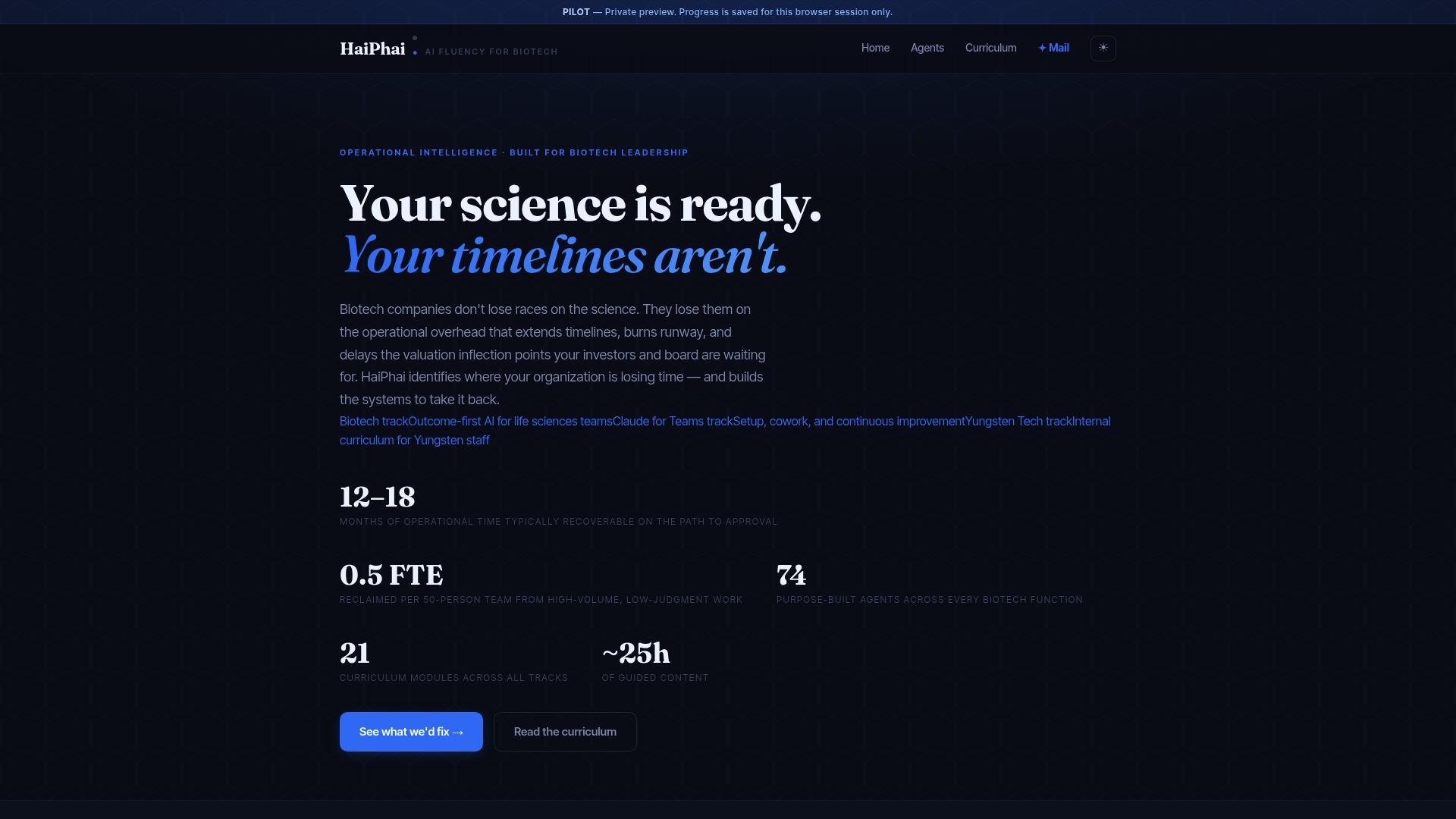
Haiphai does exactly that. From regulatory drafting to clinical site activation, Haiphai integrates AI into the workflows that are actually slowing your program down. Clients reclaim up to 18 months of operational time on the path to approval. That time translates directly into higher company valuation and stronger positioning for your next funding round. If you are ready to see where your program is losing months, Haiphai's solutions are built for life sciences teams who need results, not a generic platform. You can also review Haiphai's services to see how the operational model works in practice.
FAQ
Why does AI reduce biotech development cycles?
AI compresses development cycles by running parallel analyses across target identification, molecular design, bioprocess optimization, and clinical trial operations simultaneously. The compounding effect across all phases shortens total program timelines from 5–7 years to 3–4 years on AI-native platforms.
How much can AI shorten clinical trial timelines?
AI-driven trial design and patient matching reduce clinical trial cycle times by 30–50%, with documented enrollment improvements of 27% using AI-assisted recruitment tools.
Does faster AI design mean faster regulatory approval?
No. Regulatory approval timelines remain tied to empirical data quality. AI accelerates candidate design and documentation preparation, but the FDA requires the same standard of evidence regardless of how quickly a candidate was generated.
What is the biggest barrier to AI adoption in biotech?
Data infrastructure is the primary barrier. Most organizations require 4–6 weeks of data preparation and system integration work before any AI model can run productively. Teams that skip this step see poor model performance and delayed returns.
How does AI in bioprocess development reduce costs?
AI-guided hybrid modeling combined with digital twins reduces the number of physical experiments required per campaign by 64%, cutting costs by approximately €40,000 per project while maintaining the same predictive accuracy as traditional design-of-experiments approaches.