
The right vendor match starts with matching platform category to study complexity, not brand recognition. If your protocol has a handful of standard PRO instruments and a tight enrollment timeline, a modern API-first platform beats a heavyweight enterprise system almost every time. If you're running specialized clinician-rated scales or spirometry across a global Phase III, that calculus flips.
Apply three filters before you take a single vendor call:
- Protocol complexity: does the study need special endpoints, novel devices, or complex scoring algorithms?
- Integration and validation needs: how tightly must the eCOA system talk to your EDC or IRT/RTSM system?
- Time-to-deploy: what's your real enrollment date, and does the vendor's typical build timeline fit it?
Pro Tip: Before you evaluate a single feature, confirm the vendor can produce 21 CFR Part 11 compliant audit trails, handle HIPAA-covered data correctly, and export in CDISC format. Skip these regulatory checkboxes and every other comparison is wasted time.
TL;DR:
- Matching platform category to study complexity and integration needs ensures faster deployment, with API-first systems ideal for early-phase or decentralized trials.
- Confirm vendor compliance with regulatory standards like 21 CFR Part 11, HIPAA, and CDISC data formats before evaluating features or making commitments.
- Expect linguistic validation to take 2 to 3 weeks per language and plan for potential delays during site workflow testing and mid-study protocol amendments.
- Negotiate clear change-order terms and a fixed scope upfront to prevent budget overruns and ensure timely adaptability to protocol updates.
- An operational partner can outperform a standalone platform when internal bandwidth limits progress, focusing on workflow redesign and process efficiency.
Table of Contents
- What Should Be on Your eCOA Vendor Selection Checklist?
- How Do You Weigh Vendor Evaluation Criteria by Trial Type?
- What Does a Realistic eCOA Implementation Timeline Look Like?
- How Much Do eCOA Vendors Typically Charge?
- How Do You Reduce Implementation Risk and Track Vendor Performance?
- Why an Operational Partner Can Outperform a Standalone Platform
- How Should You Judge Vendor Reputation and Past Performance?
- How Customizable Are eCOA Solutions for Specific Trial Needs?
- Who Owns Your Data, and How Is It Managed?
- Can Your eCOA Vendor Scale With Trial Size and Phase?
- What Contract Terms Should You Negotiate Before Signing?
- How Responsive Is Vendor Technical Support?
- An Editorial Take on eCOA Vendor Priorities
- When an Operational Partner Makes More Sense Than a Platform Purchase
- Key Takeaways
- Sources
- FAQ
What Should Be on Your eCOA Vendor Selection Checklist?
A screening checklist keeps RFP conversations honest and comparable across vendors. Here's what to run through on every initial call, in order:
- Architecture model. Ask whether the platform is API-first or monolithic. API-first systems typically integrate with EDC and IRT platforms faster and with less custom engineering, which matters if your study already has committed integration partners.
- BYOD and device strategy. Confirm whether the vendor supports bring-your-own-device, provisioned devices, or both, and ask how offline mode handles connectivity gaps in rural or low-bandwidth sites.
- Accessibility features. Screen readers, font scaling, and multilingual keyboard support matter more in elderly or pediatric populations than most sponsors initially plan for.
- Data security and validation controls. Verify audit trail completeness, electronic signature workflows, and encryption both at rest and in transit. These map directly to 21 CFR Part 11 requirements, and any vendor unable to walk you through their validation package in detail is a red flag.
- Disaster recovery posture. Ask for their recovery time objective and where patient data is backed up. This is where vague answers reveal weak infrastructure.
- Standards readiness. Confirm the vendor exports data in CDISC-ready formats with proper timestamping, since retrofitting this mid-study is expensive and slow.
- Operational support model. Get specifics on UAT methodology, helpdesk service-level agreements, who owns the study build, and what training materials sites and patients actually receive.
This list mirrors what most leading vendor-selection guides converge on, and for good reason: architecture, security, and operational support are where implementations quietly succeed or fail.
How Do You Weigh Vendor Evaluation Criteria by Trial Type?
Not every criterion deserves equal weight, and the trial type should drive the ranking.
Enterprise platforms earn their premium when you're running a global Phase II or III study with a long regulatory history behind the platform, multiple concurrent studies sharing infrastructure, and a validation package regulators have already seen in prior submissions. Scale and provenance matter more than speed here.
Modern API-first platforms make sense for early-phase studies, hybrid trials, or decentralized trial (DCT) designs where you need to move fast and integrate with a changing stack of point solutions. Deployment cycles often run 4 to 8 weeks for standard PRO instruments on these platforms, compared with 12 to 16 weeks on enterprise systems once validation and customization are factored in.
Specialist vendors become necessary when the science demands it. Complex clinician-rated scales, spirometry integration, or actigraphy devices often require a vendor with deep clinical science behind the instrument, not just a flexible app builder.
Before signing anything, estimate your integration complexity honestly:
- How many external systems (EDC, IRT, safety database) need real-time data exchange?
- Does your team have engineering bandwidth to support a custom integration sprint?
- Will each integration require its own validation cycle, and who owns that testing?
Platform category should follow endpoint complexity and integration burden, not vendor familiarity, and that single decision rule prevents more downstream headaches than any feature comparison.
What Does a Realistic eCOA Implementation Timeline Look Like?
Implementation follows a predictable arc: vendor selection, kickoff, study build, user acceptance testing (UAT), validation, and go-live. Where teams get surprised is in the gaps between those milestones, not the milestones themselves.
- Selection to kickoff usually takes two to four weeks once contracts are signed, assuming legal and procurement don't stall.
- Study build varies enormously by platform category, ranging from a few weeks on API-first systems to several months on enterprise platforms with heavy customization.
- UAT and validation frequently run longer than planned because sites discover workflow issues only once they're testing against real protocol logic.
- Linguistic validation for translated instruments is the most underestimated line item. Plan on 2 to 3 weeks per language for validated instruments, and budget extra time for cognitive debriefs if patient-facing wording could affect endpoint interpretation.
Vendor responsibilities and sponsor/CRO responsibilities need explicit documentation early, because ambiguity here is where timelines quietly slip. Compress the schedule by using a vendor's existing instrument library instead of custom-building scales, running validation activities in parallel rather than sequentially, and dedicating a short integration sprint rather than letting API work drift across the whole build phase.
How Much Do eCOA Vendors Typically Charge?
Pricing models vary enough that apples-to-apples comparison requires normalizing the levers, not just the total quote.
- Per-subject or per-assessment fees, common on modern platforms, scale with enrollment and can get expensive on large studies.
- Per-license or flat study-build fees, more typical of enterprise vendors, front-load cost but offer more predictability.
- Device costs, including provisioned tablets, cellular data plans, and replacement logistics for lost or damaged units.
- Recurring costs, like helpdesk support and hosting, that continue for the study's full duration, not just the build phase.
- Mid-study change orders, which are where budgets actually blow up when a protocol amendment triggers a new build cycle.
Negotiate by bundling services (support plus build plus hosting) rather than pricing each separately, piloting on a smaller cohort before committing to full-study terms, and clarifying who retains intellectual property on any custom instrument builds.
How Do You Reduce Implementation Risk and Track Vendor Performance?
Most eCOA failures trace back to a handful of repeat offenders: scope ambiguity in the statement of work, rushed UAT, integration mismatches discovered too late, and inadequate patient support during go-live.
- Write a statement of work that names exact deliverables, not general categories of work.
- Run staged UAT with real site staff, not just the vendor's internal QA team.
- Pilot with a small subset of sites before full rollout to catch workflow issues cheaply.
- Track completion rate and time-to-first-response from week one, since both metrics tend to predict data quality problems well before they show up in a data review.
Pro Tip: Also track sync latency between the eCOA system and your EDC, plus UAT defect density. A rising defect count late in UAT is a strong signal the build wasn't ready for go-live.
Why an Operational Partner Can Outperform a Standalone Platform
Buying a platform solves the technology question. It doesn't solve the resourcing question, and for many sponsors, resourcing is the actual bottleneck.
Haiphai works as an operational partner rather than a software vendor, starting from a sponsor's strategic goals and working backward to find where regulatory drafting, site activation, or eCOA implementation is actually losing time. That AI-enabled process redesign is designed to reclaim time that would otherwise be spent managing vendor coordination internally.
If your team has the bandwidth to manage a vendor relationship end to end, a platform purchase is the right call. If internal capacity or timeline risk is the constraint, an operational partnership model addresses the gap a platform alone can't close.
How Should You Judge Vendor Reputation and Past Performance?
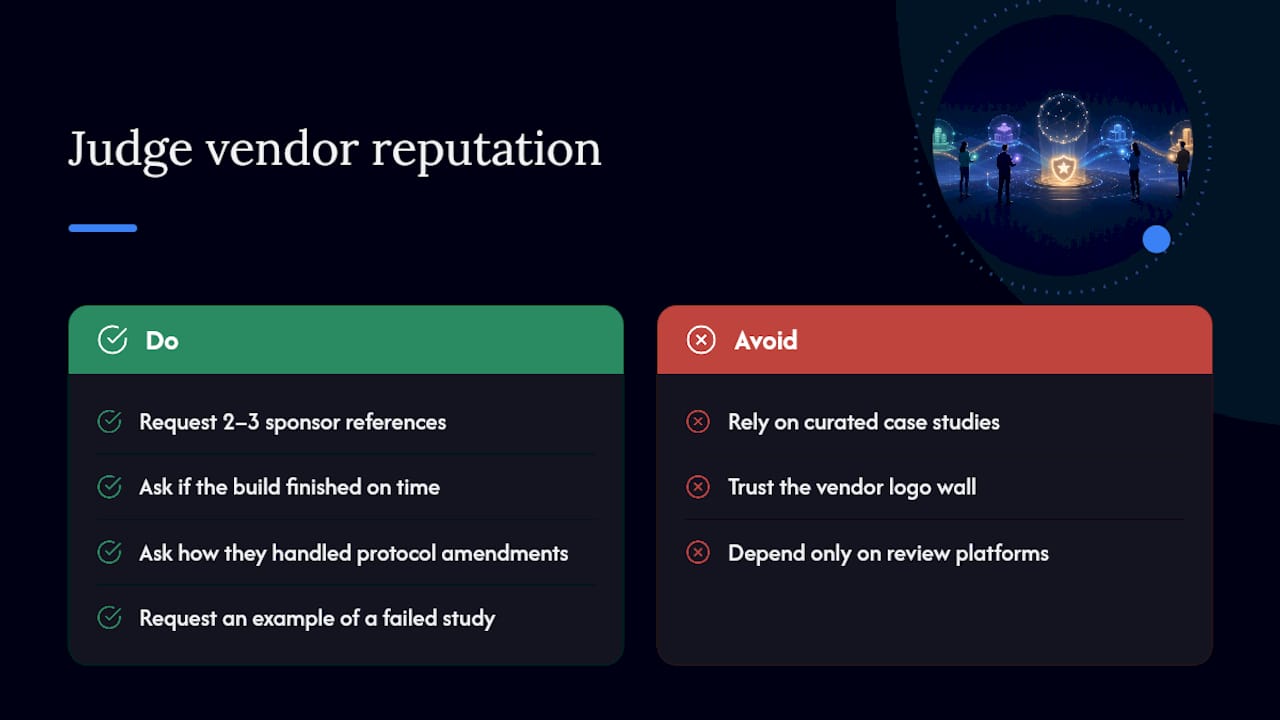
Reference calls matter more than case studies, because case studies are curated and reference calls usually aren't. Ask prospective vendors for two or three sponsor references from studies with similar complexity and phase, then ask those references specific questions: did the build finish on time, how responsive was support during go-live, and what would they do differently.
Look past the logo wall on a vendor's website. A vendor listing a dozen major pharma clients tells you they've closed deals, not that those deployments went smoothly. Ask directly about change-order frequency on past studies and how the vendor handled mid-study protocol amendments, since that's where reputation claims either hold up or fall apart.
Third-party review platforms for clinical technology vendors are thinner than in most B2B software categories, so leaning on direct reference conversations and asking for specifics on failure modes, not just successes, gives you a more honest signal. A vendor willing to discuss a study that went sideways and what they changed afterward is usually more trustworthy than one that claims a flawless record. Also check whether the vendor has experience in your specific therapeutic area, since a strong general track record doesn't always transfer to oncology-specific symptom scales or rare disease natural history studies with unusual assessment schedules.
How Customizable Are eCOA Solutions for Specific Trial Needs?
Off-the-shelf instrument libraries cover a lot of ground, but almost every study needs some degree of customization, whether that's a novel symptom diary, a modified visual analog scale, or branching logic tied to adverse event reporting.

Ask vendors directly how much of their platform is configuration versus true custom development. Configuration, changing field labels, adjusting skip logic, reordering questions, is fast and cheap. Custom development, building a new scoring algorithm or a device integration that doesn't exist yet, is slow and expensive, and it often requires its own validation cycle.
Flexibility also shows up in how easily a platform accommodates protocol amendments mid-study. A rigid system might require a full rebuild for a minor wording change, while a more flexible architecture handles it as a configuration update with a lighter validation footprint. Ask for a concrete example of how the vendor handled a mid-study amendment on a past project, and specifically how long that turnaround took.
Don't overbuy flexibility you don't need, either. A highly configurable platform built for complex adaptive trial designs can be overkill, and needlessly expensive, for a straightforward single-arm study with two standard questionnaires. Match the platform's flexibility ceiling to your protocol's actual complexity, not to a hypothetical future study.
Who Owns Your Data, and How Is It Managed?
Data ownership terms deserve as much scrutiny as technical features, and sponsors frequently gloss over this during contract negotiation. Confirm in writing that the sponsor retains full ownership of patient-reported data, not just a license to access it through the vendor's platform.
Ask what happens to your data if you terminate the contract early or the study ends. A vendor should be able to provide a full, validated data export in a standard format, not hold your data hostage in a proprietary system that requires ongoing subscription fees to access.
Data residency matters too, particularly for studies spanning multiple countries with different privacy regimes. Ask where servers are physically located and how the vendor handles cross-border data transfer requirements. For any protected health information involved, confirm the vendor's security controls map to HIPAA requirements around storage and transmission, and get a business associate agreement in place before data starts flowing, not after.
Finally, ask how the vendor separates identifiable data from clinical outcome data internally. A well-architected system keeps these layers distinct, which both protects patient privacy and simplifies downstream analysis.
Can Your eCOA Vendor Scale With Trial Size and Phase?
A platform that works beautifully for a 50-patient Phase I study can buckle under a 3,000-patient Phase III with sites across a dozen countries. Ask vendors directly about their largest deployment by patient count and by site count, and ask what broke when they scaled.
Scalability isn't just about server capacity. It's about helpdesk staffing keeping pace with site count, translation workflows handling a dozen languages instead of two, and study-build teams not becoming a bottleneck when you need three protocol amendments processed simultaneously across regions.
Ask how the vendor's support model changes as a study grows. A helpdesk that handles 20 sites well might need a completely different staffing model at 200 sites, and that gap is where response times quietly degrade if the vendor hasn't planned for it.
If you're running a multi-phase program with the same asset, ask whether the vendor supports carrying instrument libraries and configurations forward from Phase II into Phase III without a full rebuild. That continuity can save real time and money across a development program, and it's worth confirming before signing a Phase II contract that locks you into a vendor unprepared for larger, unequipped for what comes next.
What Contract Terms Should You Negotiate Before Signing?
Read the termination clause first, before pricing, before service levels, before anything else. Understand exactly what happens to your data and your study build if the relationship ends early, and make sure the exit terms are workable, not punitive.
Negotiate service-level agreements with actual teeth: specific response times for critical issues (system down, patient unable to complete assessment) versus non-critical requests, and financial remedies if those service levels aren't met. A vague promise of "prompt support" in a contract is worth nothing in practice.
Push for clarity on change-order pricing before you need one. Ask the vendor to define, in the contract, what qualifies as an in-scope configuration change versus a billable change order, since this ambiguity is where budgets get squeezed mid-study.
Consider negotiating a shorter initial term with renewal options rather than locking into a multi-year agreement for a single study, particularly with newer vendors where the relationship is still unproven. If the vendor is proposing shared intellectual property on a custom-built instrument, get clear terms on who can reuse that instrument in future studies, since this affects both cost and competitive position down the line.
How Responsive Is Vendor Technical Support?
Support responsiveness usually only becomes visible after a contract is signed, which is exactly why you should press for specifics during evaluation rather than trusting a sales deck's promises.
Ask for actual support-tier structure: is there a dedicated point of contact for your study, or does every ticket enter a general queue? Ask about hours of coverage, particularly if your trial spans multiple time zones where a patient in one region needs help outside another region's business hours.
Request historical data on average response and resolution times if the vendor can share it, and ask what happens when a critical issue (a patient locked out of an assessment during a narrow reporting window) occurs at 2 a.m. local time. The answer to that question tells you more about real support quality than any glossy SLA document.
An Editorial Take on eCOA Vendor Priorities
Three things matter more than any feature checklist: confirming regulatory readiness before anything else, testing support responsiveness before signing rather than after, and sizing platform complexity to your actual protocol, not an imagined future one. Under time pressure, check those three first. Everything else on the checklist is negotiable; these aren't.
— John
When an Operational Partner Makes More Sense Than a Platform Purchase
If your team's real constraint is internal bandwidth rather than a missing feature, Haiphai offers a different path: an embedded operational partnership that maps your specific bottlenecks, whether in eCOA vendor coordination, regulatory drafting, or clinical site activation, and redesigns the workflow around AI rather than adding another system to manage.
That approach is built to reclaim operational time on the path to approval, time that often gets lost to vendor management overhead rather than the trial science itself. It's a fit for sponsors who need deployment speed without a large internal team dedicated to vendor oversight, and less of a fit if your team already has strong internal eCOA management capacity and just needs a platform. Visit the HaiPhai sectors page to see how the model applies to your specific stage and therapeutic area.
Key Takeaways
Matching eCOA vendor category to protocol complexity, integration burden, and timeline determines implementation success more than any single feature comparison.
| Point | Details |
|---|---|
| Match category to complexity | Enterprise platforms suit global Phase II to III; API-first platforms suit early-phase and DCT designs. |
| Confirm regulatory readiness early | Verify 21 CFR Part 11, HIPAA, and CDISC compliance before comparing features. |
| Budget for translation delays | Plan 2 to 3 weeks per language for linguistic validation on patient-facing instruments. |
| Negotiate change-order terms upfront | Define configuration versus billable change orders in the contract before signing. |
| Consider an operational partner | Haiphai offers embedded AI-enabled workflow redesign when internal bandwidth, not technology, is the bottleneck. |
Sources
- Electronic records; electronic signatures (21 CFR Part 11)
- HIPAA laws and regulations — HHS
- Clinical Data Interchange Standards Consortium (CDISC)
- Navigating the eCOA vendor landscape — Castor
FAQ
What Is the Difference Between eCOA and ePRO?
ePRO refers specifically to electronic patient-reported outcomes, while eCOA is the broader category covering patient, clinician, and observer-reported outcomes collected electronically. Every ePRO system is a subset of eCOA, but not every eCOA system is limited to patient-reported data.
Which Are the Major CTMS Vendors?
Clinical trial management system (CTMS) vendors are a distinct category from eCOA vendors, though some enterprise platforms offer both. Evaluate CTMS needs separately using the same complexity and integration filters described for eCOA selection.
Who Are the Top IRT Vendors?
IRT (interactive response technology) vendors handle randomization and drug supply management, and some eCOA platforms offer integrated IRT/RTSM modules to reduce vendor-management overhead for studies needing tight coupling between randomization and patient data.
Which Pharma Data Vendors Are the Best?
There's no single best vendor across all trial types. The right choice depends on protocol complexity, integration requirements, and timeline, which is why a structured checklist beats a generic vendor ranking every time.
How Long Does eCOA Implementation Usually Take?
Modern API-first platforms often deploy standard PRO instruments in 4 to 8 weeks, while enterprise platforms with heavier validation and customization needs typically take 12 to 16 weeks.