
TL;DR:
- The best alternatives to phasevtrials.com include AI-driven operational partners like Haiphai and enterprise systems such as Medidata Rave CTMS and Veeva Vault CTMS. Haiphai acts as a tailored operational partner, helping biotech teams reclaim up to 18 months of workflow time, while others focus on complex multi-site trial management. Selecting the right platform depends on your trial complexity, integration needs, and whether AI automation aligns with your workflow.
What are the best alternatives to phasevtrials.com for biotech clinical trial operations?
The strongest alternatives to phasevtrials.com fall into two categories: enterprise clinical trial management systems built for complex, multi-site studies, and AI-driven operational partners designed specifically for lean biotech teams. For most early-phase biotech companies, the enterprise route creates more problems than it solves.
Here is how the leading options compare:
| Platform | Best For | Integration Capabilities | AI Features | Ease of Use | Time Savings Potential | Early-Phase Biotech Fit | Pricing Structure |
|---|---|---|---|---|---|---|---|
| Haiphai | Lean biotech teams needing end-to-end AI workflow optimization | Tailored integration with existing clinical systems | Protocol-to-database automation, regulatory drafting, site activation AI | High — built around your workflows | Significant time reclaimed | Excellent | Custom, outcome-based |
| Medidata Rave CTMS | Complex, data-heavy multi-site trials | Deep native EDC integration via Rave ecosystem | AI-enabled dashboards, automated monitoring reports | Moderate — steep learning curve | Strong for large trials | Limited — enterprise-grade complexity | Enterprise licensing |
| Veeva Vault CTMS | Sponsors needing unified document and operations flow | End-to-end eTMF, EDC, and CRM sync | Automated trip reports, deviation workflows | Moderate | Strong for mid-to-large sponsors | Moderate — better at scale | Enterprise licensing |
| PhaseVTrials.com | Clinical trial resource discovery | Limited — directory-focused | Minimal | High | Low | Moderate | Varies |
Medidata was named the leading solution among 13 products in Everest Group's 2024 PEAK Matrix for clinical trial management systems, which reflects its depth for large-scale operations. Veeva CTMS reports reducing monitoring time by 30% for its 200+ sponsor and CRO clients. Both are credible at scale. Neither is built for a 30-person biotech running two Phase I studies.
Haiphai occupies a different position entirely. Rather than selling software seats, it acts as an operational partner, working backward from your strategic goals to identify where time is actually being lost. Clients reclaim up to 18 months of operational time on the path to approval. That figure matters most when you are trying to hit a valuation milestone before your next funding round.
Data security and regulatory compliance are non-negotiable across all serious alternatives. Medidata and Veeva both support FDA 21 CFR Part 11 and HIPAA requirements within their platforms. Haiphai builds compliance support directly into its AI-driven workflow design, so regulatory readiness is embedded rather than bolted on.
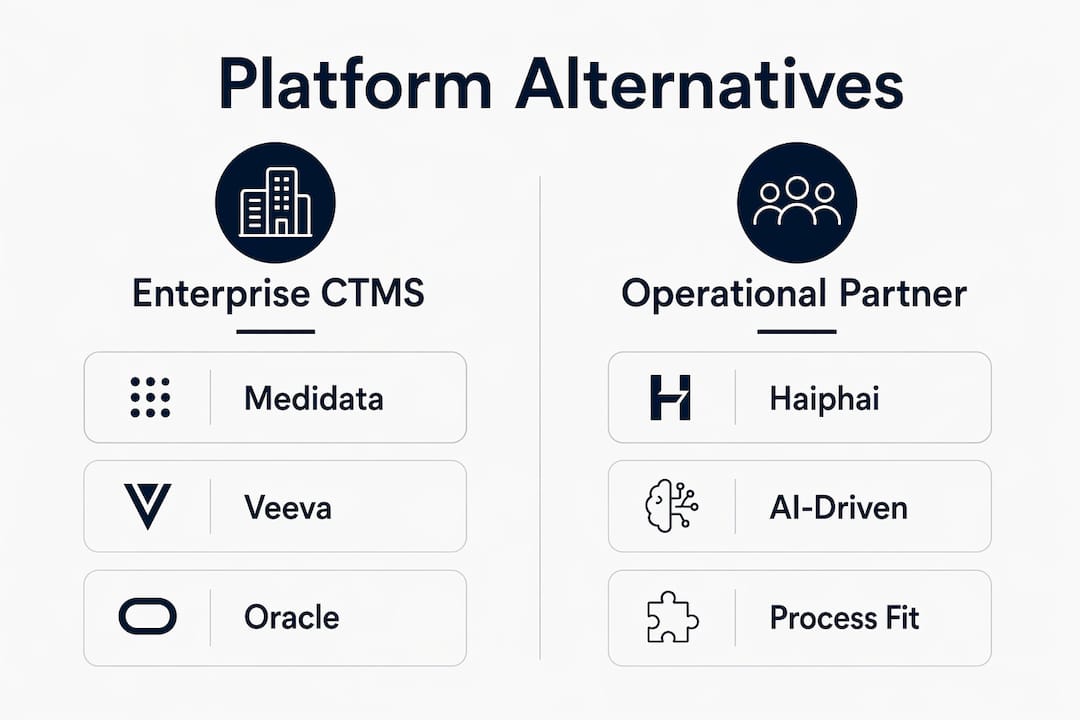
Table of Contents
- How do you choose the right clinical trial platform for your biotech?
- How does AI actually reduce bottlenecks in clinical trial operations?
- Key Takeaways
- The platform trap most biotech leaders don't see coming
- Haiphai cuts through the platform complexity for lean biotech teams
- FAQ
How do you choose the right clinical trial platform for your biotech?
The most common mistake biotech operational leaders make is evaluating platforms on feature lists rather than on how those features connect to the systems already running their trials. Advarra's industry analysis makes this point directly: fragmented manual data reconciliation kills user adoption even when the platform itself is technically impressive.
Start with your actual portfolio. Define your current trial count, therapeutic focus, geographic reach, and where you expect to be in 24 months. Selecting enterprise-grade systems without that clarity leads to configuration paralysis and costly mid-trial migrations. For a lean biotech, that is not a theoretical risk.
Key selection criteria:
- Workflow interoperability: Does it connect natively with your EDC, eTMF, and site activation tools, or does it require middleware?
- Portfolio fit: Is the complexity calibrated to your trial count and team size, or is it built for 50-site Phase III programs?
- AI depth: Does automation extend to query resolution, protocol-to-database creation, and regulatory document generation, or is it limited to dashboards?
- Validation burden: What are the CSV/GAMP 5 lifecycle costs? Underestimating validation overhead is one of the most consistent budget surprises for sponsors adopting multi-vendor stacks.
- Total cost of ownership: License fees are rarely the largest line item once integration, validation, and training are included.
- Support and onboarding: Can the vendor demonstrate live data synchronization across amendments and site additions, or only a scripted demo?
When evaluating AI capabilities, go beyond the feature checklist. The question is not whether a platform has AI, but whether that AI augments your specific workflows and automates regulatory compliance tasks your team currently handles manually.
For biotech teams with limited IT resources, the operational risk of multi-vendor stacks is real. Every additional integration point is another validation burden, another failure mode, and another vendor relationship to manage.

Pro Tip: Before signing any contract, require a live demonstration using your actual protocol and site structure. Scripted demos hide reconciliation work. A live test with real amendments and site additions will surface the manual burden that no sales deck mentions.
When reviewing software selection frameworks for clinical operations, resources like the Labrynix buyer's guide offer useful frameworks for evaluating integration depth and operational fit across clinical software categories.
How does AI actually reduce bottlenecks in clinical trial operations?
Operational bottlenecks in biotech trials rarely come from one broken process. They accumulate across fragmented systems and manual reconciliation steps that each seem manageable in isolation but compound into months of delay. AI addresses this at the workflow level, not just the task level.
The most impactful AI capabilities in clinical trial operations today include:
- Protocol-to-database automation: AI converts protocol documents into validated CRF structures, edit checks, and validation rules in minutes rather than weeks.
- Automated query management: Query generation, routing, and resolution run without manual intervention, reducing data cleaning cycles significantly.
- Regulatory document generation: Automated production of SAPs, aCRFs, TLF outputs, and FDA submission documents with validated audit trails cuts time-to-readiness across regulatory milestones.
- Risk-based monitoring: Real-time risk indicators flag site-level issues before they become protocol deviations.
- Site activation workflows: AI-driven task routing accelerates the site activation sequence, one of the most time-consuming phases in early-stage trials.
Haiphai applies this logic as an AI-driven operational partner rather than a standalone platform. The focus is on closing the gap between protocol design and patient recruitment by identifying where your specific process loses time, then building AI workflows around those exact points.
For US-based biotech companies, AI-driven automation also supports compliance with FDA 21 CFR Part 11 and HIPAA by maintaining validated audit trails and access controls within automated workflows. Integrated audit-ready modules within a single platform reduce the IT and documentation burden that lean teams cannot afford to absorb.
The AI augmentation approach matters here. Platforms that layer AI onto existing fragmented architectures often create new reconciliation problems. The more durable solution is AI embedded in a closed-loop workflow from the start.
Key Takeaways
Selecting the right alternative to phasevtrials.com requires matching AI depth and integration fit to your actual trial portfolio, not the platform's feature count.
| Point | Details |
|---|---|
| Workflow interoperability first | Fragmented manual reconciliation reduces adoption even when platform features are strong. |
| Avoid over-platforming | Enterprise systems built for big pharma add configuration and validation burden that slows lean biotech teams. |
| AI depth matters | Effective AI automates query management, regulatory documents, and site activation, not just dashboards. |
| Validation costs are real | CSV/GAMP 5 lifecycle efforts are consistently underestimated and should factor into total cost of ownership. |
| Haiphai as operational partner | Haiphai's tailored AI approach helps biotech clients reclaim up to 18 months of operational time toward approval. |
The platform trap most biotech leaders don't see coming
The conventional wisdom in clinical trial platform selection is to buy the most capable system you can afford and grow into it. That logic works for large pharma. For a lean biotech running one or two early-phase studies, it is the fastest way to burn six months on configuration, validation, and training before a single patient is enrolled.
What actually matters is not capability breadth but operational fit. A platform that handles 80% of your workflow natively and integrates cleanly with your EDC is worth more than one that handles 100% in theory but requires a dedicated IT team to maintain. The over-platforming trap is real, and it hits lean biotech teams hardest because they have the least capacity to absorb the overhead.
The other thing most articles miss: AI features are not equivalent across platforms. A dashboard with predictive analytics is not the same as a closed-loop workflow that automates regulatory document generation and site activation in sequence. Evaluate what the AI actually removes from your team's plate, not what it displays on a screen.
Haiphai's model is worth understanding on its own terms. It does not compete with Medidata or Veeva on feature parity. It competes on operational outcomes, starting from your goals and working backward to find where time is being lost. For a biotech trying to hit a valuation milestone before a Series B, that framing is more useful than a feature matrix.
Haiphai cuts through the platform complexity for lean biotech teams
Most biotech operational leaders evaluating clinical trial platforms spend weeks comparing feature lists and end up with a system that fits a larger organization's problems, not their own. Haiphai takes a different route entirely.
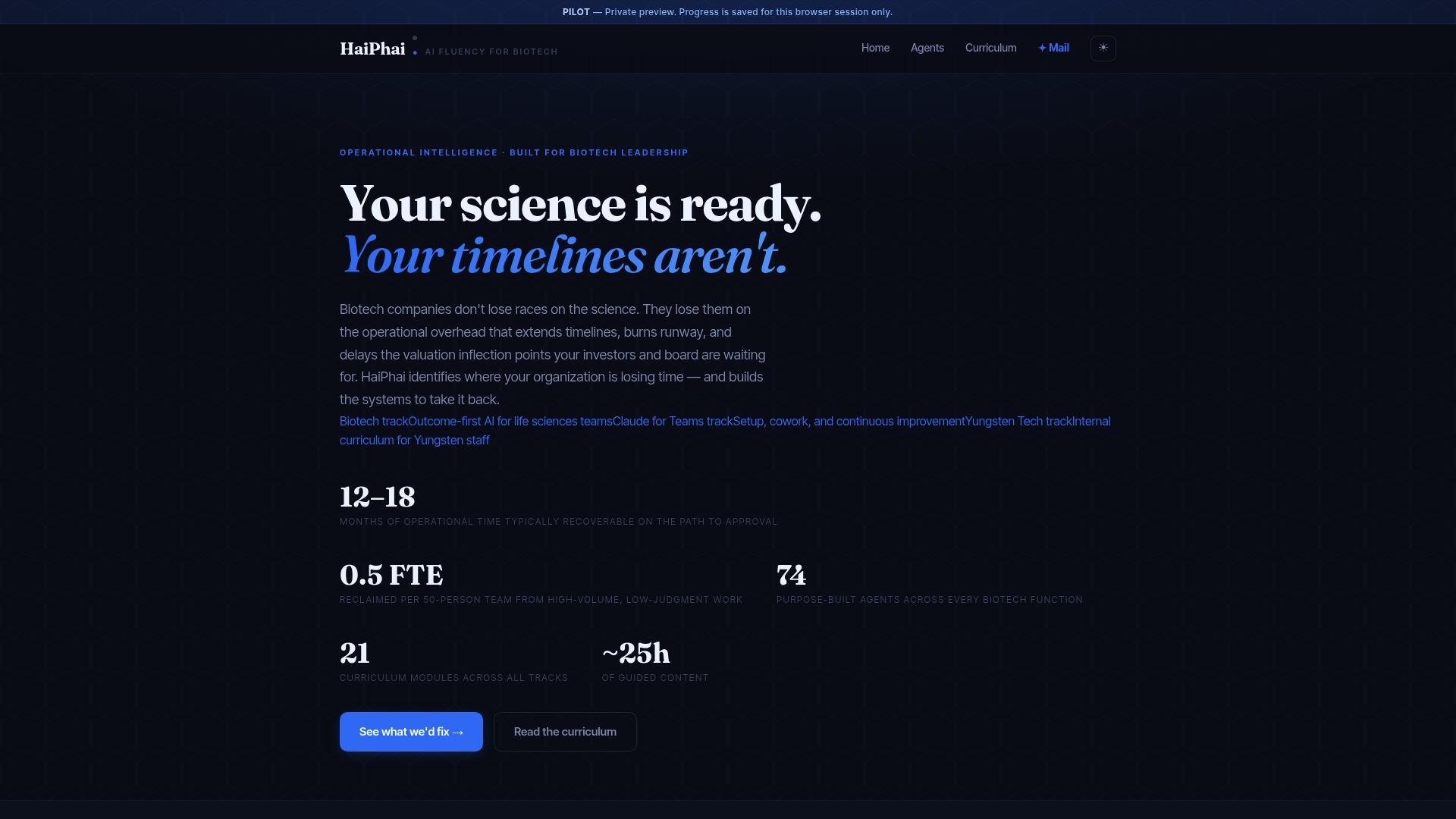
Rather than selling a platform and leaving your team to configure it, Haiphai works as an operational partner. The process starts with your strategic goals, maps the bottlenecks in your current trial workflows, and builds AI-driven solutions around those specific gaps — from regulatory drafting to clinical site activation. The result is up to 18 months of reclaimed operational time, which translates directly into earlier approval timelines and stronger valuation at your next funding event.
If you are leading a lean biotech team and need AI-driven process optimization that fits your actual trial portfolio, see what Haiphai does for biotech operations or review the full solutions overview to understand where the time savings come from.
FAQ
What are the main alternatives to phasevtrials.com for clinical trials?
The leading alternatives include Haiphai for AI-driven operational optimization, Medidata Rave CTMS for complex multi-site trials, and Veeva Vault CTMS for unified document and operations management. The right choice depends on your trial complexity, team size, and integration needs.
How does Haiphai differ from enterprise CTMS platforms like Medidata or Veeva?
Haiphai acts as an operational partner rather than a software vendor, building tailored AI workflows around your specific bottlenecks rather than providing a configurable platform your team must adapt to. Clients using Haiphai's tailored AI solutions reclaim up to 18 months of operational time on the path to approval.
What AI features should I look for in a clinical trial platform?
Prioritize platforms where AI automates protocol-to-database creation, query resolution, regulatory document generation, and site activation workflows. Dashboard analytics alone do not reduce your team's manual workload in any meaningful way.
How do I avoid over-platforming when selecting a CTMS alternative?
Define your current and projected trial counts, therapeutic focus, and geographic scope before evaluating vendors. Enterprise systems designed for large pharma add configuration and validation overhead that lean biotech teams cannot absorb without significant delays.
Are these clinical trial platforms compliant with US regulatory requirements?
Medidata, Veeva, and Haiphai all support FDA 21 CFR Part 11 compliance and HIPAA requirements. Integrated audit-ready modules within a single platform reduce the IT and documentation burden that multi-vendor stacks create for lean biotech sponsors.