
TL;DR:
- Operational partners like Haiphai address upstream process and documentation delays to prepare teams for CDMO engagement. Large CDMOs such as Catalent and Lonza provide validated manufacturing capacity for clinical and commercial stages, but capacity booking often requires long lead times. Choosing the right partner depends on program stage, specific needs, and thorough due diligence of documented transfer protocols and regulatory history.
If you're looking for alternatives to BiomanufacturingSolutions.com, the shortlist that consistently holds up for U.S. biotech decision-makers includes Haiphai, 64xBio, Catalent, Lonza, FUJIFILM Diosynth Biotechnologies, Thermo Fisher Scientific (Patheon), and KBI Biopharma. The right pick depends almost entirely on where your program sits: early-stage teams with process and regulatory bottlenecks get the most from an operational partner like Haiphai; programs ready for clinical or commercial manufacturing need a CDMO with validated capacity.
Quick-reference shortlist:
- Haiphai — operational partner for biotech teams that need AI-enabled workflow redesign, regulatory drafting automation, and site activation optimization before or alongside CDMO engagement
- 64xBio — early-stage process development and cell-line engineering, strong fit for pre-IND programs
- Catalent — broad biologics and cell and gene therapy manufacturing, multiple FDA-inspected U.S. sites
- Lonza — large-scale commercial biologics, deep cGMP infrastructure, global footprint with U.S. presence
- FUJIFILM Diosynth Biotechnologies — end-to-end biologics CDMO with a stated partner-for-life model to reduce technology-transfer risk
- Thermo Fisher Scientific (Patheon) — full-service CDMO covering drug substance through fill–finish, strong regulatory track record
- KBI Biopharma — clinical-to-commercial biologics with integrated analytical and CMC support
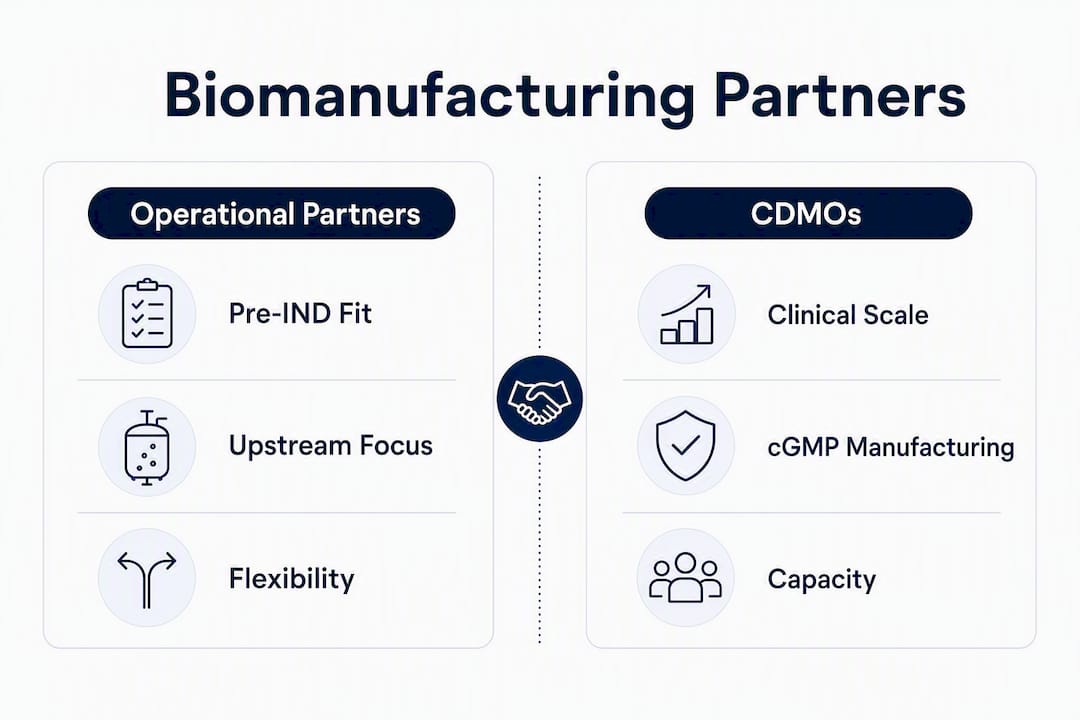
Industry guidance draws a clear line between CDMOs (manufacturing and supply) and operational partners (upstream process optimization, workflow integration). Knowing which category your program actually needs is the decision that saves the most time.
Table of Contents
- What are the best biomanufacturing service provider alternatives?
- How we selected and evaluated these alternatives
- How do you choose the right biomanufacturing partner for your program?
- When should you choose an operational partner instead of a CDMO?
- Key Takeaways
- What most procurement teams get wrong about biomanufacturing partners
- Haiphai: fixing operational bottlenecks before your CDMO clock starts
- Useful sources for procurement and technical due diligence
- FAQ
What are the best biomanufacturing service provider alternatives?
The table below maps each provider against the criteria that matter most in a procurement decision. Pricing is not publicly listed for most CDMOs; cost drivers are noted instead.
| Provider | Best for / stage fit | Core services | Scale | FDA/cGMP signals | U.S. footprint | Typical lead times | Pricing signal | Technology differentiators |
|---|---|---|---|---|---|---|---|---|
| Haiphai | Pre-IND through clinical; operational bottleneck removal | Operational diagnostic, AI-enabled workflow redesign, regulatory drafting automation, site activation | Program-level (not manufacturing volume) | Supports cGMP readiness and CMC documentation | Remote-embedded, U.S.-based | Weeks to first diagnostic; months for full engagement | Project-based and retainer consulting | AI-governed workflow automation, regulatory drafting AI |
| 64xBio | Early R&D, cell-line development | Cell-line engineering, process development | Pre-clinical to early clinical | Process development aligned to cGMP handoff | U.S.-based | Not publicly listed | Not publicly listed | Proprietary cell-line platforms |
| Catalent | Clinical and commercial biologics, cell and gene therapy | Cell-line development, process development, cGMP manufacturing, fill–finish | Clinical to commercial | Multiple FDA-inspected facilities | Multiple U.S. sites | Varies by program; commercial slots competitive | Not publicly listed; volume-dependent | Modular platforms, broad modality coverage |
| Lonza | Commercial-scale biologics | Cell-line development, process development, cGMP manufacturing | Clinical to large commercial | Extensive FDA inspection history | U.S. and global | Long lead times at commercial scale | Premium tier; volume-dependent | Proprietary CHOSOURCE cell lines, Ibex modular facilities |
| FUJIFILM Diosynth | End-to-end biologics, programs seeking long-term CDMO partner | Process development, cGMP manufacturing, fill–finish | Clinical to commercial | FDA-inspected U.S. facilities | U.S. (RTP, NC; Hillerød, Denmark) | Not publicly listed | Not publicly listed | End-to-end integration, automation |
| Thermo Fisher (Patheon) | Full-service drug substance through fill–finish | Process development, cGMP manufacturing, fill–finish, CMC support | Clinical to commercial | Strong regulatory track record, FDA-inspected | Multiple U.S. sites | Varies; fill–finish slots often booked 12+ months ahead | Not publicly listed; service-tier dependent | Broad modality platform, digital quality systems |
| KBI Biopharma | Clinical biologics with integrated CMC | Process development, cGMP manufacturing, analytical, CMC | Clinical to early commercial | FDA-inspected U.S. facilities | U.S. (Durham, NC; other sites) | Not publicly listed | Not publicly listed | Integrated analytical and CMC services |
A note on lead times: modular KUBio-style setups can compress time to usable capacity to a 10–15 month implementation window, which matters when you're evaluating whether a CDMO can actually hit your IND timeline. Fill–finish slots at large CDMOs often book out well beyond that.
How we selected and evaluated these alternatives
The shortlist was built against criteria that reflect what procurement teams and clinical ops directors actually need to verify before signing an engagement.
Selection criteria, in priority order:
- Stage-fit: does the provider serve the program stage (R&D, IND/clinical, commercial) the reader is most likely in?
- cGMP capacity and commercial-scale capability: validated suites, bioreactor count, and fill–finish availability
- Cell-line development and process development depth
- Regulatory and CMC support: in-house regulatory affairs, CMC documentation, and IND/BLA submission experience
- Technology and automation: AI integration, digital quality systems, single-use platforms
- U.S. facility footprint: FDA-inspected sites accessible to U.S.-based programs
- Published case studies or client references confirming real-world outcomes
- Technology-transfer history: documented change-control and audited transfer protocols
How evidence was weighted:
- FDA inspection records and public regulatory filings carry the most weight
- Published case studies and peer-reviewed or conference-presented validation rank above marketing copy
- Vendor capability pages were used for service scope and platform details, cross-referenced against industry reports on biomanufacturing process roles
- Integrated strategic partnerships that combine media optimization and CDMO workflow integration were weighted positively for technology-differentiator scoring
Caveats: Pricing is negotiation-dependent and not publicly listed for any CDMO on this list. Capacity availability changes quarterly. Regional availability for specific modalities (e.g., AAV, mRNA) varies by site. Always request a current capacity statement during your first vendor call.
How do you choose the right biomanufacturing partner for your program?
The decision comes down to three variables: program stage, primary objective, and what you can afford to subcontract.
Decision checklist by stage:
- Pre-IND / early R&D: Prioritize process development depth and CMC documentation support. Operational bottlenecks here (poor regulatory drafting, unmanaged change control) cost more time than manufacturing capacity ever will.
- IND / clinical: Confirm cGMP manufacturing capacity, fill–finish availability, and regulatory track record. Ask specifically about IND-enabling study support and CMC section authorship.
- Commercial: Validate commercial-scale bioreactor count, fill–finish throughput, and supply-chain redundancy. Technology-transfer history from clinical to commercial is the single biggest risk factor.
Questions to ask in your first vendor call:
- How many validated cGMP suites are currently available for a program at our stage?
- Do you provide in-house fill–finish, or is it subcontracted?
- What is your technology-transfer success rate, and can you share audited transfer protocols?
- Who owns the master batch records and facility master files during and after engagement?
- What is your change-control process, and how are client programs notified?
- What CMC documentation support do you provide for IND or BLA submissions?
Red flags to watch for:
- Vague or absent CMC support ("we can help with that" without a named regulatory affairs team)
- No published FDA inspection history or refusal to share inspection summaries
- Technology-transfer history that cannot be documented with audited protocols
- Fill–finish described as "partner network" with no named facility or lead time
Trust signals that hold up under scrutiny:
- Named FDA-inspected facilities with accessible inspection records
- Published case studies with named clients or peer-reviewed conference presentations
- Transparent capacity metrics (bioreactor count, suite availability, fill–finish throughput)
- Proactive access to QA-audited batch records and master files as part of the engagement scope
Pro Tip: Demand audited technology-transfer protocols and documented change-control history before signing. The single biggest hidden cost in vendor switches is repeated technology transfer — getting this in writing upfront eliminates the most common source of timeline slippage.
Due-diligence timelines from first contact to signed term sheet for clinical-stage CDMOs generally span several weeks, and commercial-scale engagements often take longer given capacity negotiation complexity.

When should you choose an operational partner instead of a CDMO?
The question isn't which is better. It's which problem you actually have right now.
Industry guidance is consistent: CDMOs solve manufacturing and supply problems; operational partners solve organizational and technical-process problems that create pre-CDMO burdens. Programs that go straight to a CDMO without fixing upstream bottlenecks often find that regulatory drafting delays, poor CMC planning, and unmanaged change control eat the time they expected manufacturing to save.
Choose an operational partner when:
- Your team is spending more time on manual regulatory drafting and review cycles than on science
- Clinical site activation is running months behind because of workflow gaps, not resource gaps
- You're preparing for a CDMO handoff and your CMC documentation isn't ready
- You need AI-enabled process redesign before you can make a credible CDMO RFP
Choose a CDMO when:
- Your process is locked, your CMC package is complete, and you need validated manufacturing capacity
- You're scaling from clinical to commercial and need bioreactor volume and fill–finish throughput
- Your regulatory affairs team is already managing IND/BLA submissions internally
The most efficient path for many programs is sequential: fix operational bottlenecks with an embedded partner first, then engage a CDMO with a clean CMC package and a realistic timeline. Haiphai's model is built for the first half of that sequence. By embedding AI-enabled workflow redesign and regulatory drafting automation early, teams arrive at CDMO engagement with fewer gaps and faster review cycles.
Pro Tip: When evaluating facility flexibility, ask whether the CDMO uses single-use or modular cleanroom platforms. Modular setups can compress implementation timelines significantly and let you defer capital commitment until scale is justified — a meaningful lever if your commercial timeline is uncertain.
For a deeper breakdown of partner types and when each fits, the biotech operational partner guide covers the decision framework in detail.
Key Takeaways
The most effective path to clinical and commercial readiness combines an operational partner to fix upstream bottlenecks with a CDMO that has validated cGMP capacity, fill–finish, and a documented technology-transfer history.
| Point | Details |
|---|---|
| Match partner to program stage | Operational partners fit pre-IND and IND-prep; CDMOs fit clinical-to-commercial manufacturing. |
| Demand documented transfer protocols | Audited technology-transfer records and master file access reduce the biggest source of timeline slippage. |
| Verify fill–finish availability early | Fill–finish slots at major CDMOs often have long booking times; confirm availability before finalizing your CDMO shortlist. |
| Modular facilities compress timelines | KUBio-style modular setups can deliver usable capacity in 10–15 months, a real option when commercial timing is uncertain. |
| Haiphai for operational bottlenecks | Haiphai's embedded AI model addresses regulatory drafting, site activation, and CMC-prep gaps before CDMO handoff. |
What most procurement teams get wrong about biomanufacturing partners
The conventional wisdom says: pick a big CDMO early, lock in capacity, and let them handle everything. That advice costs programs six to eighteen months they never get back.
Here's what actually happens. A team secures a CDMO slot before their CMC documentation is ready. The CDMO's regulatory affairs team is stretched across a dozen programs. Drafting cycles run long, change-control notifications pile up, and the IND submission slips. The CDMO isn't at fault — they delivered manufacturing capacity exactly as contracted. The bottleneck was always upstream.
The programs that move fastest treat operational readiness as a separate workstream from manufacturing capacity. They fix regulatory drafting cycles, site activation workflows, and CMC documentation gaps before the CDMO clock starts. That's not a new idea, but very few teams resource it deliberately. Most assume the CDMO will absorb it. Most are wrong.
When a CDMO is still the right call: if your process is locked, your team is experienced in CMC authorship, and you genuinely need bioreactor volume, go straight to a CDMO. The operational-partner model isn't a universal answer. It's the answer for teams whose primary constraint is workflow and documentation, not manufacturing capacity.
Haiphai: fixing operational bottlenecks before your CDMO clock starts
Most biomanufacturing service providers solve the manufacturing problem. Haiphai solves the problem that delays manufacturing.
Haiphai embeds directly into your biotech team as an operational partner, running a diagnostic to map where regulatory drafting cycles, site activation workflows, and CMC documentation gaps are adding months to your timeline. From there, the engagement redesigns those workflows with governed AI automation, so your team arrives at CDMO engagement with a complete CMC package and a realistic schedule. Clients report reclaiming significant operational time on the path to approval. That's not a manufacturing gain — it's a process gain, and it compounds directly into company valuation and funding readiness.
If your program is pre-IND or preparing for a CDMO handoff, the right next step is an operational diagnostic. See what Haiphai's operational partnership model covers, or review the trust and proof points before your first conversation.
Useful sources for procurement and technical due diligence
These are the primary sources used to build the shortlist, selection criteria, and stage-fit guidance in this article.
- GMP Bio — industry guidance on CDMOs and operational partners: foundational distinction between manufacturing partners and operational partners; CMC documentation best practices
- Beckman Coulter — biomanufacturing process and biofoundries overview: stage-fit guidance for applied biomanufacturing vs. drug development programs
FAQ
What is the difference between a CDMO and an operational partner?
A CDMO provides manufacturing and supply services under cGMP conditions. An operational partner focuses on upstream process optimization, workflow integration, and regulatory readiness — the work that determines whether a CDMO engagement succeeds on schedule.
Which biomanufacturing service providers have FDA-inspected U.S. facilities?
Catalent, Lonza, FUJIFILM Diosynth Biotechnologies, Thermo Fisher Scientific (Patheon), and KBI Biopharma all operate FDA-inspected U.S. facilities. Confirm current inspection status and site-specific capacity directly with each provider during due diligence.
How long does it typically take to engage a CDMO?
Due diligence and term-sheet negotiation for clinical-stage CDMOs typically runs four to eight weeks. Commercial-scale engagements take longer due to capacity negotiation complexity, and fill–finish slots at major providers often book 12 or more months in advance.
When does Haiphai fit into a biomanufacturing program?
Haiphai fits pre-IND and IND-preparation stages, when regulatory drafting cycles, site activation gaps, and CMC documentation are the primary constraints. The engagement prepares teams for a faster, cleaner CDMO handoff.
What should I ask a CDMO about technology transfer?
Ask for audited transfer protocols, documented change-control history, and confirmation of who retains master batch records and facility master files. These three items surface the most common sources of timeline slippage before you sign.