
Biotech operational partner types are defined as specialized external organizations — Contract Research Organizations (CROs), Contract Development and Manufacturing Organizations (CDMOs), and Functional Service Providers (FSPs) — that supply expert capabilities across the drug development lifecycle. Understanding these three primary partner types is the single most important operational decision a biotech executive makes, because the right model determines whether you reach the clinic in months or years. Each type serves a distinct function, carries a different risk profile, and fits a different stage of development. Choosing the wrong model costs time, capital, and competitive position.
1. What are biotech operational partner types?
Biotech operational partnership is the practice of contracting specialized external organizations to execute defined functions within a drug development or commercialization program. The industry recognizes three primary categories: CROs, CDMOs, and FSPs. Each type handles a different domain, and most mature biotech programs use at least two of them simultaneously. Knowing which type to engage, when, and for what scope is a core operational competency, not a procurement task.
2. Contract Research Organizations (CROs): Roles and strategic value
CROs manage the generation of preclinical and clinical evidence. Their core deliverables include clinical trial management, data generation, biostatistics, regulatory submission support, and pharmacovigilance. A CRO does not manufacture your drug. Its job is to produce the data package that moves your program through regulatory checkpoints.

The strategic value of a CRO lies in speed and scale. A well-selected CRO brings an established site network, trained staff, and validated data systems that a 50-person biotech cannot build internally. That access compresses study startup timelines and reduces the risk of protocol deviations that trigger regulatory delays.
CROs also provide flexibility. You can engage a full-service CRO for end-to-end trial management or a functional CRO for a single deliverable such as central laboratory services or medical writing. The choice depends on your internal bandwidth and the complexity of the study.
Key CRO service areas include:
- Clinical trial management: Site selection, patient recruitment, monitoring, and closeout
- Data management and biostatistics: Database build, data cleaning, and statistical analysis plans
- Regulatory affairs support: Submission writing, agency meeting preparation, and response drafting
- Pharmacovigilance: Adverse event collection, signal detection, and safety reporting
Pro Tip: Require a dedicated project manager with direct therapeutic area experience in your contract. Generic project management on a specialized oncology or rare disease trial adds weeks of ramp-up time and increases protocol deviation risk.
3. Contract Development and Manufacturing Organizations (CDMOs): Core functions and advantages
CDMOs cover the physical side of drug development. Their scope runs from early formulation and process development through scale-up, clinical manufacturing, and commercial production. A CDMO delivers drug substance and drug product, not data. That distinction matters when you are building your operational plan.
The most capable CDMOs offer end-to-end solutions across the full molecule lifecycle, including global distribution and serialization. That breadth means a single partner can carry a program from bench-scale synthesis to commercial launch without a technology transfer to a third site.
Integrated collaboration models that unify development and manufacturing under a single project team produce measurable results. Using parallel "Pool-to-Tox" and "Tox-to-GMP" strategies, one program shortened development to approximately 8.5 months from DNA stage to drug substance production. That compression is only achievable when the development and manufacturing teams share data and decisions in real time.
Core CDMO capabilities include:
- Formulation and process development: Identifying the right dosage form, excipients, and manufacturing process
- Analytical services: Release testing, stability studies, and method development
- Fill-finish operations: Aseptic filling, lyophilization, and final container closure
- Tech transfer: Moving a validated process from development to commercial scale without yield loss
- Lifecycle management: Post-approval changes, line extensions, and supply continuity planning
Supply risk is the most underrated reason to invest in a strong CDMO relationship. A single-source CDMO with deep process knowledge of your molecule is a supply chain asset. Replacing a CDMO mid-program costs six to twelve months of timeline and triggers regulatory notification requirements in most jurisdictions.
4. Functional Service Providers (FSPs): Specialized expertise and strategic flexibility
FSPs deliver a single functional capability to augment your internal team. The sponsor retains strategic control and decision-making authority. The FSP provides the people and systems to execute a defined function, such as biostatistics, regulatory affairs, data management, or clinical operations.
The FSP model fills a specific gap that neither CROs nor CDMOs address well. A full-service CRO takes over a function entirely. An FSP embeds within your team and operates under your SOPs. That distinction gives sponsors visibility and control that full outsourcing removes.
FSPs are particularly effective for regulatory strategy. A regulatory affairs FSP brings current agency experience and can draft briefing documents, prepare for Type B meetings, and respond to information requests without the overhead of a full CRO engagement. The sponsor's regulatory lead directs the work. The FSP executes it.
Common FSP functional areas include:
- Biostatistics and statistical programming: SAP development, CDISC-compliant datasets, and TLF production
- Regulatory affairs: Submission writing, eCTD compilation, and agency correspondence
- Data management: EDC build, data review, and database lock
- Clinical operations: Site activation, monitoring, and trial master file management
- Medical writing: Protocols, investigator brochures, and clinical study reports
Pro Tip: When using an FSP for regulatory affairs, define the escalation path in the contract. Regulatory decisions carry legal weight. Ambiguity about who has final authority on a submission strategy creates delays at the worst possible moment.
5. Comparing functional features: CROs vs. CDMOs vs. FSPs
Each partner type fits a different operational need. The table below maps the key dimensions that matter most when you are deciding which model to engage.
| Feature | CRO | CDMO | FSP |
|---|---|---|---|
| Primary deliverable | Clinical data package | Drug substance or product | Functional expertise |
| Sponsor control level | Low to moderate | Moderate | High |
| Best fit stage | Preclinical through Phase III | Development through commercial | Any stage |
| Timeline impact | Compresses study startup | Compresses manufacturing cycle | Fills gaps without ramp-up delay |
| Cost structure | Project-based or FTE | Milestone and batch-based | FTE or time-and-materials |
| Key risk | Data quality and site performance | Supply continuity and tech transfer | Scope creep and role ambiguity |
The most common mistake biotech teams make is treating these categories as mutually exclusive. A Phase II program typically runs a CRO for clinical operations, a CDMO for investigational product supply, and an FSP for biostatistics. Integrated alliance management that coordinates all three partner types under a unified governance model is increasingly the standard for global development programs.
The choice between a full-service CRO and an FSP often comes down to internal team size. A 15-person biotech with no clinical operations staff needs a full-service CRO. A 60-person biotech with an experienced clinical team may only need an FSP to cover monitoring capacity in a new geography.
6. Best practices for selecting and managing biotech operational partners
Partner selection requires a quantitative framework, not a relationship-driven shortlist. A weighted evaluation framework assigns scores across four criteria: technical capabilities (25–30%), quality and compliance (20–25%), regulatory history (15–20%), and project management (5–10%). Applying numeric scores to each criterion converts subjective impressions into repeatable, defensible decisions.
Operational failure in biotech rarely comes from poor science. It comes from administrative friction: unstructured data, decentralized vendor management, and missing document controls. Building procurement and document systems before you engage partners prevents the audit delays that derail programs at the worst moments.
Long-term partnerships that last beyond a single program are built on six pillars: shared vision, expertise, risk mitigation, innovation, quality, and transparency. These pillars enable proactive regulatory and supply chain management. They also create value that a purely transactional vendor relationship cannot produce.
Key practices for partner management include:
- Early engagement: Bring your CDMO into formulation decisions before you lock the clinical candidate. Late-stage process changes cost months.
- Co-investment mindset: Successful biotech leaders treat vendor management as a shared-risk relationship, not a service contract.
- Exit and custody provisions: Define asset ownership, data rights, and transition timelines at contract signing. Disputes over process knowledge at contract end are common and expensive.
- Continuous readiness: Move from episodic audit preparation to real-time compliance tracking. Systems that support continuous readiness reduce dependence on key individuals and allow rapid responses to regulatory inquiries.
"Practitioners recommend explicitly addressing termination and asset custody clauses upfront to avoid later disputes, comparing partnerships to marriages that require clear exit strategies." — Bioxconomy
Key takeaways
The most effective biotech programs use CROs, CDMOs, and FSPs in parallel, governed by a unified framework that assigns clear deliverables, ownership, and compliance responsibilities to each partner type.
| Point | Details |
|---|---|
| CROs generate evidence | Engage CROs for clinical trial management, data packages, and regulatory submission support. |
| CDMOs deliver product | CDMOs handle formulation through commercial manufacturing and carry supply continuity risk. |
| FSPs fill specific gaps | FSPs embed in your team and execute one function while you retain strategic control. |
| Use a weighted scorecard | Evaluate partners on technical capability, quality, regulatory history, and project management. |
| Define exit terms upfront | Asset custody and data rights must be negotiated at contract signing, not at termination. |
The operational partner model has changed. Most biotech teams haven't caught up.
The shift I've watched over the past decade is clear. Biotech programs that treat CROs, CDMOs, and FSPs as interchangeable vendors consistently underperform. Programs that build genuine co-invested relationships with each partner type consistently outperform on timelines and regulatory outcomes.
The "heroics gap" is real. When your regulatory strategy depends on one senior director who manually coordinates three CROs and two CDMOs through email threads, you have a single point of failure. That person leaves, gets sick, or burns out, and your program stalls. Scalable systems and continuous readiness are the only real fix.
What I've also seen is that the best partnerships start with an honest conversation about what happens when things go wrong. Which party owns the process knowledge if the contract ends? Who controls the data? What does a transition look like? Teams that answer those questions at the start build partnerships that survive regulatory setbacks and leadership changes. Teams that skip those conversations spend legal fees answering them later.
Treat operational partner management as a core internal capability, not a procurement function. The biotech teams that do this well operate at a scale that far exceeds their headcount.
— John
How Haiphai supports biotech operational partner integration
Coordinating CROs, CDMOs, and FSPs across a live development program generates significant administrative load. Haiphai addresses that load directly by acting as an operational partner that starts from your program goals and works backward to identify where friction is slowing you down.
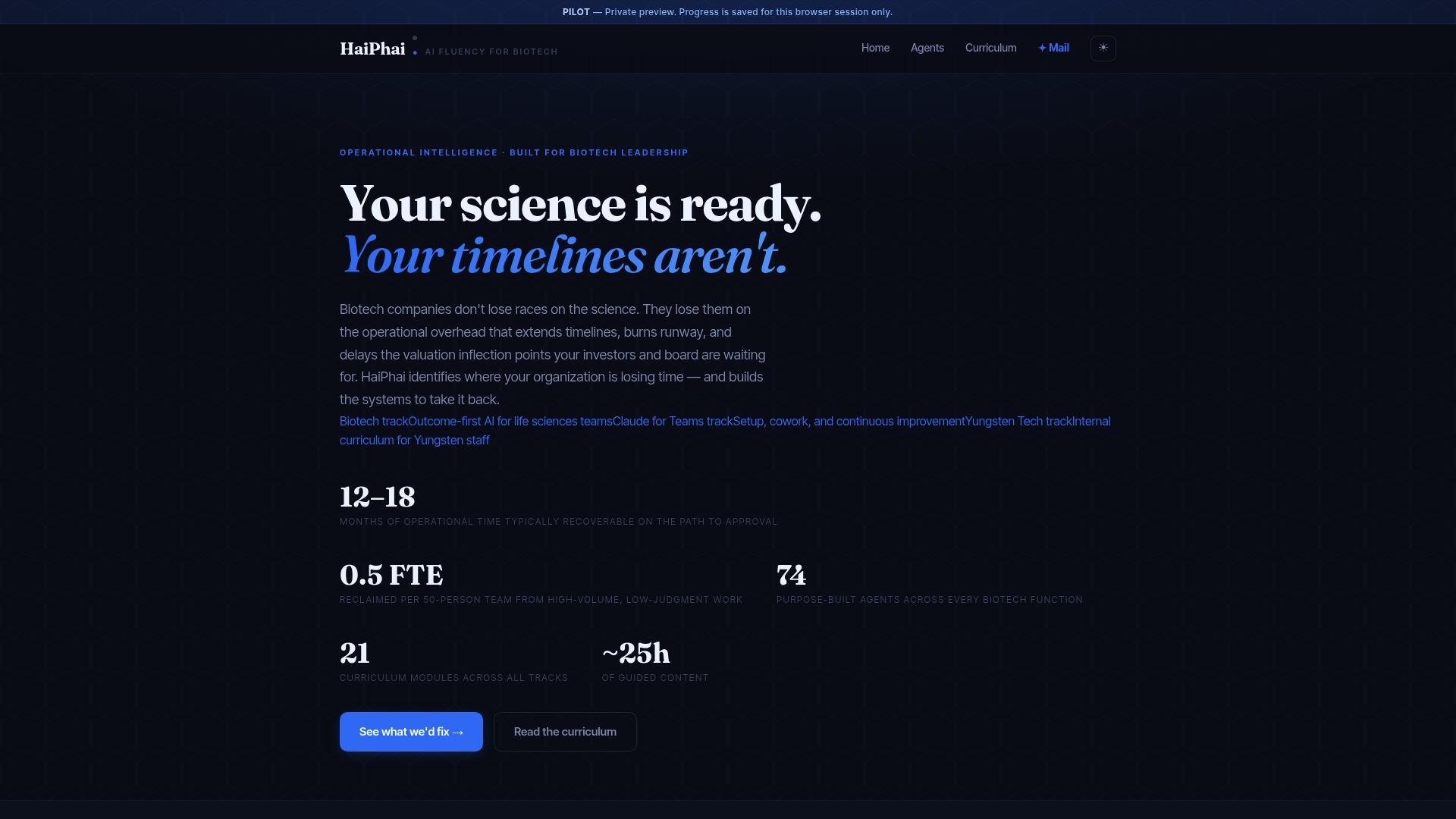
Haiphai's AI-enabled approach covers regulatory drafting, clinical site activation, and partner coordination workflows. Teams using Haiphai's AI solutions for biotech have reclaimed up to 18 months of operational time on the path to approval. That time directly affects company valuation and funding readiness. If your program is carrying manual coordination overhead across multiple partner types, Haiphai is built to remove it. Learn more about how AI augmentation in regulatory affairs can reduce the friction between your internal team and your external partners.
FAQ
What are the three main biotech operational partner types?
The three primary types are CROs, CDMOs, and FSPs. CROs generate clinical data, CDMOs handle development and manufacturing, and FSPs deliver specialized functional expertise while sponsors retain strategic control.
When should a biotech use an FSP instead of a CRO?
Use an FSP when your internal team has the strategic capability to direct a function but lacks execution capacity. FSPs embed within your team and operate under your SOPs, which gives you more control than a full-service CRO engagement.
How do integrated CDMO partnerships reduce development timelines?
Integrated CDMO models that run development and manufacturing in parallel can compress timelines significantly. One program using parallel "Pool-to-Tox" and "Tox-to-GMP" strategies reached drug substance production in approximately 8.5 months from the DNA stage.
What criteria matter most when evaluating a biotech operational partner?
A weighted framework prioritizes technical capabilities (25–30%), quality and compliance (20–25%), regulatory history (15–20%), and project management (5–10%). Applying numeric scores to each criterion makes the evaluation repeatable and defensible.
Why do biotech partnerships fail operationally?
Operational failure in biotech most often comes from administrative friction, not poor science. Unstructured data, decentralized vendor management, and missing document controls are the leading causes of audit delays and program setbacks.