
TL;DR:
- For regulated US clinical trials, an embedded operational partnership that redesigns workflows offers measurable timeline improvements. Such partnerships focus on process redesign, governance, and AI integration, unlike platform vendors that only provide tools. Starting with a clear bottleneck and a short pilot ensures effective trial process optimization and compliance.
For regulated clinical trials in the US, the right category to start with is an embedded operational partnership that combines AI-enabled workflow redesign with human governance. Point tools and general LLMs can assist, but they rarely move the needle on site activation timelines or regulatory drafting without someone redesigning the process around them.
Here is the shortlist by category:
- Operational partnership (start here for regulated trials): Haiphai. Best for biotech sponsors who need to recover timeline and reduce bottlenecks in site activation, regulatory drafting, and clinical operations. Haiphai works backward from your approval timeline to identify where the process breaks, then embeds governed AI workflows to fix it. Clients have reclaimed a substantial amount of operational time.
- Clinical-trial platforms (CTMS/eCOA/DCT): Pi Health (FICS platform), Medable, Science 37. Best for sponsors who need a purpose-built data collection and site management infrastructure with FHIR and EDC connectors. These are software-first; governance and workflow redesign are your responsibility.
- Clinician-facing AI assistants: Saner.AI. Best for clinical teams who need a conversational assistant for knowledge retrieval, documentation support, or patient-facing triage. Not built for regulatory-grade trial infrastructure.
- General LLM providers (API/enterprise): ChatGPT (OpenAI), Claude (Anthropic), Gemini (Google), DeepSeek, Grok. Best for teams building custom internal tools or augmenting specific tasks. Require significant integration work and a governance layer before they are appropriate for HIPAA-regulated workflows.
Immediate next step: Run a focused discovery session on your single biggest bottleneck, whether that is site activation lag or regulatory document turnaround. An operational partner like Haiphai can scope that in a short engagement before you commit to a platform purchase.
Table of Contents
- What are the best PiHealth.ai alternatives for clinical trials?
- Profiles for each alternative category and where they fit
- How we evaluated these alternatives
- How do you choose the right alternative for your trial?
- Why an embedded operational partnership can be the right answer for biotech sponsors
- What is the final recommendation?
- Short profiles: strengths, limits, and US availability
- What kind of support and training do these vendors actually provide?
- How well do these solutions scale across different trial sizes?
- Vendor financial stability and reputation: what to check
- Key Takeaways
- Why operational partnerships beat point tools for regulated work
- Haiphai helps you evaluate alternatives and scope a pilot
- Useful sources for vendor due diligence
- FAQ
What are the best PiHealth.ai alternatives for clinical trials?
The table below maps each alternative category to the dimensions that matter most in a US clinical-trial procurement decision.
| Category | Best for / primary use case | Compliance and privacy | Service model | Integration and connectors | Implementation speed | Professional services | Pricing model | Scalability |
|---|---|---|---|---|---|---|---|---|
| Operational partnership (e.g., Haiphai) | DCT ops, site activation, regulatory drafting, timeline recovery | Governed model; HIPAA-aligned workflow design; data residency negotiated per engagement | Managed operational partner; embedded team | Tailored to client EHR/EDC stack; FHIR, CDMS, CDISC scoped per engagement | Pilot in weeks; full redesign in months | Human-in-the-loop governance; regulatory support included | Project-based or retainer consulting fees | Scales with trial complexity; international support scoped per program |
| Clinical-trial platforms (Pi Health, Medable, Science 37) | End-to-end trial data collection, eCOA, DCT site management | Platform-level HIPAA BAA; regulatory-grade data collection; model-training policies vary | SaaS platform; some managed services | FHIR, EDC/CDMS, CDISC connectors standard | Weeks to months depending on integration scope | Varies; often limited to onboarding and technical support | Subscription or per-study licensing | Global site networks; multi-study scaling |
| Clinician-facing assistants (Saner.AI) | Clinician documentation, patient triage, knowledge retrieval | Safety-governed design; validated medical sources; HIPAA terms vary by vendor | SaaS or API; self-serve to enterprise | Limited EDC/CDMS connectors; EHR integrations vary | Days to weeks | Minimal; user-facing support | Freemium to enterprise subscription | Scales for clinical teams; not built for trial ops |
| General LLM providers (ChatGPT, Claude, Gemini, DeepSeek, Grok) | Custom tool development, document drafting, internal assistants | Enterprise tiers offer HIPAA BAA (OpenAI, Anthropic, Google); model-training opt-out varies | API or enterprise SaaS | No native EDC/CDMS connectors; custom integration required | Fast API access; production governance takes months | None by default; requires internal build | Token-based or enterprise flat rate | Highly scalable; governance is buyer's responsibility |
Key trade-offs to keep in mind:
- Speed versus governance: LLM providers give you API access in hours, but building a HIPAA-compliant, audit-trail-ready workflow on top of them takes months of internal engineering.
- Managed services versus DIY: Clinical-trial platforms handle data infrastructure, but they rarely redesign your operational processes. You get the tool; the bottleneck stays.
- US regulatory fit: For trials subject to FDA oversight, any platform handling clinical data needs a signed Business Associate Agreement (BAA) and a clear data residency policy. General LLMs vary widely on this. Operational partners like Haiphai negotiate these terms as part of the engagement.
- International trial support: Pi Health's FICS platform operates globally. Medable and Science 37 also support multi-country DCT programs. Haiphai scopes international support per program.
Profiles for each alternative category and where they fit
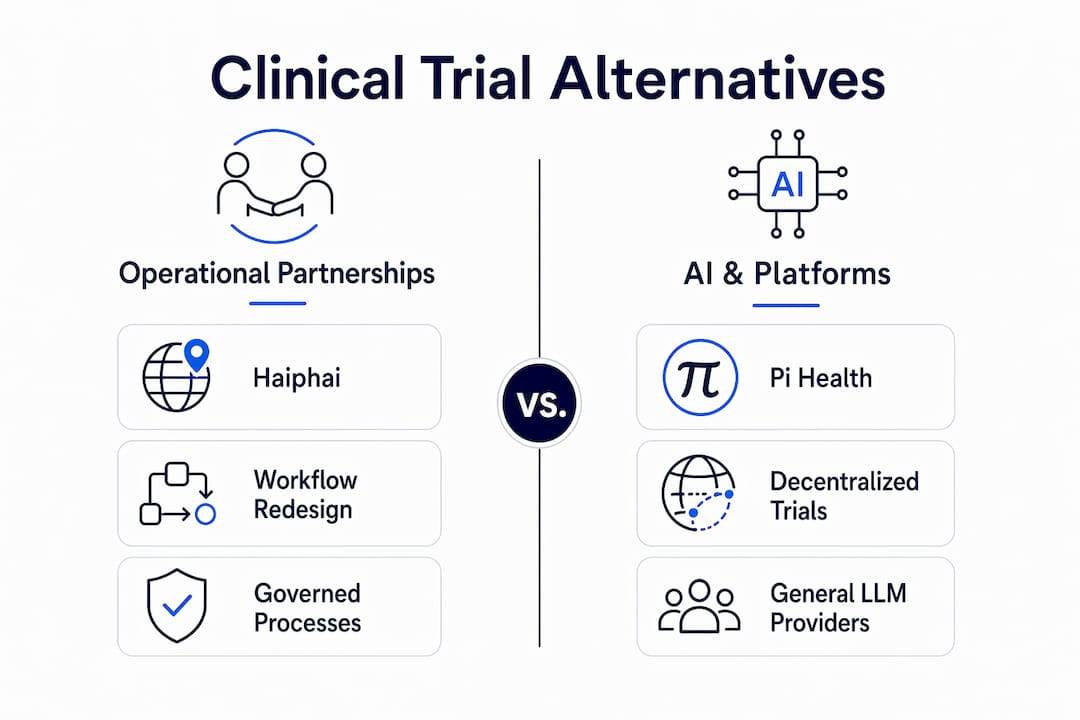
Understanding category distinctions is the single most important step before you start vendor conversations.
Haiphai: embedded operational partnership
Haiphai is not a software platform. It is an operational partner that starts from your approval timeline, maps the bottlenecks in your clinical and regulatory workflows, and then embeds AI-enabled processes to close the gaps. The typical engagement covers regulatory drafting automation, clinical site activation, and governed workflow redesign. Because the work is tailored to your existing EHR and EDC stack, integration is scoped per engagement rather than sold as a fixed connector list. The primary limit is that Haiphai is not a self-serve tool; it requires an active engagement and works best when a sponsor has a defined timeline problem to solve. Available in the US; international trial support scoped per program.

Use-case tags: DCT ops, site activation, regulatory drafting, timeline recovery, governed workflow automation
Pi Health (FICS platform): AI-native trial operating system
Pi Health describes its FICS platform as an AI-native operating system that integrates apps into a regulatory-standard data collection system and operates across global sites. It is built for end-to-end trial data management, eCOA, and site network coordination. The platform is software-first: it provides the infrastructure, but operational redesign and governance are the sponsor's responsibility. Pi Health was founded in 2021 and closed a Series A round in March 2024, per Crunchbase. Suitable for sponsors who need a purpose-built trial platform with global reach and are prepared to staff the governance layer internally.
Use-case tags: end-to-end trial data collection, eCOA, DCT site management, global trials
Medable and Science 37: decentralized trial platforms
Both Medable and Science 37 focus on decentralized clinical trial (DCT) execution, with patient-facing apps, remote monitoring, and site coordination tools. They are strong choices for sponsors running patient-centric or fully decentralized protocols. Integration endpoints typically include FHIR and EDC connectors. The limit for both is that they are platform vendors, not operational partners; workflow redesign and regulatory governance remain with the sponsor. US availability is confirmed; both support international programs.

Use-case tags: DCT ops, patient recruitment, remote monitoring, eCOA
Saner.AI: clinician-facing AI assistant
Saner.AI is a conversational AI assistant aimed at clinical teams. It handles documentation support, knowledge retrieval, and structured note-taking. It is not built for regulatory-grade trial infrastructure or EDC/CDMS integration. Think of it as a productivity layer for individual clinicians rather than a trial operations platform. HIPAA terms should be confirmed directly with the vendor before deployment in a regulated setting.
Use-case tags: clinician assistant, documentation support, patient-facing triage
ChatGPT (OpenAI), Claude (Anthropic), Gemini (Google): general LLM providers
These three are the most capable general-purpose large language models available today. OpenAI's ChatGPT Enterprise, Anthropic's Claude, and Google's Gemini (via Vertex AI) all offer enterprise tiers with HIPAA BAA options and data-use opt-out policies. Buyers searching for "medical AI" frequently land on these tools, but they are not built for trial operations. They lack native EDC or CDMS connectors and require a governance layer before they are appropriate for regulated workflows. Their real value in a clinical context is drafting, summarization, and internal knowledge management, not replacing a trial platform.
Use-case tags: regulatory document drafting, internal knowledge management, custom tool development
DeepSeek and Grok: emerging LLM providers
DeepSeek and Grok (xAI) are newer entrants with strong benchmark performance. Neither has established enterprise HIPAA BAA programs comparable to OpenAI or Anthropic as of mid-2026, and data residency policies for US clinical data are not publicly confirmed at the same level. They are worth watching for internal productivity use cases, but are not yet appropriate as primary tools for regulated US trial workflows without significant due diligence.
Use-case tags: internal productivity, document drafting (non-regulated contexts)
How we evaluated these alternatives
The market for clinical-trial technology is fragmented, with more than a dozen VC-backed companies positioned across the space. Category-level evaluation is more useful than vendor-by-vendor scoring because the right answer depends entirely on what problem you are trying to solve.
Evaluation criteria, in priority order:
- Regulatory compliance and data governance (highest weight): Does the vendor offer a HIPAA BAA? Is data residency clearly stated for US trials? What is the model-training policy for clinical data?
- Operational services and governance model: Does the vendor provide human-in-the-loop oversight, or is governance entirely the buyer's responsibility?
- Integration depth: Are FHIR, EDC/CDMS, and CDISC connectors available out of the box, or does integration require custom development?
- Evidence of timeline impact: Are there published case studies or validated operational metrics showing measurable gains?
- Implementation speed: How long from contract to a working pilot? What drives that timeline?
- Scalability and international support: Can the solution scale from a Phase II single-site study to a global Phase III program?
Information sources used: public product documentation, vendor case studies, industry intelligence databases (Crunchbase, PitchBook, CB Insights), and clinical AI integration research. Several widely searched "medical AI" tools were deprioritized for trial operations because they are designed for diagnostic or patient-facing safety workflows rather than regulatory-grade trial infrastructure. Conflating the two is one of the most common procurement mistakes in this space.
How do you choose the right alternative for your trial?
Start with your actual bottleneck, not the feature list.
Decision checklist:
- If your primary problem is site activation lag or regulatory document turnaround, start with an operational partner. Software alone will not fix a process problem.
- If you need regulatory-grade data collection infrastructure for a multi-site or global trial, evaluate clinical-trial platforms (Pi Health, Medable, Science 37) and confirm FHIR and EDC connector availability.
- If your team needs clinician-facing documentation or knowledge support, a conversational assistant like Saner.AI may be sufficient. Confirm HIPAA terms before deployment.
- If you are building a custom internal tool or augmenting a specific workflow, general LLM providers (ChatGPT Enterprise, Claude, Gemini) are the right starting point. Budget for governance build-out.
- If you are evaluating DeepSeek or Grok for regulated workflows, treat them as emerging options requiring full data residency and BAA due diligence before use.
Vendor questions to ask in an RFP or discovery call:
- What are your FHIR, EDC, and CDISC integration endpoints, and what does the implementation timeline look like?
- What is your model-training data policy for clinical data submitted through your platform?
- Do you offer a signed HIPAA BAA, and what does your data residency policy cover for US trials?
- What professional services are included, and where does your support end and the sponsor's governance begin?
- Can you provide a reference from a US-based sponsor who ran a Phase II or Phase III trial on your platform?
- What does a regulator-facing audit trail look like in your system?
Red flags that should stop a pilot:
- No regulator-facing audit trail or vague answers about how audit logs are structured
- Data residency described as "cloud-based" with no specifics on US data location
- No human governance model; the vendor positions the tool as fully autonomous
- HIPAA BAA offered only as an add-on with no clear scope
Typical implementation timelines and cost drivers:
Operational partnerships like Haiphai can run a scoped pilot in weeks, focused on a single regulatory artifact or site activation step. Full workflow redesign engagements run months, with cost driven by the number of processes in scope and integration complexity. Clinical-trial platforms typically take weeks to months to implement depending on EDC and EHR integration scope. General LLM API access is immediate, but production-grade governance for a regulated workflow adds months of internal engineering. The primary cost drivers across all categories are integration complexity (EHR/FHIR, EDC), data governance negotiations, and the scope of professional services included.
Pro Tip: Scope your first pilot around a single regulatory artifact, such as a protocol synopsis or informed consent template, plus one site activation step. This combination proves value fast and generates the audit-trail evidence you need to justify a broader rollout.
Why an embedded operational partnership can be the right answer for biotech sponsors
The distinction that matters most is not which platform has the best feature set. It is whether the vendor redesigns your regulated workflows or just gives you another tool to manage.
Industry analysis consistently shows that meaningful trial timeline gains require AI-native operating systems paired with expert-led governance and workflow redesign. Software alone is usually insufficient. The bottleneck in most biotech organizations is not a missing tool; it is the absence of integrated, governed workflow automation across site activation and regulatory drafting.
Haiphai's model addresses this directly. The engagement starts with a diagnostic mapping of operational bottlenecks, then redesigns the workflows around AI-enabled processes, and embeds a governance model that keeps human oversight in the loop. The result, according to Haiphai, is that clients can reclaim up to 18 months of operational time on the path to approval.
Recovering 18 months of operational time is not a software feature. It is the outcome of redesigning the process, embedding AI where it reduces friction, and maintaining human governance where regulators require it. That combination is what separates an operational partner from a platform vendor.
The role of AI in biotech execution is most powerful when it is embedded in a governed process rather than bolted onto an existing one. A sponsor who buys a clinical-trial platform and then tries to retrofit governance is doing the work in the wrong order.
Pro Tip: To scope a small operational pilot that proves value quickly, pick one governed workflow (e.g., regulatory drafting review) and one site activation step. Run both with a defined human-in-the-loop checkpoint. You will have measurable output and an audit trail within weeks, which is the evidence base you need for a broader program decision.
What is the final recommendation?
For timeline-sensitive, regulated US trials, the clearest path to measurable gains is an embedded operational partnership that redesigns workflows before deploying tools. Clinical-trial platforms are the right choice when you need purpose-built data infrastructure and are prepared to staff governance internally. Clinician-facing assistants and general LLMs are useful for specific productivity tasks but are not substitutes for regulatory-grade trial operations infrastructure.
Three immediate next steps:
- Internal discovery: Map your top three operational bottlenecks right now. Where does time disappear between protocol finalization and first patient in? That answer determines which category of solution you actually need.
- Vendor shortlisting: Use the comparison table above to filter by your primary use case, then send the vendor questions from the decision checklist to your top two or three candidates.
- Pilot scope: Define a single regulatory artifact and one site activation step as your pilot scope. This keeps the engagement short, measurable, and defensible to your leadership team.
If you want an operational evaluation before committing to a platform purchase, Haiphai runs structured discovery engagements that map bottlenecks and scope a governed pilot. That is a faster path to a defensible decision than a lengthy RFP process.
Short profiles: strengths, limits, and US availability
| Provider | Strengths | Limits | US availability |
|---|---|---|---|
| Haiphai | Governed workflow redesign; regulatory drafting automation; site activation optimization; significant timeline recovery | Requires active engagement; not self-serve | Yes; international scoped per program |
| Pi Health (FICS) | AI-native trial OS; global site network; regulatory-grade data collection | Governance is sponsor's responsibility | Yes; global |
| Medable | DCT-focused; patient-facing apps; FHIR connectors | Platform only; no operational redesign services | Yes; international |
| Science 37 | Decentralized trial execution; remote monitoring; patient recruitment | Platform only; limited professional services | Yes; international |
| Saner.AI | Clinician documentation; knowledge retrieval; fast deployment | Not built for trial ops or EDC integration | Yes |
| ChatGPT Enterprise | Broad capability; HIPAA BAA available; strong document drafting | No native EDC connectors; governance is buyer's responsibility | Yes |
| Claude (Anthropic) | Strong reasoning; HIPAA BAA available; data-use opt-out | No trial-specific integrations; governance is buyer's responsibility | Yes |
| Gemini (Vertex AI) | Google Cloud integration; HIPAA BAA; enterprise scale | Requires significant configuration for trial workflows | Yes |
| DeepSeek | Strong benchmark performance; low cost | No confirmed US HIPAA BAA; data residency unclear for regulated workflows | Limited enterprise support |
| Grok (xAI) | Fast iteration; competitive performance | No established HIPAA BAA program for US clinical data | Limited enterprise support |
What kind of support and training do these vendors actually provide?
Support quality varies more than feature lists suggest, and it is one of the dimensions most buyers underweight until they are mid-implementation.
Haiphai's model includes expert-led adoption as part of the engagement. Training is not a separate SKU; it is embedded in the workflow redesign process. Your team learns the governed process by doing it, with Haiphai's team alongside.
Clinical-trial platforms like Pi Health, Medable, and Science 37 typically offer structured onboarding, technical support, and user training as part of their enterprise contracts. The depth of that support varies by contract tier. For complex EDC or FHIR integrations, expect a dedicated implementation team, but confirm scope in writing before signing.
General LLM providers (OpenAI, Anthropic, Google) offer documentation, developer support, and enterprise account management at higher tiers. They do not provide clinical workflow training because that is not their product. If your team needs help building a governed clinical workflow on top of an LLM API, that work falls to you or a third-party implementation partner.
Saner.AI and similar clinician-facing tools typically offer self-serve onboarding with user support. For enterprise deployments in regulated settings, confirm whether a dedicated implementation contact is available.
How well do these solutions scale across different trial sizes?
A Phase II single-site study and a global Phase III program have almost nothing in common operationally, and the right solution for one is often wrong for the other.
Haiphai scales with trial complexity. Engagements are scoped per program, so a sponsor running a single-indication Phase II can start with a focused pilot on one regulatory workflow, then expand to full site activation and cross-functional operations as the program grows. International support is scoped per engagement.
Clinical-trial platforms are generally built for scale. Pi Health's global site network and FICS platform are designed for multi-country programs. Medable and Science 37 both support large DCT programs with multi-site coordination. The scaling challenge for platform vendors is governance: as trial complexity grows, the sponsor's internal governance burden grows with it.
General LLM providers scale technically without friction. The challenge is that governance complexity scales with trial size too, and LLM providers do not help you manage that. A small internal drafting tool built on ChatGPT Enterprise is manageable; a global trial workflow built on the same API without a governed process layer is a regulatory risk.
For sponsors moving from early-phase to late-phase programs, the clinical trial enrollment and AI integration considerations become significantly more complex. Plan for that transition early.
Vendor financial stability and reputation: what to check
Vendor stability matters more in clinical trials than in most software categories. A platform that goes dark mid-study is not just an inconvenience; it is a regulatory and patient safety event.
Pi Health closed a Series A funding round in March 2024. It is a VC-backed company founded in 2021, which means it is early-stage by enterprise software standards. That is not disqualifying, but it does mean you should ask about data escrow arrangements and business continuity plans before signing a multi-year contract.
Medable and Science 37 are more established in the DCT space, with longer track records and broader customer bases. Both have navigated the post-pandemic DCT market normalization, which tested the durability of several DCT-focused vendors.
OpenAI, Anthropic, and Google are among the most well-capitalized technology companies in the world. Financial stability is not a concern for any of them. The relevant stability question for these providers is policy stability: model-training data policies, HIPAA BAA terms, and enterprise pricing have all shifted over the past two years, and they will continue to shift.
For any vendor, request references from US-based sponsors who have completed a study on the platform, not just started one. Completion references are a much stronger signal than pilot references.
Key Takeaways
For regulated US clinical trials, an embedded operational partnership that redesigns governed workflows delivers more measurable timeline gains than swapping software platforms alone.
| Point | Details |
|---|---|
| Start with your bottleneck | Map site activation and regulatory drafting gaps before selecting a tool category. |
| Operational partners vs. platforms | Platforms provide infrastructure; operational partners like Haiphai redesign the process and embed governance. |
| HIPAA BAA is non-negotiable | Confirm a signed BAA and clear US data residency policy before any vendor enters your trial workflow. |
| LLMs need a governance layer | ChatGPT, Claude, and Gemini are powerful for drafting but require significant internal build-out for regulated use. |
| Haiphai for timeline recovery | Haiphai's embedded partnership model aims to significantly recover operational time for biotech sponsors. |
Why operational partnerships beat point tools for regulated work
The conventional wisdom in clinical AI procurement is that better software produces better trials. After reviewing how these categories actually perform in regulated settings, that framing misses the real problem.
Most biotech sponsors do not have a software gap. They have a process gap. The bottlenecks in site activation and regulatory drafting are not caused by using the wrong platform; they are caused by workflows that were never designed around AI, governed handoffs, or audit-trail requirements. Dropping a new tool into that environment produces the same delays with a different interface.
What actually moves timelines is redesigning the process first, then embedding AI where it reduces friction, then maintaining human oversight where regulators require it. That sequence is what an operational partner delivers. A platform vendor delivers the tool and leaves the sequence to you.
The scenario where this distinction matters most is a sponsor approaching a pivotal trial with a tight funding runway. At that stage, a six-month implementation delay on a new platform is not an inconvenience; it is a valuation event. An operational partner who can scope a governed pilot in weeks and show measurable output before the next board meeting is a fundamentally different kind of asset.
Haiphai helps you evaluate alternatives and scope a pilot
Most biotech sponsors spend more time evaluating tools than fixing the process those tools are supposed to support. Haiphai's approach is the opposite: start with a diagnostic of your operational bottlenecks, then scope a governed pilot around the one or two workflows where AI can recover the most time fastest.
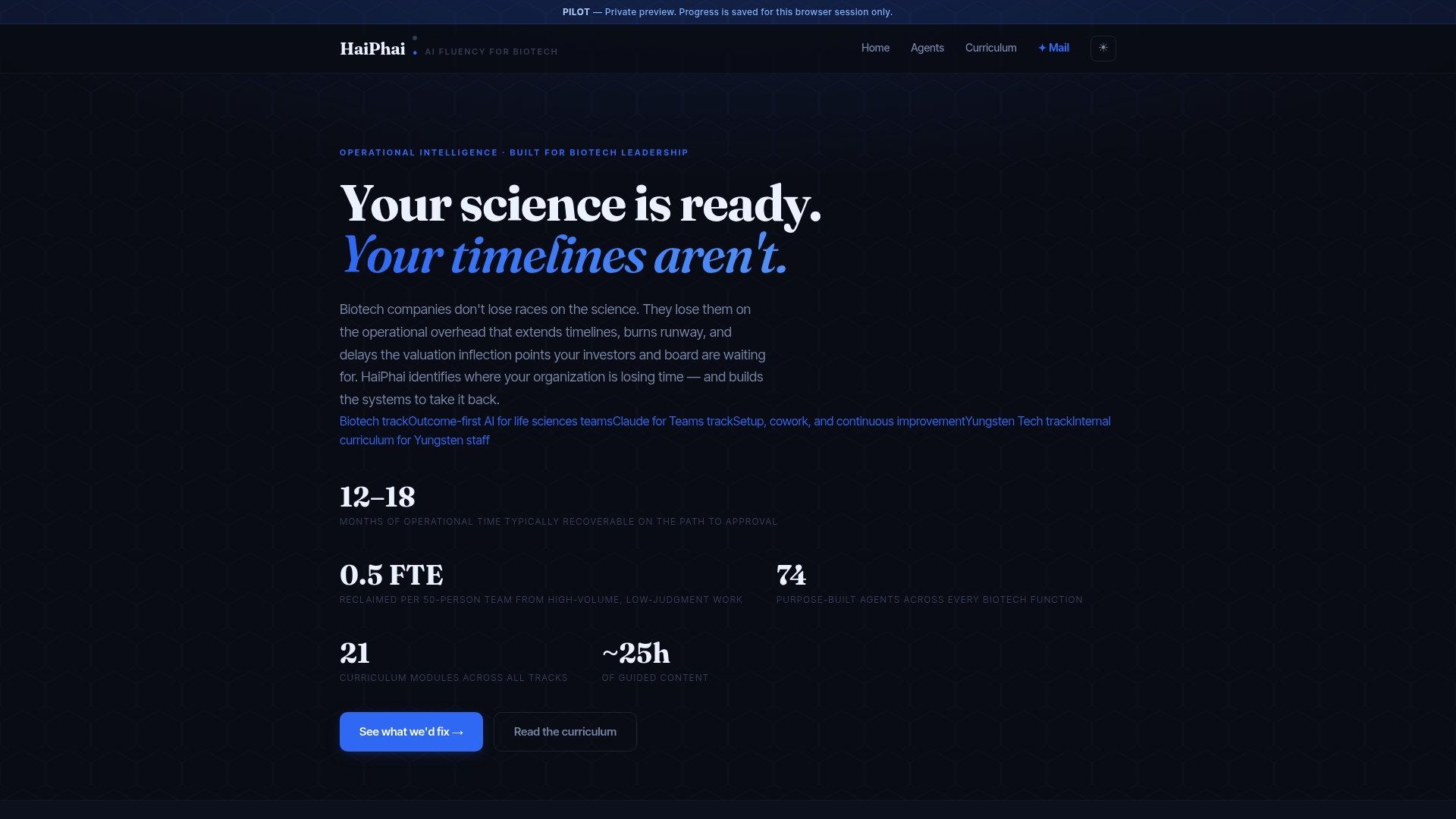
A typical Haiphai engagement begins with a structured discovery session covering site activation, regulatory drafting, and cross-functional handoffs. From there, the team scopes a pilot that delivers measurable output in weeks, not quarters. The solutions overview covers the full range of operational partnership services, from diagnostic mapping to ongoing performance monitoring. If you are evaluating pihealth.ai alternatives and want an operational perspective before committing to a platform, book a discovery call with Haiphai to define your pilot scope.
Useful sources for vendor due diligence
Use these sources to go deeper on vendor profiles, market positioning, and regulatory guidance before finalizing your shortlist. Always verify HIPAA BAA terms directly with the vendor and request at least one customer reference from a completed US trial.
- Pi Health on Crunchbase: Funding history, founding date, and competitor set for Pi Health. Useful for vendor stability assessment.
- Pi Health on CB Insights: Intelligence summary covering FICS platform capabilities and global site network.
- Pi Health on PitchBook: Detailed company profile including funding rounds and market positioning. Useful for financial stability checks.
- Pi Health company site: Primary source for FICS platform documentation and stated integration capabilities.
- Medicus AI Health Copilot: Reference for understanding the design differences between clinician-facing AI assistants and regulatory-grade trial platforms.
- Haiphai blog: Operational case studies, AI integration guidance, and regulatory drafting automation resources for life sciences teams.
- Haiphai: AI in regulatory affairs: Deep dive on regulatory drafting automation, audit trail requirements, and governance models for US trials.
- Haiphai: clinical trial alternatives comparison: Sample shortlists and procurement questions for clinical-trial platform evaluation.
FAQ
What is the best AI platform for clinical trial operations?
For regulated US trials, an embedded operational partnership that redesigns governed workflows delivers more consistent timeline gains than a standalone platform. Haiphai is purpose-built for this; clinical-trial platforms like Pi Health, Medable, and Science 37 are strong choices when you need purpose-built data infrastructure and can staff governance internally.
Is Pi Health a CRO?
Pi Health is not a contract research organization. It positions itself as an AI-native operating system for clinical trials, focused on data collection, site coordination, and regulatory-standard data management through its FICS platform.
Which AI agent works best for healthcare professionals?
For clinical documentation and knowledge retrieval, Saner.AI and ChatGPT Enterprise are the most commonly deployed options. For regulated trial workflows, these tools require a governance layer and HIPAA BAA before use in a clinical setting.
What are the top healthcare AI companies in the US?
The leading categories are clinical-trial platforms (Pi Health, Medable, Science 37), general LLM providers with enterprise HIPAA programs (OpenAI, Anthropic, Google), and operational partners like Haiphai that embed AI into governed biotech workflows. The right category depends on whether your primary need is data infrastructure, clinician productivity, or operational timeline recovery.