
AI integration in life sciences is defined as the systematic deployment of machine learning, natural language processing, and agentic AI systems across research, clinical, and commercial workflows to reduce time-to-decision and improve outcome quality. The life sciences AI integration benefits now documented in peer-reviewed literature and industry deployments are not incremental. They are structural. AI-powered systems achieve up to 90% improvement in clinical site selection and a 5× acceleration in in-silico drug discovery. For biotech and pharma professionals managing compressed timelines and rising regulatory complexity, these numbers represent a fundamental shift in what is operationally possible.
1. AI accelerates drug discovery at every stage
Machine learning in life sciences has moved well beyond pattern recognition in genomic datasets. Multimodal AI models now handle virtual screening, de novo drug design, and pharmacokinetic prediction within a single integrated pipeline. The result is faster hypothesis generation and fewer experimental iterations before a viable candidate emerges.
AI-driven predictive modeling of pharmacokinetics, toxicity, and drug-target interactions enables research teams to eliminate low-probability candidates before they consume wet-lab resources. This shifts the experimental burden from broad screening to targeted validation, which is where scientific expertise creates the most value.

The 5× acceleration in in-silico discovery is not a theoretical ceiling. It reflects what structured AI deployment delivers when models are trained on domain-specific biological data rather than generic datasets. The practical implication is that a discovery program that previously required 18 months of computational and experimental cycling can now reach candidate nomination in under four months.
That said, speed without biological grounding creates its own risks. Experts caution that AI-identified candidates do not guarantee downstream success, and that integrating clinical biological context remains essential to avoid late-stage failure. The acceleration benefit is real. It requires domain-aware model architecture to hold.
Pro Tip: When evaluating AI platforms for drug discovery, ask vendors specifically how their models incorporate biological heterogeneity and clinical context. Generic large language models applied to molecular data without domain-specific fine-tuning produce faster outputs, not better ones.
2. Clinical site selection improves by up to 90%
Site selection is one of the most consequential and historically manual steps in clinical development. Identifying sites with the right patient populations, investigator experience, and infrastructure has traditionally relied on relationship networks and historical performance data that is often incomplete or outdated.
AI changes this by processing real-world data, electronic health records, and ClinicalTrials.gov datasets simultaneously to score and rank sites against protocol-specific criteria. The 90% improvement in site selection performance documented in structured AI deployments reflects both better site quality and faster identification. Fewer underperforming sites mean fewer protocol amendments, fewer timeline extensions, and lower per-patient costs.
This benefit compounds across the trial lifecycle. Better sites recruit faster, retain patients longer, and generate cleaner data. Each of those outcomes reduces the probability of a complete response letter from the FDA or EMA, which is where development programs lose years, not months.
3. Patient recruitment timelines shrink significantly
Recruitment failure or delay is the single most common reason clinical trials miss their primary endpoints on time. AI-enabled patient matching tools can screen thousands of candidates simultaneously, cross-referencing eligibility criteria against structured and unstructured clinical data at a scale no human team can replicate.
The operational impact is a recruitment phase that compresses from years to months in many therapeutic areas. For rare disease programs where eligible patients are geographically dispersed, AI-driven matching combined with decentralized trial infrastructure can be the difference between a viable trial and one that never reaches enrollment targets.
Beyond speed, AI improves recruitment diversity by identifying eligible patients across demographic groups that traditional site-based recruitment systematically underrepresents. More representative trial populations produce more generalizable efficacy and safety data, which strengthens regulatory submissions and post-market surveillance.
4. Operational efficiency scales across document-heavy workflows
Life sciences enterprises are transitioning from discrete digital pilots to unified operational fabrics that integrate clinical, regulatory, and commercial data. This shift reduces manual document effort across protocol drafting, regulatory submission preparation, safety narrative writing, and clinical study report generation.
The efficiency gains here are not about replacing scientific judgment. They are about eliminating the administrative overhead that consumes scientific talent. A regulatory affairs team that spends 60% of its time reformatting documents and chasing version control is not adding strategic value. AI-powered document automation returns that capacity to work that requires human expertise.
AI tools also reduce rework cycles in protocol drafting by flagging inconsistencies between inclusion criteria, endpoints, and statistical analysis plans before submission. Catching those misalignments early, rather than during agency review, is a concrete time-saving that accumulates across every program in a portfolio.
5. Regulatory compliance becomes a design feature, not an afterthought
GxP-compliant AI deployment is the architecture decision that separates organizations that scale AI quickly from those that stall in validation cycles. Early investment in GxP-compliant system architecture accelerates deployment and avoids the regulatory delays that come from retrofitting compliance onto systems built without it.
The practical benefits of building compliance in from the start include:
- Auditability by default. Every model decision, data input, and output is logged in a format that satisfies 21 CFR Part 11 and Annex 11 requirements without manual reconstruction.
- Faster validation cycles. Systems designed for regulated environments require less remediation before IQ/OQ/PQ sign-off, which shortens the path from development to production use.
- Reduced rework. Automated policy enforcement prevents the data handling errors that trigger corrective and preventive action cycles.
- Global scalability. Traceability and auditability built into the architecture support multi-regional submissions without rebuilding compliance documentation for each jurisdiction.
The competitive advantage in life sciences AI increasingly hinges on architecture that supports traceability, auditability, and regulated scale. Organizations that treat compliance as infrastructure rather than a checkpoint move faster and spend less on remediation.
Pro Tip: Before deploying any AI system in a regulated workflow, map the system's data lineage from input to output and confirm it produces an audit trail your quality team can defend during an inspection. If the vendor cannot show you that trail in a live demo, the system is not production-ready for life sciences.
6. Personalized medicine and patient-centric care advance together
AI-driven patient stratification improves trial inclusion by matching individuals to protocols based on biomarker profiles, comorbidities, and treatment history rather than broad demographic criteria. This produces trial populations that more accurately reflect the patients who will ultimately receive the therapy, which strengthens the clinical and commercial case for approval.
Real-world data integration supports personalized therapy by enabling safety monitoring that continues after approval. AI systems processing wearable device data, electronic health records, and patient-reported outcomes can detect safety signals earlier than traditional pharmacovigilance methods. Earlier detection means faster label updates and fewer serious adverse events reaching patients at scale.
Adaptive treatment regimens powered by AI decision support systems represent the next frontier in data-driven healthcare solutions. These systems adjust dosing recommendations based on individual patient response data in near real time, moving clinical practice from population-level protocols toward genuinely individualized care. The ethical governance requirements for these systems are significant, but the patient outcome improvements they enable are equally significant.
7. Commercial operations and go-to-market speed improve together
The impact of AI on research timelines translates directly into commercial value. A drug that reaches market 12 months earlier than it would have under traditional development timelines generates substantially more net present value, particularly in therapeutic areas with strong pricing power and limited competition.
Here is how AI integration affects commercial operations across the product lifecycle:
| Function | Without AI integration | With AI integration |
|---|---|---|
| Market access preparation | Manual data aggregation, 6-12 months | Automated evidence synthesis, 2-4 months |
| Pricing negotiation inputs | Retrospective real-world data | Real-time outcomes data from integrated sources |
| Launch readiness | Sequential cross-functional planning | Parallel workflows coordinated by agentic AI |
| Post-market surveillance | Periodic signal review | Continuous monitoring with automated flagging |
Agentic AI models coordinate decisions and workflows across commercial functions, improving market responsiveness without adding headcount. For biotech companies preparing for their first commercial launch, this coordination capability is particularly valuable because it compensates for the organizational infrastructure that larger pharma companies have built over decades.
Unified data environments backed by cloud-native architectures improve visibility and traceability across product lifecycles. That visibility is not just an operational convenience. It is the data asset that supports pricing negotiations, health technology assessments, and investor communications simultaneously.
Key takeaways
AI integration in life sciences delivers the greatest returns when compliance, domain-specific architecture, and unified data infrastructure are treated as foundational requirements rather than optional upgrades.
| Point | Details |
|---|---|
| Drug discovery acceleration | Structured AI deployment achieves 5× faster in-silico discovery compared to traditional methods. |
| Clinical site selection | AI-powered site scoring delivers up to 90% improvement in selection performance and reduces trial delays. |
| Compliance as infrastructure | GxP-compliant architecture built early prevents validation delays and supports global regulatory submissions. |
| Commercial speed | Agentic AI and unified data environments compress go-to-market timelines across all commercial functions. |
| Patient outcomes | AI-driven stratification and real-world data integration improve trial diversity and post-market safety monitoring. |
What I've learned about AI in life sciences after years of watching deployments succeed and fail
The organizations that extract the most value from AI integration in life sciences share one characteristic that has nothing to do with the technology itself. They treat AI as operational infrastructure, not as a project. The distinction matters more than any specific tool or model choice.
When AI is a project, it has a start date, an end date, a budget, and a sponsor. When the sponsor moves on or the budget cycle ends, the project stalls. When AI is infrastructure, it has owners, governance, and a roadmap that connects to business outcomes. Those organizations are still running and improving their systems three years after the initial deployment.
I have also seen the biological complexity problem underestimated repeatedly. The efficiency gains from AI in healthcare require measuring clinical impact beyond model accuracy. A model that performs brilliantly on a benchmark dataset and fails in a heterogeneous patient population is not a technology problem. It is a domain knowledge problem that no amount of compute will solve. The teams that build domain expertise into their AI architecture from the start spend less time explaining failures to their boards.
The compliance point deserves more emphasis than it typically receives in AI benefit discussions. Every month saved in validation cycles because compliance was designed in rather than bolted on is a month of patent life recovered. For a drug with $1 billion in annual peak sales, that math is not abstract.
— John
How Haiphai helps life sciences teams capture these benefits faster
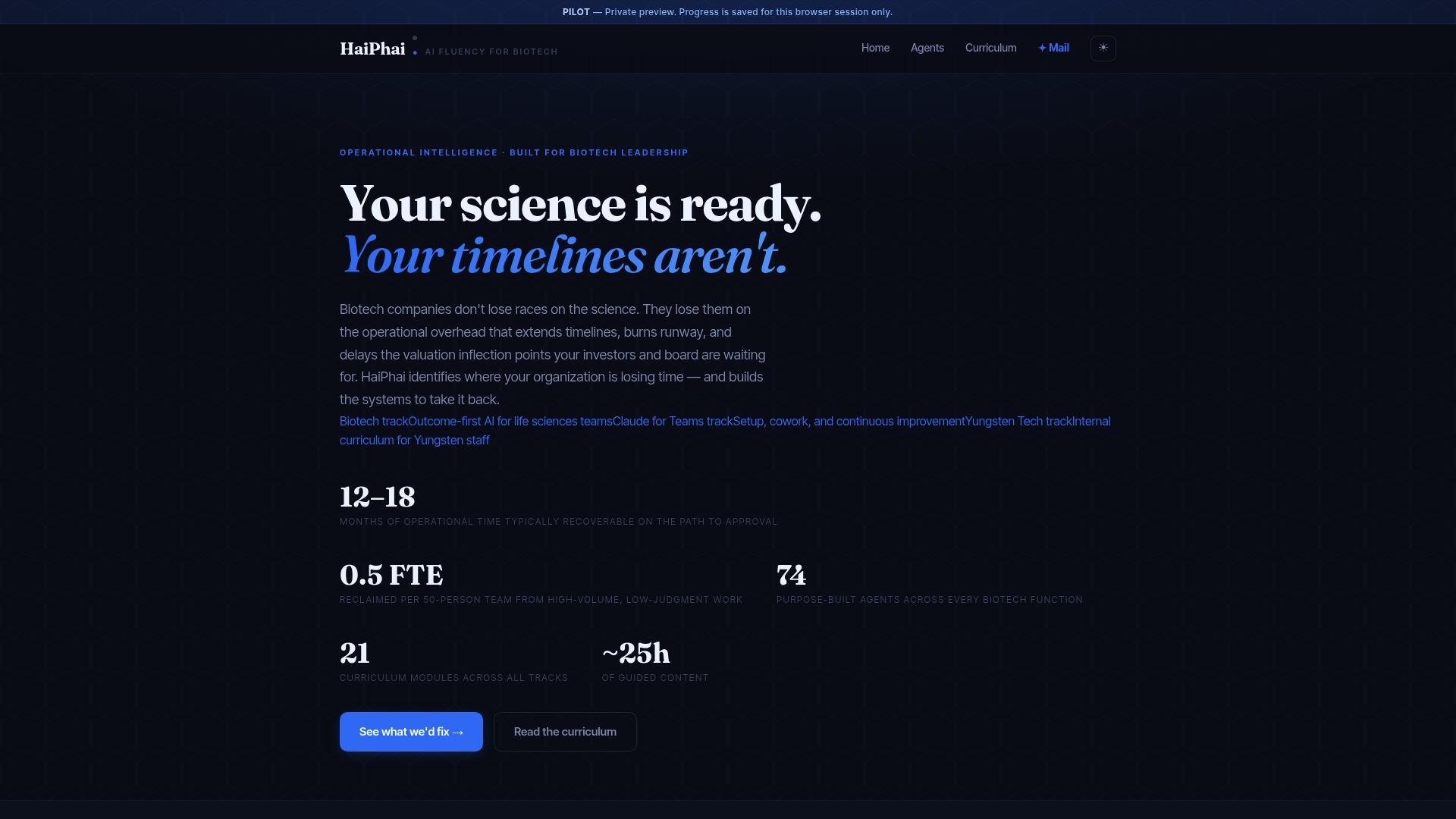
Haiphai works with biotech companies that are losing time and capital to operational bottlenecks in regulatory drafting, clinical site activation, and cross-functional coordination. Unlike generic software deployments, Haiphai starts from your strategic goals and works backward to identify exactly where AI integration will recover the most time on your path to approval. Clients reclaim up to 18 months of operational time, which directly increases company valuation and strengthens funding positions. If you are ready to move from AI as a pilot to AI as infrastructure, explore Haiphai's approach and see how the methodology applies to your specific development stage.
FAQ
What are the top benefits of AI integration in life sciences?
AI integration delivers accelerated drug discovery, improved clinical site selection, faster patient recruitment, reduced regulatory documentation burden, and better patient outcome monitoring. Structured deployments achieve up to 90% improvement in site selection and 5× faster in-silico discovery.
How does machine learning improve clinical trial efficiency?
Machine learning screens thousands of patient records simultaneously to match candidates against eligibility criteria, compressing recruitment timelines significantly. It also scores clinical sites against protocol-specific performance data, reducing the number of underperforming sites that delay trials.
What does GxP-compliant AI deployment mean?
GxP-compliant AI deployment means building auditability, traceability, and data integrity requirements into the AI system architecture from the start, rather than adding them after development. This approach accelerates regulatory validation and reduces compliance-related deployment delays.
How does AI integration affect drug development timelines?
AI reduces time across multiple development phases simultaneously, from target identification through regulatory submission preparation. The cumulative effect can compress overall development timelines by months to years, increasing the net present value of assets in the pipeline.
Is AI in healthcare safe for regulated clinical workflows?
AI in regulated clinical workflows requires ethical governance frameworks that address accuracy, bias, and patient safety alongside efficiency gains. Systems designed with GxP compliance and continuous monitoring built in are appropriate for regulated use; generic AI tools applied without domain-specific governance are not.