
The fastest route to shorten biotech time-to-market is an embedded AI operational partnership that combines diagnostic bottleneck mapping, governed AI-enabled workflow redesign, and accountable human-in-the-loop validation. Not a software subscription. Not a pilot that never scales. A structured engagement where an external partner maps your actual operational constraints, redesigns the workflows that create delay, and governs the AI outputs that feed regulated decisions.
The core elements that deliver measurable time savings:
- Diagnostic bottleneck mapping: identify where time is actually lost before deploying any tool
- Governed AI-enabled workflow redesign: regulatory drafting, clinical site activation, and data operations rebuilt around AI-assisted processes
- Human-in-the-loop validation: named accountable roles at every decision point that touches the regulatory record
- Accountable governance: versioned models, traceable data lineage, and defined change control from day one
Haiphai's embedded operational partnerships are built around exactly this model. Clients can reclaim significant operational time on the path to approval.
Table of Contents
- How do embedded AI partnerships actually shorten time to market?
- What should you look for in an embedded AI partner?
- What engagement models exist, and how much time can you realistically reclaim?
- How do you stay aligned with FDA expectations for AI in regulated workflows?
- Key Takeaways
- Why pilots fail and embedded partnerships don't
- Haiphai works with biotech teams that need to move now
- Sources and further reading
- FAQ
How do embedded AI partnerships actually shorten time to market?
These partnerships shorten timelines because they align external AI capability with internal workflow redesign and governance, rather than layering tools onto broken processes.
The mechanism works in four steps. First, a structured diagnostic surfaces the specific handoffs, data gaps, and approval loops that create delay. Second, targeted AI interventions address those bottlenecks directly, whether that means accelerating regulatory document drafts, compressing clinical site activation cycles, or cleaning data inputs earlier in the pipeline. Third, parallelizing workstreams that previously ran sequentially can compress months of calendar time. Fourth, governed model validation prevents the rework that typically follows uncontrolled AI deployment in regulated environments.
Research published in the Medical Research Archives documents a multi-speed diffusion pattern: AI adoption moves fast in discovery and document generation, but slows sharply in clinical and regulatory settings. The enablers that bridge that gap are platform partnerships, venture-client models, and human-centered workflow design. That is the enterprise-level capability gap that an embedded partner fills.
The life sciences AI integration benefits that actually show up on a timeline are almost always downstream of this kind of operating-model change, not the AI tool itself.
What should you look for in an embedded AI partner?
Prioritize partners that demonstrate operational diagnostics, measurable milestone commitments, and validated experience in regulated environments. Marketing claims about AI capability are easy to make; the questions below surface real operational depth.
Selection criteria:
- Does the partner begin with a structured diagnostic, or do they lead with a tool recommendation?
- Can they commit to measurable milestones (time-to-IND readiness, activation lead time reduction) in the engagement letter?
- Do they have documented governance: model versioning, data lineage, change control, and named approvers?
- Have they worked in CMC, clinical operations, or regulatory affairs specifically, not just general AI consulting?
- Do they design human-in-the-loop roles into every workflow that touches a regulated output?
Red flags: pilot-only engagements with no scale path, no traceable model versioning, no named accountable role for AI outputs, and no time-saved commitments in writing.
| Question to Ask | What a Strong Answer Looks Like |
|---|---|
| How do you identify our bottlenecks? | Structured diagnostic methodology with defined outputs |
| What milestones do you commit to? | Named KPIs with timelines in the contract |
| How do you handle model updates? | Versioned change control with documented approvals |
| Who is accountable for AI outputs? | Named human role, not "the system" |
| How do you align with FDA expectations? | Risk-tiered validation plan referencing current guidance |
The role of AI in biotech execution depends almost entirely on whether the partner can answer these questions with specifics, not slides.
What engagement models exist, and how much time can you realistically reclaim?
Realistic reclaimed time can vary widely depending on workflow and data maturity, depending on starting data-operations maturity. The range is wide because initial data quality is the single largest variable.
Three engagement models cover most situations. A diagnostic-to-pilot model runs 8–12 weeks, surfaces the top bottlenecks, and delivers one validated intervention. An embedded team model runs 6–18 months, redesigns multiple workflows, and scales governed AI across clinical, regulatory, and CMC operations. A retainer model provides ongoing operational partnership after the core redesign is complete.

A survey of pharmaceutical R&D leaders found organizations are using AI/ML across an average of 13.6 areas, with near-universal intent to reduce development timelines. The gap between intent and realized value is almost always a governance and embedding problem, not a technology problem.
| Phase | Milestone | Typical Window | Expected Time Impact |
|---|---|---|---|
| Diagnostic | Bottleneck map delivered | Weeks 1–6 | Baseline established |
| Pilot | One workflow validated | Weeks 6–10 | 1–3 months reclaimed |
| Embed | 2–3 workflows live | Months 4–12 | 3–9 months reclaimed |
| Scale | Full program operational | Months 12–18 | Up to 18 months reclaimed |
KPIs to track: activation lead time, regulatory submission readiness score, time-to-milestone reduction, and model validation pass rate. AI-assisted project planning in life sciences consistently shows activation lead time as the earliest measurable signal of partnership impact.
How do you stay aligned with FDA expectations for AI in regulated workflows?
Align every project to a risk-tiered validation plan that maps FDA draft guidance expectations to your specific use case and names accountable human roles before any AI output enters the regulatory record.
The FDA draft guidance analysis published by SCIRP identifies the core requirements: transparency and documentation, a total product lifecycle approach for models, versioning and change control, independent test sets and stress testing, and predefined update protocols. These are not optional for any AI output that informs a regulatory submission.
Practical checklist:
- Define the risk tier for each AI use case (administrative vs. safety-relevant vs. regulatory-record-impacting)
- Assign a named human approver for every output that enters a regulated document
- Establish model versioning and change-control procedures before go-live
- Build independent test sets that reflect real operational data, not just training distributions
- Document data lineage from source to output for every model in scope
Industry comment letters reviewed by Clinical Trial Vanguard make clear that the near-term regulatory battleground is mature AI oversight: data lineage, change control, and named human oversight, not autonomous AI systems. Sponsors that treat AI as a decision-maker rather than a decision-support tool will face remediation requests.
One constraint worth planning around: ICH quality guidelines specify real-time stability monitoring windows that cannot be compressed regardless of AI capability. Build those hard timelines into your reclaim estimates from the start.
Pro Tip: Structure your vendor documentation requirements like a Drug Master File reference: require the partner to maintain a controlled document package covering model architecture, training data provenance, validation results, and change history. This shifts audit burden to the partner and gives your regulatory team a clean evidence trail.
Haiphai's governance and compliance framework is built around exactly these requirements, with controls designed for regulated AI deployments. For a deeper look at augmentation-first regulatory use cases, the AI in regulatory affairs guide covers practical alignment steps.
Key Takeaways
An embedded AI operational partnership that combines diagnostic bottleneck mapping, governed workflow redesign, and human-in-the-loop validation is the highest-confidence route to reclaiming months on the biotech development timeline.
| Point | Details |
|---|---|
| Start with a diagnostic | Map bottlenecks before deploying any AI; the diagnostic determines where time savings are actually available. |
| Regulatory drafting and site activation first | These workflows deliver the most calendar-time impact and should be the first intervention targets. |
| Governance is non-negotiable | Model versioning, data lineage, and named human approvers must be in place before any AI output enters a regulated document. |
| Realistic reclaim range | Partnerships typically deliver 2–6 months in trial activation and 3–9 months in regulatory drafting, depending on data maturity. |
| Haiphai as embedded partner | Haiphai's diagnostic-to-scale model aims to reclaim substantial operational time on the path to approval. |
Why pilots fail and embedded partnerships don't
The conventional wisdom in biotech AI adoption is that you start with a pilot, prove value, then scale. That sequence sounds logical. It almost never works.
Pilots are scoped to succeed in isolation. They use clean data, motivated champions, and a narrow workflow that does not represent the operational complexity of the real environment. When the pilot ends, the organization faces the actual problem: integrating AI into a regulated, cross-functional workflow where data is messy, decision rights are unclear, and the FDA expects documented human oversight.
The Clinical Leader analysis makes the point directly: AI compresses evidence generation, but the binding constraint moves to enterprise decisioning. Organizations that restructure decision rights and capital-commitment timing capture the value. Those that run pilots and wait for "proof" simply move the bottleneck downstream.
The operating-model change is the hard part. It requires an OpEx mindset, cross-functional decisioning authority, and leadership willing to commit capital before every uncertainty is resolved. That is exactly what an embedded partner is designed to support, not just the AI tooling, but the organizational change that makes the tooling matter.
Haiphai works with biotech teams that need to move now
Biotech teams that have already run pilots and are still waiting for timeline impact have a governance and embedding problem, not a technology problem. Haiphai's embedded operational partnerships are built to solve that specific gap: a structured diagnostic identifies where time is actually lost, AI-enabled workflow redesign addresses those bottlenecks directly, and a governed rollout keeps every output aligned with FDA expectations.
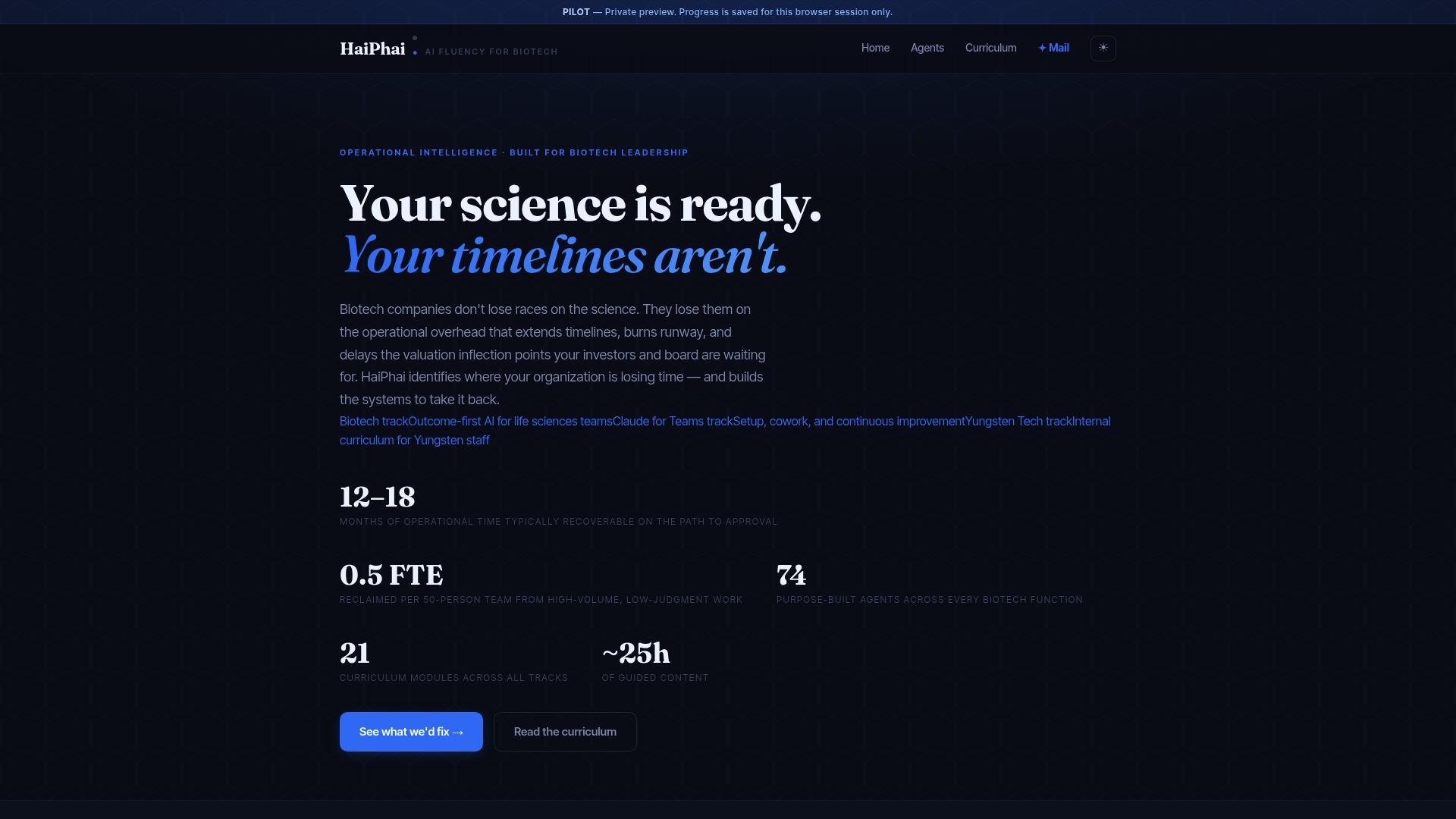
Haiphai works across clinical operations, regulatory affairs, and CMC workflows, with a governance framework designed for regulated AI deployments. Engagements start with a scoped diagnostic that delivers a bottleneck map and prioritized intervention plan within six weeks. From there, the embedded team moves to pilot, validation, and scale on a milestone-based timeline with measurable KPIs in the engagement letter.
To request a diagnostic or get a scoped proposal, visit Haiphai's solutions page or review the governance and compliance framework before your first conversation.
Sources and further reading
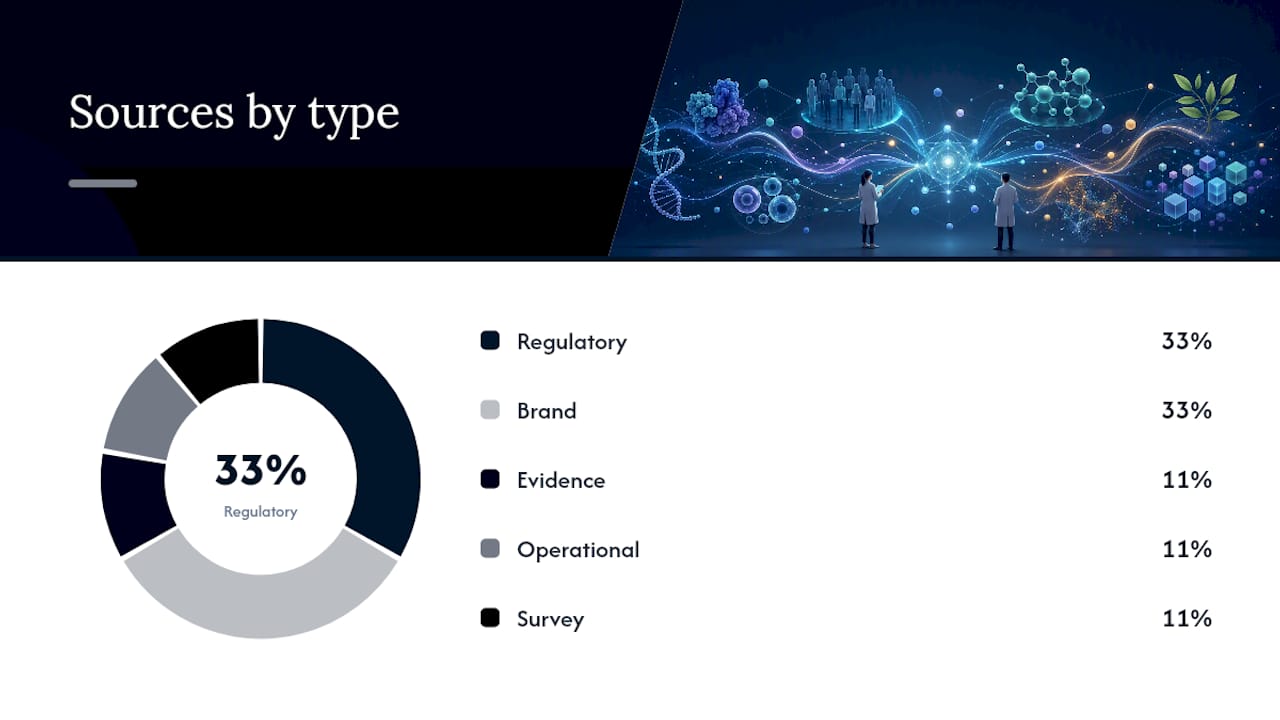
The table below maps each source to its primary use in the article.
| Source | Type | Primary Use |
|---|---|---|
| Medical Research Archives — AI in Biopharma | Evidence | Multi-speed diffusion pattern; enterprise partnership rationale |
| SCIRP — FDA AI Guidance Analysis | Regulatory | Risk-tiered validation, lifecycle approach, documentation requirements |
| ICH Quality Guidelines | Regulatory | Non-compressible stability timelines; hard downstream constraints |
| Clinical Leader — Systemic Bottleneck | Operational | Operating-model change; enterprise decisioning as binding constraint |
| PPD — Pharma R&D Challenges 2026 | Survey | AI/ML adoption breadth; governance and embedding as next phase |
| Clinical Trial Vanguard — FDA AI Rulebook | Regulatory | Data lineage, change control, named human oversight requirements |
| Haiphai Solutions | Brand | Embedded partnership services and engagement models |
| Haiphai Trust | Brand | Governance, security, and compliance framework |
| Haiphai — AI in Regulatory Affairs | Brand | Augmentation use cases; practical regulatory alignment steps |
For downstream manufacturing and peptide API sourcing considerations that intersect with AI-enabled supply chain planning, PeptiLab's sourcing guide covers practical vendor partnership steps.
FAQ
What is an embedded AI operational partnership in biotech?
An embedded AI operational partnership places an external team inside your workflows to diagnose bottlenecks, redesign processes with governed AI, and deliver measurable time savings. It differs from a software subscription because the partner owns the operational change, not just the tooling.
How much time can an embedded AI partner realistically save?
Realistic reclaim ranges from 2–6 months in trial activation to 3–9 months in regulatory drafting workflows, depending on starting data-operations maturity. Haiphai's model targets up to 18 months reclaimed on the path to approval.
What FDA requirements apply to AI used in regulatory submissions?
The FDA draft guidance expects transparency, risk-tiered validation, model versioning, change control, independent test sets, and named human approvers for any AI output that enters a regulated document or submission.
What are the biggest red flags when evaluating an AI partner?
Pilot-only engagements with no scale path, no traceable model versioning, no named accountable human role, and no measurable time-saved commitments in the contract are the four clearest warning signs.
How does Haiphai structure its engagements?
Haiphai starts with a six-week diagnostic that maps bottlenecks and prioritizes interventions, then moves to a governed pilot, embedded rollout, and scale phase, with milestone-based KPIs and regulatory alignment built into every stage.