
Automating competency-first site training and SOP workflows shortens site activation and cuts administrative burden without weakening the audit trail behind it. The method rests on three moves: track competency instead of hours, reuse validated training across studies, and deliver study-specific instruction only where risk demands it. Sponsors running these workflows through a structured operational partner, the way Haiphai builds them, routinely reclaim weeks of dead time per site before first patient in.
TL;DR:
- Automated training workflows focus on competency verification, reuse of validated training, and study-specific instruction only when necessary, significantly reducing activation delays.
- Critical decisions depend on role experience, study risk tier, and amendment frequency, ensuring tailored, efficient training that avoids unnecessary repetition.
- Building the program around clear roles, a connected technology stack, and pilot testing on high-value categories can cut site activation timelines by up to 50 percent.
- Regulatory compliance requires upfront validation plans, version control, human oversight, and automated traceability for training and competency evidence.
- Successful adoption hinges on early engagement with site staff, transparent reuse policies, dedicated support, and explicit communication of benefits to foster trust and change management.
Table of Contents
- What Training Management Automation Actually Covers in Biotech
- How Do You Decide What to Automate and What to Reuse?
- Building the Operational Roadmap: People, Technology, and Pilots
- What Do Regulators Expect From Automated Training Systems?
- What Pilot Checklist and KPIs Prove Impact to Leadership?
- How Do You Get Site Staff to Actually Adopt an Automated System?
- How Should You Handle Data Security for Training Records?
- Can the Same System Scale Across Trial Phases and Regions?
- Haiphai's Perspective on Operational Partnership
- Ready to Pilot Training Automation With an Operational Partner?
- Primary Sources Behind This Framework
- Sources
- FAQ
What Training Management Automation Actually Covers in Biotech
Training management automation, in a clinical and regulatory operations context, means something narrower than corporate learning software. It is not about enrolling employees in courses or tracking completion rates for a general workforce. It is the automated handling of investigator and site staff training, SOP knowledge transfer, competency verification, and the training-related steps embedded in site activation and submission timelines.
That distinction matters because most of what gets written about "training management" online describes enterprise LMS platforms built for HR departments. Biotech operations teams need something else: a system that ties training completion to delegation logs, feeds evidence into the eTMF, and knows the difference between a coordinator who has run six prior studies on the same protocol platform and one starting cold.
The operational components look like this:
- Role-based competency matrices that map who needs which training, by job function and study risk tier.
- Modularized content split between reusable foundational skills (Good Clinical Practice, platform navigation) and study-specific instruction (protocol amendments, device handling).
- Automated tracking and reminders that flag lapsed certifications or pending modules before they block site activation.
- eTMF and delegation log linkage so training evidence lands automatically in the record an auditor will eventually pull.
Site activation delays are frequently traced to scattered documents and late training completion rather than any single regulatory holdup, according to an analysis of what slows site activation. Centralized, automated workflows address that root cause directly. FDA leadership has also signaled active interest in reducing administrative dead time across trial conduct, citing it as a meaningful share of the gap between Phase 1 and submission in recent pilot program commentary.
How Do You Decide What to Automate and What to Reuse?
Not every training element deserves the same treatment. The SCRS Cut 25 guidance pushes sponsors toward a competency-first model: verify what a site team already knows how to do, and reserve study-specific training for genuine gaps. Reciprocity is the operative idea. A coordinator certified on a given EDC platform six months ago on a different trial should not sit through the same module again just because the sponsor changed.
A practical decision framework runs on three variables:
- Role experience — has this person performed this function on a comparable protocol before?
- Study risk tier — does the protocol carry elevated safety, dosing, or device complexity that demands fresh instruction regardless of experience?
- Amendment frequency — how often will the protocol change, and does that argue for just-in-time retraining over one-time onboarding?
Cross these three factors and most training decisions sort themselves. A veteran coordinator on a low-risk, stable protocol needs almost nothing beyond a competency attestation. A new hire on a high-risk oncology trial with frequent amendments needs the full study-specific track, refreshed at every amendment.
For reusable competency, the minimal evidence package should include a signed attestation, the original training certificate or completion record, and a reference to the prior protocol or platform where the skill was demonstrated. Industry consortiums including Advarra have described this reuse and reciprocity model as a risk-based approach that sponsors are increasingly building into their site agreements.
Pro Tip: Build your reuse policy into the site contract template, not just the training platform. If reciprocity isn't written into the agreement, monitors will default to requiring fresh training out of habit, and the automation gains never materialize.
Building the Operational Roadmap: People, Technology, and Pilots
Automation fails when it is bolted onto an unclear process. Get the roles and architecture right first, then pilot before scaling.
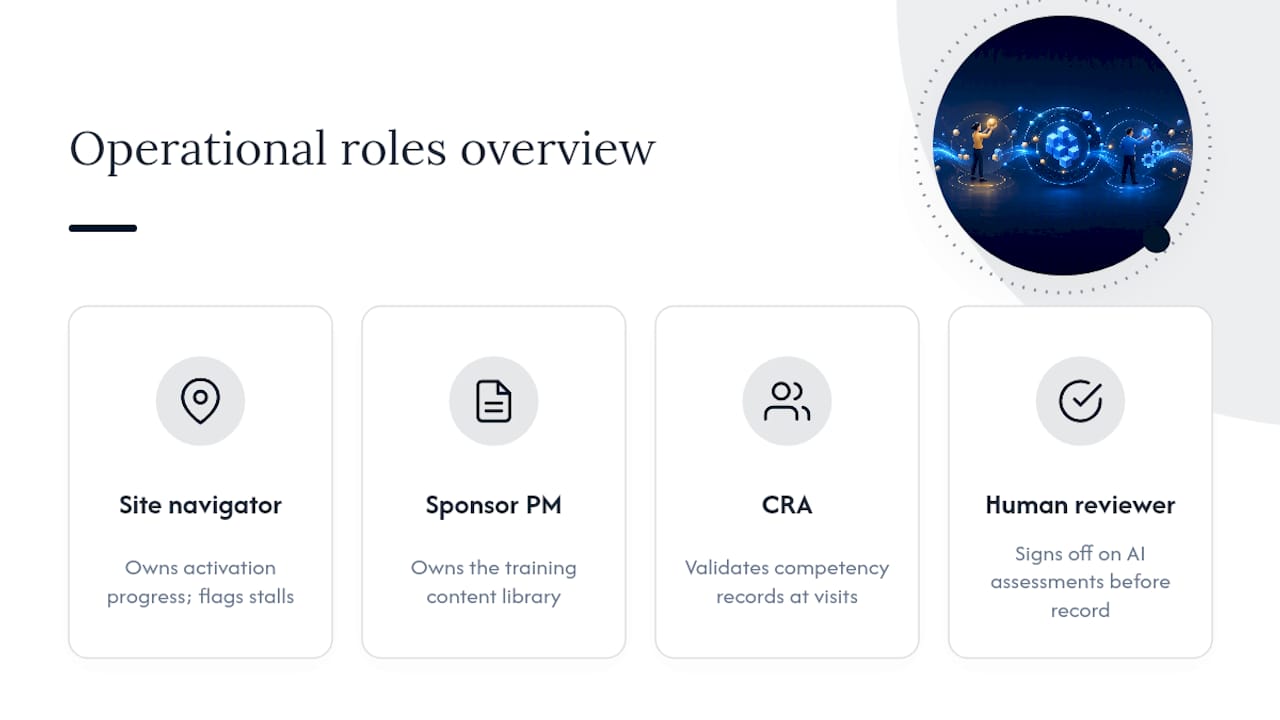
Staffing. Four roles matter most: a site navigator who owns activation progress and flags stalls, a sponsor project manager who owns the training content library, a CRA who validates competency records at monitoring visits, and a human reviewer who signs off on any AI-generated assessment or training recommendation before it becomes part of the regulatory record.
Technology architecture. The stack needs four connected layers: modularized training content (foundational versus study-specific), a competency tracking store that timestamps and versions every record, a workflow engine that triggers reminders and JIT retraining on amendments, and connectors into the eTMF and delegation log so evidence flows without manual re-entry.
Pilot design. Pick one high-value competency category, such as EDC platform reciprocity, and run it across 4 to 6 representative sites with different operating models. Appoint a site navigator, instrument the eTMF connection, and measure activation days and training completion lag over a defined window, an approach consistent with pilot methodology described in research on accelerating start-up cycles.
Aggregated analyses of AI integration across clinical workflows report timeline gains in the range of 30 to 50 percent, with cost reductions up to 40 percent, though the same research flags validation and interoperability as persistent barriers. Treat that range as directional, not a guarantee, until your own pilot confirms it.
Pair a navigator role with automated tracking rather than deploying either alone. That combination reduced activation variability and made a 90-day activation target realistic in pilot trials, per the same accelerated start-up research cited above.
What Do Regulators Expect From Automated Training Systems?
Regulatory acceptability hinges on a handful of governance practices that need to exist before automation goes live, not after an inspector asks for them.
- Prospective specification. Define the context of use, validation plan, and human oversight checkpoints for any AI-assisted assessment before deployment, not retroactively. Peer-reviewed review work on AI and NLP in clinical research consistently flags this as the difference between an acceptable pilot and an unvalidated black box.
- Version control on training content and algorithms. Every change to a competency assessment tool or scoring logic needs a documented version history, tied to the date and rationale for the change.
- Human-in-the-loop sign-off. No automated competency determination should become part of the regulatory record without a named human reviewer confirming it.
- Audit trail and eTMF linkage. Training evidence and delegation log entries need to trace back to source records automatically, not through a monthly manual reconciliation.
- Validation protocols for algorithm updates. Treat any change to an automated assessment tool the way you would treat a protocol amendment: document it, justify it, and re-validate before rollout.
FDA's own posture toward AI pilots in trial conduct has been described as encouraging early, iterative dialogue rather than a wait-and-file-later approach, according to the same GovExec coverage of FDA pilot programs. Sponsors who bring their validation plan to the conversation early tend to move faster than those who build first and explain later.
What Pilot Checklist and KPIs Prove Impact to Leadership?
A pilot earns its scale-up budget on specific numbers, not a general sense that things feel smoother.
- Select one protocol and 4 to 6 sites with varied operating models.
- Map role-based competency requirements against study risk tier.
- Integrate training completion data with the eTMF and delegation log.
- Train and deploy a site navigator to own activation milestones.
- Track results for a defined window, typically 12 weeks.
The KPIs that matter to leadership: site activation days (before versus after), percentage of training hours satisfied through reuse rather than fresh instruction, time-to-complete study-specific modules, and operator hours saved per site. The SCRS Cut 25 initiative sets a public benchmark, a 25 percent reduction in site training burden, worth citing directly when presenting before/after comparisons to a steering committee.
How Do You Get Site Staff to Actually Adopt an Automated System?
The best-designed training automation stack fails if coordinators route around it. Adoption problems usually trace back to one of three causes: the system adds steps instead of removing them, sites weren't consulted before rollout, or the training on the training system itself was an afterthought.
Start with a small group of site coordinators as design partners before broad rollout, not after. Ask them to walk through their current activation process and point out exactly where duplicate training wastes their time. That input shapes what the automation actually needs to fix.
Communicate the reuse policy explicitly and early. Site staff who have sat through the same GCP module for three different sponsors in one year are primed to resent anything that looks like more of the same. When you can tell them upfront that platform competency carries forward, adoption resistance drops noticeably.
Assign a single point of contact, ideally the site navigator role, who can answer questions and troubleshoot in real time during the first few weeks. A helpdesk ticket that takes three days to answer during week one of rollout will cost you the whole site's goodwill.
Finally, report back. Sites that see their own activation numbers improve, and hear that explicitly, become advocates for the next protocol's rollout instead of skeptics.
How Should You Handle Data Security for Training Records?
Training and competency records carry personnel data, and depending on your platform, potentially participant-linked information through delegation logs and monitoring visit notes. That combination puts them squarely inside your data governance scope, not outside it.
Vendor selection matters more here than in most operational software decisions. A training automation platform that touches personally identifiable staff information or links to participant-facing systems needs the same scrutiny you'd apply to any system handling protected health information. No AI tool is automatically compliant with health data regulations on its own, regardless of what a vendor's marketing implies; compliance depends on how the system is configured, hosted, and governed.
Access controls need to be role-based and auditable. A CRA should be able to see training completion status; they generally should not have edit access to the underlying competency assessment logic. Data retention policies for training records should mirror your broader trial master file retention schedule, not run on a separate clock that creates reconciliation headaches at inspection time.
Cross-border trials add another layer. Training data collected at a site in one country, processed by a platform hosted in another, and reviewed by a sponsor team in a third triggers multiple data protection regimes simultaneously. Build your data flow map before you pick a vendor, not after you discover a gap during a regulatory inspection.
Can the Same System Scale Across Trial Phases and Regions?
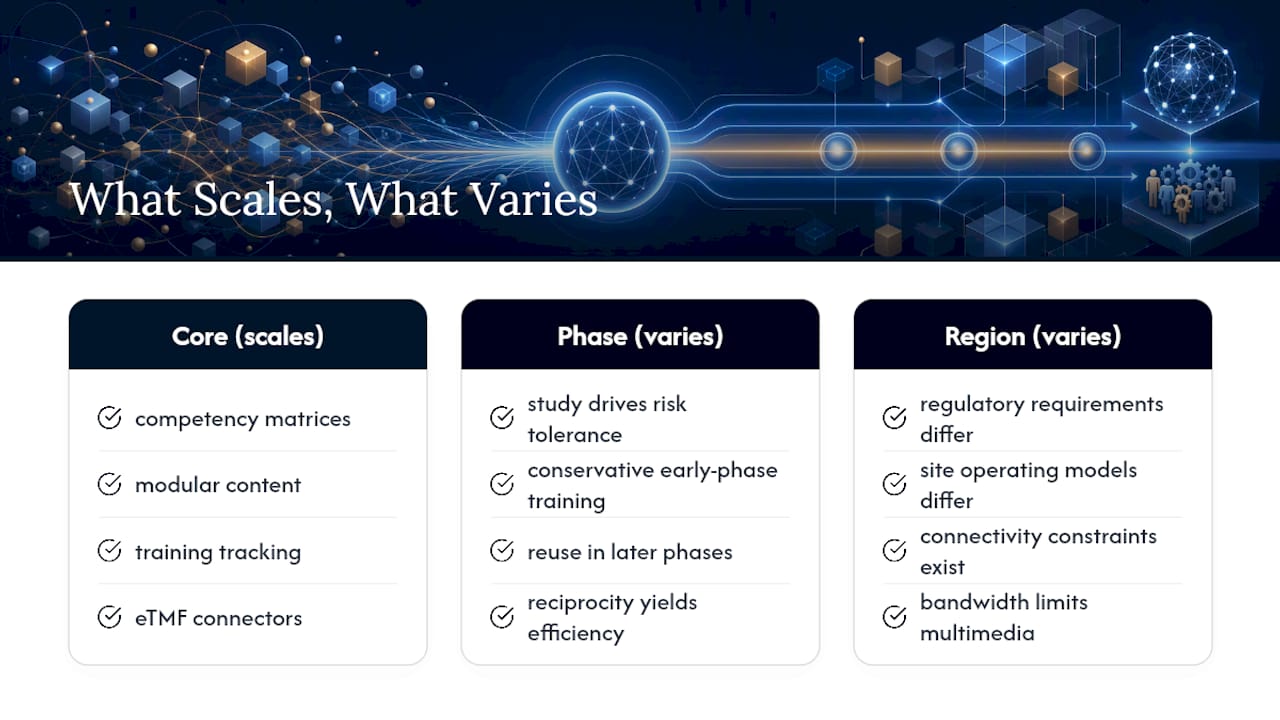
A training automation system built for a single Phase 2 oncology study in three countries needs real redesign, not just more licenses, before it can handle a global Phase 3 program with 40 sites. The core architecture (competency matrices, modular content, tracking, eTMF connectors) stays consistent. What changes is the configuration layer underneath it.
Study phase drives risk tolerance. Early-phase trials with intensive safety monitoring justify more conservative, study-specific training even for experienced staff. Later-phase trials with established safety profiles and standardized procedures are where reuse and reciprocity deliver the biggest efficiency gains, since site teams are more likely to have relevant prior experience.
Geography drives customization in ways that go beyond translation. Regulatory training requirements differ by region, site operating models vary widely (academic medical centers run differently than dedicated trial sites), and connectivity constraints in some regions make bandwidth-heavy multimedia training modules impractical. A platform that assumes uniform infrastructure across all sites will create activation bottlenecks in exactly the regions where speed matters most.
The practical approach is to design the automation framework once, then build a configuration checklist for each new phase or region rather than a full rebuild. That checklist should specify local regulatory training requirements, connectivity constraints, and which reuse reciprocity agreements apply to that market's site network. Sponsors running multi-region programs through documented process automation patterns tend to hit fewer surprises at each new region's first site activation.
Haiphai's Perspective on Operational Partnership
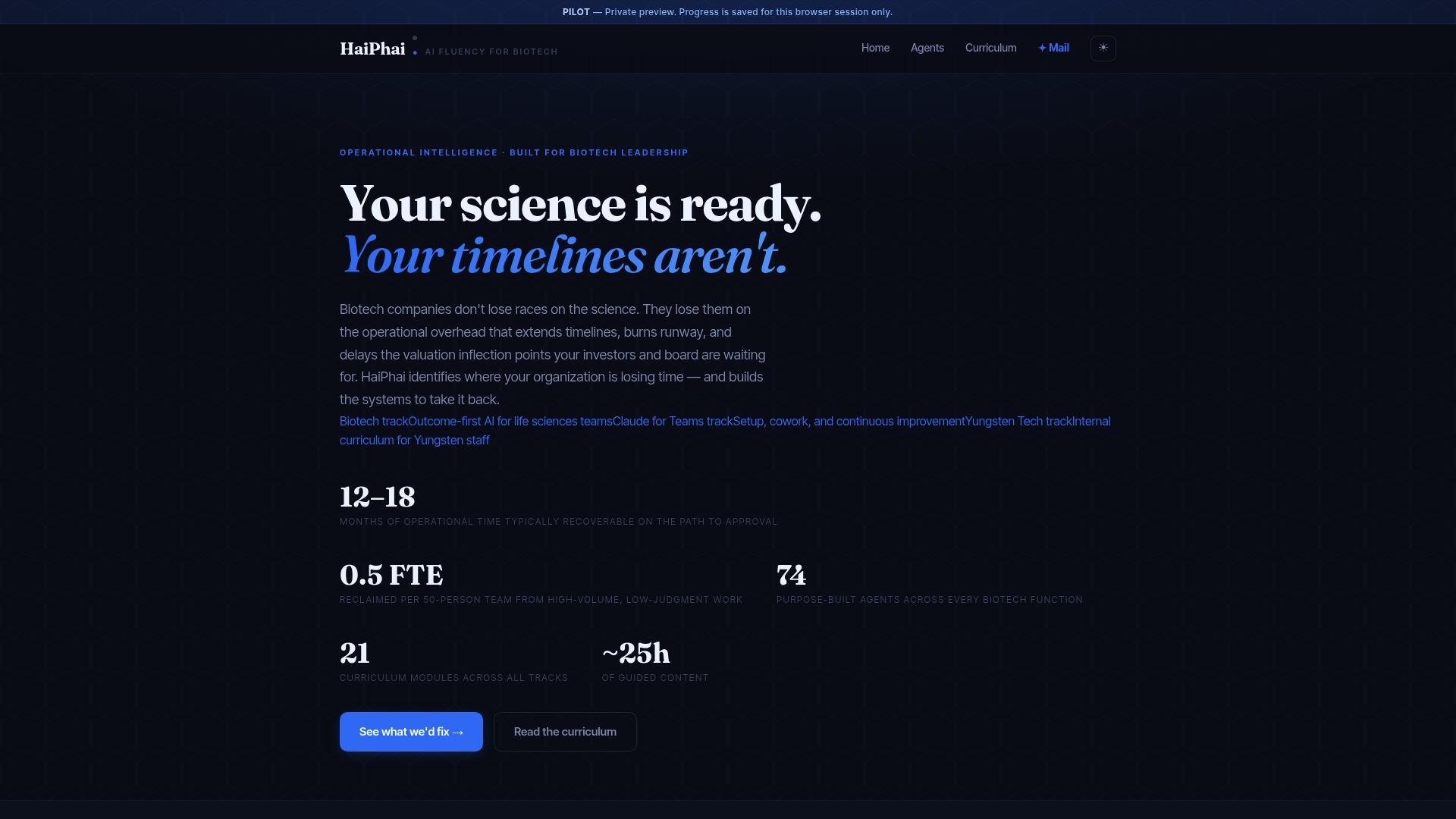
We built Haiphai around a simple observation: software alone doesn't fix training bottlenecks, because the bottleneck usually lives in the workflow around the software, not in the tool itself. Our operational model starts with a diagnostic that maps where training and competency verification actually stall a client's site activation, then designs the automation to fit that specific gap. That approach is why clients working with us have reclaimed up to 18 months of operational time on their path to approval.
The pitfalls we see repeatedly: scope creep where a training pilot balloons into a full platform migration before anyone proves the concept works, missing eTMF integrations that leave training evidence stranded outside the audit trail, and governance built as an afterthought instead of a prerequisite. Each one is avoidable with the right sequencing and a governance framework in place before the first module goes live.
[Author credentials and named case data available on request.]
— John
Ready to Pilot Training Automation With an Operational Partner?
An initial engagement with Haiphai starts with a diagnostic, not a software demo. We map where your training and competency workflows actually create delay across site activation and regulatory readiness, design the automation around that specific bottleneck, and run a scoped pilot before anything scales across your site network. The outcome sponsors care about most: fewer activation days and training records that hold up under audit the first time.
If your current site activation timeline is dragging on duplicate training and disconnected eTMF records, that diagnostic is the fastest way to find out exactly where the time is going. Start a diagnostic conversation with Haiphai and see what a competency-first pilot could look like for your next protocol.
Primary Sources Behind This Framework
This guide draws on SCRS Cut 25 competency-based training guidance, FDA commentary on AI pilots in trial conduct, and peer-reviewed research on accelerated site activation strategies.
Sources
- SCRS Cut 25 guidance to reduce clinical research site training (2026)
- FDA pilots real-time clinical trial tools and AI (GovExec, 2026-04-29)
- Review of AI/NLP in clinical research and regulatory context (2026)
- Accelerating start-up cycles in investigator-initiated multicenter clinical trials (Journal of Clinical and Translational Science, 2025)
FAQ
What Is Training Management Automation in Clinical Research?
It refers to automating investigator and site staff training, SOP competency tracking, and the training steps embedded in site activation, distinct from corporate HR learning platforms.
How Much Can Automation Reduce Site Activation Time?
Results vary by protocol, but pairing a site navigator role with automated milestone tracking has made a 90-day activation target more feasible in pilot research, and aggregated analyses cite timeline gains of 30 to 50 percent across AI-integrated clinical workflows generally.
Does Reused Training Satisfy Regulatory Inspectors?
Yes, when it is backed by a documented competency attestation, the original certification record, and a clear reference to the prior study or platform, consistent with the reuse reciprocity model in SCRS Cut 25 guidance.
What Governance Must Exist Before Automating Training Assessments?
Prospective specification of context of use, version control on any assessment logic, and a named human reviewer signing off before an automated determination enters the regulatory record.
Can Haiphai Help Design a Training Automation Pilot?
Yes. Haiphai runs a diagnostic to locate the specific bottleneck in a client's training and site activation workflow, then designs and pilots the automation around that gap before recommending a scaled rollout.