
Integrated agentic AI, unified data platforms, and lab automation are three primary levers that compress cycle times across every stage of drug development, from discovery through regulatory submission. Analysis cited in MIT Technology Review suggests generative AI combined with computational tools could significantly cut discovery timelines. The role of technology integration in biotech speed is not theoretical anymore — AstraZeneca is already running closed-loop AI systems where models prioritize candidates and robots execute only the top-ranked experiments.
Before your next leadership briefing, three steps matter most:
- Baseline first. Measure current cycle times for site activation, IND submission, and dataset curation before any pilot launches; you cannot prove ROI without a pre-integration benchmark.
- Pick one bottleneck. Select a single high-friction process (regulatory drafting or site activation are the fastest wins) and scope a 90-day pilot with defined success criteria.
- Build governance in parallel. Assign a data owner, a model owner, and a regulatory lead before the pilot starts. Validation and audit-trail requirements do not wait until scale.
Table of Contents
- How does technology integration shorten each drug-development stage?
- What are the core technical building blocks that enable speed?
- How do you move from pilot to platform operationally?
- Which KPIs actually prove time savings?
- What does FDA expect from AI-driven workflows?
- What risks should you plan for before you start?
- How does Haiphai's approach sequence pilot to scale?
- A 6-step action plan you can start in the next 90 days
- Key Takeaways
- Why operational pragmatism beats technology enthusiasm
- Haiphai can help you run your first pilot
- Useful sources
- FAQ
How does technology integration shorten each drug-development stage?
The impact of tech in biotech is uneven across stages, which is exactly why mapping it matters before you commit budget.
Discovery is where the compression is most dramatic. Nature Biotechnology frames the next decade as AI translating biological complexity — turning high-dimensional omics and sequence data into testable hypotheses, rather than promising instant predictability. AstraZeneca's design-make-test-analyze loop puts this concretely: models rank candidates, labs run only the top tier, and the feedback cycle tightens with every iteration.
Translational and preclinical work benefits from virtual screening and digital twins that triage compounds before expensive in vivo studies. Automated high-throughput systems generate AI-ready data at volumes traditional workflows cannot match.
Clinical operations see gains through AI-assisted protocol design, patient stratification, and site activation. Faster diagnostic data delivery directly shortens run-in times and reduces the lag between enrollment and first-patient-in. AI-driven imaging reads also cut manual pathology review cycles.
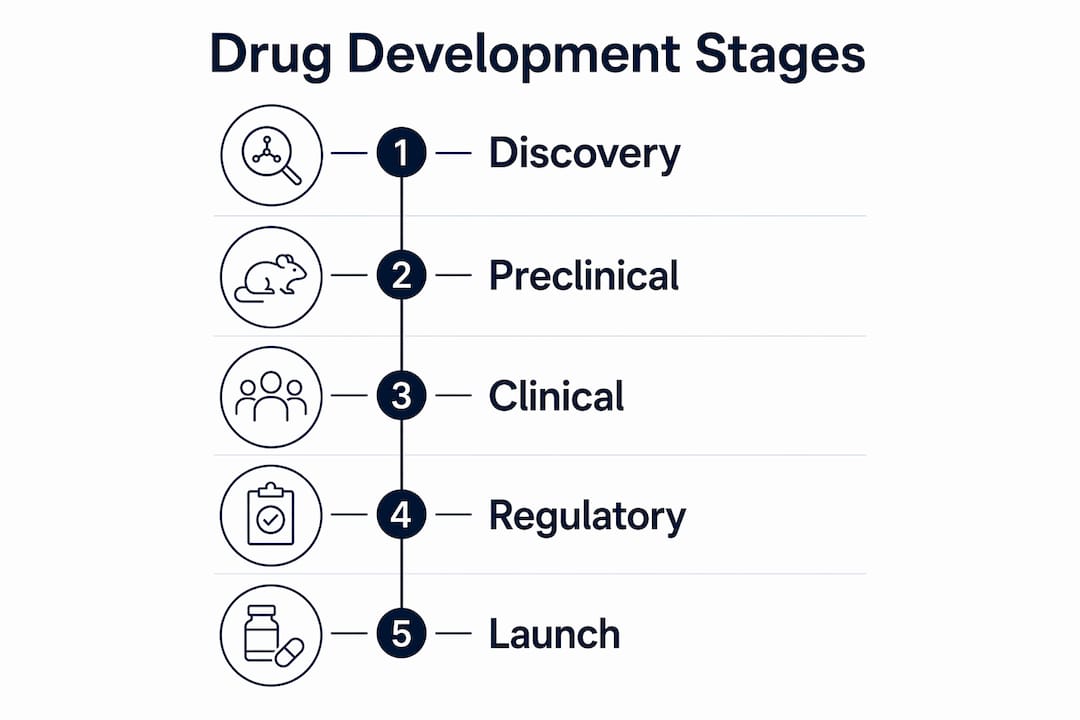
Regulatory is where automation pays off quietly but consistently. Structured evidence generation, automated dossier assembly, and AI-assisted safety signal detection reduce amendment risk and review cycles. The AI enrollment gap between protocol design and patient recruitment is one of the most addressable inefficiencies in the entire pipeline.
Pro Tip: Don't try to compress all five stages at once. Discovery and regulatory drafting offer the fastest, most measurable ROI for a first pilot — start there and use the wins to fund the next phase.
One honest caveat: Nature Biotechnology is clear that AI yields are uneven. Chemistry, toxicology, and manufacturing contain non-compressible work. Set expectations accordingly.
What are the core technical building blocks that enable speed?
The technology stack behind advancements in biotech speed has five interdependent layers. Missing one creates a bottleneck that limits the others.
- Unified data platform / data mesh. Centralize multimodal datasets — omics, assay results, clinical records, manufacturing logs — into a single environment where models can train on complete, consistent data. Without this, every downstream AI application fights data fragmentation.
- Agentic AI and generative models. Automate candidate generation, prioritization, and closed-loop optimization. AstraZeneca's approach bridges data silos with autonomous workflows so scientists focus lab resources on higher-probability candidates.
- LIMS / ELN and instrument integration. Speed lab workflows, reduce handoffs between systems, and produce structured, AI-ready records. A LIMS that cannot export clean data to a model training pipeline is a dead end.
- Workflow automation and orchestration. Robotic sample handling, scheduling automation, and pipeline orchestration execute experiments faster and at higher throughput. SETR's 2026 biotechnology report identifies DNA synthesis throughput and lab automation as physical bottlenecks that limit AI-only speed gains.
- APIs, interoperability, and master data management. Prevent data silos and eliminate manual reconciliation. Without open interoperability standards, integrating a new tool means months of custom engineering.
Think of the integration as a loop: data feeds the model, the model directs execution; execution generates new data, and the loop learns. Every layer above is a node in that cycle. Weaken one node and the whole loop slows.
How do you move from pilot to platform operationally?
Governance is what separates a successful pilot from a one-time experiment. The table below maps the four roles every integration program needs.

| Role | Core Responsibility |
|---|---|
| Data Owner | Data quality, lineage, access controls, and pipeline maintenance |
| Model Owner | Model training, versioning, performance monitoring, and retraining triggers |
| Quality / Regulatory Lead | Validation protocols, audit trails, change control, and FDA alignment |
| Product / Operations Lead | Pilot scope, milestone tracking, stakeholder communication, and scaling decisions |
Pilot selection criteria come down to four questions: How severe is the bottleneck? Is the data ready? How high is the regulatory sensitivity? What is the ROI horizon? Site activation and regulatory drafting score well on all four questions for most mid-size biotechs.
A minimum viable pilot checklist: defined scope, a pre-integration baseline metric, a minimum viable dataset, a validation plan with rollback triggers, and explicit success criteria before day one.
Scaling means choosing platform-based over point solutions wherever possible. Labiotech's 2026 trend coverage notes that companies prioritizing scalable, platform-based assets are moving AI from discovery accelerator to operational infrastructure inside clinical programs. That shift is where measurable speed gains accumulate.
Pro Tip: Regulatory drafting and site activation pilots deliver operational ROI fastest. Both have clear baselines, defined outputs, and limited regulatory sensitivity compared to model-driven clinical decision support.
Which KPIs actually prove time savings?
- Discovery-to-IND time. The end-to-end clock from target identification to IND submission. Establish a historical baseline from your last two or three programs before the pilot starts.
- Time-to-first-patient-in (FPIN). Measures clinical readiness and site activation efficiency. Captures the combined effect of protocol design, site selection, and activation automation.
- Site activation time. Standalone metric for the regulatory and operational steps between site selection and first patient screened. A direct proxy for clinical operations efficiency.
- Protocol amendment frequency. Fewer amendments signal better upfront protocol design, often enabled by AI-assisted feasibility modeling and patient stratification.
- Dataset curation time. Hours spent cleaning, reconciling, and preparing data for analysis. Automation here compounds across every downstream use.
- Model prediction precision and recall. Technical health metrics for any AI component. Drift in either signals retraining is needed before it affects downstream decisions.
- Percentage of automated tasks. Tracks adoption and workflow coverage. A pilot that automates 60% of a process is not the same as one that automates 20%.
For reporting cadence, weekly check-ins on model performance metrics and monthly reviews of cycle-time KPIs work well for a 90-day pilot. Set a threshold-based success criterion before launch — for example, a 20% reduction in site activation time or two fewer protocol amendments per study — so the go/no-go decision is objective.
What does FDA expect from AI-driven workflows?
The FDA's direction is clear: justify the context of use, validate proportional to risk, and document everything. The AIM-NASH tool qualification demonstrates a concrete regulatory pathway for AI-driven endpoints, and FDA guidance reinforces that explainability and context of use are non-negotiable for any AI component touching a regulated workflow.
Practical validation steps for a pilot:
- Data lineage and provenance. Every training dataset needs a documented source, version, and access log.
- Reproducible model training. Seed control, versioned code, and environment snapshots so any run can be reproduced.
- Performance monitoring and change control. Define drift thresholds and a retraining schedule before deployment.
- 21 CFR Part 11 considerations. Electronic records and signatures for any AI output that enters a regulatory submission need audit trails, access controls, and time-stamped logs.
- Pre-submission strategy. For AI tools that inform clinical endpoints or safety signals, a Type C meeting or written request to FDA early in the program reduces late-stage amendment risk.
For AI in regulatory affairs, the documentation burden is front-loaded but pays off at submission. Build the validation package during the pilot, not after.
What risks should you plan for before you start?
| Risk | Likely Impact | Mitigation |
|---|---|---|
| Data quality gaps | Slowed model performance, unreliable outputs | Focused data acquisition plan; synthetic augmentation where appropriate |
| Model drift | Silent degradation of predictions over time | Automated monitoring, defined retraining triggers, performance dashboards |
| Vendor lock-in | Migration costs, integration debt, reduced flexibility | Open interoperability standards, contractual SLAs, data portability clauses |
| Insufficient validation | Regulatory rejection, audit findings, program delays | Risk-tiered validation protocol built into pilot scope from day one |
| Change management failure | Low adoption, workaround behaviors, wasted investment | Cross-functional alignment before launch; named executive sponsor |
Pro Tip: Start with your highest-signal datasets and most instrumented processes. They reduce model drift exposure and give you the cleanest baseline for proving ROI.
How does Haiphai's approach sequence pilot to scale?
Haiphai works as an operational partner, not a software vendor. The distinction matters: the engagement starts from your strategic goals and works backward to identify where integration recovers the most time.
A representative pilot sequence looks like this:
- Months 0–3 (Pilot). Scope: clinical site activation plus regulatory drafting automation; primary KPIs: site activation time and amendment frequency. Haiphai maps the current workflow, identifies data gaps, and deploys a minimum viable integration with a validation plan in place.
- Months 3–6 (Validate). Performance review against baseline. Model monitoring active. Regulatory documentation package built. Go/no-go decision based on pre-agreed thresholds.
- Months 6–12 (Scale). Expand to adjacent workflows. Platform integration replaces point solutions. Governance roles formalized. Clients working through this sequence can reclaim up to 18 months of operational time on the path to approval, though outcomes vary by program complexity and data readiness.
Three operational lessons from this model: cross-functional alignment must happen before month one, not during; dataset curation takes longer than teams expect and should be scoped explicitly; and regulatory pre-submission engagement, even informal, prevents late-stage surprises.
A 6-step action plan you can start in the next 90 days
- Step 1: Secure a sponsor. Brief the COO or CMO with a one-page summary: the bottleneck, the pilot scope, the success metric, and the budget estimate. No sponsor, no pilot.
- Step 2: Audit your data. Identify which datasets are clean, structured, and accessible. Data readiness is the single most common reason pilots stall.
- Step 3: Select one use case. Site activation or regulatory drafting. Narrow scope, clear baseline, measurable output.
- Step 4: Build the governance and validation plan. Assign the four roles from the table above. Write the validation protocol before the first model runs.
- Step 5: Execute with tight milestones. 30-day, 60-day, and 90-day checkpoints. Review KPIs against baseline at each gate.
- Step 6: Evaluate and decide. Use the pre-agreed success criteria to make a go/no-go call. Document what worked, what did not, and what the next pilot should be.
For the board communication, keep it to three slides: the bottleneck and its cost, the pilot design and success criteria, and the ask (budget approval and sponsor nomination). Clinical and regulatory stakeholders need a separate briefing that emphasizes validation approach and FDA alignment.
Key Takeaways
Technology integration compresses biotech timelines most reliably when agentic AI, unified data platforms, and lab automation operate as a connected system rather than isolated tools.
| Point | Details |
|---|---|
| Discovery compression is real | Generative AI combined with computational tools can cut discovery timelines by up to 50%, per analysis in MIT Technology Review. |
| Governance enables scale | Assigning data, model, quality, and operations owners before a pilot launches is what converts a one-time experiment into a repeatable platform. |
| Measure before you integrate | Baseline KPIs (site activation time, FPIN, amendment frequency) must be captured before the pilot starts or ROI claims are unverifiable. |
| Haiphai's operational model | Haiphai sequences pilot → validate → scale to reclaim up to 18 months of operational time, starting from your strategic goals rather than a fixed software stack. |
Why operational pragmatism beats technology enthusiasm
The most common failure mode in biotech technology integration is not picking the wrong tool. It is skipping the organizational groundwork that makes any tool work. I have seen programs with genuinely strong AI components stall because no one owned the data pipeline, or because the regulatory team was not in the room when the validation approach was designed.
The importance of tech in biotech is real, and the evidence from AstraZeneca and Nature Biotechnology is compelling. But technology is the easy part. The hard part is treating integration as an organizational change that happens to involve a technology stack, not the other way around. The leaders who get this right brief their executives on bottlenecks and outcomes, not on model architectures. They pick one constrained pilot, prove the number, and use that proof to fund the next step. That is the playbook.
Haiphai can help you run your first pilot
Most biotech operations teams know where their biggest bottleneck is. The harder question is how to scope a pilot that produces a defensible ROI number in 90 days without creating a compliance liability.
Haiphai's operational approach starts with your program goals, maps the integration points that recover the most time, and runs the pilot with governance and validation built in from day one. The focus is on site activation, regulatory drafting, and AI augmentation — the three areas where operational time savings accumulate fastest and where the path to FDA-aligned validation is clearest. Clients working with Haiphai can reclaim substantial operational time on the path to approval.
To get started, request a pilot scoping call through Haiphai's services page or review the sector-specific integration examples at haiphai.com/sectors.
Useful sources
- Nature Biotechnology — 30 Years of Nature Biotechnology. Frames AI's role as translating biological complexity rather than eliminating it — the most authoritative framing of realistic AI expectations in discovery and translational work.
- MIT Technology Review — How AI Helps Scientists Design the Next Generation of Medicines. Covers AstraZeneca's closed-loop AI discovery program and cites analysis suggesting up to 50% discovery compression. Primary source for company-level implementation evidence.
- Labiotech — Biotech in 2026: Key Trends. Covers the strategic shift to platform assets and AI's move from discovery optics to clinical program infrastructure. Also references FDA's 2025–2026 direction on AI validation and context of use.
- StartUs Insights — Top 10 Trends in Biotechnology in 2026. Useful overview of digital twins, multi-omics integration, and manufacturing automation trends.
- SETR 2026 — Biotechnology and Synthetic Biology. Stanford/SETR policy report on DNA synthesis throughput, lab automation, and the physical bottlenecks that limit AI-only speed gains.
- Ko Health Labs — Why Faster Data Delivery Improves Clinical Trial Outcomes. Practical evidence on how faster diagnostic and imaging data delivery shortens trial timelines.
FAQ
How does technology integration speed up biotech development?
Integrated agentic AI, unified data platforms, and lab automation compress cycle times at every stage — from candidate prioritization in discovery to automated dossier assembly at regulatory submission. Analysis cited in MIT Technology Review suggests discovery timelines alone could shrink by up to 50%.
What is the fastest ROI from a first integration pilot?
Clinical site activation and regulatory drafting automation consistently deliver the fastest, most measurable returns because both have clear baselines, defined outputs, and manageable regulatory sensitivity for a first deployment.
What FDA requirements apply to AI tools in drug development?
FDA expects a context-of-use justification, validation proportional to risk, and full documentation including audit trails. The AIM-NASH tool qualification provides a concrete example of the regulatory acceptance pathway for AI-driven endpoints.
How does Haiphai approach technology integration for biotech teams?
Haiphai acts as an operational partner, starting from a team's strategic goals to identify bottlenecks and sequence pilots. Clients can reclaim substantial operational time on the path to approval through this approach.
Which KPIs should a pilot track to prove time savings?
The most reliable pilot KPIs are site activation time, time-to-first-patient-in, protocol amendment frequency, and dataset curation time. All four require a pre-integration baseline to produce a credible ROI comparison.