
No AI product carries a federal HIPAA seal of approval, and none ever will. HIPAA compliance is not a feature you buy. It is a result you engineer through a signed Business Associate Agreement, a controlled deployment architecture, and daily operations that hold up under an OCR investigation. If you are evaluating an AI tool for anything that touches protected health information, that distinction should shape every decision you make from here forward.
A deployment earns HIPAA-compliant status when it has all of the following in place, and it loses that status the moment any one piece fails:
- A signed BAA with every vendor that creates, receives, maintains, or transmits PHI
- A private inference path, not a public API endpoint
- Automated PHI masking or DLP that strips identifiers before any model call
- Immutable audit logging retained for a period consistent with HIPAA audit documentation requirements
- Role-based access control enforcing the minimum necessary standard
- A documented breach notification plan mapped to the specific AI vendor
One more rule sits above all of these: never route PHI through a consumer chat tier. Free or personal-account versions of general-purpose chatbots carry no BAA and no contractual privacy floor, no matter how good the model is.
Key Takeaways
HIPAA-compliant AI is achieved through a signed BAA, private inference architecture, automated PHI masking, and six-year immutable audit logging, never through the AI product alone.
| Point | Details |
|---|---|
| No certification exists | HHS does not certify AI products; compliance is assessed at the organizational deployment level. |
| BAA chain must be complete | Every vendor and sub-processor touching PHI needs a signed BAA, with no exceptions. |
| Four architectures, one baseline | Cloud-managed, vendor HIPAA tier, private VPC, and self-hosted all require the same core controls. |
| Consumer chat tiers are off-limits | Free or personal-account chatbots carry no BAA and must never process PHI. |
| Operational partners close the gap | HaiPhai builds governed, tailored AI deployments for biotech teams navigating regulatory and clinical workflows. |
Table of Contents
- What Makes an AI Deployment HIPAA Compliant Under U.S. Law?
- The Technical Controls Checklist Every HIPAA-Compliant Deployment Needs
- Which Deployment Architecture Fits Your Risk Tolerance?
- What Contract Language Should You Demand From an AI Vendor?
- How Do You Keep an AI Deployment Compliant After Launch?
- How HaiPhai Approaches Compliant AI for Biotech Teams
- What Should You Ask Before Signing Any AI Vendor Contract?
- Primary Sources for Auditors and Security Teams
- The Conventional Advice on AI and HIPAA Misses the Real Risk
- Get Compliant AI Deployments Built for Your Regulatory Timeline
- Sources
- FAQ
What Makes an AI Deployment HIPAA Compliant Under U.S. Law?
Three federal rules govern how AI can touch patient data: the Privacy Rule, the Security Rule, and the Breach Notification Rule. Together they form the baseline every AI deployment has to satisfy, and none of them certify a product. HHS states plainly that there is no federal HIPAA certification program for software. Compliance is assessed at the level of the organization and its deployment, not the vendor's marketing page.
Here is how the three rules actually map to AI use:
- The Privacy Rule governs what PHI an AI system is allowed to see, use, or disclose, and under what permitted purpose.
- The Security Rule governs the technical, physical, and administrative safeguards protecting PHI once it is electronic, which almost every AI workflow makes it.
- The Breach Notification Rule governs what you must do, and how fast, if an AI vendor or your own configuration exposes PHI.
A Federal Register update effective in 2025 tightens cybersecurity expectations under the Security Rule specifically because ePHI now flows through far more third-party processing systems than the original rule anticipated, AI included.
The trigger for most of this is a simple legal term: Business Associate. Any vendor that creates, receives, maintains, or transmits PHI on your behalf is a business associate under HIPAA, full stop, regardless of whether it calls itself an "AI platform," a "productivity tool," or a "clinical assistant." If an AI vendor touches PHI and you have not signed a BAA with them, you are already out of compliance, even if their infrastructure is technically secure. The BAA is the legal instrument that obligates the vendor to the same safeguards you are obligated to, and without it there is no shared accountability, only exposure on your side alone.
The Technical Controls Checklist Every HIPAA-Compliant Deployment Needs
Legal language means nothing without an engineering team that can implement it. Here is the operational checklist to hand your infrastructure and security leads before any AI system goes near clinical data.
- De-identify before the model ever sees it. Run automated DLP that strips or masks the 18 HIPAA identifiers, names, dates, medical record numbers, device identifiers, and the rest, before a prompt leaves your environment. This is the single highest-leverage control in the entire stack. Security-by-design masking built into the pipeline reduces risk far more reliably than after-the-fact policy training ever does.
- Route inference through private endpoints. Whether that means a cloud provider's private link, a VPC peering connection, or a dedicated network path, PHI should never traverse the public internet to reach a model.
- Encrypt in transit and at rest. TLS 1.2 or higher for anything moving, AES-256 for anything stored. Confirm who holds the encryption keys; some vendor configurations leave key custody with the vendor, which weakens your control story during an audit.
- Log everything, immutably, for six years. Every prompt, every response, every access event needs a tamper-evident record. HHS guidance treats six years as the standard retention floor for audit documentation. Your logs should capture the user identity, timestamp, the model endpoint called, and whether PHI was present in the payload, not just a generic "request sent" entry.
- Enforce role-based access and minimum necessary. Not every clinician, analyst, or administrator needs the same level of access to an AI system's inputs and outputs. Scope permissions to the smallest set that lets each role do its job.
Application logs and model-level traces need to live separately. Store de-identified prompt hashes in your standard logging system, and if you retain any raw PHI prompt store at all, encrypt it, restrict access tightly, and put it on its own retention schedule distinct from your general logs.
Pro Tip: Ask your AI vendor to show you a live log export, not a description of their logging capability. If they cannot produce a real audit trail on demand during a sales call, they cannot produce one during an OCR investigation either.
Which Deployment Architecture Fits Your Risk Tolerance?
Four architecture patterns cover nearly every real-world HIPAA-compliant AI deployment, and each one trades control for operational simplicity in a different place. Practitioner guidance on LLM deployment architecture converges on these same four patterns, and the consistent warning across that guidance is that a signed BAA alone never makes a deployment compliant. The architecture and the operations around it have to hold up too.

Pattern A: cloud provider managed endpoint under your existing cloud BAA. This is the fastest path if you already have a BAA with a major cloud provider, since some of their AI services fall under that same agreement. The catch is that eligibility is per-model and per-service, not blanket. Verify in writing that the specific model you plan to call is covered, and confirm the no-training default is active for your account tier.
Pattern B: vendor-managed HIPAA tier with a negotiated BAA and zero-retention endpoints. Several model and cloud providers now offer enterprise tiers built for exactly this. Zero-retention enterprise options exist specifically because consumer tiers explicitly fall outside BAA coverage. Moderate operational burden, but you need contractual proof, not a sales assertion, that retention is actually set to zero.
Pattern C: private VPC or private endpoints inside your own cloud account, with model-level routing you control. This gives you stronger visibility into exactly where PHI travels, at the cost of more infrastructure work on your side. Data sensitivity is the deciding factor here: research data governed by 42 CFR Part 2, active clinical trial data, or proprietary biotech R&D often justifies the added effort.
Pattern D: self-hosted or on-premises GPU infrastructure. No external BAA is even needed for inference, because nothing leaves your walls. This is the highest control and highest cost option, both in capital expenditure and in the ongoing operational load of running your own model infrastructure.
| Pattern | Operational effort | Best fit |
|---|---|---|
| A: Cloud-managed endpoint | Low | Fast pilots under an existing cloud BAA |
| B: Vendor HIPAA tier | Moderate | Teams needing negotiated zero-retention terms |
| C: Private VPC / private endpoint | Medium to high | 42 CFR Part 2 data, clinical trial workflows |
| D: Self-hosted / on-prem | Highest | Maximal control for sensitive biotech R&D |
If you are fine-tuning a model on PHI at any point, the training job itself needs to run on infrastructure covered by a BAA, or on private hardware entirely. Cloud fine-tuning jobs that skip explicit BAA coverage for the training step, as opposed to just the inference step, are a common and costly compliance gap.
What Contract Language Should You Demand From an AI Vendor?
A signed BAA is table stakes, not proof of a secure deployment. The real work is in the specific clauses inside it and the operational evidence that backs them up.
- Explicit no-train language. The contract should state, without ambiguity, that your data will not be used to train or fine-tune the vendor's underlying models.
- Zero-retention or defined retention terms. If the vendor retains prompts or outputs at all, the contract needs to specify for how long and why, not leave it undefined.
- Named sub-processors. Every downstream vendor that touches your data through the AI provider needs to be listed by name, not described generically as "cloud infrastructure partners."
- Advance notice of sub-processor changes. You need the contractual right to be notified, and ideally to object, before a vendor adds a new sub-processor to the chain.
- Breach notification timelines. The contract should specify exact notification windows, and those windows need to be short enough to meet your own downstream reporting obligations under the Breach Notification Rule.
- Indemnity language. If the vendor's failure causes your breach, the contract should make clear who bears the liability.
Every one of those vendors, the primary AI provider and every named sub-processor, has to be inside the BAA chain. A single unlisted sub-processor that touches PHI is a broken chain, and it is the kind of gap OCR investigators look for first. Do not take a vendor's word for any of this. Ask for a redacted BAA excerpt, a sample audit log export, and screenshots of the actual retention configuration in their admin console. Vendors who can produce this evidence quickly are usually the ones who have actually built for HIPAA rather than bolted a compliance page onto their marketing site.
How Do You Keep an AI Deployment Compliant After Launch?
Signing a BAA and shipping an architecture is day one. HIPAA compliance for AI is a program, not a project, and it needs the same ongoing attention as any other part of your security posture.
Start by updating your organizational risk analysis to include AI-specific hazards: model drift, prompt injection, unintended PHI leakage through model outputs, and third-party sub-processor changes. The NIST AI Risk Management Framework gives privacy officers a workable structure for this, mapping AI-specific risks into the same governance cycle you already run for other systems.
From there, build continuous monitoring into the workflow rather than treating it as an annual checkbox:
- DLP alerting that flags any attempt to send unmasked identifiers to a model
- Periodic red-team testing of the AI system's prompt handling and output filtering
- Configuration drift detection, since a vendor's default settings can change during a routine update
Workforce training matters as much as the technology. Staff need explicit rules against pasting patient information into any consumer-tier chatbot, even when the workaround feels faster than the sanctioned tool. A confidentiality agreement template built for HIPAA contexts gives you a starting point for formalizing that expectation with new hires and contractors.
Your incident response plan needs AI-specific detail, not a generic breach playbook. Name the specific model endpoint involved, the vendor's incident contact path, and who on your team has authority to pull forensic logs from the AI platform without delay.
Pro Tip: Run a tabletop exercise where the "breach" originates from your AI vendor, not your EHR. Most incident response plans have never been tested against that scenario, and the gaps show up fast.
Governance artifacts that survive an OCR investigation share a pattern: a documented AI risk analysis, screenshots or log extracts proving your technical configuration, signed BAAs naming every sub-processor, and tamper-evident logs with exportable retention proof. Build toward producing those four things on demand, not toward a policy binder that looks good in a drawer.
How HaiPhai Approaches Compliant AI for Biotech Teams
Biotech and life sciences organizations face a sharper version of this problem: regulatory drafting, clinical site activation, and trial data all carry PHI exposure, and delays in any of those workflows have direct financial consequences. HaiPhai operates as an embedded operational partner rather than a software vendor, starting from a company's strategic goals and working backward to find the bottlenecks slowing down its path to approval. Clients working with HaiPhai have reclaimed up to 18 months of operational time on their approval pathway, time that matters directly to valuation and funding timelines.
That operational model maps onto the compliance checklist in practical ways:
- Deployments are tailored to each client's data sensitivity, not delivered as a one-size-fits-all platform
- Regulatory drafting and clinical site activation workflows are built with governed automation rather than open-ended tool access
- Governance support is built into the engagement, not left for the client to figure out after go-live
What Should You Ask Before Signing Any AI Vendor Contract?
Run this sequence before any AI tool touches PHI in your organization, and do not skip steps because a vendor's sales team seems confident.
- Confirm the BAA covers the exact service you will use. A BAA that covers a vendor's storage product but not their new AI feature is common, and it is a gap that only shows up when you ask directly.
- Request the list of named sub-processors in writing. If the vendor cannot produce this list promptly, treat that as a warning sign about how tightly they manage their own supply chain.
- Ask for evidence of no-training and zero-retention settings. A configuration screenshot or an admin console walkthrough, not a marketing claim.
- Verify private endpoint architecture. Ask specifically how traffic routes, and whether any part of the path touches the public internet.
- Request SOC 2 or equivalent attestations. These do not replace a BAA, but they add independent evidence of operational maturity.
- Run an acceptance test on a demo account. Send a sample prompt with fake PHI-shaped data, then verify the log capture, the retention export, and the DLP redaction actually work as described.
Pro Tip: Treat "we're SOC 2 compliant" as an incomplete answer. SOC 2 speaks to general security controls, not to HIPAA-specific obligations like the BAA chain or the minimum necessary standard. Ask for both.
A few answers should stop procurement cold: any suggestion that a consumer-tier account is "fine for now," vague language about retention that the vendor cannot pin down in writing, or an inability to produce a real audit log sample when asked directly.
Primary Sources for Auditors and Security Teams
- HHS HIPAA Security Rule guidance: authoritative source confirming no federal HIPAA certification exists
- Federal Register 2025 cybersecurity update: strengthened technical safeguard expectations for ePHI
- NIST AI Risk Management Framework: structure for AI-specific risk governance
- Peer-reviewed analysis of AI chatbots and HIPAA: documents privacy risks and vendor compliance challenges
The Conventional Advice on AI and HIPAA Misses the Real Risk
Most guidance on this topic treats the BAA as the finish line. It is the starting line. The research bears this out: the failure mode that actually gets organizations in trouble is the shared responsibility gap, the assumption that a vendor's BAA covers your prompt logs, your observability tooling, or your vector store when it typically does not. A signed contract without a matching technical audit is a false sense of security dressed up as due diligence.
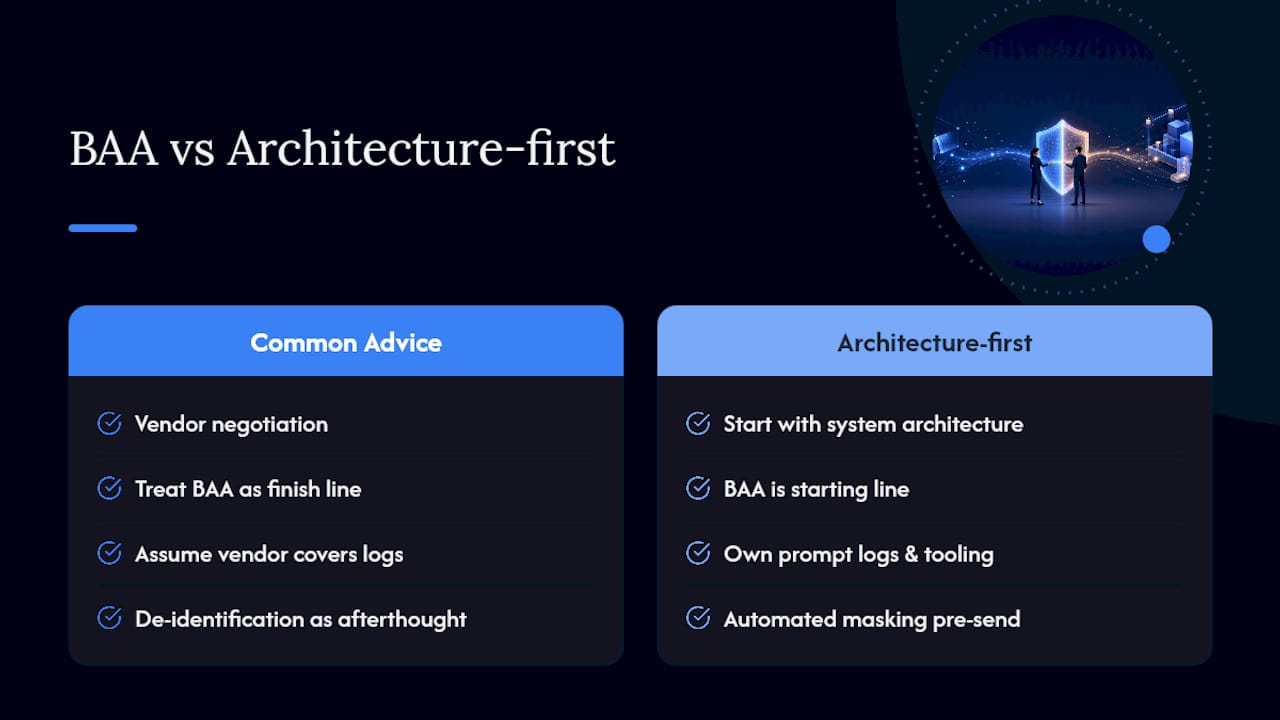
The prioritization most privacy officers get backward is spending months on vendor negotiation while treating de-identification as an afterthought. Automated masking of the 18 identifiers before a prompt ever leaves your environment does more risk reduction than any clause you will negotiate into a contract. If you fix the technical pipeline first, the contract negotiation gets easier, because you are no longer relying entirely on the vendor's promises to protect you.
Start with the architecture. The paperwork should confirm what your systems already enforce, not substitute for it.
— John
Get Compliant AI Deployments Built for Your Regulatory Timeline
Building a HIPAA-compliant AI deployment from scratch, choosing an architecture, negotiating BAA language, standing up audit logging, means months your competitors are spending on regulatory submissions instead. HaiPhai is the operational partner that closes that gap for biotech and life sciences teams: instead of handing you a generic platform and a compliance checklist, HaiPhai maps your specific bottlenecks in regulatory drafting and clinical site activation, then builds tailored AI workflows with the governance and audit infrastructure already accounted for.
This is not a software subscription. It is an embedded partnership that starts with your approval timeline and works backward to fix what is actually slowing you down, with technical controls and vendor governance built in from day one rather than retrofitted after a security review flags a gap. If your team is evaluating AI tools for regulatory or clinical operations and needs the compliance architecture handled by people who have done it before, visit HaiPhai's sectors page to see how the engagement model fits your current pipeline stage and start a conversation about your specific bottlenecks.
This article is general information, not a substitute for advice from a qualified lawyer. Consult a qualified legal professional about your own circumstances before acting on anything here.
Sources
- HHS — HIPAA Security Rule and related guidance
- AI Chatbots and Challenges of HIPAA Compliance for AI Developers and Vendors — PMC
- Federal Register — HIPAA Security Rule update (cybersecurity)
- NIST — AI Risk Management Framework
- Prodinit — HIPAA-Compliant LLM Deployment: Architecture
FAQ
Is there any AI that is HIPAA compliant out of the box?
No. No AI product is intrinsically HIPAA compliant; compliance results from a signed BAA, a private deployment architecture, and operational controls like audit logging, none of which come pre-installed in any tool.
Can ChatGPT be used in a HIPAA-compliant way?
Consumer-tier ChatGPT accounts carry no BAA and cannot be used with PHI under any circumstance. Enterprise API tiers with a negotiated BAA and zero-retention settings can be part of a compliant deployment, but only when contractually confirmed and technically configured correctly.
Is GPT-5 or any specific model version HIPAA compliant?
No individual model version is HIPAA compliant on its own. Compliance depends entirely on the deployment tier, whether a BAA covers that specific service, and whether zero-retention and private-endpoint settings are actually active.
Is AI prohibited under HIPAA?
AI is not prohibited under HIPAA. It is regulated the same way any other technology touching PHI is regulated, through the Privacy, Security, and Breach Notification Rules, and it requires the same BAA and safeguard framework as any other business associate relationship.
What is the minimum audit log retention period for AI systems handling PHI?
Six years is the standard retention floor for HIPAA audit documentation, and that applies to AI system logs the same way it applies to any other electronic PHI access record.