
The role of AI in regulatory document drafting is to automate first-draft generation, detect cross-document compliance conflicts, and produce audit-ready outputs that meet FDA, EMA, and ICH standards while keeping human specialists in control of final decisions. For biotech and life sciences teams, this is no longer a future capability. It is an operational reality that is reshaping how Clinical Study Reports, Investigator Brochures, and CMC submissions get written. The tools available in 2026, from Zifo's AI authoring platform to LexHarmoni's stress-testing engine and RuleExpert's AI Consent Drafter, demonstrate that automated regulatory drafting can cut timelines from days to minutes without sacrificing compliance rigor.
What evidence proves AI's efficiency gains in regulatory drafting?
The numbers here are not incremental. They represent a structural shift in how regulatory work gets done.
AI-powered stress-testing tools cut compliance review from 8 hours to 2 minutes for complex friction studies. That is not a productivity improvement. It is a fundamentally different workflow, one where a task that consumed an expert's entire morning now runs in the background while they do something else.

Consent drafting shows a similarly dramatic compression. RuleExpert's AI Consent Drafter generates DPDP-compliant language in 3 seconds, replacing a 3-day manual legal retainer process. The language is reviewed at the template level by legal experts, so the speed gain does not come at the cost of legal defensibility.
On the submission side, Zifo's platform reduces first-draft timelines from days to hours while maintaining 21 CFR Part 11 and EU ANNEX 11 compliance through audit trails and metadata tracking. For biotech teams under pressure to hit regulatory milestones before funding rounds close, that compression matters enormously.
Three patterns emerge from these cases:
- Speed gains are not marginal. AI reduces hours to minutes and days to seconds across consent drafting, stress-testing, and submission authoring.
- Compliance is built in, not bolted on. Tools like Zifo's platform generate traceability and audit trail data as part of the drafting process, not as a post-hoc review step.
- Human oversight remains the final gate. Every tool in this category positions AI as the first-draft engine, with human specialists reviewing and finalizing before submission.
The impact of AI on compliance is therefore not about replacing regulatory expertise. It is about removing the manual, repetitive work that consumes that expertise before it can add real value.
How do different AI approaches compare in regulatory drafting workflows?
Not all AI is the same, and the distinction matters enormously in a regulated environment. Three architectures dominate the current regulatory AI space, and each has a different risk and benefit profile.
| AI Approach | Strengths | Limitations | Best Use Case |
|---|---|---|---|
| Generative LLMs | Fast text generation, flexible drafting, handles unstructured data | Non-deterministic outputs, audit trail gaps | First-draft authoring, summarization |
| Deterministic rules engines | Byte-identical results, full auditability, traceable logic | Less flexible, requires structured rule sets | Compliance checking, conflict detection |
| Agentic AI workflows | Distributes tasks across specialized agents, covers research through finalization | More complex to deploy and govern | End-to-end regulatory submission pipelines |
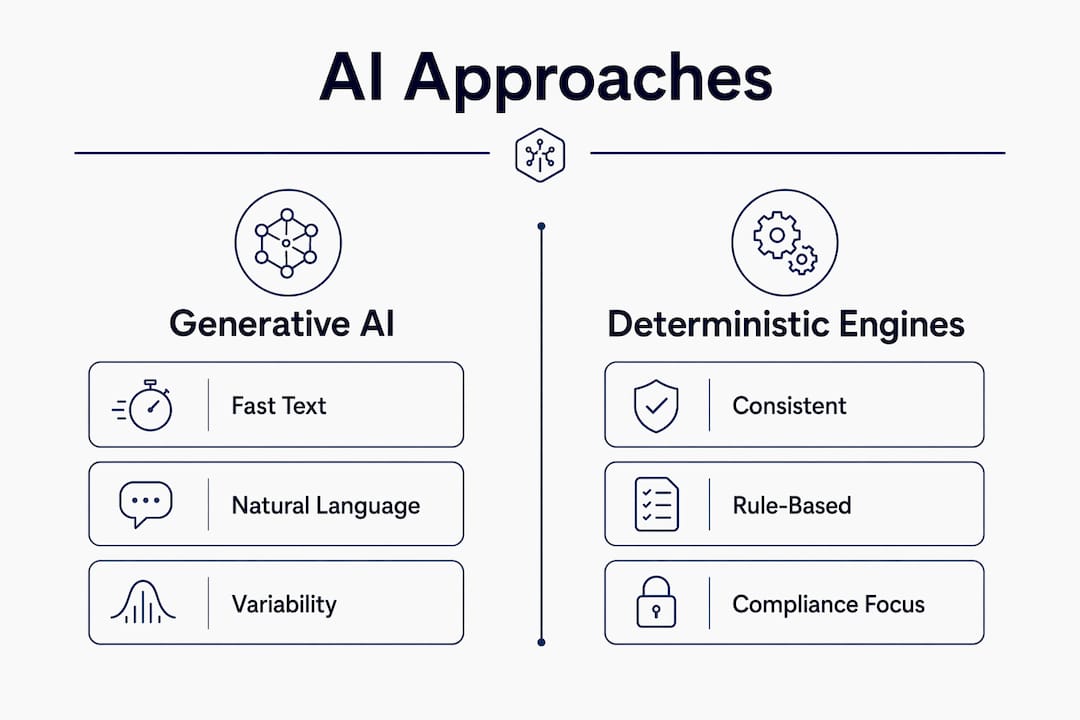
Generative AI tools are excellent at producing readable, structured text from complex source data. The problem is that a large language model can produce slightly different outputs on repeated runs, which creates real problems when regulators ask for audit trails. You cannot defend a submission if you cannot reproduce the exact reasoning that generated a specific clause.
Deterministic rules engines like Lambda-RAG solve this by separating compliance checking from text generation entirely. The rules engine evaluates regulatory requirements using pure code logic, producing byte-identical results every time. This separation of concerns is what makes the output legally defensible. The LLM drafts the text. The rules engine verifies it. Neither task bleeds into the other.
Agentic AI workflows take this further by distributing tasks across specialized agents that collaborate sequentially. A research agent pulls relevant regulatory precedents. A drafting agent generates the document structure and language. A compliance agent checks the output against applicable statutes. The result is a pipeline that covers the full authoring lifecycle without requiring a single generalist model to handle everything.
One underappreciated advantage of large-context AI models is their ability to detect cross-document conflicts by loading an entire regulatory corpus into a single context window of 1 million or more tokens. Retrieval-augmented generation, which pulls document fragments on demand, misses conflicts that only become visible when two regulations are read side by side. Full-corpus loading catches those conflicts before they reach a reviewer.
Pro Tip: When evaluating AI tools for regulatory work, ask vendors specifically whether their compliance-checking layer is deterministic or generative. If the answer is generative only, the tool is not audit-ready for FDA or EMA submissions without additional human verification steps.
What practical applications of AI streamline biotech regulatory submissions?
The clearest way to understand how AI aids in document preparation is to follow a submission document from initiation to filing and identify where AI changes the work.
-
Template-driven first drafts. AI authoring platforms ingest structured data from clinical trials, CMC records, and preclinical studies, then populate document templates for Clinical Study Reports, Investigator Brochures, and Module 3 CMC sections. What previously required a regulatory writer to spend two to three days assembling source data now takes hours.
-
Cross-format data synthesis. Regulatory submissions draw from structured databases, PDF study reports, and narrative summaries simultaneously. AI tools for legal documents and regulatory submissions can synthesize across these formats, pulling the relevant data points into the correct document sections without manual copy-paste errors.
-
Compliance-aligned formatting. Zifo's platform generates drafts that are 21 CFR Part 11 compliant from the first output, with metadata and version control built into the authoring workflow. This means the document is inspection-ready before it reaches a human reviewer, not after.
-
Human-in-the-loop review integration. The most effective AI in document creation workflows do not remove human reviewers. They restructure the review task. Instead of building a document from scratch, a regulatory writer reviews, edits, and approves an AI-generated draft. The cognitive load shifts from construction to critical evaluation, which is where expert judgment actually adds value.
-
Audit trail generation. Every edit, approval, and version change is logged automatically. For FDA inspections and EMA queries, this traceability is not optional. AI platforms that generate audit trails as a native output remove a significant post-submission compliance burden.
For teams working across FDA, EMA, and ICH standards simultaneously, the consistency gains are particularly significant. A human writer adapting a CSR for both FDA and EMA submission formats introduces variation. An AI platform trained on both regulatory frameworks applies the correct formatting and language conventions to each version automatically.
Deployment flexibility also matters in this context. Private cloud and on-premises options allow biotech organizations to use AI authoring tools without exposing proprietary clinical data to shared infrastructure. For companies with confidentiality obligations around unpublished trial data, this is a non-negotiable requirement.
Pro Tip: Before deploying any AI authoring tool, map your existing document templates against the AI platform's output formats. Misalignment between your internal style guides and the AI's default templates creates more rework than it saves. Invest two weeks in template alignment upfront to avoid months of downstream corrections.
What are the risks and necessary human oversight in AI regulatory drafting?
AI tools for regulatory document drafting carry real risks, and understanding them is what separates effective adoption from costly mistakes.
The most significant risk is non-determinism in generative outputs. A large language model that produces slightly different text on repeated runs cannot support a regulatory audit trail without additional controls. If a compliance reviewer asks why a specific claim appears in a submission, the answer cannot be "the AI generated it." The answer must trace back to a specific source document, a specific rule, and a specific human decision.
"AI excels at structuring, identifying vulnerabilities, and summarizing complex arguments, but human experts must finalize outputs to meet regulatory standards." — Harvard Journal on AI and Federal Rulemaking
This framing of AI as an informed subordinate is the most accurate mental model for regulatory teams. Think of it as a highly capable research assistant who can draft, organize, and cross-reference, but who requires a senior specialist to review every output before it carries legal weight. The assistant accelerates the work. The specialist owns the result.
Additional risks worth managing:
- Black-box reasoning. AI tools that cannot explain why they generated a specific clause create trust problems with regulators. Explainability features, where the tool cites the source regulation for each output, are not optional in a compliance context.
- Data confidentiality. Sending proprietary trial data to a shared AI platform creates IP and regulatory exposure. Deployment architecture must be evaluated before any sensitive data touches an AI system.
- Compliance agent verification. Agentic workflows that include a dedicated compliance agent checking drafts against applicable statutes reduce the risk of non-compliant language reaching a human reviewer. This is a design requirement, not an optional feature.
The European research regulations landscape in 2026 adds further complexity for teams submitting to EMA, where AI-generated content in regulatory submissions may face additional scrutiny as guidance frameworks evolve. Staying current on regulatory agency positions on AI-assisted authoring is now part of the compliance function itself.
Key takeaways
The role of AI in regulatory document drafting is to accelerate first-draft generation and compliance verification while human specialists retain final authority over every submission.
| Point | Details |
|---|---|
| Speed gains are structural | AI cuts stress-testing from 8 hours to 2 minutes and consent drafting from 3 days to 3 seconds. |
| Determinism protects auditability | Separate deterministic rules engines from generative drafting to produce byte-identical, audit-ready compliance checks. |
| Agentic workflows cover the full pipeline | Specialized agents for research, drafting, and compliance verification outperform single-model approaches for complex submissions. |
| Human oversight is non-negotiable | AI acts as an informed subordinate; regulatory specialists must review and finalize every AI-generated document. |
| Deployment architecture matters | Private cloud and on-premises options protect proprietary clinical data while enabling AI authoring capabilities. |
Where I think most biotech teams are getting this wrong
The teams I see struggling with AI adoption in regulatory drafting are not the ones who move too fast. They are the ones who treat AI as a drop-in replacement for a regulatory writer and then wonder why the outputs require as much rework as a manual draft.
The shift that actually works is redesigning the workflow around AI's strengths. AI is exceptional at first-draft generation, cross-referencing source data, and applying formatting rules consistently. It is not good at exercising regulatory judgment on ambiguous cases, and it should not be asked to. When you build a process where AI handles the construction work and your regulatory specialists handle the judgment calls, you get both speed and quality.
The resistance I encounter most often is from experienced regulatory writers who see AI as a threat to their expertise. The honest answer is that their expertise becomes more valuable in an AI-assisted workflow, not less. The work shifts from assembly to evaluation, and evaluation requires exactly the kind of deep regulatory knowledge that takes years to build.
The future of this space is agentic. Multi-agent systems where specialized AI handles research, drafting, and compliance checking in sequence will become the standard pipeline for major submissions within the next two to three years. Teams that build familiarity with these workflows now will have a significant operational advantage when that becomes the norm.
— John
How Haiphai accelerates regulatory document drafting for biotech teams
Haiphai works with biotech and life sciences teams to identify exactly where manual regulatory drafting is creating timeline bottlenecks, then deploys AI agents tailored to those specific workflows.
Unlike off-the-shelf authoring tools, Haiphai starts from your submission milestones and works backward to identify where AI can compress timelines without introducing compliance risk. The result is an AI deployment that fits your regulatory process rather than forcing your process to fit the tool. Clients working with Haiphai's AI solutions have reclaimed significant operational time on their path to approval, a direct factor in maximizing valuation and funding readiness. If your regulatory drafting timelines are a bottleneck, that is exactly the problem Haiphai is built to solve.
FAQ
What is the role of AI in regulatory document drafting?
AI automates first-draft generation for documents like Clinical Study Reports and Investigator Brochures, stress-tests drafts for compliance conflicts, and generates audit trails. Human specialists review and finalize all outputs before submission.
Can AI-generated regulatory documents meet FDA and EMA standards?
Yes, when the AI platform is designed for compliance. Tools like Zifo's authoring platform generate 21 CFR Part 11 and EU ANNEX 11 compliant drafts with built-in traceability, provided human-in-the-loop review is part of the workflow.
What is the difference between generative AI and deterministic rules engines in regulatory drafting?
Generative AI produces flexible, readable text but can vary between runs. Deterministic rules engines like Lambda-RAG produce byte-identical compliance checks every time, making them the correct tool for audit-trail-dependent regulatory verification.
How does agentic AI improve regulatory submission workflows?
Agentic AI uses multiple specialized agents, covering research, drafting, and compliance checking, that work sequentially. This distributes the task complexity across domain-specific models rather than asking one generalist model to handle the entire submission pipeline.
Is AI safe to use with confidential clinical trial data?
It depends on deployment architecture. Platforms offering private cloud or on-premises deployment, such as Zifo's solution, allow biotech organizations to use AI authoring capabilities without exposing proprietary data to shared infrastructure.