
A clinical trial risk register is the living, versioned record that ties every identified risk to a measured key risk indicator and to your monitoring plan. It exists to satisfy ICH E6(R3)'s Quality by Design expectations and FDA's risk-based monitoring guidance, not to sit in a folder. The single action to take now: stop treating it as a spreadsheet you fill out once at study start, and make it the traceable source of truth your monitoring team, your steering committee, and any inspector will actually use.
TL;DR:
- A risk register should be a dynamic, traceable record linked to measurable indicators, not just a static spreadsheet, to meet regulatory expectations.
- Every entry must include detailed root causes, controls, mitigation plans, ownership, evidence links, and risk scoring based on residual severity and likelihood.
- Risk thresholds for escalation and mitigation should be pre-defined, with residual risk scores guiding prioritization and resource allocation.
- Linking risks to KRIs and setting automated alert thresholds improve monitoring accuracy and help escalate issues before they become inspection findings.
- Continuous governance, version control, automation, and active stakeholder ownership are critical for maintaining inspection readiness and operational effectiveness.
Table of Contents
- What Goes Into a Clinical Trial Risk Register
- How to Score and Prioritize Clinical Trial Risks
- Linking Risks to KRIs, QTLs, and the Monitoring Plan
- Governance, Version Control, and Staying Inspection Ready
- A Template Row and How to Build an Executive Heat Map
- Keeping the Register Live: Automation and Operational Practice
- What Actually Gets Flagged in Inspections
- Getting Your Risk Register Built and Governed Properly
- Primary Sources Worth Reading Directly
- Sources
- FAQ
What Goes Into a Clinical Trial Risk Register
A register that survives scrutiny needs more than a risk name and a red/yellow/green flag. Inspectors want to see the logic: what the risk is, why it exists, what you did about it, and proof that someone checked.
At minimum, each entry needs these fields:
- Risk ID and category (a stable identifier you can reference in the monitoring plan and eTMF)
- Description and root cause (not just "enrollment slow" but why)
- Existing controls already in place before any new mitigation
- Proposed mitigation and a contingency if mitigation fails
- Owner with a name, not a department
- Target completion date and current status
- Triggers/KRIs that would signal the risk is materializing
- Residual risk after controls are applied
- Evidence links pointing to the artifact proving the action happened
Coverage matters as much as detail. A documented taxonomy that spans safety, data integrity, site operations, vendor performance, technology, and regulatory submission risk keeps teams from over indexing on one domain (enrollment, usually) while missing a vendor contract renewal that quietly expires mid-study. Organizing entries by domain also makes aggregation for governance reporting far less painful than sorting a flat list after the fact.
For inspection readiness, the evidence links are the part teams skip and regret. A closed mitigation needs a signed training log, a CAPA record, an updated SOP, or a validated monitoring report attached, not a status field that just says "Done." The Clinical Trials Toolkit has downloadable forms that illustrate this level of detail if you want a starting structure.
How to Score and Prioritize Clinical Trial Risks
Most experienced teams score risk with a Risk Rating Number: RRN = Severity × Likelihood, sometimes multiplied by a third factor for detectability when a risk could go unnoticed for a long stretch. Score both severity and likelihood on a 1 to 5 scale (five levels tends to force more useful discrimination than a 1 to 3 scale, without the false precision of a 1 to 10).
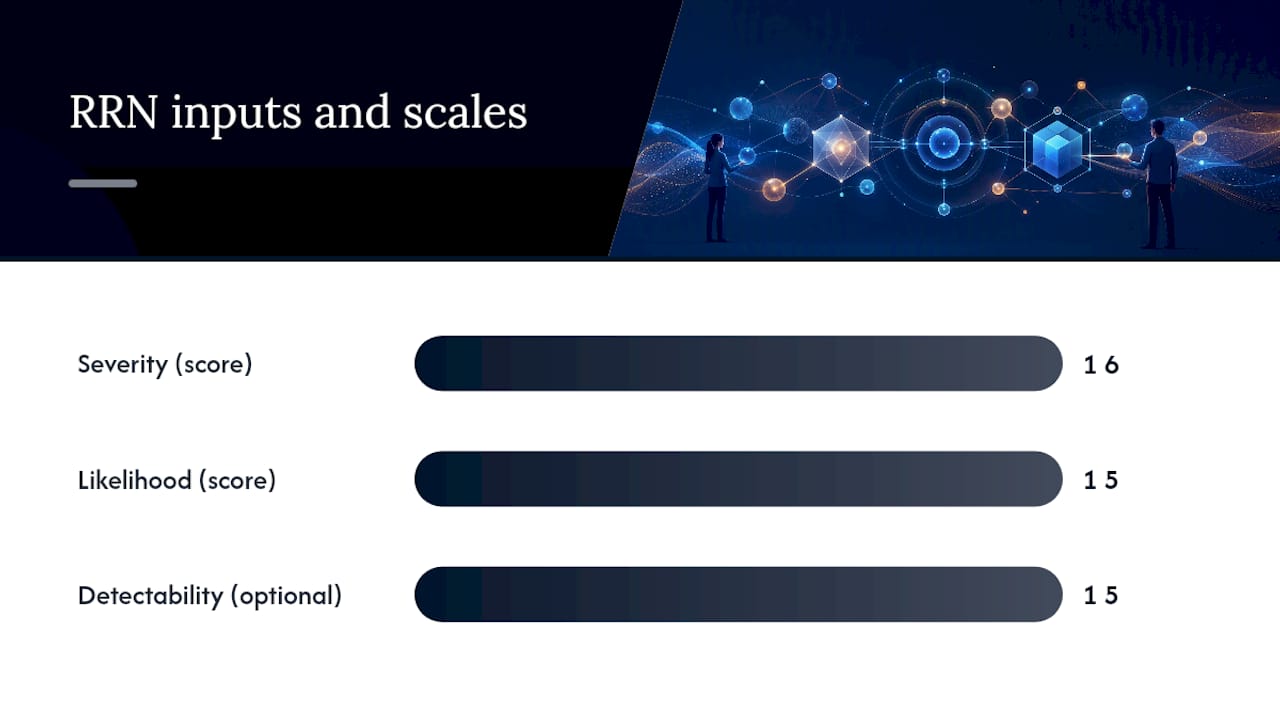
Pro Tip: Calculate residual risk after controls, not before. A risk with severity 4 and likelihood 4 (RRN 16) might drop to an RRN of 6 once source data verification is in place — that residual number is what actually belongs in your prioritization conversation.
Set thresholds in advance, not while you're staring at a bad number:
- RRN 1 to 6: accept and monitor at standard cadence
- RRN 7 to 14: mitigate, assign an owner and completion date
- RRN 15 and above: escalate to the steering committee immediately
This mirrors the approach Royal Papworth's research risk SOP documents for prioritizing mitigation and escalation across a trial portfolio. The thresholds themselves matter less than the fact that you wrote them down before you needed them.
Linking Risks to KRIs, QTLs, and the Monitoring Plan
A risk without a measurable indicator is an opinion. Every register entry needs at least one key risk indicator or quality tolerance limit that tells you, objectively, whether the risk is trending the wrong way.
- Define the KRI before data collection starts. Screen failure rate above 40%, query aging past 14 days, or eCOA completion below 85% are common examples that give a monitoring team something concrete to watch, not a vague sense of unease.
- Set the tripwire threshold and the action it triggers. A QTL breach on a critical-to-quality parameter should automatically escalate to a defined review, not wait for the next scheduled meeting.
- Configure alerting against the same threshold used in the register, so the vendor's data feed and the clinical operations team are reacting to the same number, not two slightly different ones.
- Use the mapping to decide monitoring intensity. A site with three KRIs trending toward threshold earns targeted, more frequent monitoring; a site with clean indicators can stay on a centralized, lower-touch schedule.
This is exactly the sequencing FDA's risk-based monitoring guidance describes: monitoring plans built from documented risk assessments, with intensity adjusted as new risk information arrives.
Governance, Version Control, and Staying Inspection Ready
The register needs an owner, a review cadence, and an audit trail, or it decays into a document nobody trusts. A workable rhythm: weekly operational review of open, high-RRN items, and monthly steering committee review of the full register and any escalations.
- Assign a named accountable owner per risk domain, not just per individual risk
- Version every update with a date, author, and change rationale
- Restrict edit access and log who touched what
- Link every closed item to its eTMF artifact: signed training records, CAPA closures, or validated report output
Pro Tip: If an entry has been "in progress" for more than two review cycles with no evidence attached, that's your first inspection finding waiting to happen. Flag it before an auditor does.
Operational frameworks built for regulatory-grade trials treat this weekly-then-monthly cadence, combined with strict eTMF traceability, as the baseline for staying audit-ready year round rather than scrambling before an inspection.
A Template Row and How to Build an Executive Heat Map
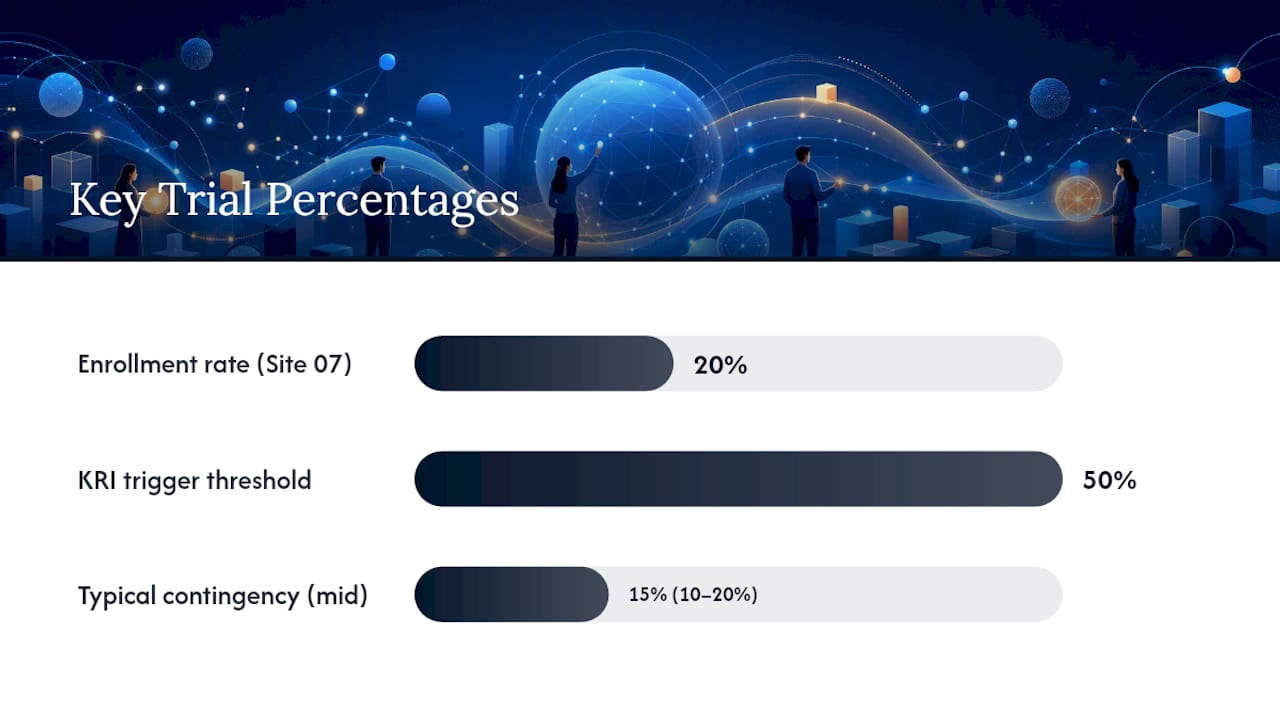
A minimal template row needs these columns: ID, Category, Description, Root Cause, Existing Controls, Mitigation, Contingency, Owner, Target Date, Status, KRI/Trigger, Residual RRN, Evidence Link.
Filled with a common example, low enrollment at a single site, it looks like this:
- ID: RISK-014 | Category: Operational, Recruitment
- Description: Site 07 enrolled 2 of 10 target patients by month 4
- Root Cause: Referral pathway from partner clinic underperforming
- Existing Controls: Monthly enrollment tracking call
- Mitigation: Add second referral site; refresh site staff training
- Contingency: Reallocate target enrollment to two backup sites
- Owner: Clinical Operations Lead, Site 07
- Target Date: Week 10 | Status: In progress
- KRI/Trigger: Enrollment rate below 50% of target by month 3
- Residual RRN: 6 (down from 15) | Evidence Link: Site training log, revised enrollment plan
For steering committee reporting, sum or weight the residual RRNs across the register into a Total Normalized Risk Score, then plot categories on a heat map of likelihood versus severity. That single visual tells an executive team in seconds whether the portfolio's risk profile is improving or drifting. Contingency budgets should scale with this score rather than defaulting to a flat 10 to 20% padding, since modeling work on trial risk mitigation shows optimized allocation against the actual risk profile lowers the portfolio's overall TNRS for the same budget.
Keeping the Register Live: Automation and Operational Practice
Automated protocol scanning and KRI data feeds catch drift faster than a quarterly manual review ever will, especially for query aging or eCOA completion metrics that change daily. But automation identifies; it does not judge. A human still needs to decide whether a flagged trend is a genuine risk or a temporary blip, and manual checklists alone are increasingly insufficient for adaptive or multi-region designs where risk profiles shift site by site.
Pro Tip: Define your KRI thresholds before you turn on any automated feed. An alert threshold set after the vendor contract is signed usually gets negotiated down to whatever the vendor's system already reports, not what your risk profile actually needs.
A practical operating rhythm: run a cross-functional seed workshop to populate the top risks, hold weekly ops reviews against live dashboards, and align contingency budgets to the risk taxonomy rather than a department's default. An operational partner that starts from your program's strategic goals and works backward can spot where a manual process, not a lack of effort, is creating the operational risk in the first place, then design the governed automation to close it.
What Actually Gets Flagged in Inspections
Traceability beats scoring elegance every time. An inspector cares far less about whether your RRN scale runs 1 to 5 or 1 to 10 than whether every closed mitigation has a real artifact behind it.
Watch for three red flags: entries with no owner assigned, risks with no KRI linkage at all, and thresholds that shift between review cycles without documented rationale. Any one of these turns a clean register into a finding.
Two moves fix most of this fast. Run a cross-functional workshop to seed your top ten risks properly, with real owners in the room, not assigned after the fact. Then add two automated KRI feeds, screen failure rate and query aging are usually the highest-value starting points, so the register updates itself instead of waiting for someone to remember.
— John
Getting Your Risk Register Built and Governed Properly
Most teams don't lack risk awareness. They lack the operational bandwidth to build a register, wire it to real KRI feeds, and keep the governance cadence running while also managing the trial itself. Haiphai works as an embedded operational partner rather than a software vendor: it starts from your program's approval timeline, backtracks to find where risk tracking and monitoring decisions are actually bottlenecked, and builds the automation and governance model around your team, not a generic template.
That diagnostic approach is why clients working with Haiphai have reclaimed up to 18 months of operational time on the path to approval, time that matters directly for funding rounds and valuation, not just internal efficiency. If your risk register currently lives in a spreadsheet nobody updates between monitoring visits, that's usually the first bottleneck worth fixing. Visit the Haiphai sectors page to see how the operational partnership model applies to your specific therapeutic area and trial phase.
Primary Sources Worth Reading Directly
- FDA guidance on risk-based monitoring plans: what to include in a monitoring plan and how risk assessments should inform it
- ICH E6(R3) Step 4 final guideline: Quality by Design and continuous risk management expectations
- Royal Papworth risk rating SOP: a practical RRN scoring model in operational use
Sources
- FDA guidance: Content of clinical trial monitoring plans and risk-based approaches
- ICH E6(R3) Step 4 final guideline (2025)
- SOP: Assessment and registration of trust risk rating for research studies (Royal Papworth)
FAQ
What Should Be Included in a Risk Register?
At minimum: a risk ID, category, description and root cause, existing controls, mitigation and contingency plans, an owner, target dates, status, linked KRIs, residual risk score, and evidence links for closed items.
Is a Risk Register a Regulatory Requirement?
There's no single regulation mandating a document called a "risk register" by name, but ICH E6(R3) and FDA's risk-based monitoring guidance both expect sponsors to document risk assessments and tie them to a monitoring plan, which in practice requires this kind of record.
What Are the Three Core Components of a Risk Register?
Most frameworks reduce it to identification (what the risk is and why), assessment (severity, likelihood, and resulting RRN), and control (mitigation, contingency, owner, and monitoring linkage).
How Do I Create a Clinical Trial Risk Register?
Start with a cross-functional workshop to identify and score your top risks, build the register with the core fields and a documented taxonomy, link each entry to a measurable KRI, then set a weekly operational and monthly governance review cadence to keep it current.