
TL;DR:
- A biotech development risk profile assesses scientific, clinical, regulatory, manufacturing, and commercial risks to determine project success. Managing each risk category and updating the profile regularly can protect program value and improve decision-making.
A biotech development risk profile is the integrated assessment of scientific, clinical, regulatory, manufacturing, and commercial risks that collectively determine the probability of success for a given drug or therapy program. Every biotech project carries this profile from day one, and it shapes valuations, funding rounds, and go/no-go decisions at every stage. Biotech development typically spans 10–12 years with costs often exceeding US$2 billion per asset. That scale of investment means even moderate risk misreads can destroy shareholder value or kill a program entirely. Biotech professionals who understand this profile make better capital allocation decisions, negotiate from a stronger position, and build more credible development plans.
What is a biotech development risk profile?
A biotech development risk profile is not a single score. It is a structured map of five distinct risk categories, each with its own drivers, timelines, and financial consequences. The industry term most analysts use is "probability-adjusted risk profile," which reflects the fact that each risk type must be weighted by its likelihood and its impact on the overall program value.

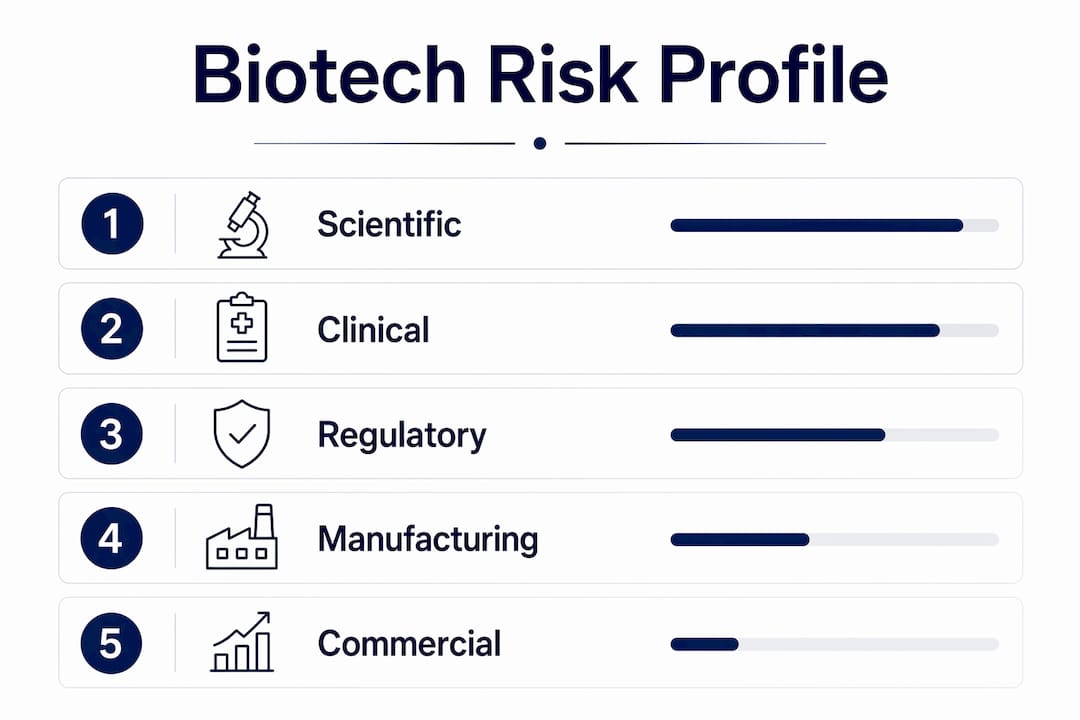
The five categories are scientific risk, clinical risk, regulatory risk, manufacturing risk, and commercial risk. Each one can independently kill a program or reduce its net present value to zero. Understanding how they interact is the core skill in biotech risk assessment.
Pro Tip: Build your risk profile as a living document. Update it after every major data readout, regulatory interaction, or manufacturing milestone. A static risk profile is a false sense of security.
| Risk type | Core driver | Key implication |
|---|---|---|
| Scientific | Mechanism validity and efficacy data | Program termination if target biology fails |
| Clinical | Trial design, enrollment, and data quality | Phase failure destroys sunk capital |
| Regulatory | FDA or EMA approval unpredictability | Valuation swings of 30% or more |
| Manufacturing | GMP compliance and scale-up costs | Production failure blocks commercialization |
| Commercial | Market adoption, patent life, competition | Revenue projections become unreliable |
Scientific risk is the most fundamental. If the therapeutic mechanism does not work in humans, no amount of regulatory expertise or manufacturing efficiency saves the program. Clinical risk builds on top of that: even a validated mechanism can fail if trial design is flawed, enrollment is slow, or the patient population is poorly defined. Clinical trial enrollment delays are among the most common and costly sources of clinical risk in mid-stage programs.
Manufacturing risk is frequently underestimated by early-stage teams. GMP-compliant production is expensive to establish and technically demanding to scale. Commercial risk, meanwhile, only becomes visible late in development, but patent expiration timelines and competitive entries must be modeled from the start.
How do clinical development phases reduce risk?
The linear progression through clinical phases acts as a sequential risk filter. Each successful phase transition meaningfully improves the probability that the overall program survives to approval. Risk reduces by approximately half at every successful transition from IND filing through FDA submission. That compounding effect is why late-stage assets command dramatically higher valuations than preclinical ones.
-
Preclinical stage. Animal and in vitro data establish proof of concept. Large-animal models carry more predictive weight than cell-based assays. Programs relying solely on in vitro data carry the highest scientific risk at this stage.
-
IND filing. The Investigational New Drug application is the first formal regulatory checkpoint. A successful IND filing signals that the FDA accepts the safety rationale for human testing. Failure here often reflects gaps in preclinical safety packages.
-
Phase 1. Safety and tolerability in a small human cohort. The primary risk is unexpected toxicity. A clean Phase 1 dataset cuts total capital loss risk substantially and opens the door to institutional investment.
-
Phase 2. Efficacy signals in a targeted patient population. This phase carries the highest binary risk because it is the first real test of whether the drug works as intended. Many programs that survive Phase 1 fail here.
-
Phase 3. Large-scale confirmatory trials. The cost per patient is highest here, and failure at this stage is financially catastrophic. A Phase 3 failure after hundreds of millions in spending is the defining disaster scenario in biotech.
-
FDA submission and review. Complete Response Letters (CRLs) at this stage can delay approval by one to three years. FDA clinical holds carry a lasting negative signal to investors, even after resolution, because they suggest weaknesses in trial design or safety oversight.
Pro Tip: Treat each phase transition as a formal investment decision, not just a scientific milestone. Reassess the full risk profile at every gate before committing capital to the next phase.
Analysts must shift to probability-based valuation frameworks rather than traditional equity methods to account for these layered, time-dependent risks. A program's value is not its peak sales potential. It is peak sales potential multiplied by the cumulative probability of reaching each milestone.
What role does regulatory unpredictability play in the biotech risk profile?
Regulatory risk is the most volatile component of the biotech industry risk profile because it is largely outside the developer's control. Regulatory unpredictability can reduce clinical-stage biotech valuations by 30% by raising the cost of capital and lowering perceived approval probability. A share priced at $20 based on expected approval can fall to $14 on regulatory uncertainty alone, with no change in the underlying science.
Regulatory unpredictability does not just delay approvals. It damages the entire capital ecosystem around a program. Specialist biotech investors shift capital toward de-risked assets. Generalist investors exit the sector entirely. The result is a funding gap that compounds development timelines and forces teams into unfavorable financing terms.
FDA leadership instability amplifies this problem. The FDA's Center for Drug Evaluation and Research had six different leaders in the period beginning in early 2025. That level of turnover produces inconsistent guidance, shifting review standards, and unpredictable timelines for sponsors.
The practical consequences for biotech teams include:
- Delayed financing rounds tied to regulatory milestones
- Widening bid-ask spreads in partnership negotiations
- Increased cost of capital as investors price in approval uncertainty
- Commercial timeline compression when approvals arrive late
AI-augmented regulatory affairs workflows are one of the most effective responses to this environment. Teams that use AI to accelerate regulatory drafting, track agency guidance changes, and model approval scenarios reduce their exposure to process-driven delays.
The most effective mitigation strategy is early and sustained regulatory dialogue. Requesting Type B meetings with the FDA before Phase 3 initiation, engaging in pre-submission programs, and maintaining consistent communication with reviewers all reduce the probability of a CRL or clinical hold.
What challenges do academic and SME biotech developers face?
Academic and small-to-medium enterprise (SME) biotech developers carry a distinct version of the biotech development risk profile. Their risk is amplified by resource constraints, limited regulatory experience, and manufacturing access barriers that larger organizations do not face.
Early-stage biotech enterprises depend heavily on external GMP manufacturing facilities because the upfront cost of building compliant internal capacity is prohibitive. This creates a dependency on specialized contract manufacturing organizations (CMOs) that adds scheduling risk, quality control complexity, and cost unpredictability to an already difficult development path.
The regulatory challenge is equally acute. Many academic developers avoid early regulatory engagement due to low awareness or lack of preparedness. That avoidance creates downstream problems: trial designs that do not meet agency expectations, safety packages that require costly remediation, and funding delays tied to regulatory uncertainty.
The compounding effect of these barriers looks like this in practice:
- Limited funding forces reliance on milestone-based grants, which create stop-start development timelines
- GMP access bottlenecks delay IND filing by months or years
- Regulatory naivety leads to Phase 1 designs that generate insufficient data for Phase 2 investment decisions
- Fragmented oversight across international jurisdictions adds complexity for programs seeking multi-market approval
Small biotech teams can compete at larger scales by building operational models that prioritize regulatory readiness and external manufacturing partnerships from the earliest stages. The teams that treat regulatory strategy as a core competency, not an afterthought, consistently outperform peers with equivalent science.
Key Takeaways
A biotech development risk profile integrates scientific, clinical, regulatory, manufacturing, and commercial risks, and each category must be actively managed to protect program value and investor confidence.
| Point | Details |
|---|---|
| Risk profile has five components | Scientific, clinical, regulatory, manufacturing, and commercial risks each require separate assessment and mitigation strategies. |
| Phase transitions cut risk in half | Each successful clinical phase transition approximately halves total capital loss risk, directly increasing program valuation. |
| Regulatory unpredictability is costly | A 30% valuation drop from regulatory uncertainty is documented, making early FDA engagement a financial priority. |
| SMEs face compounded barriers | GMP access costs and low regulatory awareness amplify development risk for academic and small biotech teams. |
| Probability-based valuation is required | Traditional equity methods fail in biotech; scenario-weighted frameworks that account for phase-specific survival rates are the standard. |
The risk profile is where science meets financial reality
After working with biotech teams across development stages, the pattern I see most often is this: teams build excellent science and then treat the risk profile as a compliance exercise rather than a strategic tool. That gap between scientific ambition and risk-adjusted planning is where programs fail, not in the lab.
The most dangerous blind spot I encounter is manufacturing risk. Teams spend years perfecting their molecule and then discover, six months before IND filing, that no CMO can meet their timeline or quality requirements. That is not bad luck. It is a failure to model manufacturing risk early enough.
The second blind spot is overconfidence in preclinical data. In vitro results are not a reliable predictor of human outcomes. Programs that enter Phase 1 with only cell-based evidence carry far more scientific risk than their teams typically acknowledge. Large-animal model data is not just a regulatory preference. It is a genuine signal of translational probability.
Regulatory risk is the one that keeps me most focused right now. The current environment of leadership instability at major agencies means that even well-designed programs face unpredictable review timelines. The teams that build regulatory strategy into their development plan from day one, not as a late-stage activity, consistently reach milestones faster and with fewer surprises.
My honest recommendation: run a formal risk profile review at every major decision point, not just at phase transitions. The risk landscape changes with every competitive approval, every agency guidance update, and every financing round. A risk profile that was accurate six months ago may be dangerously out of date today.
— John
How Haiphai helps biotech teams manage development risk
Biotech development risk does not wait for convenient moments to surface. It shows up in regulatory review cycles, manufacturing timelines, and clinical data gaps, often all at once.
Haiphai works as an operational partner for life sciences teams, starting from your program goals and working backward to identify where risk is accumulating. Its AI-powered tools support regulatory drafting, clinical site activation, and scenario modeling, helping teams reclaim up to 18 months of operational time on the path to approval. For biotech professionals managing complex development risk across multiple programs, that time directly translates to higher valuations and stronger funding positions. Haiphai's approach is built around your specific program needs, not a generic workflow.
FAQ
What is a biotech development risk profile?
A biotech development risk profile is the structured assessment of scientific, clinical, regulatory, manufacturing, and commercial risks that determine the probability of success and the valuation of a biotech program. It is a living document that must be updated at every major development milestone.
How does regulatory risk affect biotech valuations?
Regulatory unpredictability can reduce clinical-stage biotech valuations by approximately 30% by raising the cost of capital and lowering perceived approval probability. FDA clinical holds and CRLs carry lasting negative signals to investors even after resolution.
What is the biggest risk in early-stage biotech development?
Scientific risk is the most fundamental early-stage risk because a failed therapeutic mechanism cannot be rescued by regulatory or commercial expertise. Programs relying solely on in vitro preclinical data carry the highest scientific risk entering Phase 1.
Why do SME biotech developers face higher development risk?
SME and academic developers face compounded risk from GMP manufacturing access barriers, limited regulatory experience, and milestone-dependent funding structures that create stop-start development timelines. Early regulatory engagement and external manufacturing partnerships are the most effective mitigations.
How should analysts value early-stage biotech companies?
Analysts must use probability-weighted, scenario-based frameworks rather than traditional equity methods, because biotech value is a function of peak sales potential multiplied by the cumulative probability of reaching each clinical and regulatory milestone.