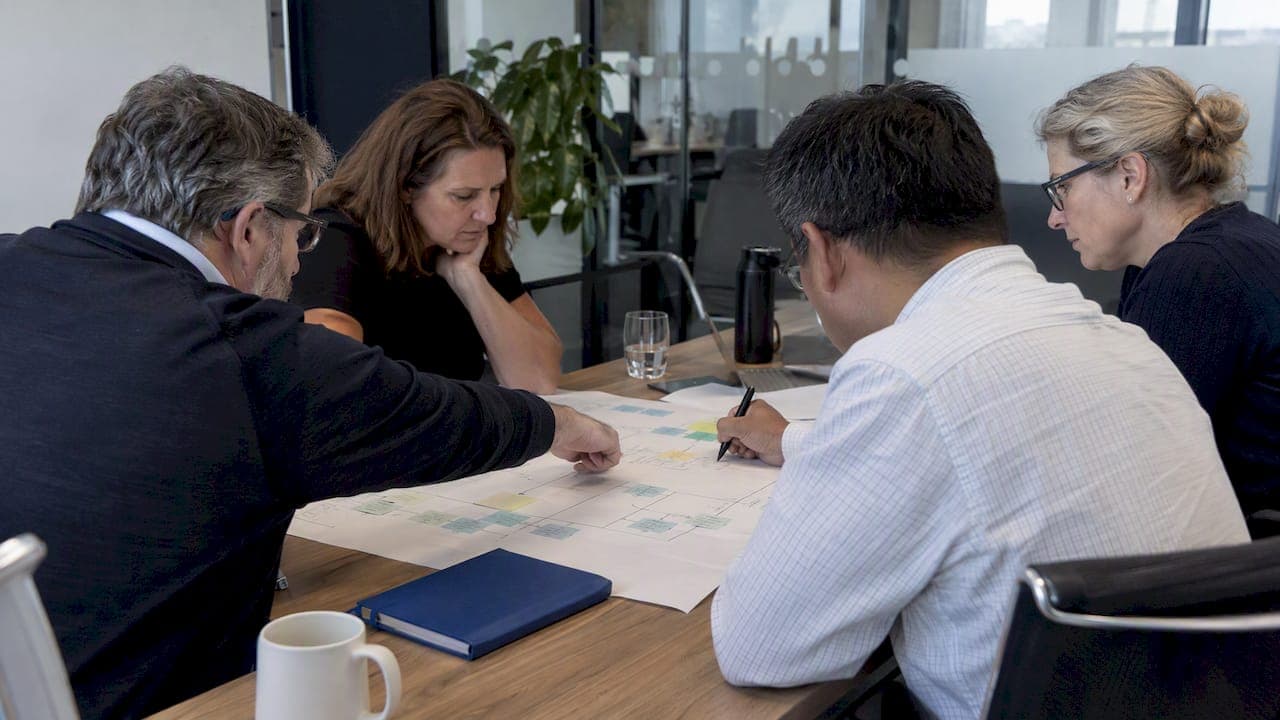
An executive alignment workshop is a structured, facilitated session in which a leadership team surfaces its disagreements, settles priorities and decision rights, and leaves with written commitments it can be held to. In biotech, the version that works is built around the handful of decisions that move your timeline: trial design, site strategy, regulatory path, funding milestones and the handoff from R&D to commercial. Below is how to design one, what to put on the agenda, and how to tell afterward whether it worked.
TL;DR
- A good alignment workshop produces decisions, owners and dates, not a shared feeling. Agreement in the room proves little.
- Design matters more than topic. Research on strategy workshops links outcomes to how the event is structured, who attends and what happens around it.
- Biotech teams need to stress-test science against regulatory, access and operational reality while trial designs can still change.
- Plan a series, not a one-off: a diagnostic beforehand, the workshop itself, and a 30, 60 and 90 day follow-up.
- Measure alignment by what happens afterward: fewer reopened decisions, less cross-functional friction, commitments that hold.
Table of Contents
- What an executive alignment workshop is (and is not)
- Why biotech teams need a different kind of workshop
- The pre-work: diagnose before you gather
- Who should be in the room
- A workable agenda
- Topics biotech teams should not skip
- Why one workshop is rarely enough
- How to tell whether it worked
- Our perspective: alignment is an operations problem
- When an outside partner helps
- A short checklist before you book the room
- FAQ
- Sources
What an executive alignment workshop is (and is not)
It is not an offsite with a strategy deck and a nice dinner. It is not a values exercise either. It is a working session with a narrow job: get the people who run clinical, regulatory, CMC, finance, business development and (eventually) commercial to agree on a small number of choices, and to be explicit about who decides what.
The distinction that matters is between agreement and alignment. Leadership strategist Tristam Brown argues that alignment is not consensus in the boardroom. It shows up afterward, in whether strategic intent travels consistently through the organization, in how often decisions get reset, and in the absence of cross-functional friction.
That definition gives you something to design toward. If the success test is behavior in the weeks after the session, the workshop has to produce things that change behavior: ranked priorities, named owners, decision rights and a review cadence.
Why biotech teams need a different kind of workshop
Generic alignment advice assumes a company that already sells something. Many biotech leadership teams are aligning around a product that does not exist yet, with a funding clock running and a regulator who will have the final say.
The gap between development and commercial is where much of the damage happens. A Pharmaceutical Executive analysis of biotech pathways notes that companies often bring in leaders who can bridge R&D and commercial operations too late, which leads to misallocated resources and missed regulatory milestones. The same piece reports that only 28% of first-time biotech launches exceed analysts' pre-launch forecasts, against nearly 50% for experienced companies. Its advice for founders is to start the cultural shift early, and to pressure-test clinical research against future access and reimbursement realities while trial designs are still malleable.
That last point is a good test of any biotech alignment agenda. If your workshop never asks "what will a payer or a health system need to see from this program, and does the current design deliver it?", it is probably aligning the team around the wrong question.

The pre-work: diagnose before you gather
The most common failure is showing up cold. A two-day session cannot both discover the problems and resolve them. Do the discovery first.
- Interview each participant separately. Ask three things: what are the two or three decisions that, if made differently, would change our timeline most? Where do you see other functions working against your priorities? What do you think the CEO believes that you do not?
- Map the real bottlenecks. Pull the last two or three slips against plan and trace each to a cause. Was it a decision that nobody owned, a handoff between teams, a dependency on a CRO, a document that took six rounds of review? We cover why this happens in why biotech timelines extend past projections.
- Write a one-page synthesis. Themes only, unattributed. Circulate it a week ahead so nobody is surprised by what is said.
- Fix the decision list. Choose four to six decisions the group must leave with. If you cannot name them, you are not ready to book the room.
A concrete example from start-up operations shows why the bottleneck map matters. The Association of Clinical Research Professionals describes site activation as a deadline job dressed as a paperwork job: teams treat the site initiation visit as the milestone, while pharmacy, laboratory and administrative readiness frequently stall after it. An executive team that thinks "activation" means one thing while clinical operations means another is misaligned in a way that costs weeks, and a workshop can only surface that if someone has traced the process beforehand.
Who should be in the room
Fewer people than you think, but the right ones. Healey and colleagues' study of strategy workshops examined how design characteristics relate to outcomes, and participant mix is one of the design choices it treats as consequential. Our practical reading for a biotech team:
- Core: CEO, heads of clinical, regulatory, CMC or technical operations, finance, and business development.
- Include early: whoever owns market access or commercial strategy, even if the role is a part-time advisor. Their absence is the classic blind spot described above.
- On call, not in the room: CRO or key vendor leads, the board chair or a lead investor. Bring them in for a defined segment, such as the milestone and funding discussion.
- Facilitator: someone who is not part of the reporting line and has no stake in any option. The CEO should be a participant, not the moderator.
A workable agenda
Below is a one-and-a-half-day structure for a team of six to ten. Shorten it if the pre-work is strong.
| Block | Purpose | Output |
|---|---|---|
| 1. Diagnostic readout (60 min) | Share the synthesis and the bottleneck map | Agreed description of the problem |
| 2. Goal backtrack (90 min) | Start from the next value-inflection milestone and work backward | A dependency chain with owners |
| 3. Productive dissent (90 min) | Assign people to argue against the leading plan | A list of hidden risks and conflicting incentives |
| 4. Trade-offs and priorities (2 hrs) | Rank programs, spend and headcount against the chain | A ranked list, with what is explicitly deprioritized |
| 5. Decision rights (90 min) | Decide who decides, who is consulted, who is informed | A one-page decision map |
| 6. Commitments (60 min) | Convert agreements into written commitments | Owners, dates, review cadence |
Backtrack from the goal
Start with the outcome that changes the company's position: an IND clearance, a pivotal readout, a financing event. Then ask what must be true six months before that, and six months before that. This turns an abstract argument about priorities into a concrete one about sequence. For the funding side of this logic, see our piece on maximizing biotech company valuation.
Build in productive dissent
Silence is not consent. A write-up on false alignment describes teams that act as though they agree on direction and execution while significant differences remain unresolved. The fix is procedural: assign a pair of executives to make the strongest case against the preferred plan, or ask each person to write down the one assumption they think is most likely to be wrong before anyone speaks. People who would never object aloud will write it down.
Settle resource allocation in the open
Most alignment disputes are resource disputes in disguise. If two programs compete for the same clinical operations team, no amount of shared vision resolves it. Put the trade-off on the table, use explicit criteria, and record what loses. Our guide to biotech resource allocation frameworks covers criteria you can use.
Write the decision map
For each of the four to six decisions, record one decider, the people who must be consulted and the people who must only be informed. Also record the trigger for reopening it: new data, a regulatory comment, a cost threshold. A decision with a defined reopening trigger is much less likely to be quietly relitigated.

Topics biotech teams should not skip
These come up repeatedly when leadership teams in life sciences get stuck:
- CRO governance. Biotech startups often over-rely on contract research organizations without internal governance. Johns Hopkins researchers studying start-up cycles in investigator-initiated multicenter trials developed an accelerated start-up approach built on lean management principles. A related line of practice uses dedicated site navigators focused on operational blockers. Whether to adopt something like this is an executive decision about ownership, not a task for a project manager alone.
- Site selection logic. Agree on what data you will use to choose sites, and whether you are competing for the same crowded sites as everyone else.
- Regulatory path assumptions. Does every function share the same view of the submission timeline, and of what "ready" means for each document?
- Commercial reality checks. What would payers and health systems need to see, and is that being generated now?
- Knowledge continuity. What happens to institutional knowledge when a key regulatory lead or clinical scientist leaves?
For the cross-functional piece, how to manage cross-functional biotech teams effectively goes deeper on day-to-day mechanics.
Why one workshop is rarely enough
The workshop is a starting point. Research on strategy workshops finds that outcomes depend heavily on design, not just on what is discussed, and on what happens in the organization around the event. In practice, the teams we see lose the gains in the first two weeks, when the calendar fills up and nobody owns the follow-through.
A sturdier pattern is a short series:
- Diagnostic (two to three weeks before): interviews and bottleneck map.
- Workshop: the agenda above.
- 30-day check: are the commitments being met? Which decisions were reopened, and why?
- 60 to 90 day review: has anything changed in cycle times, handoffs or escalations? Revise the decision map.
Be cautious about any claim that a single session transforms a team. We are not aware of solid evidence that it does, and the design research points the other way.
How to tell whether it worked
Because alignment shows up in behavior, measure behavior. Useful signals:
- Decision resets: how many decisions made in the workshop were reopened, and were they reopened through the agreed trigger or through side conversations?
- Escalations: are cross-functional disputes reaching the CEO less often?
- Commitment hit rate: what share of written commitments were delivered by the date?
- Message consistency: ask three people at different levels what the top priorities are. If you get three answers, the cascade has not worked.
- Cycle time on known bottlenecks: document review loops, site activation steps, vendor approvals.
A warning from the strategy literature: managers who focus too narrowly on refining alignment processes can end up with polished answers to the wrong strategic question, according to research on why strategy execution unravels. In volatile conditions, which describe most clinical programs, teams also need room to adapt to facts on the ground while staying coordinated. Build a review step into the plan so that alignment does not harden into rigidity.
Our perspective: alignment is an operations problem
We come at this from the operating side. When we work with biotech teams, the alignment problem rarely turns out to be about vision. Everyone wants the program to succeed. The trouble is that the strategy lives in slide decks while the work lives in handoffs: a regulatory draft waiting on a data table, a site waiting on a contract, a decision waiting on a person who thinks it belongs to someone else.
So we start from the strategic goal and backtrack to the points where work actually stalls. Often the most useful output of an alignment session is a plain list of those points, each with an owner. Then the question becomes which of them are worth redesigning, and where AI can take over repetitive work such as first-draft regulatory documents or site activation tracking, with human review and governance kept in place.
Three convictions shape how we think about this:
- Alignment without a mechanism decays. A decision map and a review cadence matter more than a good conversation.
- Technology follows the workflow, not the other way around. Buying a tool before agreeing on the process and the owner tends to automate the confusion.
- Governance is part of speed. Teams move faster when it is clear who approves what, and what must stay with a human expert.
If you want a view on where AI helps and where it should not, our page on where AI can help in regulatory affairs and what must stay human is a good starting point.
— John
When an outside partner helps
A facilitator can run the room. What many teams lack is someone who can then work inside the operations to carry decisions through. That is the gap our operating partnership and AI Velocity Diagnostic are built for: we map where your operations are slowing down against your strategic goals, redesign the affected workflows with AI where it fits, and stay on to govern adoption. If you are weighing that against building the capability in-house, our decision framework for a fractional AI partner versus an internal team lays out the criteria.
A short checklist before you book the room
- Can you name the four to six decisions the group must leave with?
- Have you interviewed every participant privately?
- Is there a written bottleneck map tied to your next major milestone?
- Is market access or commercial input represented?
- Is the facilitator independent of the reporting line?
- Is the 30 and 90 day follow-up already on calendars?
- Is there a named owner for the follow-through, with time to do it?
If the answer to several of these is no, postpone and do the pre-work. A well-prepared half day beats a poorly prepared two days.
FAQ
What does executive alignment mean?
It means the leadership team shares the same understanding of priorities, trade-offs and who makes which decisions, and acts on it consistently. The proof is behavioral: decisions stay made, and teams below the executive level hear the same message from every leader. Agreement in a meeting is not enough.
How long should an executive alignment workshop be?
For a team of six to ten, one to two days is typical, preceded by individual interviews and followed by check-ins at about 30 and 90 days. The length matters less than the preparation and the follow-through. A short session with strong pre-work often outperforms a long one without it.
Who should facilitate it?
Someone outside the reporting line, with no stake in the outcome, who is comfortable pushing senior people on vague answers. The CEO should participate rather than run the session, since the group will otherwise tend to defer. An internal facilitator can work if they sit outside the leadership team's hierarchy.
How is a biotech alignment workshop different from a generic one?
The agenda has to bridge science, regulatory path, operations and eventual commercial reality, often under a funding deadline. That means testing trial design and development plans against access and regulatory expectations early, and dealing with CRO governance and site activation as executive topics. Generic exercises on values or team dynamics rarely touch those.
How do we know if the workshop worked?
Look for fewer reopened decisions, fewer cross-functional escalations, written commitments delivered on time and consistent answers when you ask people at different levels about priorities. Check at 30 and 90 days rather than judging by how the session felt.
Sources
- Off to Plan or Out to Lunch? Design characteristics and outcomes of strategy workshops (British Journal of Management)
- Leadership team alignment (LSA Global)
- From Lab to Market: Tracking Today's Shifting Pathways for Biotech (Pharmaceutical Executive)
- Study Startup and Site Activation: Roles, Pay and Day-to-Day 2026 (ACRP)
- The Meeting Went Great. So Why Is Nothing Happening? (Glade)
- Accelerating start-up cycles in investigator-initiated multicenter clinical trials (Johns Hopkins University)
- Why Strategy Execution Unravels (PRISM)