
TL;DR:
- Effective biotech team management requires early formal governance, including decision-making frameworks, accountable roles, and shared KPIs. Hiring bridge generalists and establishing communication protocols prevent silos, delays, and rework across functions. Implementing structured processes before problems arise leads to faster, more aligned progress toward program milestones.
Managing cross-functional biotech teams is defined as the coordinated leadership of scientists, regulatory specialists, operations staff, and commercial functions toward shared project milestones under a single governance structure. Without that structure, teams default to siloed work, duplicated effort, and timeline drift that compounds at every stage gate. The industry term for this discipline is cross-functional team governance, and it applies from first-in-human studies through commercial launch. Biotech project leaders who formalize governance early consistently outperform those who treat coordination as an informal activity.
What are the core governance frameworks for managing cross-functional biotech teams?
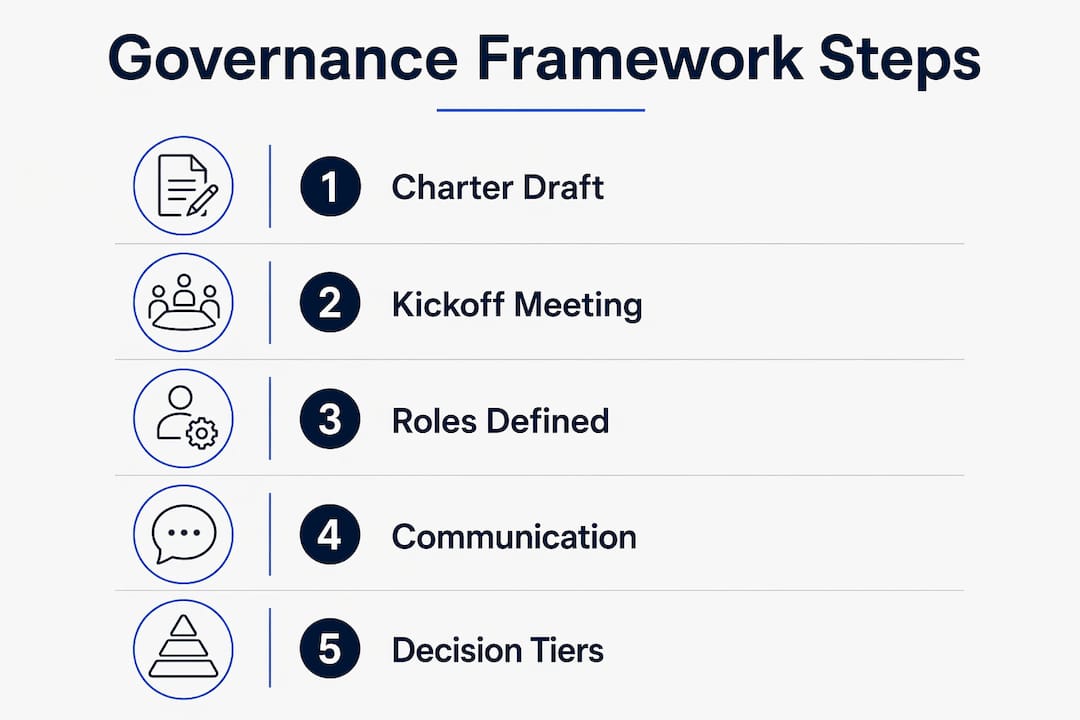
Governance is not overhead. It is the operating system that turns alignment from an aspiration into a repeatable process. Best-practice governance uses a three-tier decision-making framework: Tier 1 covers daily operations handled by study teams, Tier 2 covers tactical trade-offs resolved by cross-functional leads, and Tier 3 covers strategic decisions made by executive committees. Each tier has defined authority, so decisions land at the right level without escalating unnecessarily or stalling silently.
The framework requires two supporting roles to function. A single accountable owner holds ultimate responsibility for each workstream, and domain leads own execution within their function. This separation prevents the diffusion of accountability that kills momentum in matrix organizations. Decision integrators, typically project managers, enforce follow-through across functions and flag when decisions are overdue.
Two tools make governance concrete:
- RACI matrices assign Responsible, Accountable, Consulted, and Informed roles for every major decision and deliverable.
- Governance charters codify meeting cadence, decision rights, escalation thresholds, and shared KPIs that hold all functions jointly accountable.
Cross-functional projects do not succeed through perfect alignment. They succeed through governance systems that accommodate misalignment with disciplined decision processes and shared OKRs. That distinction matters because misalignment is inevitable in complex biotech programs. The governance system's job is to resolve it quickly, not prevent it entirely.
Pro Tip: Draft your governance charter before the first cross-functional kickoff meeting. A charter written after conflict erupts reflects politics, not principles.
Which team composition strategies optimize cross-departmental coordination in biotech?
Team composition is the single most underrated driver of cross-departmental coordination. Most biotech leaders focus on hiring deep specialists, which is necessary but not sufficient. The teams that move fastest also hire bridge generalists: people who can translate between biology, computation, clinical operations, and regulatory affairs without being the domain expert in any one area. Bridge generalists prevent the siloed parallel work that forces expensive rework downstream.
The composition challenge intensifies during growth. Delaying cross-functional matrix structures between 30 and 150 employees produces structural dysfunction and measurable timeline drift. That range covers most Series A through Series C companies, which means the majority of scaling biotechs are operating without the structures they need precisely when they need them most.
Three composition principles apply at any stage:
- Embed computational scientists directly into R&D functions rather than housing them in IT or data teams. Early embedding avoids integration friction and scientific drift that accumulates when data teams operate separately.
- Hire for cross-functional behavior, not just scientific excellence. Reference conversations that probe collaboration skills matter as much as publication records. Brilliant individual contributors who cannot work across functions are a documented cause of project delays.
- Develop leaders internally at each growth pivot. Leadership capability, not headcount, determines whether a team of 80 operates like a coordinated unit or a collection of competing departments.
The commercial function deserves specific attention. Biotech teams routinely add commercial staff too late, which means regulatory and clinical decisions get made without market input. Integrating commercial roles at the program level, not just at launch planning, changes the quality of upstream decisions.
How to implement communication protocols and resolve cross-department bottlenecks in biotech?
Communication protocols set at project kickoff determine whether bottlenecks surface early or silently compound. The protocol must specify meeting frequency, agenda ownership, decision-ready criteria, and escalation thresholds before the first milestone. Teams that define these elements after problems emerge spend more time negotiating process than solving problems.

External partnerships with CROs and CDMOs require explicit escalation paths. A standard deviation investigation at a CDMO can run eight weeks. Eight weeks of unresolved investigation can push a financing milestone past an investor's decision window, which is a catastrophic outcome for a company dependent on that round. Project managers must link CDMO timelines directly to investor milestones and flag deviations the moment they appear, not after the investigation closes.
Structured escalation is a health signal, not a failure signal. Failing to escalate tactical trade-offs within one to two weeks produces silent delays that stretch into months. The escalation path should run from the cross-functional lead to the steering committee, with a defined window and a defined decision format.
A practical communication protocol for cross-functional biotech projects includes these steps:
- Define meeting cadence upfront. Weekly operational syncs, biweekly cross-functional lead reviews, and monthly steering committee sessions cover all three governance tiers.
- Set decision-ready criteria. Every agenda item that requires a decision must arrive with a recommendation, supporting data, and a clear ask. No recommendation, no decision slot.
- Assign a communication owner for each external partner. One internal contact owns the relationship with each CRO or CDMO. Split ownership creates gaps.
- Normalize escalation explicitly. Tell teams at kickoff that escalating an unresolved issue is expected behavior. Teams that treat escalation as failure hide problems until they become crises.
- Track milestone dependencies visibly. A shared dependency map updated weekly prevents the "I didn't know that was blocked" conversations that derail timelines.
Pro Tip: Build a 72-hour response SLA into every external partner agreement. Unanswered questions are the leading cause of silent schedule slippage in CDMO relationships.
What operational practices support quality control across biotech project teams?
Operational consistency across functions requires more than good intentions. It requires formal tools that enforce standards at every handoff. Modular templates and preflight checklists for regulatory submissions reduce errors and rework by giving every contributor a common starting point. A preflight process treats cross-document consistency the way aviation treats pre-flight checks: mandatory, structured, and signed off before departure.
The preflight model works best with a single submission coordinator who enforces terminology, dates, and references against master templates. Cross-document consistency managed this way prevents the regulator queries that add weeks to IND and NDA review cycles. One coordinator with authority over the final document set is more effective than distributed review by five contributors with no single point of accountability.
The table below shows how specific coordination practices affect biotech project timelines.
| Coordination practice | Impact on project timeline |
|---|---|
| Three-tier governance framework | Reduces decision latency by routing issues to the correct authority level |
| RACI matrix with named owners | Eliminates accountability gaps that cause rework and missed handoffs |
| Preflight submission checklist | Cuts regulator queries by catching inconsistencies before submission |
| Embedded computational scientists | Accelerates data integration and reduces scientific drift between functions |
| Shared OKRs across functions | Aligns incentives so teams optimize for program success, not departmental metrics |
Shared KPIs are the operational glue that holds cross-functional incentives together. When regulatory affairs, clinical operations, and CMC each report against their own metrics, they optimize locally and create friction at the boundaries. Shared program-level KPIs force joint accountability and surface trade-offs before they become conflicts.
Version control in a controlled document environment is non-negotiable for teams managing parallel workstreams. Uncontrolled document versions are the most common source of regulatory submission errors in mid-size biotech companies. A controlled environment with named version owners and audit trails removes that risk category entirely.
Key Takeaways
Effective cross-functional biotech team management requires formal governance, deliberate team composition, and communication protocols defined before problems arise, not after.
| Point | Details |
|---|---|
| Three-tier governance | Separate daily, tactical, and strategic decisions to route authority correctly and cut delays. |
| Bridge generalists matter | Hire translators between scientific domains to prevent siloed work and downstream rework. |
| Escalation is a health signal | Set a one-to-two-week escalation window to prevent silent delays from compounding. |
| Preflight checklists reduce rework | A single submission coordinator enforcing master templates cuts regulatory query cycles. |
| Shared KPIs align incentives | Program-level metrics prevent departments from optimizing locally at the program's expense. |
What I've learned about governance that most biotech leaders resist
The most common mistake I see in biotech team leadership is treating governance as something you add when things go wrong. Teams build the charter after the first missed milestone, write the RACI after the first accountability dispute, and define escalation paths after the first silent delay becomes a crisis. By then, the damage is done and the culture is already defensive.
The teams that move fastest are the ones that invest in governance infrastructure before they feel they need it. That means writing the charter before kickoff, embedding the decision integrator from day one, and normalizing escalation explicitly in the first all-hands. It feels like overhead at the start. It feels like a competitive advantage six months later when your program is on schedule and your peers are renegotiating timelines with their boards.
The bridge generalist insight also took me longer to internalize than it should have. I spent years watching brilliant scientists talk past each other because no one in the room could translate between the biology team and the data team, or between clinical operations and regulatory affairs. Hiring one person who can hold both conversations simultaneously is worth more than two additional domain experts who cannot. The 50-person biotech that operates with the coordination of a 500-person organization almost always has bridge generalists in key seats.
Governance is not a tax on scientific work. It is the infrastructure that lets scientific work move at the speed the program requires.
— John
How Haiphai supports cross-functional coordination in biotech
Biotech teams that have governance frameworks in place still face one persistent problem: the operational work of maintaining them. Tracking decisions, managing document versions, flagging escalation windows, and connecting regulatory timelines to financing milestones requires consistent attention that project managers cannot always sustain manually.
Haiphai acts as an operational partner that starts from your program goals and works backward to identify where coordination breaks down. Its AI-driven approach covers regulatory drafting support, clinical site activation, and structured escalation tracking, giving cross-functional teams the visibility they need to stay on schedule. Clients report reclaiming up to 18 months of operational time on the path to approval. For teams managing complex cross-functional programs, Haiphai's solutions for biotech teams translate governance principles into day-to-day operational practice.
FAQ
What does managing cross-functional biotech teams mean?
Managing cross-functional biotech teams means coordinating scientific, regulatory, operational, and commercial functions under a shared governance structure with defined decision rights and accountability. The goal is to align diverse expertise toward program milestones without siloed delays.
How does a three-tier decision framework reduce bottlenecks?
The three-tier framework assigns daily decisions to study teams, tactical trade-offs to cross-functional leads, and strategic calls to executive committees. This routing prevents both over-escalation and decision paralysis by matching authority to the complexity of the issue.
When should a biotech company formalize its cross-functional structure?
A biotech company should formalize its cross-functional matrix structure before reaching 30 employees and certainly before 150. Delaying past that range produces structural dysfunction and measurable timeline drift during the most capital-intensive growth phases.
What is a bridge generalist and why does biotech need them?
A bridge generalist is a team member who can translate between scientific domains such as biology, computation, clinical operations, and regulatory affairs without being the primary expert in any one area. They prevent siloed parallel work that forces expensive rework and slows cross-departmental coordination.
How do shared OKRs improve cross-functional collaboration in biotech?
Shared OKRs align incentives across functions so that regulatory, clinical, and CMC teams optimize for program success rather than departmental metrics. They surface trade-offs early and reduce the boundary friction that causes delays at functional handoffs.