
A biotech go-to-market roadmap is a timeline-aligned commercialization plan that connects regulatory milestones, clinical development, and commercial execution into a single operating framework. Executives who build this plan early, starting at Phase II, consistently reach approval faster and with stronger investor positioning than those who treat launch as a post-approval activity. The roadmap integrates FDA submission timelines, CMS reimbursement strategy, payer evidence development, and field team deployment into one coordinated sequence. Getting this right is not a marketing exercise. It is a multi-year operational discipline that determines whether your product reaches patients, and at what speed.
What does a biotech go-to-market roadmap require before you build it?
A commercialization plan without clear launch objectives is a schedule, not a strategy. Before your team writes a single milestone, you need measurable targets: peak revenue, geographic priority markets, adoption rate by quarter, and the patient population you are targeting first. Vague goals produce vague plans, and vague plans fail investor scrutiny.
Therapy area expertise is the second non-negotiable. Your value narrative must be grounded in the clinical reality of your indication. Payers, physicians, and patients each need a different version of the same core message, and all three versions must be consistent. A misaligned value narrative discovered during a payer negotiation six months before launch is extremely costly to fix.

Governance is the structural backbone of the entire effort. A RACI framework that assigns clear ownership across medical affairs, regulatory, commercial, and manufacturing prevents the coordination failures that derail launches. Assign a launch lead with authority to enforce accountability across all workstreams. Without that role, cross-functional meetings produce minutes but no decisions.
Commercial team involvement must begin at Phase II, not at NDA submission. Investors expect this. Strategic architecture tied to value inflection points matters far more to sophisticated investors than a polished static deck. Preparation for the first investor meeting should begin 4–6 months in advance, with a dynamic plan that updates as data readouts arrive.
Pro Tip: Build your biotech go-to-market readiness checklist as a living document. Update it after every data readout, regulatory interaction, and payer meeting. A static checklist becomes a liability the moment the clinical picture shifts.
How do you build a phased framework aligned to clinical and regulatory milestones?
The most effective market entry plan for biotech follows a phased structure that reverse-engineers from the target approval date. Reverse-engineering milestones from the anticipated approval date, working backward through clinical, regulatory, and commercial activities, is the defining best practice that separates well-executed launches from reactive ones.
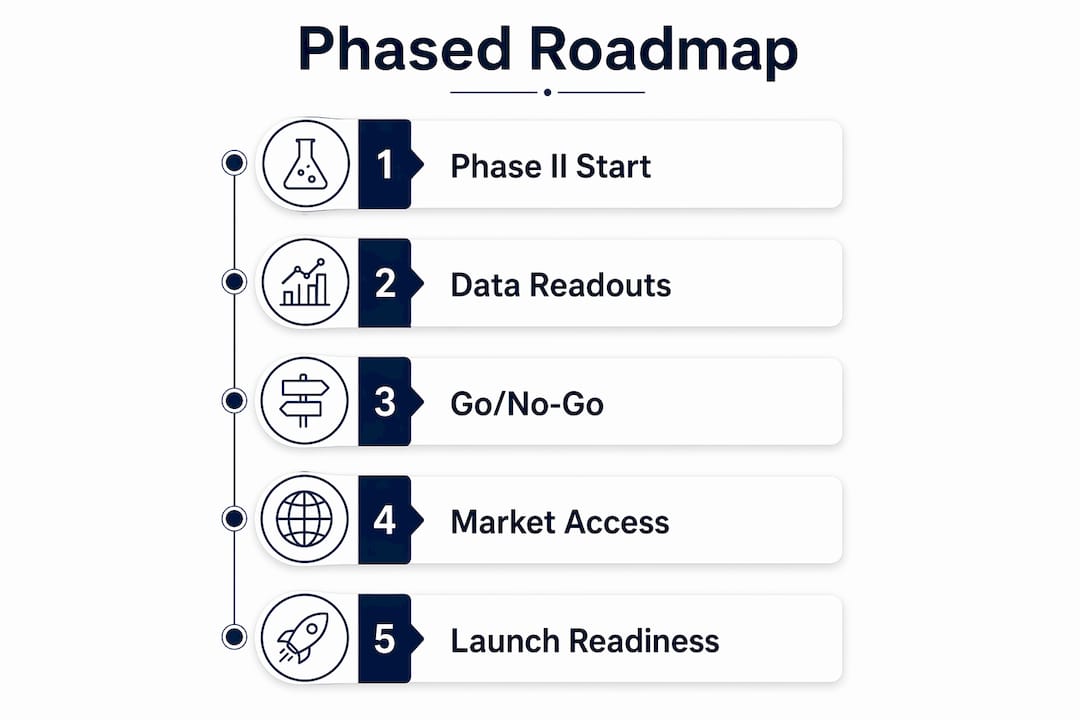
Phase 1: Commercial landscape mapping
This phase runs during Phase II trials and covers four core workstreams:
- Payer landscape analysis. Map formulary positioning, coverage criteria, and reimbursement pathways for your therapy area. Identify the top five payers by covered lives in your priority geography.
- Competitive positioning. Define your differentiated profile against current standard of care and late-stage pipeline assets. This is not a marketing exercise. It is a clinical and economic argument.
- KOL network development. KOL programs typically need 12–18 months to mature before launch. Start identifying, mapping, and engaging key opinion leaders during Phase II, not after Phase III results.
- HEOR evidence planning. Health economics and outcomes research must align with your clinical trial design. Endpoints that payers care about must be captured in the trial, not added post hoc.
Phase 2: Integrated strategic framework
| Workstream | Key deliverable | Timing before approval |
|---|---|---|
| Market access | Payer evidence dossier and contract strategy | 18+ months |
| Medical affairs | Publication plan and advisory board program | 18 months |
| Brand and commercial | Positioning platform and messaging hierarchy | 12 months |
| Regulatory | Label strategy and risk management plan | 12 months |
| Supply chain | Commercial manufacturing readiness | 9 months |
Market access planning must begin at least 18 months before approval to develop payer evidence and negotiate contracts. That timeline is not conservative. It reflects the actual negotiation cycles of major payers and pharmacy benefit managers.
Go/no-go decision gates should align with data readouts and funding events. If your Phase III interim analysis is scheduled for a specific quarter, your commercial investment decisions for that period should be contingent on that readout. Tying spending to data protects capital and keeps the plan credible with your board.
What operational steps drive launch readiness and execution?
Operational launch readiness is where most biotech commercialization strategies either hold together or fall apart. The plan looks right on paper, but execution requires parallel workstreams moving on precise timelines with clear ownership.
The critical operational steps are:
- Field team hiring and training. Recruit and onboard your sales and medical science liaison teams at least six months before launch. Training on clinical data, payer messaging, and compliance requirements takes longer than most teams budget for.
- Payer contracting. Finalize formulary agreements and patient support programs before approval, not after. Delays in reimbursement access directly reduce early adoption rates.
- Launch communications. Deploy brand messaging, medical education materials, and digital channels in a sequenced rollout. Physicians need to hear your clinical story before your sales team arrives.
- Supply chain and pharmacovigilance. Coordinating supply chain alongside regulatory compliance and pharmacovigilance systems is a launch requirement, not a post-launch cleanup task. Product availability on day one is non-negotiable.
- Early market feedback loops. Build a structured process to capture prescriber feedback, access barriers, and competitive responses in the first 90 days. Adapt messaging and support programs based on real data, not assumptions.
Pro Tip: Assign a single owner to each operational workstream and require a written risk log updated weekly in the 90 days before launch. Most launch failures trace back to a risk that was known but not escalated in time.
AI in regulatory affairs is accelerating the speed of submission drafting and label negotiation. Teams that integrate AI tools into regulatory operations reduce cycle times on document preparation and can redirect that capacity to payer evidence development.
What pitfalls most often derail biotech go-to-market success?
The most common failure in biotech commercialization is not a bad product. It is a good product with a plan that was built too late, too broadly, or too rigidly.
Biotech launch strategy is not simply marketing. It is a multi-year, integrated process starting well before approval and extending post-launch. Teams that treat launch as a post-approval event consistently underperform on adoption, revenue, and investor confidence in the first 12 months.
The specific pitfalls that appear most often are:
- Aspirational manufacturing timelines. Confirmed CDMO relationships correlate with higher fundraising success than late vendor evaluation. Firms still vetting contract manufacturers six months before a GMP campaign face both supply risk and investor credibility risk simultaneously.
- Late commercial team engagement. Bringing in commercial leadership at Phase III is too late to influence trial design, endpoint selection, or payer evidence strategy. The cost of fixing those gaps post-approval is measured in years, not months.
- Overreaching market scope. Targeting every geography and every patient segment at launch depletes resources and dilutes messaging. Focusing on a beachhead market where the clinical problem is clear and the value proposition is credible builds the repeatable processes that support expansion.
- Static strategy decks. Investors who fund Series B and beyond expect a dynamic plan that evolves with value inflection milestones. A deck that has not been updated since the last data readout signals operational immaturity.
- Enrollment delays and funding gaps. Oncology and cardiometabolic programs between Phase II and Phase III often cost $100M–$300M and are highly vulnerable to enrollment delays or unexpected subgroup signals. Build contingency timelines and maintain a 90-day cash runway buffer beyond your projected milestones.
Clinical trial enrollment delays are one of the most underestimated risks in biotech growth strategy. A six-week enrollment slip can push your data readout past a funding window and force a bridge round at unfavorable terms.
Key Takeaways
A biotech go-to-market roadmap succeeds when commercial planning starts at Phase II, milestones are reverse-engineered from the approval date, and every workstream has a named owner with a live risk log.
| Point | Details |
|---|---|
| Start commercial planning at Phase II | Waiting until Phase III costs you payer evidence time, KOL relationships, and investor confidence. |
| Reverse-engineer from approval date | Work backward from your target launch date to set clinical, regulatory, and commercial milestones. |
| Lock in CDMO relationships early | Confirmed manufacturing agreements improve fundraising outcomes and reduce supply risk before launch. |
| Focus on a beachhead market first | A narrow, credible initial target builds repeatable processes before you expand geographically. |
| Update the roadmap continuously | Investors expect a dynamic plan that reflects current data readouts and value inflection points. |
What I've learned from watching biotech launches succeed and fail
The pattern I see most often is not a science problem. It is a synchronization problem. A team with genuinely differentiated clinical data misses its launch window because the commercial and regulatory workstreams were never connected to the same timeline. The medical affairs team is publishing. The payer team is still building the evidence dossier. The field team is not yet hired. And the product is approved.
What changed the outcome in the cases I have watched go well was almost always the same thing: someone with authority sat down 30 months before the anticipated approval date and built a single integrated timeline. Not a PowerPoint. A working document with owners, dates, dependencies, and a weekly review cadence. That document became the operating system for the entire launch.
AI is changing what is possible in this process. Teams using AI augmentation for regulatory drafting, payer evidence synthesis, and clinical data analysis are compressing timelines that used to take quarters into weeks. The teams that benefit most are not the ones with the largest budgets. They are the ones that integrated AI into their workflow early enough to let it shape the plan, not just speed up the paperwork.
My strongest advice: treat your biotech commercialization strategy as a living system, not a deliverable. The moment it becomes a document you present rather than a plan you operate, it stops protecting you.
— John
How Haiphai supports your path from roadmap to launch
Building a go-to-market roadmap that holds up under investor scrutiny and clinical uncertainty requires more than a good template. It requires operational intelligence that connects your regulatory milestones, manufacturing commitments, and commercial workstreams in real time.
Haiphai works as an operational partner for biotech teams, starting from your strategic goals and identifying where your current process is losing time. The Haiphai solutions platform covers manufacturing risk assessment, CMC timeline tracking, and investor-ready documentation, all built around your specific program. Teams working with Haiphai have reclaimed up to 18 months of operational time on the path to approval. Explore Haiphai's services to see where your roadmap can move faster.
FAQ
What is a biotech go-to-market roadmap?
A biotech go-to-market roadmap is a timeline-aligned plan that connects clinical development, regulatory submission, payer access, and commercial launch into a single coordinated framework. It typically begins at Phase II and runs through post-launch market feedback.
When should commercial planning start in biotech?
Commercial planning should start at Phase II, not at NDA submission. Market access planning alone requires at least 18 months before approval to develop payer evidence and negotiate formulary contracts.
What is a beachhead market in biotech commercialization?
A beachhead market is the narrowest, most credible initial patient segment where your clinical value proposition is clearest. Focusing there first builds repeatable commercial processes before you expand to broader geographies or indications.
How does a biotech Series B readiness checklist differ from a go-to-market plan?
A Series B readiness checklist confirms that your operational and clinical infrastructure meets investor expectations at a specific funding stage. A go-to-market roadmap is the broader multi-year plan that the checklist validates at key milestones.
What role does AI play in biotech go-to-market execution?
AI accelerates regulatory drafting, payer evidence synthesis, and enrollment forecasting, compressing timelines that previously took quarters. Teams that integrate AI early into their commercial and regulatory workflows gain the most measurable time savings.