
Biotech timelines extend past projections because scientific uncertainty, regulatory requirements, and operational friction do not stack neatly. They compound. A program can have strong Phase I data, adequate funding, and a capable team, and still run two to four years behind its original schedule by the time it reaches approval. The 20-year end-to-end reality of drug development, described by René Kuijten at EQT Life Sciences as an engineering fact rather than a pessimistic estimate, catches sponsors and investors off guard precisely because early milestones move faster than the middle ones. Biology does not compress on demand.
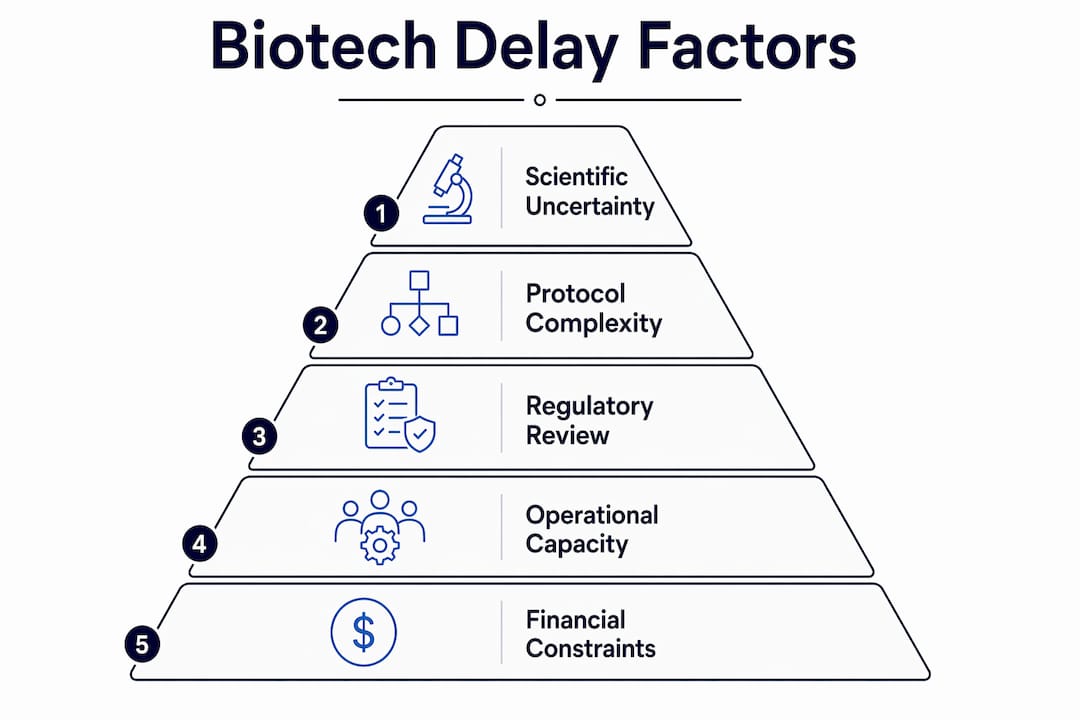
The core causes of extended development timelines fall into overlapping categories:
- Scientific complexity and irreducible uncertainty in validating targets and clinical results
- Regulatory review cycles, FDA manufacturing inspections, and late-stage data requests
- Protocol amendments that cascade into re-consent, IRB renegotiations, and data rework
- Trial site activation delays and patient recruitment shortfalls
- Chemistry, manufacturing, and controls (CMC) bottlenecks with no practical recovery window
- Funding cycle mismatches that pause capacity buildouts mid-construction
- External shocks including pandemics and geopolitical disruptions
Optimistic projections fail not because they misread the science, but because they assume these factors away. The following sections break down each one.
Why biotech timelines extend past projections: scientific and regulatory factors
The most common reason timelines drift is not a single regulatory hold-up. It is cumulative friction across scientific uncertainty, protocol complexity, operational drag, and manufacturing challenges, all arriving at once.
Biological complexity and the Phase II wall
Phase II is where most promising science dies. The Phase II transition success rate sits at 28.9% across all disease areas, the lowest of any clinical phase. When a program fails or requires redesign at this stage, the portfolio-level timeline estimate resets entirely. Sponsors who model phase transitions as independent events systematically underestimate how often a Phase II failure forces a restart that adds years, not months.
Only 7.9% of drug development programs that enter Phase I reach U.S. FDA approval. That attrition rate is not a regulatory failure. It reflects how much biological uncertainty remains unresolved even after years of preclinical work.
Protocol amendments and the IRB burden
Protocol amendments have become structurally embedded in modern trials. Since 2015, the share of protocols carrying at least one amendment has risen from 57% to 76%. Each amendment after first-patient-in triggers a renegotiation of the IRB package, informed consent form, site contract, training plan, and electronic data capture build. Sites absorb all of that labor. Sponsors rarely budget for it because the amendment was not anticipated when the original budget was written.
The Trial Complexity Score, derived from a machine learning analysis of over 16,000 trials, shows that a 10-percentage-point increase in complexity correlates with roughly 33–36% longer trial duration across all phases. Average complexity scores across all trials rose by more than 10 percentage points over the past decade.
FDA review and manufacturing inspections
The FDA issues Complete Response Letters (CRLs) when applications are deemed inadequate. Among 43 novel therapeutics with CRLs between 2020 and 2024, manufacturing deficiencies were the most common issue, cited in 65% of facility-related letters and 51% of CMC-related ones. Median time from CRL receipt to resubmission and approval was 1.28 years.
The Hengrui-Elevar rivoceranib and camrelizumab combination illustrates how manufacturing problems compound. The FDA rejected the combination three separate times over manufacturing deficiencies across multiple facilities, each rejection resetting the approval clock. Orca Bio's cell therapy Orca-T faced a similar dynamic: the FDA postponed its decision by three months after the company submitted additional CMC data late in the review cycle.
Pro Tip: Expedited regulatory pathways, including Breakthrough Therapy and Fast Track designations, primarily improve regulatory engagement. Cohort-level data from 2020–2024 shows they have not consistently shortened median development or approval durations. Treat them as communication tools, not schedule guarantees.
Operational challenges and capacity constraints driving biotech delays
Operational friction is where timeline projections most reliably fall apart. A program can clear scientific and regulatory hurdles and still lose 12 to 18 months to site activation delays, manufacturing bottlenecks, and funding gaps.

Site activation and enrollment velocity
Time-to-site activation shows a statistically significant positive correlation with total protocol complexity score, with a rho of 0.61 at the 75% activation threshold. That is not a weak signal. Protocol complexity is one of the strongest predictors of how long it takes to get a site running, stronger than most operational variables sponsors focus on during pre-activation. Sites working with local IRBs on complex oncology or CNS protocols routinely carry 60 to 90-day review cycles for full board submissions. When an enrollment plan assumes 45-day activation and the IRB cycle alone consumes 60 days, the math was wrong before the first patient inquiry arrived.
CMC and manufacturing bottlenecks
CMC timelines behave like minimum-duration pipelines. Once formulation or manufacturing starts late, there is no practical recovery before regulatory milestones. Stability programs and GMP slotting accumulate delays independently of other timeline elements. A late start in formulation development does not get absorbed by parallel workstreams. It pushes every downstream milestone.
Funding cycle mismatches
Capital providers require operational certainty before funding biomanufacturing facilities. Sponsors cannot provide operating-date certainty before operations are assured. That circular dependency is not theoretical. Liberation Bioindustries paused construction of a U.S. biomanufacturing facility at 75% completion while searching for additional funding. The facility was ready. The capital structure was not.
Pro Tip: Map your CMC start dates against your IND filing and Phase I activation targets before finalizing your development plan. A six-week slip in formulation development can translate to a six-month slip at the regulatory submission stage, with no recovery path in between. Haiphai's operational bottleneck analysis starts here.
Key biotech industry trends in 2025–2026 influencing development timelines
The structural forces driving timeline extensions are not easing. Several 2025–2026 trends are making the problem more acute.
Increasing protocol complexity. The average Trial Complexity Score across all phases has risen from the low-30s to the mid-40s over the past decade. Phase 2 and Phase 3 scores now sit in the low-to-mid 50s. A 10-point increase in that score correlates with trial durations varying three to fivefold within the same indication.
AI accelerating discovery but not clinical development. AI has compressed preclinical drug discovery meaningfully. Insilico Medicine used generative AI to identify a novel fibrosis target and advance a candidate to Phase II in roughly four years, a timeline that would have taken far longer by conventional methods. Recursion Pharmaceuticals and Exscientia have similarly used AI to shorten target identification and candidate selection. But the bottleneck has shifted from molecule identification to evidence generation. Widening the discovery pipeline fills the clinical development backup faster. It does not clear it.
Rare disease and complex population recruitment. Eligibility criteria written for clean populations that do not exist in the real world remain a persistent problem. Sites are overextended, patients are hard to identify, and sponsors regularly discover late in development that their trial population does not resemble the patients who will actually use the drug.
Regulatory environment and financing climate. FDA's Diversity Action Plan requirements, mandated under the Food and Drug Omnibus Reform Act signed in December 2022, have pushed sponsors to broaden eligibility criteria and build stratified enrollment targets into protocols. The intent is sound. The operational consequence is more complex screening logic, more extensive baseline assessments, and higher screen failure rates at sites that have not historically served those populations.
How AI and operational efficiency can reduce timeline overruns
AI has genuinely changed the front end of drug development. The question is whether those gains survive contact with clinical infrastructure.
"AI cannot compress Phase III trials. It cannot replace the 10,000-patient study that tells you whether a drug kills people at scale. Biological validation has irreducible time costs, and anyone selling you a 5-year drug development timeline is selling you something else entirely." — The Split, analyzing René Kuijten's framework at EQT Life Sciences
The practical opportunity lies in targeting the operational layers that sit between scientific readiness and regulatory submission. That means:
- Protocol design review before IRB submission, with a site operations lead checking visit schedules against actual clinic hours
- CMC start-date mapping against IND and Phase I activation targets
- AI-assisted regulatory drafting to reduce the cycle time between FDA feedback and resubmission
- Decentralized trial elements to redistribute procedural burden away from site visits
- Enrollment modeling grounded in real screen failure rates, not optimistic assumptions
Haiphai works from your strategic goals backward, identifying where operational drag is actually accumulating rather than applying generic software to the problem. The focus on AI in regulatory affairs and clinical site activation reflects where the evidence points: the bottleneck is evidentiary and operational, not computational. Teams that address patient recruitment gaps with AI-assisted matching and protocol simplification recover months that generic project management tools never touch.
Pro Tip: Before your next IND filing, run a protocol complexity audit against your site activation assumptions. The protocol complexity tax compounds downstream in ways that do not appear on a Gantt chart until enrollment is already behind.
How financial and investment cycles extend development timelines
Funding does not flow on scientific merit alone. Capital markets require operational certainty, and biotech programs rarely provide it cleanly. The result is a recurring pattern: a program reaches a milestone that should trigger the next financing round, but the round takes longer than projected, which delays the next operational phase, which pushes the next milestone, which delays the following round.
Investors evaluating biotech timelines often underweight the gap between scientific readiness and capital availability. A company can have Phase II data in hand and still wait six to twelve months for a financing round to close, during which manufacturing scale-up, site activation for Phase III, and regulatory preparation all slow or stop. That pause does not appear in the original development plan. It shows up in the actual timeline.
The Liberation Bioindustries situation, a facility paused at 75% completion, is an extreme version of a common dynamic. Most delays are quieter: a CMC program that cannot start because the next tranche has not closed, a Phase III that opens six months late because the Series C took longer than modeled. Investors who treat funding timelines as independent of development timelines will consistently underestimate total program duration.
How patient recruitment and retention challenges extend trial timelines
Enrollment is the most reliable source of timeline slippage that sponsors underestimate at the planning stage. A biotech company can have a promising mechanism, adequate funding, and a clean manufacturing plan, then still lose months because the right patients are hard to find, referral patterns are weak, or inclusion criteria are too narrow.
Rare disease, oncology, neurology, and immune-mediated conditions each bring specific recruitment problems. Sites routinely absorb two to three screen failures per enrolled patient on complex protocols. Across a 20-site network, those screen failures compound into budget shortfalls that trigger renegotiations six months into enrollment. Retention compounds the problem: a patient who drops out mid-trial does not just represent a lost data point. They represent a gap in the statistical model that may require additional enrollment to fill, extending the trial window.
The FDA's 2024 final guidance on decentralized clinical trial elements points toward one part of the answer: redistributing procedural burden through remote assessments, home health visits, and local lab options. Decentralized elements do not reduce protocol complexity, but they reduce the on-site coordination load, which is where retention failures most often originate.
How data quality issues and repeated analyses add months to timelines
Dirty data is a timeline problem, not just a quality problem. When a protocol asks for too much, sites struggle, patients drop, monitors chase deviations, and databases accumulate errors that require remediation before any analysis can run. The amount of data collected in late-stage trials has increased sharply over the past decade, and not all of it is essential to the primary scientific question.
A database lock that should take four weeks takes twelve when query resolution backlogs are deep. A statistical analysis plan that assumed clean data requires reanalysis when the data is not clean. Each iteration adds weeks. Across a Phase III program, repeated analyses triggered by data quality issues can add three to six months to the submission timeline, none of which appeared in the original project plan.
Sponsors who invest in reducing protocol deviations at the design stage, rather than chasing them during monitoring, recover that time at the back end. The fix is earlier and cheaper than the remediation.
How adverse events and safety monitoring delays affect approval timelines
An unexpected adverse event does not just pause enrollment. It triggers a cascade: safety monitoring committee review, potential protocol amendment, FDA notification, possible clinical hold, and in some cases a full program redesign. Each step has its own timeline, and none of them run in parallel with the original development schedule.
The FDA's requirement for updated safety analyses appeared in 98% of Complete Response Letters issued between 2020 and 2024. That figure reflects how often safety data packages are incomplete or require additional follow-up at the time of submission. A safety signal that emerges late in a Phase III trial can add a year or more to the approval timeline, even when the signal ultimately does not change the risk-benefit assessment.
Programs in oncology and cell therapy face particular exposure here. Complex mechanisms of action generate complex safety profiles, and regulators require time to evaluate them thoroughly. Orca Bio's three-month FDA delay for additional CMC and safety data is a contained example of a dynamic that, in more serious cases, extends to multi-year holds.
How pandemics and geopolitical events disrupt biotech timelines
COVID-19 demonstrated that external shocks can simultaneously disrupt every layer of a development program. Clinical sites closed or reduced capacity. Patient enrollment stopped. Supply chains for raw materials and drug substance fractured. FDA inspectors could not travel to manufacturing facilities, which directly caused CRL issuances for programs that were otherwise ready for approval. The Hengrui-Elevar rivoceranib CRL in 2024 was partly triggered by the FDA's inability to complete clinical inspections amid travel restrictions.
Geopolitical events create similar, if slower-moving, disruptions. Trade restrictions affect API sourcing. Regulatory harmonization between the U.S. and international markets becomes harder when political relationships deteriorate. Programs that rely on manufacturing sites in geopolitically sensitive regions carry timeline risk that does not appear in a standard risk register.
The lesson is not to avoid international development. It is to build contingency into CMC and site activation plans for scenarios that project plans routinely exclude.
Key Takeaways
Biotech timelines extend past projections because scientific, regulatory, operational, and financial frictions compound across every development phase, making optimistic single-point estimates structurally unreliable.
| Point | Details |
|---|---|
| Phase II is the primary failure point | Phase II programs advance at a substantially lower rate than other phases, forcing restarts that add years to portfolio timelines. |
| Protocol complexity drives activation delays | A 10-point rise in Trial Complexity Score correlates with 33–36% longer trial duration across all phases. |
| Manufacturing deficiencies dominate CRLs | 65% of CRLs issued 2020–2024 cited facility deficiencies; median time to resubmission and approval was 1.28 years. |
| Expedited pathways do not guarantee speed | Cohort-level data shows no consistent reduction in median development duration for expedited programs. |
| AI compresses discovery, not clinical development | The bottleneck has shifted from molecule identification to evidence generation and clinical infrastructure. |
FAQ
How long does biotech drug development typically take?
On average, it takes 10.5 years for a Phase I asset to progress to regulatory approval, and the full path from discovery through market entry often runs longer when pre-IND work and post-approval planning are included.
Will biotech rebound in 2026?
The sector continues to produce meaningful approvals and new modalities, but the structural bottlenecks in clinical development infrastructure, evidence generation, and manufacturing have not resolved. AI-driven discovery is expanding the pipeline of candidates heading toward IND filings, which increases pressure on an already strained clinical development system.
Why is biotech struggling despite AI advances?
AI has compressed preclinical discovery but has not materially shortened clinical trial durations or regulatory review timelines. The bottleneck has shifted to evidence generation: assembling regulatory-grade, causally defensible data packages that the FDA requires before approval, a process that remains slow, institutional, and difficult to accelerate computationally.
What is the biggest single cause of biotech timeline extensions?
There is no single cause. Timeline extensions result from cumulative friction across scientific uncertainty, protocol complexity, operational drag, and manufacturing challenges stacking on top of one another. Programs that slow down long before a regulator says no typically do so because the target biology is messy, the patient population is hard to reach, or the trial design asks too much of sites and participants.
How can biotech teams reduce timeline overruns?
The highest-leverage interventions happen early: protocol complexity audits before IRB submission, CMC start-date mapping against IND targets, and AI-assisted regulatory drafting to shorten resubmission cycles. Haiphai's approach starts from your approval target and works backward to identify where operational drag is actually accumulating, rather than applying generic tools to a generic problem. Teams working with Haiphai's sector-specific solutions have reclaimed up to 18 months of operational time on the path to approval.