
The fastest way to cut contract cycle time is to combine standardized templates and playbooks, targeted automation in a CLM system, disciplined negotiation guardrails, and consistent measurement against a baseline. Organizations using automated agreement workflows report an average of 36% efficiency gains and legal teams report 37% time savings on agreement tasks. Pick one high-volume contract type and run a 60 to 90 day pilot before rolling changes out further.
TL;DR:
- WorldCC’s 2023 benchmark puts medium complexity contracts at 11.6 weeks domestically and 13.7 weeks internationally, giving teams a reference for setting realistic targets.
- Track median cycle time by contract type, time in each stage, touch time, and handoff delays; overall averages can conceal the actual bottleneck.
- Choose a high volume, low complexity contract with committed stakeholders; rare or heavily customized agreements will not produce enough evidence during a short pilot.
- A CLM platform should connect to CRM and e signature systems, report by contract type and stage, and retain audit trails for automated decisions.
- In biotech, delays often stem from missing clinical data or unclear handoffs among legal, clinical, regulatory, and finance teams, rather than legal review alone.
Table of Contents
- Build a prioritized toolkit: templates, clause libraries, and routing rules
- How to measure contract cycle time: formulas, benchmarks, and dashboards
- Step-by-step implementation playbook: prioritize, pilot, govern, scale
- When automation and CLM software actually reduce cycle time
- HaiPhai applied: an operational-partnership example for high-complexity regulated workflows
- Bottlenecks unique to the biotech contract lifecycle
- The role of AI-driven diagnostics in finding hidden inefficiencies
- Getting clinical, regulatory, and executive teams moving together
- Embedding institutional knowledge into contract workflows
- Governance models that protect compliance while speeding approvals
- What results look like when cycle time improves in biotech settings
- Sustaining speed with governance: balance and trade-offs
- Start an AI Velocity Diagnostic to find your own cycle time bottlenecks
- FAQ
- Sources
Build a prioritized toolkit: templates, clause libraries, and routing rules
Most delay in a contract lifecycle comes from repetition, not complexity. The same clauses get rewritten, the same redlines get argued, and the same approvals get requested over email long after the terms are settled. A prioritized toolkit removes that repetition at each stage.
Self-service templates let requesters generate a compliant first draft without waiting for a lawyer to start from scratch, which compresses the request-to-draft stage dramatically. Clause libraries with pre-approved, fallback, and "walk away" language give negotiators a reference point instead of a blank page, which shortens back-and-forth on terms that rarely change deal economics. Pre-approved deal terms paired with tiered approval thresholds mean only genuinely unusual contracts reach a senior reviewer, cutting the approval loops that stall routine deals. Clear routing rules and service-level agreements at intake remove the administrative lag of contracts sitting in someone's inbox waiting to be noticed.
- Self-service templates cut the time between request and first draft by removing the lawyer as a bottleneck for routine language.
- Clause libraries with pre-approved fallback positions reduce the number of negotiation rounds on standard terms.
- Tiered approval thresholds route low-risk contracts around senior reviewers entirely.
- Intake SLAs and routing rules prevent contracts from sitting unassigned between stages.
None of this works if sales and legal disagree about what counts as a guardrail. Getting that alignment in writing before a pilot starts avoids the most common cause of playbook failure: reps who negotiate around the playbook because no one told them it existed.
Pro Tip: Get sales and legal to co-sign the playbook's guardrails before launch, not after the first dispute over a redline.
Pro Tip: Set a hard escalation rule, such as any contract stuck more than 48 hours in one stage automatically flags a manager, so delays surface before they become patterns.
How to measure contract cycle time: formulas, benchmarks, and dashboards
You cannot shorten what you have not defined. Cycle time is the total elapsed time from contract request to full execution. Time-in-stage measures how long a contract sits in a single phase, such as redline review or final approval. Touch time is the actual work time spent on a contract, excluding idle waiting. Handoff delay is the gap between one party finishing their part and the next party starting theirs, often the single largest hidden cost in a slow process.
The core formula is simple: cycle time equals the sum of time-in-stage across every stage a contract passes through, plus all handoff delays between them. Calculating this by contract type, rather than as a single company-wide average, exposes which category is actually dragging down your numbers.
Benchmark data from WorldCC's 2023 survey found average cycle times for medium-complexity domestic and international contracts spanning multiple weeks, a useful reference point for setting realistic targets rather than arbitrary ones.
Track these on a recurring dashboard:
- Median cycle time by contract type, since averages get skewed by a handful of outliers.
- Time-in-stage for each phase, to pinpoint where contracts actually stall.
- Touch time versus total elapsed time, which reveals how much delay is waiting rather than working.
- Volume and win rate by stage, to confirm speed gains are not costing you deal quality.
Many legal operations teams aim for a 20 to 40 percent cycle time improvement in the first year of a structured effort, a range consistent with the efficiency gains reported in Deloitte's 2026 AI CLM study.
Step-by-step implementation playbook: prioritize, pilot, govern, scale
Pick a pilot target with three filters: high volume, low-to-medium complexity, and clear stakeholder buy-in. A contract type that is rare or highly customized will not generate enough data points to prove anything in 90 days, and a type with reluctant stakeholders will stall regardless of the tooling.
Set the pilot scope narrowly. Define a baseline cycle time, a target improvement, and a rough return on investment before you touch the process, so success is measurable rather than anecdotal.
Governance has to exist from day one, not get added after speed creates a problem. That means a documented approval matrix, a RACI chart showing who owns each stage, and training so the people running the new process actually understand why the guardrails exist.
- Select one high-volume, low-complexity contract type and confirm stakeholder agreement.
- Document the current baseline: median cycle time, time-in-stage, and handoff delays.
- Set a target improvement and a 60 to 90 day timeline.
- Build or update templates, clause libraries, and approval thresholds for that contract type.
- Assign a RACI owner for each stage and train the team on the new workflow.
- Run the pilot, track the dashboard weekly, and log exceptions.
- Compare results to baseline, refine the playbook, and expand to an adjacent contract type.
Pro Tip: Resist the urge to pilot your most painful contract type first. Prove the model on something simple, then apply the credibility to the harder problem.
When automation and CLM software actually reduce cycle time

Automation does not speed up judgment calls, but it removes nearly all the friction around them. The activities that compress most reliably are routing a document to the right reviewer, inserting approved clause language automatically, comparing redlines against a prior version, and triggering approvals once pre-set conditions are met.
Before buying or expanding a CLM platform, require that it integrates with the systems your team already lives in, particularly your CRM and e-signature tool, since a disconnected system just creates a new manual step. Reporting and dashboards need to break numbers down by contract type and stage, not just show a single average. Role-based workflows should route contracts automatically based on value, risk, or counterparty type. Auditability matters as much as speed: every automated decision needs a visible trail for compliance review.
- Automation compresses routing, clause insertion, redline comparison, and conditional approvals most reliably.
- Integrations with CRM and e-signature tools prevent the CLM from becoming an isolated extra step.
- Role-based, auditable workflows let you scale approvals without losing a compliance record.
- Clean, consistent contract taxonomy and metadata are what make any of the resulting metrics trustworthy.
Deloitte and DocuSign's 2026 study found legal teams reported 37% time savings on agreement management activities, alongside 36% cost avoidance and 29% cost savings from reduced labor, gains tied to automation paired with standardized language rather than automation alone. Scope a pilot narrowly: pick one workflow, measure before-and-after time-in-stage, and bring in the people who will actually use the tool before you finalize procurement criteria.
HaiPhai applied: an operational-partnership example for high-complexity regulated workflows
Buying CLM software and embedding an operational partner solve different problems. Software gives you a system of record. An embedded partner redesigns the workflow around your specific regulatory and scientific requirements, then stays to govern how it runs.
For biotech teams, that distinction shows up most clearly in regulatory drafting, parallel approval routing, and governed automation, the areas where generic templates break down because every submission depends on prior scientific and clinical context. We focus on backtracking from a company's strategic approval timeline to find exactly where that context gets lost between teams.
Some clients have reported reclaiming significant operational time on their path to approval through embedded, AI-enabled workflow redesign.
That claim reflects our own reported outcomes in client engagements, not a universal benchmark, and it illustrates why embedded expertise matters more as complexity rises.
- Workflow redesign targets regulatory drafting, parallel approvals, and governed automation specifically.
- Governance and adoption are built in from the start, not added after a tool is deployed.
- Our biotech workflow playbook shows how governed AI gets embedded into regulated processes without losing audit control.
Bottlenecks unique to the biotech contract lifecycle
Biotech contracts rarely move at the speed of a standard commercial agreement because they depend on inputs that commercial contracts do not have: clinical trial data readiness, regulatory precedent, and scientific sign-off from people whose primary job is not contracting. A clinical trial agreement, for instance, often cannot finalize budget and indemnification terms until a protocol amendment clears internal review, creating a dependency chain that a generic playbook will not anticipate.
Site activation agreements stall for a related reason: legal, clinical operations, and finance each hold a piece of the approval, and none of them owns the handoff between the others. Material transfer agreements and licensing contracts introduce another layer, since intellectual property terms frequently require input from scientific leadership who are not part of the standard contract routing.
The result is that biotech contracts accumulate handoff delay, not just review time. A contract can sit "in progress" for weeks while it waits for a scientist to confirm a data point that has nothing to do with the legal language itself. Identifying where those handoffs actually occur, rather than assuming the bottleneck is legal review, is the step most teams skip, and it is usually where the largest time savings are hiding.
The role of AI-driven diagnostics in finding hidden inefficiencies
Standard process maps tend to show how a contract is supposed to move, not how it actually moves. AI-driven diagnostics work differently: they analyze historical contract data, timestamps, and handoff patterns to show where documents actually sit idle, which stakeholders cause the longest delays, and which contract types deviate most from their intended path.
That distinction matters because the fix for a bottleneck caused by missing clinical data looks nothing like the fix for one caused by an overloaded legal reviewer, and a generic playbook applied to the wrong root cause wastes the pilot. Diagnostics that surface the actual pattern, rather than the assumed one, let a team customize the workflow redesign instead of applying a one-size-fits-all template.

This is the starting point of how we approach a new engagement: mapping the strategic approval goal, then working backward through the data to find exactly where time is lost, before recommending any automation or process change. The diagnostic step determines what gets built, rather than fitting the client into a pre-set solution.
Getting clinical, regulatory, and executive teams moving together
A contract rarely sits with one function for its entire lifecycle. A clinical trial agreement touches clinical operations for scope, regulatory for compliance language, finance for budget terms, and an executive for final sign-off, and each handoff between those groups is a place where a document can sit untouched for days.
Speeding up contract processing in this setting is less about any single team working faster and more about making the handoffs between teams explicit. That means a shared view of where a contract currently sits, a single owner accountable for moving it to the next stage, and approval thresholds that let routine terms skip a layer of review entirely when risk is low.
Cross-functional speed also depends on including regulatory and clinical stakeholders in the design of the workflow itself, not just the legal team. A process built by legal alone tends to optimize for legal review time while leaving the regulatory and clinical handoffs just as slow as before. Embedding representatives from each function in the initial pilot design, and giving them visibility into the same dashboard, keeps the whole chain accountable to the same timeline instead of three separate ones.
Embedding institutional knowledge into contract workflows
Every organization has a handful of people who know why a particular clause exists, which counterparties always push back on indemnification, and which precedent applies to an unusual deal structure. When that knowledge lives only in someone's memory, cycle time becomes dependent on that person's availability, and it disappears the moment they leave.
Capturing this knowledge starts with turning recurring decisions into documented playbook entries rather than one-off emails. Every time a negotiator makes a judgment call on a non-standard term, that decision and its reasoning belong in the clause library, not just in the final signed document. Precedent databases that tag past contracts by counterparty, deal type, and negotiated outcome let a new team member find the answer to "how have we handled this before" without interrupting a senior colleague.
Governed automation can reinforce this by surfacing the right precedent automatically when a similar clause comes up again, rather than relying on someone remembering to check. The goal is a workflow where institutional knowledge is structurally part of the process, searchable and applied consistently, instead of an asset that walks out the door with any one employee.
Governance models that protect compliance while speeding approvals
Speed and compliance are often framed as opposites, but the organizations that sustain faster cycle times long-term are the ones that build governance into the speed itself rather than treating it as a brake. A tiered approval matrix is the clearest example: it does not remove oversight, it applies oversight proportionally, so a standard renewal gets a light check while a novel licensing deal still gets full scrutiny.
Audit trails are the second pillar. Every automated routing decision, clause substitution, and approval needs a visible record showing who approved what and when, both for internal compliance and for regulatory review in a biotech context specifically. Our governed AI guidance covers why no automation tool is compliant on its own, and why the governance layer around it is what actually determines whether speed is safe.
The third pillar is a defined exception path: a documented process for when a contract needs to break from standard terms, so deviations get handled deliberately rather than through an ad-hoc email chain that leaves no record at all. Governance structured this way becomes the thing that lets a team move faster with confidence, not the thing slowing them down.
What results look like when cycle time improves in biotech settings
The clearest evidence of improvement in a biotech contracting process shows up as a shrinking gap between baseline and post-pilot cycle time for a specific contract type, measured against the same dashboard used to set the original target. A clinical trial agreement that previously spent several weeks waiting on cross-functional sign-off, for example, moves faster once the handoff between clinical operations and legal has an explicit owner and a tiered approval path.
Operational improvements tend to compound. Once a site activation agreement process is redesigned with clear routing and pre-approved budget language, the same structure often applies directly to a related contract type, such as a material transfer agreement, without starting the redesign from scratch. That is the practical argument for piloting narrowly first: a validated playbook for one contract type becomes the template for the next, rather than a one-time fix.
For biotech specifically, faster contract cycles connect directly to the broader approval timeline, since a delayed clinical trial agreement or site activation contract pushes back the trial itself. Reclaiming operational time earlier in the process, before a trial even begins, is often where the largest cumulative time savings show up by the time a company reaches regulatory submission.
Sustaining speed with governance: balance and trade-offs
Speed without governance is a liability wearing the costume of a win. A team that shaves weeks off cycle time by skipping review steps will eventually sign something it regrets, and the cleanup costs more time than the shortcut ever saved. The organizations that keep their gains are the ones that treat governance as part of the speed, not a tax on it.
The harder, less glamorous work is getting legal operations and sales to agree on where the guardrails sit before a dispute forces the conversation. That alignment, not the software, is usually what determines whether a faster process survives its first hard negotiation.
Start with one contract type, measure honestly, and keep the audit trail intact even when it feels like friction. That discipline is what separates a durable improvement from a temporary sprint.
— John
Start an AI Velocity Diagnostic to find your own cycle time bottlenecks
If the bottlenecks above sound familiar, the fastest path forward is not another template library. Our AI Velocity Diagnostic maps your specific workflow, from clinical and regulatory operations through executive sign-off, and identifies exactly where contracts and related approvals are losing time before recommending any fix.
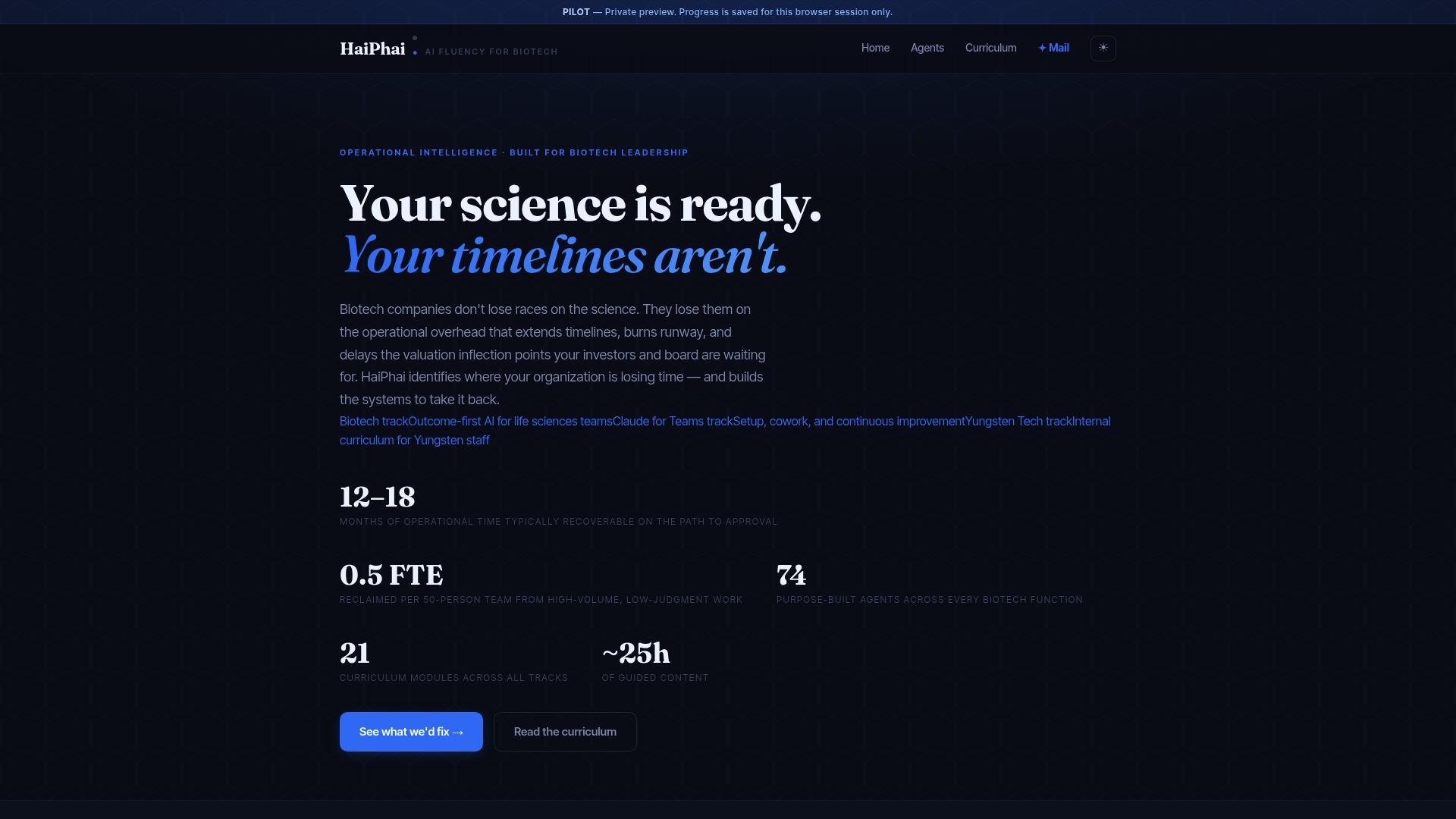
From there, we design a tailored workflow redesign, typically starting with governed automation around the highest-friction handoffs, and stay embedded to train your team and monitor results against the baseline we set together. This looks less like buying a license and more like gaining an operational partner who already understands biotech timelines.
- Diagnostic mapping of where contracts and related approvals currently stall.
- A tailored roadmap for governed automation and workflow redesign.
- Embedded support through adoption, not just a handoff after implementation.
See what our operating partnership looks like for a team at your stage, or explore our solutions built specifically for clinical, regulatory, and executive operations.
FAQ
What does cycle time reduction mean?
Cycle time reduction means shortening the total elapsed time it takes a contract, or any repeatable process, to move from start to completion. In contracting specifically, it covers every stage from initial request through drafting, negotiation, approval, and signature.
What is contract cycle time?
Contract cycle time is the total elapsed time from when a contract is requested to when it is fully executed by all parties. WorldCC's 2023 benchmark found average cycle times of 11.6 weeks for medium-complexity domestic contracts and 13.7 weeks for international contracts.
What are examples of CLM tools?
Contract lifecycle management tools typically include features for template generation, clause libraries, automated routing and approvals, redline comparison, and e-signature integration. The right feature set depends on contract volume and complexity, so a specific tool choice should follow a diagnostic of where your own process actually stalls rather than a generic feature checklist.
How do you reduce cycle time?
The most reliable approach combines standardized templates and clause libraries, tiered approval thresholds, targeted automation for routing and clause insertion, and consistent measurement against a baseline. Deloitte and DocuSign's 2026 study found organizations using automated agreement workflows reported an average of 36% efficiency gains, a result tied to pairing automation with standardized processes rather than deploying automation alone.
Sources
- Navigating the fog of uncertainty — World Commerce & Contracting
- AI contract lifecycle management: Capitalizing on AI — Deloitte US