
Compressing site activation and regulatory drafting requires redesigning roles and handoffs first, then applying AI where it removes repetitive work. Done together, this kind of clinical workflow redesign can reclaim substantial operational time. HaiPhai's engagements, for example, have helped clients reclaim up to 18 months on the path to approval. The next move for any executive reading this: run a focused diagnostic on where your activation and drafting timelines are actually leaking time.
TL;DR:
- Most site activation delays stem from sequential contract, IRB, and documentation processes, which can be shortened by parallelizing work streams.
- Reshaping roles and handoffs before or during AI adoption leads to significantly better outcomes than simply adding new tools without operational change.
- AI tools can reduce regulatory draft preparation time by up to 97 percent, but human review is still essential for submission readiness and compliance.
- Integrating AI with existing clinical systems through structured data ingestion is crucial to prevent data duplication and maintain audit trails.
- Conducting a focused diagnostic on one program and redesigning workflows before scalability helps prevent governance gaps and sustains speed gains.
Table of Contents
- Why Clinical Workflow Redesign Matters Now
- A 5-Step Operating-Model Framework for Redesigning Clinical Workflow
- How Do You Compress Site Activation Timelines?
- How Does AI Accelerate Regulatory Drafting?
- Making the Gains Durable: Governance and Change Management
- Connecting AI Tools to Existing Clinical Systems
- What Compliance and Risk Issues Come With AI in Clinical Workflows
- Training Clinical Teams for AI-Assisted Workflows
- What Do Successful Clinical Workflow Redesigns Look Like?
- HaiPhai's Approach to Executing Clinical Workflow Redesign
- An Executive's Take on What Actually Moves the Needle
- Sources
- FAQ
Why Clinical Workflow Redesign Matters Now
Trial start-up has gotten slower, not faster, even as sponsors add more software to the process. A recent ICON survey found that 55% of respondents report site selection to full activation taking longer than five months, with contract and budget negotiation cited repeatedly as the top bottleneck. That is not a technology gap. It is an operational one.
Statistic Callout: Administrative work, mostly contract negotiation, frequently consumes 30 to 40% of total site activation time — meaning a five-month activation window can lose two months to paperwork alone.
BioPharm International calls this the clinical execution gap: the space between well-designed science and operational friction that stalls it at the site level. The gap shows up in three recurring places:
- Contract and budget cycles that run sequentially instead of in parallel with IRB submission
- Document collection processes that depend on manual chasing rather than structured intake
- Regulatory drafting that starts from a blank page instead of a governed template
On the regulatory side, large language model tools have shown they can cut first-draft preparation time dramatically, though the output still needs expert hands before it is submission-ready. That distinction, drafting speed versus submission readiness, is the whole game in the next two sections.
A 5-Step Operating-Model Framework for Redesigning Clinical Workflow
Most sponsors try to fix activation and drafting delays by buying another tool. That rarely works on its own. Bain's research on clinical trials found that only 16% of sponsors and CROs are actually reshaping roles and workflows around AI, even though 65% are piloting it somewhere. The organizations reshaping workflow, not just adding software, report meaningfully better outcomes.
Here is a five-step sequence that works for most clinical development programs, regardless of therapeutic area:
- Diagnose. Map the end-to-end timeline from protocol finalization to first patient in, and mark every handoff. Contracts, IRB submission, and data ingestion are almost always where time pools up.
- Prioritize. Pick two or three workstreams with the highest leverage. For most programs, that means site activation and regulatory drafting, since both sit on the program's critical path.
- Redesign roles and handoffs. Bring medical and commercial functions into planning earlier instead of treating activation as a downstream administrative task. Create a dedicated activation owner who runs contracting, IRB, and document collection at the same time instead of one after another.
- Apply AI where it removes repetitive work. First drafts, consistency checks across documents, and structured data ingestion are the highest-value targets, not judgment calls that require clinical expertise.
- Govern and iterate. Set KPIs, document AI use for audit purposes, and build quality gates before scaling a pilot across more sites or more documents.
- Bottlenecks hide in handoffs, not in individual tasks
- Role redesign has to happen before or alongside AI adoption, not after
- Governance is not a compliance afterthought. It is what makes the speed gains defensible later
Pro Tip: Run the diagnostic on one active program before touching a second. A framework that works cleanly on paper often reveals a different bottleneck once it meets real site contracts and a real IRB calendar.
How Do You Compress Site Activation Timelines?
Site activation compresses when you stop running it as a single-file relay race and start it as parallel work with a dedicated owner. The mechanisms are well documented, and none of them require exotic technology.
Start with site selection, not activation. Over-select relative to your enrollment target, since some attrition is expected, and build readiness checks into the selection process itself: staffing capacity, prior activation speed, IRB relationship, and contracting history. Sites that stall tend to show warning signs before the contract is even signed.
Then parallelize everything that can run at once. Begin contract negotiation, IRB submission, and document collection simultaneously rather than sequentially. Use a central IRB where the study design allows it. Pre-populate contract templates with your standard terms so negotiation starts from 80% agreement instead of zero.
- Pre-negotiated budget and contract language templates
- Central IRB submission where regulatory pathway permits
- A single named activation owner per site with clear escalation authority
- Recruitment launch timed to match activation, not bolted on afterward
Invest in the boring operational layer. Dedicated activation project management and firm escalation service-level agreements matter more than most sponsors expect. Industry analyses show that parallel processing and central IRB adoption can cut activation time by 30 to 50% per site in well-managed programs. That range depends heavily on how disciplined the parallelization actually is, not just whether it is attempted.
Pro Tip: Track "days from contract execution to first patient screened" as a separate metric from overall activation time. It isolates whether your bottleneck is legal, regulatory, or operational readiness at the site.
Human-centered engagement matters too. Sites that feel supported, rather than chased for paperwork, respond faster and drop out less. ICON's industry commentary points squarely at reducing administrative burden on sites as the highest-leverage lever sponsors control directly.
How Does AI Accelerate Regulatory Drafting?
AI earns its place in regulatory drafting on narrow, high-volume tasks: first drafts of Module 2 narratives, variation letters, cross-document consistency checks, and gap analysis against submission requirements. These are exactly the tasks where a model can produce a usable starting point fast, and where a human reviewer's time is best spent refining rather than originating.
A published study on the AutoIND framework found that AI reduced initial IND drafting time from roughly 100 hours to about 3.7 hours for certain sections, a reduction of around 97%. That number sounds almost too good, and the same study is clear about why it isn't the whole story: quality scoring showed the drafts still needed human refinement for emphasis and concision before they were submission-ready.
A workable pipeline follows five steps:
- Ingest and extract source data and prior submissions into a structured format the model can work from.
- Draft the first version using templates that enforce structure and terminology consistency.
- Refine and review with an accountable human expert, focused specifically on emphasis, concision, and scientific framing.
- Verify and trace every claim back to source data, maintaining an audit trail of what the AI generated versus what a human edited.
- Publish and monitor the final document, feeding lessons back into the templates for the next cycle.
Statistic Callout: Enterprise regulatory authoring platforms report 50 to 60% reductions in author time when AI drafting is embedded inside a governed, template-enforced workflow rather than used as a standalone tool.
The guardrails matter as much as the speed. Unpublished or regulated data belongs in a validated environment, not a general-purpose chat tool. Completeness scoring and template enforcement catch what a tired reviewer might miss on a Friday afternoon. Treat any drafting time reduction claim, including the 97% figure above, as a first-draft metric, not a submission-readiness guarantee.
Making the Gains Durable: Governance and Change Management
Speed gains from clinical workflow redesign disappear fast without a governance structure to hold them. The model that tends to work assigns three roles: admins who own templates and access controls, composers who configure AI outputs for specific document types, and writers and reviewers who remain accountable for what actually gets submitted or filed.
Five metrics are worth tracking on a monthly cadence during a redesign rollout:
- Activation lead time, from site selection to first patient screened
- First-draft hours per regulatory document type
- Number of review cycles before final sign-off
- Site attrition rate post-selection
- Completeness of AI-use audit trails per document
Pro Tip: Document AI use inside your existing quality system from day one, not retroactively. Auditors and regulators respond far better to a workflow that was designed for traceability than one patched together after the fact.
Change management is the part sponsors most often shortcut. Pilot on one program before scaling, train the people doing the work rather than just the people approving the budget, and keep the audit-ready records that make a future inspection a non-event instead of a scramble.
Connecting AI Tools to Existing Clinical Systems
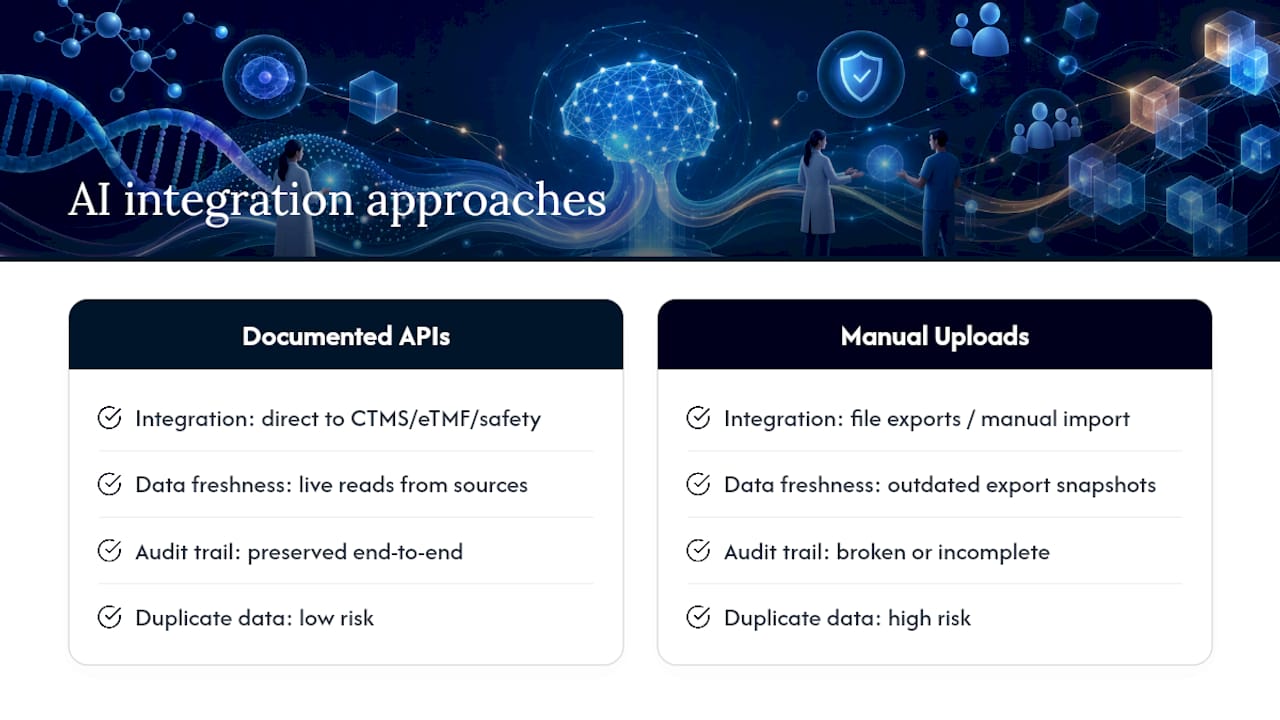
Redesigned workflows only work if the AI layer talks to the systems your teams already trust. That means integration with your clinical trial management system, electronic trial master file, and regulatory information management platform, not a parallel tool that creates a second source of truth.
The practical failure mode here is data duplication. A drafting tool that pulls from an outdated export of your safety database will produce a confident, well-formatted, wrong first draft. Structured data ingestion, where the AI tool reads directly from your CTMS or document management system rather than from manually uploaded files, closes that gap and keeps the audit trail intact.
Site activation tools face a similar test. If your activation tracker cannot pull contract status, IRB submission dates, and document collection progress from the systems your CRA teams update daily, you have built a dashboard nobody trusts, which means nobody updates it, which means the dashboard becomes useless within a quarter.
The fix is architectural, not aspirational: prioritize AI tools with documented application programming interfaces to your existing eTMF, CTMS, and safety systems over standalone platforms that require parallel data entry. A structured authoring approach tends to integrate more cleanly than a generic writing assistant precisely because it is built around your document templates and data structure rather than a blank text box.
What Compliance and Risk Issues Come With AI in Clinical Workflows
The core risk in AI-driven clinical workflows is not the AI making an obviously wrong claim. It is a subtly wrong claim that reads fluently enough to pass a distracted review. That risk profile changes how you build guardrails.
Traceability is the first requirement. Every AI-generated draft needs a record of what data it pulled from, what prompt or template generated it, and who reviewed and changed what. Without that record, you cannot answer a regulator's question about how a submission was produced, and you cannot defend the document if a discrepancy surfaces later.
Data handling comes second. Regulated or unpublished clinical data belongs in a validated, access-controlled environment. Feeding proprietary trial data into a general-purpose consumer AI tool is a data governance failure waiting to be discovered during an audit, not a shortcut worth the risk.
Human accountability is the third piece, and it cannot be delegated to the model. Someone with clinical or regulatory expertise has to sign off on every AI-assisted document, and that person's review has to be substantive, not a rubber stamp on a polished-looking draft. AI governance platforms that build completeness scoring and template enforcement into the workflow help make that review faster without making it superficial.
Training Clinical Teams for AI-Assisted Workflows
Rolling out AI tools without training the people using them wastes most of the time savings. Teams that don't understand what the model is good at tend to either over-trust it, letting unreviewed claims slip through, or under-trust it, rewriting drafts from scratch and canceling out the speed gain entirely.
Effective training splits into two tracks. Reviewers need to understand where AI drafting systematically underperforms, typically emphasis, concision, and scientific framing, so they know exactly where to focus their attention instead of re-reading every line with equal scrutiny. Composers and template owners need enough technical fluency to configure outputs for specific document types without needing a data science background.
The pilot-to-scale path matters more than the training content itself. Run the new workflow on one program with a small team first. Let that team surface the failure modes specific to your organization's documents and site relationships, then build those lessons into training material before rolling it out to a second or third program. A rollout that skips the pilot almost always relearns the same lessons the hard way, just with more people and more documents in flight.
What Do Successful Clinical Workflow Redesigns Look Like?
The pattern across successful redesigns is consistent: sponsors that treat AI as one part of a broader operating-model change outperform sponsors that treat it as a standalone efficiency tool. Bain's research on clinical trial operations backs this directly, finding that organizations reshaping roles and workflows around AI report materially higher performance gains than those simply piloting AI on top of an unchanged process.
The common thread in programs that work is sequencing. They diagnose the actual bottleneck before choosing a tool. They redesign the handoff, embedding medical and commercial functions earlier rather than treating activation as transactional, before layering in AI. And they build the governance structure, audit trails, completeness scoring, human accountability, before scaling past a single pilot program.
The programs that struggle tend to invert that order: they buy a tool first, hope the workflow adjusts around it, and discover the governance gaps only after a document or a site relationship goes wrong. Best practice here is less about which specific technology gets chosen and more about whether the operational redesign happens before, or instead of, the technology purchase.
HaiPhai's Approach to Executing Clinical Workflow Redesign
HaiPhai works as an operational partner rather than a software vendor, starting from your program's strategic goals and backtracking to find where the timeline is actually leaking. The diagnostic comes first: mapping site activation and regulatory drafting bottlenecks specific to your program, not a generic industry template.
From there, HaiPhai builds the redesign around your actual documents and site relationships, then integrates AI into drafting and activation workflows under governed, traceable processes rather than a bolt-on tool. That combination of tailored diagnostics plus governed AI integration can help clients reclaim substantial operational time on their path to approval. For a company weighing valuation timing or a funding milestone, 18 months is not a rounding error. It is the difference between raising on strong data and raising under time pressure.
If your program is stuck in the five-month-plus activation window that ICON's survey found is now common, or your regulatory team is drowning in first drafts, the fastest way to find out where your specific leaks are is a focused diagnostic. Visit HaiPhai's sectors overview to see how the operational partnership model applies to your therapeutic area and start scoping that diagnostic now.
An Executive's Take on What Actually Moves the Needle
Skip the tool-shopping exercise. Run a short diagnostic on one program, apply the five-step framework to site activation and regulatory drafting specifically, and measure the pilot against activation lead time, first-draft hours, and review cycles before scaling anything. The programs that win this are the ones that fix sequencing and roles first, then let AI do the narrow, repetitive work it's actually good at.
— John
Sources
- The Clinical Execution Gap: Why Great Science Often Fails at the Trial Stage | BioPharm International
- Clinical trials face persistent challenges and new opportunities | Bain & Company
- LLM-based AutoIND study (arXiv) — AI-assisted regulatory drafting time and quality findings
FAQ
What Is Clinical Workflow Redesign?
Clinical workflow redesign restructures roles, handoffs, and process sequencing in clinical development, often paired with AI applied to specific bottlenecks like site activation and regulatory drafting, rather than deploying software on top of an unchanged process.
How Much Time Can AI Save on Regulatory Drafting?
Published research on the AutoIND framework found first-draft preparation time reduced by around 97% for certain IND sections, though every draft still required expert human refinement before it was submission-ready.
Why Do Site Activation Timelines Keep Getting Longer?
Contract negotiation and IRB delays are the top drivers; a recent ICON survey found 55% of respondents report activation taking longer than five months, largely due to sequential rather than parallel processing.
Does AI Adoption Alone Fix Clinical Operational Delays?
No. Bain's research found only 16% of sponsors and CROs are reshaping roles and workflows around AI, and that group reports significantly better outcomes than those piloting AI without operational redesign.
How Does HaiPhai Help With Clinical Workflow Redesign?
HaiPhai acts as an operational partner, running tailored diagnostics on activation and regulatory drafting bottlenecks and integrating governed AI into the redesigned workflow, with clients reporting up to 18 months of reclaimed operational time.