
For biotech leaders, an AI governance platform is not software you buy off a shelf. It's an embedded partnership that maps your operational bottlenecks, redesigns workflows around governed AI, and automates regulatory drafting and clinical site activation under audit-ready controls. The point isn't AI for its own sake. It's recovering months of operational time on the path to approval while keeping every output traceable to a validated process.
TL;DR:
- Successful AI governance in biotech requires embedded partnerships that focus on workflow redesign and audit-ready traceability from the start.
- Initial pilots should be narrow, targeting one document type or site step, with clear acceptance criteria and measurable KPIs to prove value quickly.
- Data readiness is the largest barrier, making harmonized, traceable data a prerequisite before scaling AI-driven workflows.
- Partners must demonstrate regulatory expertise, clear validation plans, and seamless integration into existing change-control processes to ensure compliance.
- Estimated operational time recovery can reach up to 18 months, but this depends heavily on the scope, data quality, and rigorous monitoring throughout deployment.
Table of Contents
- What Does an AI Governance Platform Actually Do?
- Why Does AI Governance Matter Right Now?
- A Staged Framework for Deploying Governed AI in GxP Workflows
- Is Your Data Actually Ready for AI Governance?
- How Do You Choose the Right Governance Partner?
- What Kind of Timeline Recovery Should You Expect?
- What Founders Miss When Evaluating AI Governance
- How Haiphai Fits Into Your Governance Plan
- Sources
- FAQ
What Does an AI Governance Platform Actually Do?
Strip away the marketing language and the work breaks into five parts: diagnostic mapping of where time actually leaks, workflow redesign around the bottlenecks you find, regulatory drafting automation, clinical site activation optimization, and ongoing monitoring once the new process is live.
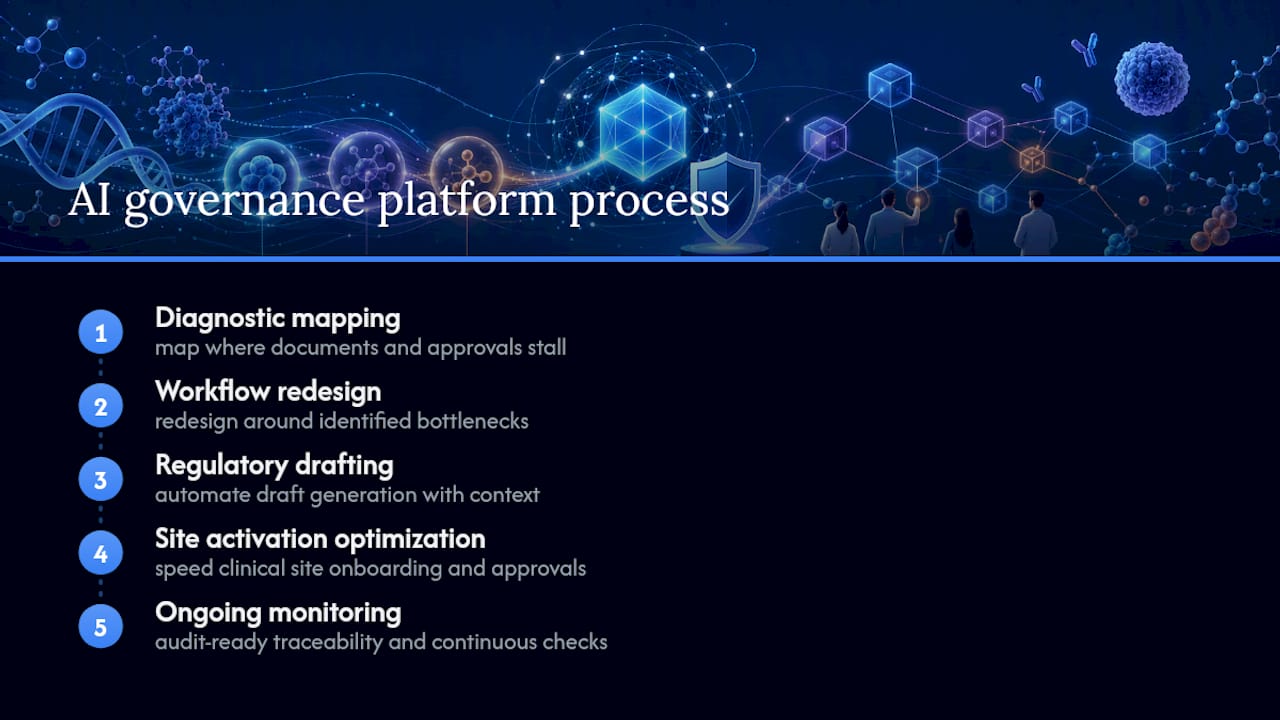
This is not a roundup of standalone software tools you install and configure yourself. A generic AI writing assistant doesn't know your SOPs, your regulatory history, or which reviewer flags matter at your company. An embedded partner does, because the diagnostic phase captures that institutional knowledge before any workflow gets touched.
What should leaders expect on day one of an engagement? A working baseline of where documents and approvals currently stall, a scoped pilot with defined acceptance criteria, and audit-ready traceability artifacts that show exactly how each AI-assisted output was reviewed and by whom. If a partner can't produce that traceability from the first pilot, the engagement isn't governance. It's just automation with extra risk attached.
Why Does AI Governance Matter Right Now?
The evidence for AI's impact on regulatory and clinical timelines is no longer speculative. One LLM-based drafting platform reduced first-draft composition time for IND documents by roughly 97%, cutting a multi-day task to under four hours. That gap is the whole argument for governance: raw AI output speeds up composition, but it doesn't replace judgment.
The 97% draft-time reduction is real, but so is the 22 to 30% quality gap it leaves behind. Governance is what closes that gap without slowing the process back down.
Major drugmakers are already using AI to compress trial site selection from weeks to hours and to track thousands of regulatory filings at once. Meanwhile, trial start-up and reporting workflows often run multi-week behind schedule at many sponsor organizations, often because of fragmented vendor handoffs rather than any single failure point.
Regulators aren't asking teams to choose between speed and control. The FDA's 2025 draft guidance treats AI oversight as risk-proportionate, scaling validation rigor to how critical a given model is to patient safety or data integrity, not applying one blanket standard to every use case.
A Staged Framework for Deploying Governed AI in GxP Workflows
Rolling out AI in a GxP environment without a staged plan is how you end up with a fast pilot and an unusable audit trail six months later. The Integrated Validation, Ethics, and Lifecycle (IVEL) framework lays out seven stages aligned with FDA guidance, the ISPE AI Maturity Model, and EU Annex 22. Here's how that translates into an operational sequence:
- Risk classification. Rank the intended use case by patient-safety and data-integrity impact before writing a single line of code or prompt.
- Data ingestion and lineage. Establish where the source data lives, who owns it, and how every transformation gets logged.
- Drafting with human-in-loop review. Deploy the LLM or template-driven tool for first-pass output, with a named reviewer accountable for every edit.
- Validation and performance qualification. Test against predefined acceptance criteria, not vague "looks good" sign-off.
- Change-control release. Move the workflow into production only through your existing change-control process, not around it.
- Monitoring and remediation. Track performance against thresholds you set in advance, with a defined path to fix drift.
- Periodic re-validation. Revisit risk classification and acceptance criteria as the model, the data, or the regulatory guidance shifts.
At each stage, demand a concrete artifact: written acceptance criteria before stage three, a traceability report at the end of stage four, and documented monitoring thresholds before stage six goes live. If a partner can't hand you those documents, they're not actually running the framework.
Pro Tip: Scope your first pilot around one document type or one site activation step, not an entire function. A narrow pilot with clean before-and-after metrics builds the internal case for scaling far faster than a broad rollout that's hard to measure.
Is Your Data Actually Ready for AI Governance?
Most AI pilots don't fail because the model is weak. They fail because the data underneath it is a mess. Data readiness is the single largest barrier to realizing AI's operational value in pharma, and more than half of organizations report unstructured data that's never been harmonized across systems.
Before you pilot anything, work through this checklist:
- Confirm who has access to the source data and whether that access is documented.
- Check whether formats and terminology are harmonized across departments, or whether each team built its own version of the truth.
- Map metadata and lineage so every data point can be traced back to its origin.
- Align document structures to eCTD or your relevant regulatory content standards.
- Verify the audit trail captures every AI-assisted edit, not just the final output.
- Review security controls against your existing data governance policy, not a new one built for the pilot alone.
Expect a competent partner to hand you sample templates, a traceability artifact from a prior engagement, and a written security attestation before you commit budget with MayFlower's biopharma tools and services. If any of those three is missing, that's your signal to keep looking.
Pro Tip: Budget roughly a quarter of your pilot timeline for data harmonization work alone. Teams that skip this step almost always end up repeating it mid-pilot, at a higher cost.
How Do You Choose the Right Governance Partner?
Not every AI vendor understands the difference between a clever prompt and a validated GxP process. Evaluate a prospective partner against five criteria:
- Biotech domain experience. Ask for specific examples of regulatory drafting or clinical operations work, not general AI implementation case studies.
- Regulatory and validation expertise. Confirm they can speak fluently about FDA's risk-proportionate framework and how it applies to your specific use case.
- Traceability and change-control fit. The workflow they propose has to slot into your existing change-control process, not require you to build a parallel one.
- Measurable time-to-value. Insist on a pilot with a defined metric, whether that's draft turnaround time or site activation days.
- Security and data governance. Data sensitivity in biotech is high enough that many organizations still prefer in-house builds over third-party platforms; your partner needs to address that concern directly, not wave it away.
Red flags worth walking away from: no written validation plan, opaque data lineage they can't explain simply, and no measurable KPI attached to the pilot. On the commercial side, a project-based or retainer structure tied to specific deliverables tends to serve biotech leaders better than an open-ended subscription, since it keeps the engagement accountable to outcomes rather than seat count. For teams still sorting out which workflows to tackle first, a structured prioritization approach makes the pilot conversation with any partner far more productive.
What Kind of Timeline Recovery Should You Expect?
Haiphai's client engagements point to as much as 18 months of operational time reclaimed on the path to approval, a figure that should be treated as a ceiling for well-scoped work, not a guarantee for every engagement. The reliable way to measure it: establish a baseline (current draft turnaround, current site activation days), track pilot metrics against that baseline, then validate the outcome against your original acceptance criteria before you claim the win.

Timeline compression compounds. A biotech that shaves even six months off its regulatory submission cycle often changes its funding conversation, because investors price runway and probability of approval together. Conservative estimates protect that credibility better than headline numbers.
What Founders Miss When Evaluating AI Governance
The biggest blind spot I see is treating governance as a compliance tax instead of the thing that makes speed sustainable. Teams that skip validation to move faster usually end up re-doing the work once a reviewer flags an untraceable AI edit, and that rework costs more than the time they saved.
Three moves worth making this quarter: run a quick audit of where your regulatory or clinical documents actually stall, scope one narrow pilot with a written baseline, and require monitoring KPIs in the contract before you sign, not after the pilot starts.
— John
How Haiphai Fits Into Your Governance Plan
Haiphai is built around the exact framework this article just walked through: diagnostic mapping first, then governed workflow redesign, then regulatory drafting automation and clinical site activation support, with monitoring built in from day one rather than bolted on later. That's a different starting point than a software vendor selling you a tool and leaving the validation work to your team.
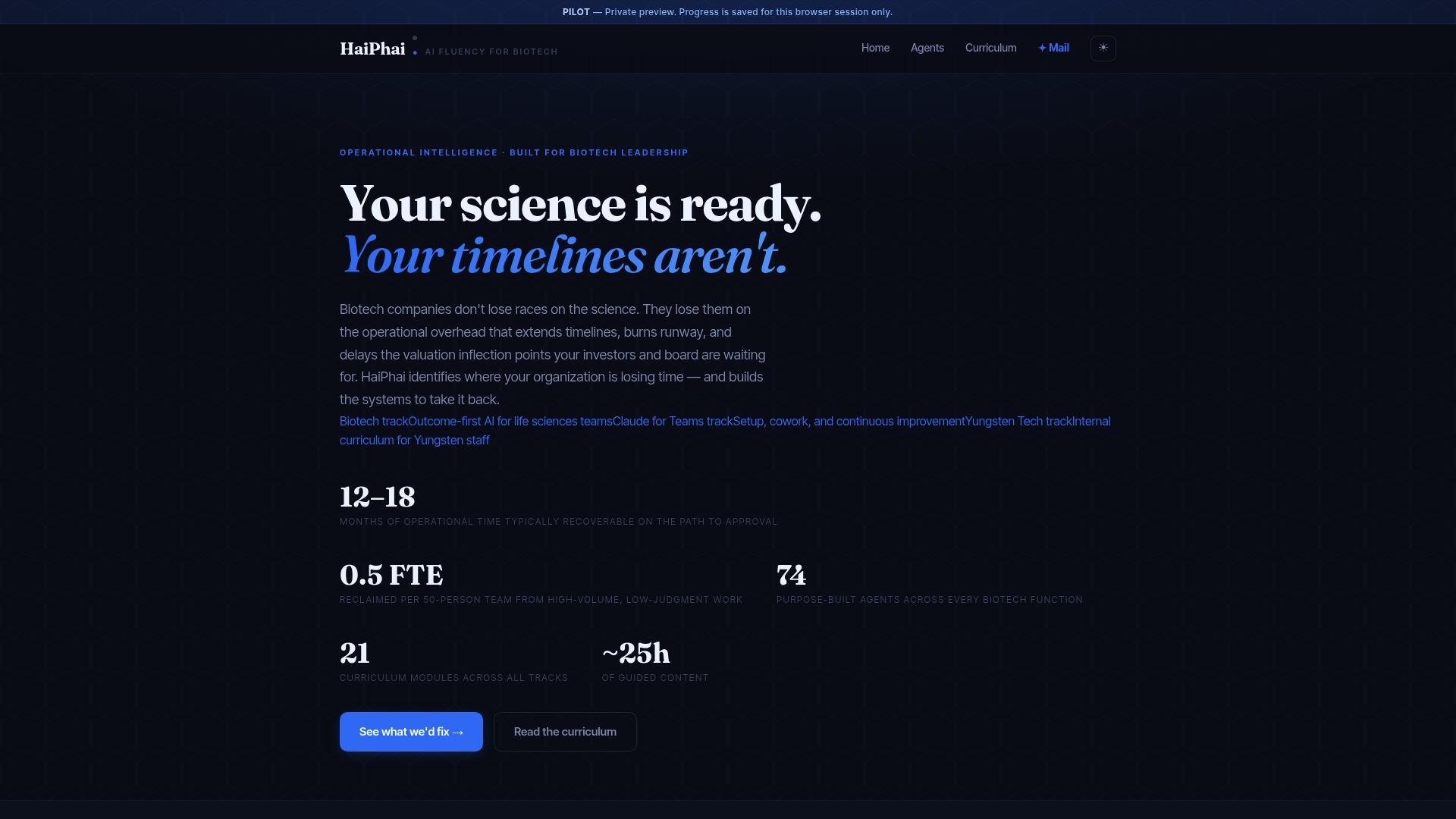
If you're weighing a pilot against the criteria in the evaluation section above, that's exactly the conversation worth having before you commit budget elsewhere. Haiphai's engagements start with a diagnostic that identifies your specific bottlenecks and gives you a scoped, measurable pilot plan, the same structure covered in this regulatory document drafting guide. Book a diagnostic conversation with Haiphai to see where your organization's biggest time recovery actually sits.
Sources
For deeper technical grounding, review the IVEL framework analysis, the AutoIND drafting-time study, and the Nature Reviews Clinical Oncology piece on AI's role in trial operations.
- AI faces data issues and regulatory hurdles (BioProcess Intl.)
FAQ
What Is an AI Governance Platform in Biotech?
In this context, it's an embedded consulting partnership that redesigns regulatory and clinical workflows around governed AI, rather than a standalone software tool you configure yourself.
How Much Time Can Governed AI Workflows Save?
Client engagements at Haiphai have reclaimed as much as 18 months of operational time toward approval, though the actual figure depends on baseline bottlenecks and pilot scope.
Does the FDA Regulate AI Used in Drug Development?
Yes. The FDA's 2025 draft guidance takes a risk-proportionate approach, scaling validation requirements to how critical the AI use case is to safety or data integrity.
How Long Should a First AI Governance Pilot Run?
Most effective pilots scope one document type or one site activation step with a defined baseline, keeping the timeline short enough to measure results within one quarter.
What's the Biggest Barrier to AI Adoption in Pharma?
Data readiness, specifically harmonized, traceable data, remains the largest gating factor before any AI workflow can scale reliably.