
Structured authoring tools break regulatory documents into reusable, metadata-tagged content blocks and pair them with AI-assisted drafting to populate eCTD submissions faster and more consistently than traditional document-based writing. Instead of starting each summary or module from a blank page, teams draft once, tag the content, and reuse it across filings and regions. Operational partners like Haiphai apply this approach selectively, tailoring the workflow redesign to a sponsor's actual bottlenecks rather than installing a generic platform.
TL;DR:
- AI-assisted drafting can reduce initial content creation time by around 97%, but human editing remains essential for submission readiness.
- Structured authoring relies on metadata-tagged content blocks that are reused across dossiers, improving consistency and reducing manual errors.
- A successful pilot involves limiting scope to specific document types, standardizing metadata, and integrating source systems before scaling organization-wide.
- AI-generated drafts tend to over-explain routine findings and under-emphasize critical safety data, requiring focused review for emphasis and accuracy.
- Partnering with a tailored implementation provider, like Haiphai, enhances operational adoption by addressing content bottlenecks and aligning workflows with regulatory standards.
Table of Contents
- What Are Structured Authoring Tools, and Why Do Regulatory Teams Need Them?
- How Do Structured Authoring and AI Work Together in Practice?
- What Evidence Shows AI-Assisted Drafting Actually Saves Time
- How Do You Pilot Structured Authoring Without a Failed Rollout?
- What Are the Risks and Regulatory Limits of AI-Generated Drafts?
- What Should You Look for in a Structured Authoring Partner?
- The Real Gap Between AI Speed Claims and Submission-Ready Work
- How Haiphai Turns Structured Authoring Into Real Timeline Savings
- Sources
- FAQ
What Are Structured Authoring Tools, and Why Do Regulatory Teams Need Them?
Traditional regulatory writing is document-based: a team drafts a Module 2 summary as one long file, then repeats similar language in Module 3, then again for a different region's dossier. Structured authoring flips that model. Content lives in discrete, metadata-tagged blocks, and writers draft each block once and reuse it wherever it's needed. That's the "create once, use often" principle behind content-based authoring, and it's the core distinction between structured content management systems and the old copy-paste-and-edit approach.
A component content management system, or CCMS, sits underneath this. It stores each content block with metadata describing its source, version, approval status, and where it belongs in the eCTD structure. This is what Structured Content and Data Management (SCDM) formalizes for CMC and technical sections: instead of PDFs, sponsors work with machine-readable, reusable data blocks that auto-populate multiple sections at once.
The push toward this model isn't cosmetic. ICH's CTD and eCTD standards already assume modular content. FDA's PQ/CMC initiative and the broader move toward structured, data-centric submissions signal that reviewers increasingly expect traceable, consistently tagged content rather than free-text narrative repeated with small variations.
How Do Structured Authoring and AI Work Together in Practice?
The pipeline behind AI-enabled structured authoring runs through five stages, each building on the one before it:
- Ingest and extract. Source data comes from LIMS, electronic lab notebooks, clinical databases, and prior submissions.
- Semantic mapping into SCDM. Extracted data gets tagged with metadata and slotted into the content-block structure that maps to eCTD sections.
- AI-assisted, template-driven drafting. A language model generates initial narrative text using approved templates and the tagged source data, not from scratch.
- Human refinement. Regulatory writers edit for concision, emphasis, and scientific judgment the model can't replicate.
- Automated assembly and validation. The finished blocks get packaged into eCTD format with automated checks.
Templates and metadata are what keep the AI-generated draft from drifting into inconsistent terminology or contradicting itself between sections. Traceability matters just as much: every generated sentence should trace back to a specific source file or data point, which is what makes an audit trail possible later.
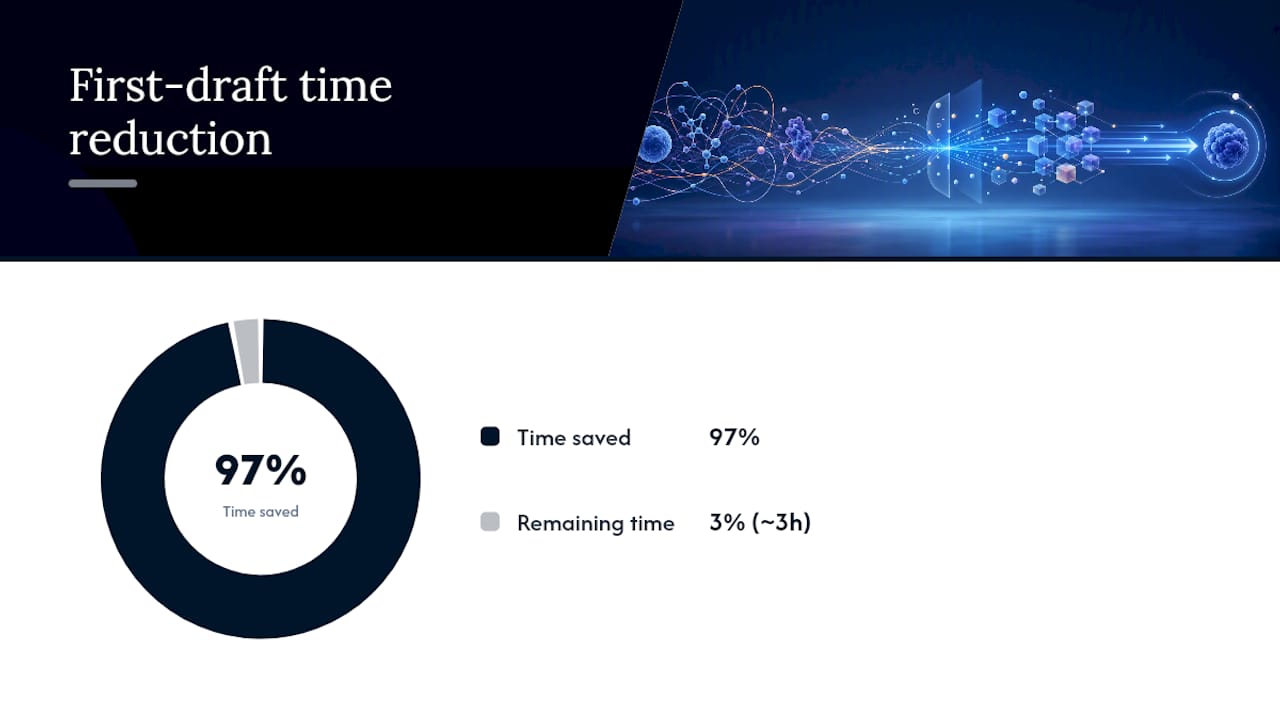
Studies of platforms like AutoIND report first-draft time reductions of roughly 97% for certain IND nonclinical summaries, compressing work that took about 100 hours down to 2.6 to 3.7 hours. That number only holds up if human review sits at stage four as a mandatory gate, not an afterthought.
What Evidence Shows AI-Assisted Drafting Actually Saves Time
The headline number from the AutoIND evaluation, a nearly 97% cut in initial drafting time, is real but comes with a caveat that matters more than the statistic itself: quality scores for AI-generated drafts still required human editing before the documents were submission-ready. Speed and readiness are not the same thing, and treating them as identical is the single most common mistake teams make when they pilot these tools.
What sponsors can reasonably expect when the workflow is set up correctly:
- Faster submission cycles, driven by compressed drafting time rather than fewer reviewers.
- A more consistent narrative voice across a large dossier, since content blocks carry the same tagged language into every section that needs it.
- Fewer manual packaging errors when eCTD validation is integrated directly into the assembly step rather than bolted on afterward.
McKinsey's analysis of pharma regulatory workflows frames this correctly: the principal value of AI in regulatory drafting is timeline compression and a consistent dossier voice, not headcount reduction. Scientific staff spend their time interpreting and refining rather than typing boilerplate.
The quality gaps that remain are specific and predictable rather than random. AI drafts tend to run long, over-explain routine findings, and misjudge which results deserve emphasis versus a passing mention. None of that eliminates the need for expert reviewers. It just changes what reviewers spend their time on, shifting effort from drafting to editing for concision and judgment.
How Do You Pilot Structured Authoring Without a Failed Rollout?
Start narrow. A single Post-Approval Change dossier or one Module 2/3 component gives you a controlled test of content reuse across two or three filings before you commit to broader adoption. Measure first-draft time, editing hours per document, and the number of content blocks successfully reused, not just whether the pilot "felt faster."
- Scope the pilot to a bounded document type with a clear success metric tied to hours saved and reuse rate.
- Standardize metadata and content blocks before drafting begins, so every stakeholder tags content the same way.
- Align stakeholders across regulatory, clinical operations, and IT, and assign clear governance for who approves a content block for reuse.
- Integrate source systems like LIMS, eLN, and document management platforms so extraction doesn't require manual re-entry.
- Run validation and training cycles before scaling, including a formal change management plan for the teams whose workflow shifts most.
Skipping the metadata standardization step is the most common failure mode. Buying a platform without agreeing on shared tagging conventions creates fragmented silos instead of the reuse the tooling was supposed to deliver.
Pro Tip: Pick a pilot document type your team has already filed multiple times. You'll have real prior drafts to compare against, which makes the time-savings measurement honest instead of anecdotal.
What Are the Risks and Regulatory Limits of AI-Generated Drafts?
The same studies that report dramatic speedups also document consistent, predictable weaknesses. AI-generated drafts tend toward verbosity, misjudge emphasis on safety-relevant findings, and can lose the traceability link back to source data if the pipeline isn't built to preserve it. These aren't random errors; they show up reliably enough that review workflows can be built specifically to catch them.
Watch for these patterns in review:
- Over-explanation of routine or expected findings, padding sections that reviewers will skim anyway.
- Under-emphasis of findings that carry real safety or efficacy weight.
- Broken traceability, where generated text can't be mapped back to a specific source record.
On the regulatory side, FDA's 2025 draft guidance on AI use in regulatory submissions, along with the ongoing shift toward eCTD 4.0 and HL7 RPS, points toward reviewers expecting stronger traceability and validation documentation, not less. Sponsors who treat AI output as a mechanical shortcut rather than a drafting aid will run into exactly the gaps that guidance is meant to catch.
Mitigation isn't complicated, but it has to be deliberate: fine-tune models on your own approved language where possible, run structured validators against every generated block before it reaches a human reviewer, and make human sign-off a mandatory gate rather than a courtesy step.

What Should You Look for in a Structured Authoring Partner?
Evaluating readiness comes down to specific, checkable capabilities rather than a vendor's marketing claims. A useful checklist covers three areas.
Capability fit:
- Compliance with eCTD and, ideally, eCTD 4.0/HL7 RPS standards for future-proofing.
- Template flexibility that matches your actual document types, not a generic library.
- Built-in provenance and traceability from generated text back to source data.
- Validation tooling integrated into the assembly step, not a separate manual check.
- A security posture that matches the sensitivity of clinical and CMC data.
Operational fit:
- Professional services support for the process redesign work, not just software licensing.
- Documented experience with life-sciences implementations specifically, since general-purpose content tools miss regulatory nuance.
- Willingness to support a narrowly scoped pilot before a full rollout.
Contract terms worth negotiating up front include audit support during inspections, a clear change control process for template updates, and service-level commitments on deliverable turnaround. Skipping these terms is how sponsors end up locked into a platform that can't adapt when a region's Module 1 requirements change.
The Real Gap Between AI Speed Claims and Submission-Ready Work
Most coverage of AI in regulatory drafting fixates on the speed number and treats the quality caveat as a footnote. That's backwards. A 97% reduction in drafting time is only useful if the remaining 3% of effort, the human refinement stage, gets the resourcing it needs. Teams that skip that step don't get faster submissions; they get faster first drafts that stall in QC review, which erases most of the time saved.
The harder problem isn't the AI. It's that structured authoring exposes how inconsistent an organization's content practices already were. Metadata that nobody standardized, content blocks that exist in three slightly different versions across departments, source systems that were never designed to talk to a CCMS. AI-assisted drafting doesn't fix that; it makes the fix unavoidable, because reuse only works if the underlying content is actually structured.
That's why the tooling question matters less than the operational one. A platform can be technically excellent and still fail if nobody redesigned the workflow around it. This is where a tailored partnership beats a self-service rollout. Diagnosing the actual bottleneck, whether it's fragmented metadata, siloed source systems, or a governance vacuum, has to come before anyone picks a tool.
— John
How Haiphai Turns Structured Authoring Into Real Timeline Savings
Everything covered above, content-block reuse, metadata governance, pilot-first rollout, human review gates, only pays off if it's built around your specific bottlenecks. That's the gap Haiphai fills. Rather than dropping in a generic platform, Haiphai starts by diagnosing where your regulatory drafting and site activation processes actually stall, then builds the AI-enabled workflow around that diagnosis.
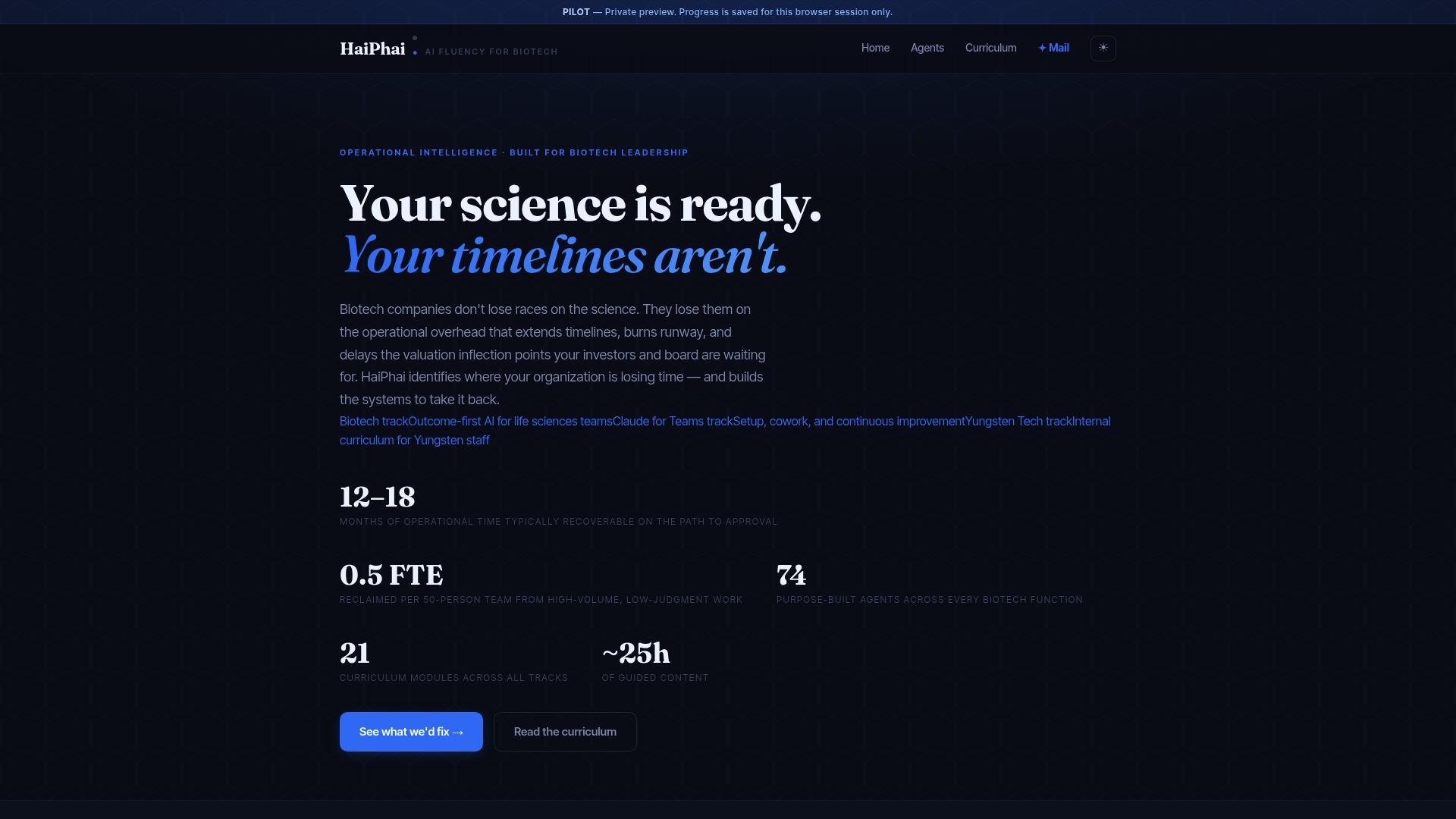
Clients working with Haiphai have reclaimed up to 18 months of operational time on the path to approval, time that matters directly for funding milestones and company valuation. The engagement typically starts with a diagnostic that maps your bottlenecks against the evaluation criteria above: metadata readiness, source system integration, governance gaps. From there, Haiphai scopes a pilot with concrete success metrics before any wider rollout. If your team is weighing whether structured authoring is worth the investment, visit Haiphai's sectors page to see how the operational partnership model applies to your specific submission timeline.
Sources
- PMC article on structured content authoring
- AutoIND/Weave evaluation preprint (arXiv)
- Journal of Pharmaceutical Sciences: Structured content and data management for CMC
- McKinsey: Rewiring pharma regulatory submissions with AI
FAQ
What Is the Difference Between Content-Based and Document-Based Authoring?
Document-based authoring treats each regulatory document as a standalone file; content-based authoring breaks the same information into reusable, metadata-tagged blocks that populate multiple documents and eCTD sections at once.
How Much Time Can AI-Assisted Drafting Actually Save?
Evaluations of platforms like AutoIND report first-draft time reductions of roughly 97% for certain IND nonclinical summaries, though human refinement for concision and emphasis remains necessary before submission.
Does Structured Authoring Eliminate the Need for Regulatory Writers?
No. It shifts reviewer effort from drafting to editing for concision, emphasis, and traceability, since AI-generated drafts consistently show gaps in those areas.
What Should a Pilot Program Look Like?
Start with a narrowly scoped document type, such as a Post-Approval Change dossier or a single Module 2/3 component, and measure reuse across two or three filings before scaling further.
Can Haiphai Help With Structured Authoring Implementation?
Yes. Haiphai operates as an operational partner that diagnoses drafting and site-activation bottlenecks first, then tailors an AI-enabled structured authoring workflow rather than deploying a one-size-fits-all platform.