
What does regulatory intelligence mean in biotech?
Regulatory intelligence (RI) is the systematic process of collecting, analyzing, and disseminating regulatory information to support proactive compliance and strategic decision-making in biotech. It is not passive monitoring. RI turns raw regulatory signals from agencies like the FDA, EMA, and ICH into decisions your team can act on before a guidance document becomes an enforcement problem.
The distinction from standard compliance is worth stating plainly. Compliance means following rules that already exist. Regulatory intelligence means watching for rules that are being written, shaped, or revised, and positioning your program accordingly. Think of compliance as following the map and RI as watching the road ahead for construction.
Key elements of a functioning RI program include:
- Regulatory surveillance: Continuous monitoring of guidance documents, draft regulations, advisory committee proceedings, and agency communications across relevant jurisdictions
- Data analysis: Interpreting what new or revised requirements mean specifically for your product portfolio, therapeutic area, and development stage
- Dissemination: Routing analyzed intelligence to the right internal teams, from clinical operations to CMC, so insights translate into decisions
- Tool infrastructure: Platforms like IQVIA Regulatory Intelligence and Cortellis aggregate data from over 80 global regulatory agencies, cutting manual research time and reducing the risk of missed updates
- External engagement: Active participation in comment periods and dialogue with regulatory bodies, not just passive reading of what they publish
Why regulatory intelligence gives biotech teams a real strategic edge
The core value of RI is shifting your team from reactive to anticipatory. When a new FDA draft guidance drops on a Monday morning, a team with a mature RI program already has context: how it compares to prior guidance, which product lines it affects, and what comment period strategy makes sense. A team without RI scrambles.
Concrete benefits include:
- Faster market entry: Anticipating regulatory pathways and preparing submissions aligned with current agency expectations reduces back-and-forth cycles with reviewers
- Reduced development delays: Timely alerts on evolving ICH, FDA, and EMA standards help teams avoid designing clinical trials or CMC packages that will require costly redesign later
- Better resource allocation: When you know which regulatory changes are coming, you can staff and budget for them rather than absorbing surprise costs mid-program
- Stronger submissions: Comparative analysis of approved products and agency precedent, available through platforms covering over 300,000 reports, lets regulatory writers build arguments grounded in what reviewers have already accepted
- Competitive positioning: Teams that engage proactively with draft guidance can influence the final regulatory environment, not just adapt to it
The importance of regulatory intelligence compounds at scale. A single missed update on a CMC requirement can delay approval by months. For a biotech with a finite runway, that delay has direct valuation consequences.
The three operational pillars that make RI work
Effective regulatory intelligence programs rest on three integrated components, as identified in the PDA Journal: information collection, information analysis, and information dissemination. How well these three connect to each other, and to your broader quality and clinical systems, determines whether your RI program is a genuine asset or just a subscription to a database nobody reads.
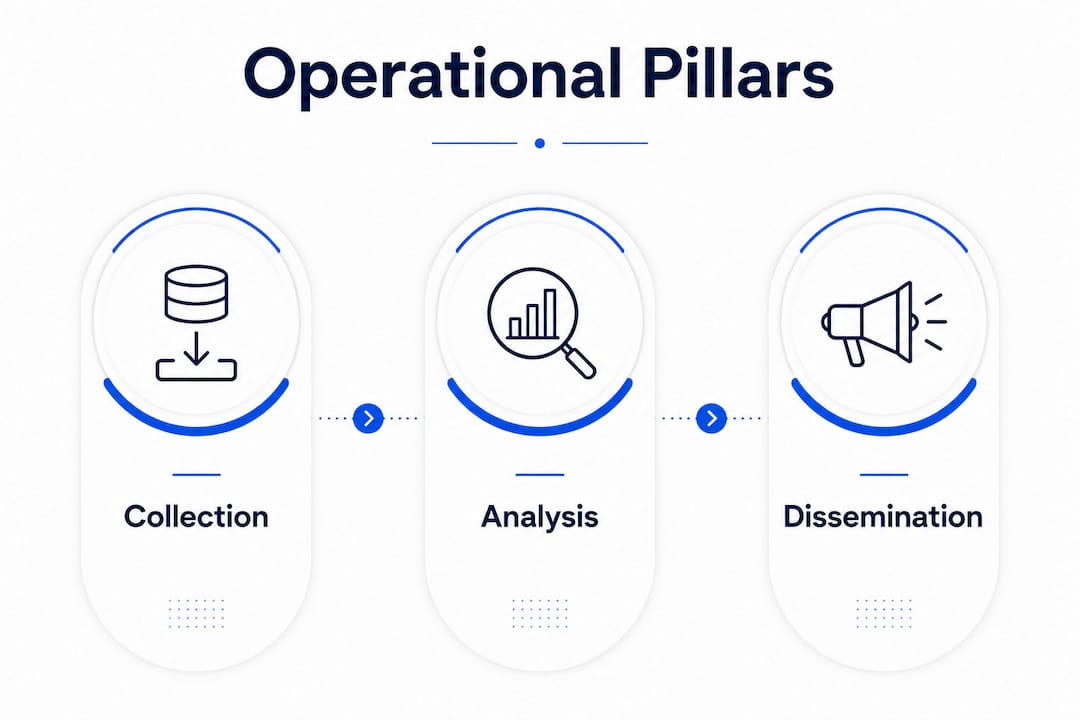
Collection is the foundation. It covers systematic gathering of regulatory information across multiple jurisdictions: laws, guidance documents, advisory committee transcripts, compendia, position papers, and agency news. Automated platforms handle the volume that no team can manage manually.
Analysis is where most programs underinvest. Raw regulatory updates have no value until someone interprets their implications for your specific product, indication, and development stage. This requires regulatory affairs professionals who understand both the science and the agency's historical posture on similar questions.

Dissemination closes the loop. Analyzed intelligence needs to reach clinical teams before protocol finalization, CMC teams before dossier preparation, and safety teams before submission. Structured workflows, often integrated with a Quality Management System, make this routing reliable rather than ad hoc. Integration with QMS early in development is standard practice among high-performing biotech firms preparing for inspection readiness.
How regulatory intelligence supports your product from IND to approval
RI touches every phase of the biotech product lifecycle, and its value is highest when it starts earliest.
- Preclinical and concept stage: Starting RI early in product concept phases prevents costly pivots later. Regulatory signals about evolving safety standards or shifting agency priorities can reshape a development hypothesis before significant capital is committed
- Clinical trial design: Real-time alerts on FDA and ICH guidance updates help protocol teams design studies that will survive regulatory scrutiny, not just scientific review
- Regulatory submissions: Comparative intelligence on precedent approvals, agency questions on similar products, and current reviewer expectations strengthens the strategic framing of every submission package
- CMC planning: Monitoring agency expectations on manufacturing standards across global markets prevents the technical gaps that account for a meaningful share of regulatory delays
- Post-market and lifecycle management: RI continues after approval, tracking pharmacovigilance requirements, label update expectations, and market-specific post-approval commitments
Real-time alerts are a practical differentiator here. When an agency publishes a revised guidance or opens a comment period, teams with automated monitoring can respond within days. Teams relying on manual review often miss the window entirely.
Pro Tip: Set up jurisdiction-specific alert filters in your RI platform from day one of a new program. Broad global monitoring creates noise; targeted alerts by therapeutic area and regulatory pathway create signal.
What industry experts say about integrating RI into biotech operations
The Drug Information Association's Regulatory Intelligence Network defines RI as "the act of gathering and analyzing publicly available regulatory information. This includes communicating the implications of that information and monitoring the current regulatory environment for opportunities to shape future regulations, guidance, policy, and legislation."
That last phrase is the part most teams skip. Monitoring is table stakes. Shaping is the competitive advantage.
The cultural shift this requires is real. Teams accustomed to reactive compliance treat RI as a news feed. Teams that extract strategic value from it treat RI as an input to planning, change control, and external engagement calendars. The PDA Journal literature review frames RI effectiveness as directly tied to how well collection, analysis, and dissemination integrate with the organization's QMS and clinical development operations.
AI is accelerating this integration. Platforms with natural language processing can surface relevant precedents from hundreds of thousands of documents in seconds, letting regulatory professionals focus on interpretation rather than retrieval. Haiphai's AI augmentation approach applies this logic across regulatory drafting and clinical site activation, with clients reclaiming up to 18 months of operational time on the path to approval.
Pro Tip: Treat regulatory signals as change control triggers. When a new draft guidance arrives, route it through your change control process automatically, not just to your RI inbox. That single process change separates mature RI programs from ones that collect information but never act on it.
Case studies: when RI changes the outcome
The practical impact of regulatory intelligence shows up most clearly in specific decision points.
Clinical trial design pivot: A mid-size biotech developing a gene therapy product monitored FDA advisory committee transcripts and identified a shift in how the agency was weighing long-term follow-up data for similar products. The team redesigned their follow-up protocol before submitting their IND, avoiding a likely agency request for amendment that would have added months to the timeline.
CMC submission alignment: A biologics team used comparative regulatory intelligence to identify that a target market had recently updated its manufacturing standards in ways not yet reflected in published guidelines. By accessing expert-curated local intelligence, they prepared a dossier that met the actual current expectation rather than the published one, clearing CMC review on the first cycle.

Draft guidance engagement: A biotech with an orphan drug program tracked a draft FDA guidance on rare disease endpoint flexibility during the comment period. Their regulatory team submitted comments grounded in their clinical data, and the final guidance incorporated language that directly supported their planned trial design.
These are not exceptional outcomes. They are what happens when RI is embedded in operations rather than treated as a reference library.
Challenges you will actually face when building an RI program
Regulatory intelligence is not difficult to understand. It is difficult to operationalize consistently.
The most common failure mode is collection without analysis. Teams subscribe to regulatory databases, receive daily alerts, and then lack the internal bandwidth to interpret what those alerts mean for their specific programs. The inbox fills up; the insights never reach the people who need them.
Volume is a related problem. Global biotech programs touch FDA, EMA, PMDA, and dozens of additional agencies. Monitoring all of them without structured filtering produces noise that overwhelms the signal. Platforms covering 80+ global markets help, but only if the team has defined which jurisdictions and therapeutic areas actually matter for their portfolio.
Organizational silos create dissemination failures. RI insights generated by a regulatory affairs team that never reach clinical operations or CMC are wasted. Without structured routing, often through QMS integration, intelligence stays siloed in the department that collected it.
Finally, many biotech teams, particularly startups, treat RI as a function to build later. The academic literature is clear that RI remains underrepresented despite its fundamental importance. Starting late means absorbing the cost of regulatory surprises that earlier intelligence would have prevented.
Best practices for embedding RI into your biotech workflows
Getting RI right is less about the platform you choose and more about the processes you build around it.
Start at program inception. RI integrated at the product concept stage shapes development strategy. RI bolted on at the submission stage can only react to the strategy already locked in.
Define your regulatory universe. Map the agencies, jurisdictions, and guidance categories relevant to each program. Targeted monitoring beats comprehensive noise every time.
Connect RI to change control. Treat incoming regulatory signals as potential triggers for process or protocol updates. Formalizing this connection, through your QMS, makes the response automatic rather than dependent on someone remembering to act.
Assign ownership. RI without a named owner becomes everyone's responsibility and no one's priority. Designate a regulatory intelligence lead or function, even in small teams.
Engage externally. Proactive engagement with regulatory authorities during draft guidance periods moves your team from rule-follower to rule-shaper. Comment submissions, participation in industry associations, and direct agency dialogue all build relationships that pay off during review.
Use AI to handle volume. Automated surveillance, classification, and early warning alerts free your regulatory professionals to focus on interpretation and strategy. For teams operating with lean headcount, this is not optional. Haiphai's operational solutions are built specifically for biotech teams that need to operate at scale without proportional headcount growth.
Key Takeaways
Regulatory intelligence in biotech is the proactive, systematic process of collecting, analyzing, and disseminating regulatory information to guide compliance and strategic decisions across the full product lifecycle.
| Point | Details |
|---|---|
| RI is forward-looking | Unlike compliance, RI anticipates regulatory changes before enforcement, giving teams time to adapt. |
| Three core pillars | Collection, analysis, and dissemination must connect to QMS and clinical operations to be effective. |
| Tools aggregate global data | Platforms like Cortellis cover 80+ markets and over 300,000 regulatory reports, reducing manual tracking. |
| Start early | Beginning RI at the product concept stage prevents costly development pivots and submission setbacks. |
| External engagement matters | Participating in draft guidance comment periods lets biotech teams influence the regulations they will later follow. |
FAQ
What does regulatory intelligence mean?
Regulatory intelligence is the systematic process of identifying, monitoring, analyzing, and acting on regulatory changes before they take effect, so organizations can prepare rather than react.
What does a regulatory affairs function do in biotech?
Regulatory affairs manages the strategy and execution of product approvals, working with agencies like the FDA and EMA to navigate submission requirements, safety reporting, and post-market compliance across the product lifecycle.
What does a regulatory intelligence job involve?
A regulatory intelligence professional monitors global agency outputs, analyzes their implications for specific product programs, and routes findings to clinical, CMC, and safety teams through structured dissemination processes.
How is regulatory intelligence different from regulatory compliance?
Regulatory compliance is backward-looking: following rules that exist today. Regulatory intelligence is forward-looking: detecting and interpreting changes before they become requirements, so your program is already aligned when enforcement begins.
When should a biotech company start building an RI program?
At the product concept stage. Starting RI early prevents costly development pivots and ensures regulatory signals shape strategy from the beginning, rather than forcing reactive adjustments during submission preparation.