
Compressing a biotech development timeline is defined as the deliberate reduction of time between target identification and regulatory approval by eliminating administrative dead time, deploying AI-driven drug discovery, and structuring capital around measurable milestones. The industry term for this discipline is timeline compression, and it has moved from a competitive advantage to a survival requirement. With drug candidate success rates falling to 1 in 16, the cost of slow execution is no longer just financial. It is existential. Biotech executives who master timeline compression through AI, milestone-based financing, and real-time regulatory models will define the next decade of drug development.
How to compress biotech development timelines with AI
AI-driven drug discovery is the single most powerful lever available to compress a biotech development timeline today. McKinsey projects that AI will cut average timelines by 18 months by 2028 through improvements in target identification, molecular design, and clinical trial stratification. That is not a marginal gain. It represents roughly 20% of a typical development cycle reclaimed before a single patient is enrolled.
The clearest proof point is in bispecific antibody development. Integrated DNA-to-IND processes, supported by machine learning platforms built on NVIDIA infrastructure, have compressed timelines from 22 to 24 months down to 13 months. That reduction comes from parallel processing of tasks that were previously sequential: target validation, lead optimization, and toxicology modeling now run simultaneously rather than in a chain.
Clinical trial stratification is where AI delivers its second major impact. Predictive patient selection models reduce screen failure rates, which historically consume months of enrollment time and millions of dollars. When a trial recruits the right patients faster, Phase 1 completion accelerates and the data package for the next funding tranche arrives on schedule.

Pro Tip: Use AI-generated patient stratification models during IND-enabling studies, not after Phase 1 enrollment opens. Embedding selection criteria early prevents the screen failure spiral that kills timelines before they start.
Key areas where AI compresses the biotech project timeline:
- Target identification: Machine learning screens billions of molecular interactions in weeks rather than years
- Lead optimization: Generative chemistry platforms propose and rank candidates without wet-lab iteration cycles
- Toxicology prediction: In silico ADMET modeling reduces animal study dependency and shortens IND-enabling timelines
- Trial stratification: Biomarker-driven patient selection, supported by tools like peptide biomarker analysis, cuts screen failure rates and accelerates enrollment
Why milestone-based funding improves biotech outcomes
Milestone-based financing is the capital structure that keeps timeline compression from collapsing under its own ambition. 23.6% of life-science venture financings are now structured as tranched seed or milestone-based rounds, releasing capital only after defined development events such as IND nomination or clinical site activation. This structure forces discipline that lump-sum financing never does.
The role of milestones in biotech fundraising is not simply administrative. Each milestone is a value-inflection point that reduces investor risk, justifies the next capital tranche, and proves the team can execute. Typical milestone-based rounds cover an 18 to 24 month window and require $8 to $15 million to reach Phase 1 completion. That window maps almost exactly to the timeline compression gains that AI and regulatory optimization deliver.
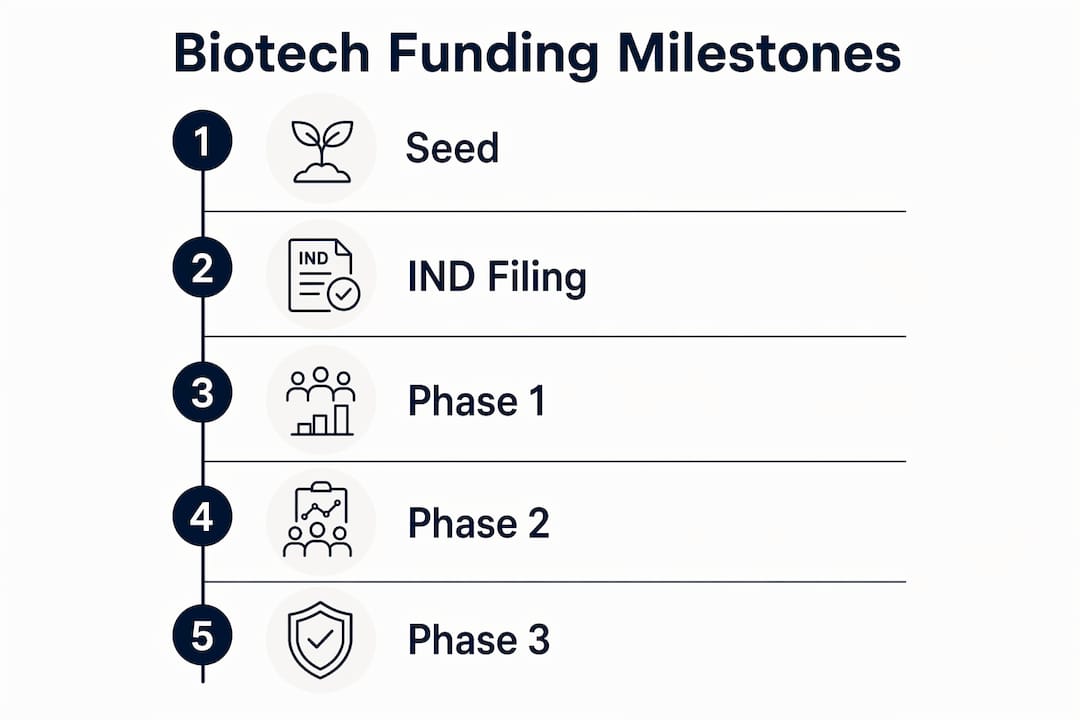
Tranched financing also changes how investors evaluate risk. Staged financing enables investors to assess each development step sequentially, abandon failing programs early, and redeploy capital to higher-probability assets. Later tranches carry lower hurdle rates because uncertainty has been systematically reduced. This is why milestone-driven companies attract better capital partners at better terms.
| Milestone | Typical Timing | Capital Trigger |
|---|---|---|
| IND nomination | Months 6 to 9 | Seed tranche release |
| IND filing acceptance | Months 10 to 14 | Series A initiation |
| Phase 1 site activation | Months 15 to 18 | Series A tranche 2 |
| Phase 1 completion | Months 20 to 24 | Series B preparation |
The most successful biotech companies treat each financing round as a rigorous competition anchored to specific value-inflection milestones, not as a runway extension exercise. That mindset shift is what separates teams that compress timelines from teams that simply spend faster.
How do real-time clinical trials reduce development time?
Traditional clinical trial phases are administrative constructs, not scientific necessities. Approximately 45% of total drug development time is classified as administrative dead time generated by batch documentation submission and review cycles. Real-time clinical trial models aim to eliminate that dead time by replacing periodic data packages with continuous data streaming directly to regulators.
The FDA has piloted real-time review programs with companies including AstraZeneca and Amgen, targeting a 20 to 40% reduction in development timelines by removing phase-gate latencies. The mechanism is straightforward: instead of waiting for a Phase 1 package to be compiled, submitted, and reviewed over months, regulators access a live data environment and make decisions in near real time. The phase designations themselves, Phase 1, 2, and 3, originate from paper-based processes that continuous data streaming is actively dissolving.
Here is how to structure regulatory interactions for maximum timeline compression:
- Engage FDA early through Pre-IND meetings. Establish data expectations and submission formats before IND filing, not after a clinical hold.
- Adopt electronic data capture platforms that support real-time data access for both internal teams and regulatory reviewers.
- Design adaptive trial protocols that allow dose escalation or cohort expansion without full protocol amendments.
- Request Breakthrough Therapy Designation or Fast Track status where the clinical profile supports it. Both designations unlock rolling review and more frequent FDA interactions.
- Build a regulatory affairs team with real-time trial experience. This is a specialized skill set that differs materially from traditional submission management.
Pro Tip: Map every administrative touchpoint in your current IND-enabling and Phase 1 process. Identify which steps require FDA response and which are internal queuing delays. Most teams discover that 30 to 50% of their perceived "regulatory" timeline is actually internal process latency they control entirely.
Global partnerships and geographic optimization for speed
Geographic optimization is an underused lever for accelerating biotech R&D timelines. China's share of the global biopharma pipeline rose from 1% in 2010 to 25% in 2025, driven by high-throughput manufacturing capacity, lower clinical costs, and accelerating regulatory infrastructure. Western biotechs that ignore this shift are leaving speed and cost efficiency on the table.
The strategic model that sophisticated operators use is a split development approach. Early-phase, high-volume work including lead optimization, manufacturing scale-up, and initial safety studies runs in China or other high-productivity regions. Data-sensitive late-phase work, pivotal trials, and FDA-facing submissions stay in the U.S. or Europe. This preserves FDA trust while capturing the speed advantages of global capacity.
| Development Stage | Preferred Region | Primary Advantage |
|---|---|---|
| Lead optimization and synthesis | China, India | Cost and throughput |
| Early toxicology and safety | China, Eastern Europe | Speed and capacity |
| Phase 1 and 2 trials | U.S., Western Europe | Regulatory credibility |
| Pivotal Phase 3 trials | U.S., EU | FDA and EMA alignment |
| CMC and manufacturing scale-up | U.S., Singapore | Quality and IP protection |
Contract research organizations (CROs) such as WuXi AppTec and Lonza provide the operational infrastructure for this split model without requiring a company to build its own international footprint. The key risk to manage is data integrity and IP protection in early-phase offshore work. Robust contractual controls and a LIMS implementation framework that enforces data standards across sites are non-negotiable for any company using this approach.
Common pitfalls that destroy compressed timelines
Timeline compression fails most often not because of science, but because of operational and governance failures that were entirely predictable. Avoidable clinical holds caused by manufacturing deficiencies or incomplete regulatory documentation during the IND-enabling phase are among the most common and most expensive timeline killers in early-stage biotech.
The following failures account for the majority of timeline compression breakdowns:
- Inadequate CMC documentation: Manufacturing process gaps trigger clinical holds that can add six to twelve months to a program. Regulatory hygiene in chemistry, manufacturing, and controls must begin at IND-enabling, not at Phase 2.
- Dilutive fundraising without milestone clarity: Raising capital without defined, time-bounded milestones signals execution risk to investors and often results in down rounds that distract leadership and slow decision-making.
- Board composition misaligned with stage: Boards without members who have direct FDA interaction experience consistently underestimate regulatory timelines and approve under-resourced regulatory affairs teams.
- Sequential rather than parallel workstreams: Teams that run toxicology studies before beginning CMC development, or that wait for IND acceptance before initiating site selection, add months of unnecessary latency.
- Overreliance on a single CRO: Single-vendor dependency creates a critical path bottleneck. Distributing work across two qualified CROs for key studies provides schedule insurance without significant cost increase.
Anticipatory regulatory hygiene is the practice of building your regulatory submission package as if the FDA will ask for everything, before they ask. Teams that adopt this mindset rarely face clinical holds. Teams that treat regulatory documentation as a post-study administrative task almost always do.
Key takeaways
Compressing a biotech development timeline requires simultaneous execution across AI deployment, milestone-aligned capital, real-time regulatory engagement, and global operational design.
| Point | Details |
|---|---|
| AI cuts timelines materially | DNA-to-IND processes using machine learning have reduced bispecific antibody timelines from 24 months to 13 months. |
| Milestone funding enforces discipline | Tranched financing tied to IND filing and Phase 1 completion keeps teams accountable and capital efficient. |
| Real-time trials eliminate dead time | Up to 45% of development time is administrative. Real-time FDA data access targets a 20 to 40% timeline reduction. |
| Geographic split accelerates early phases | China's 25% share of the global pipeline reflects real speed and cost advantages for early-phase work. |
| Operational hygiene prevents holds | Clinical holds from CMC or documentation gaps are avoidable and represent the most common cause of timeline collapse. |
Why most timeline compression efforts stall before they start
I have watched well-funded biotech teams invest in AI platforms, hire experienced regulatory affairs staff, and still miss their IND filing dates by six months or more. The failure is almost never the technology. It is the assumption that deploying better tools automatically produces better timelines.
The teams that actually compress their development cycles share one characteristic: they treat timeline management as a strategic discipline, not a project management function. They model milestone probabilities, discount valuations accordingly, and make capital deployment decisions based on data rather than optimism. They also pick capital partners who understand that a clinical hold is not a failure of science. It is a failure of process.
The shift from "grow at all costs" to value extraction through disciplined de-risking is the most important operational change a biotech executive can make. Every dollar spent before a clear milestone is defined is a dollar that reduces your negotiating position in the next round. Every month of administrative dead time that goes unmeasured is a month your competitor is using to file their IND.
Proactive regulatory strategy, real partnerships with CROs who have direct FDA relationships, and AI tools that are actually integrated into your development workflow rather than bolted on as reporting layers. These are the three things I would prioritize above everything else. The companies that get this right do not just move faster. They build programs that are structurally harder to derail.
— John
How Haiphai helps biotech teams reclaim lost time
Haiphai was built specifically for biotech teams who know where their bottlenecks are but lack the operational infrastructure to eliminate them at speed. Rather than offering a generic software platform, Haiphai acts as an operational partner: starting from your regulatory and clinical milestones, working backward to identify exactly where administrative latency is accumulating, and deploying AI to remove it.
Clients using Haiphai's AI-driven platform have reclaimed up to 18 months of operational time on the path to approval. That time translates directly into higher valuations at each funding milestone and stronger negotiating positions with investors. For life sciences teams managing IND-enabling studies, clinical site activation, or regulatory drafting, Haiphai provides the operational leverage that turns a compressed timeline from a goal into a deliverable.
FAQ
What does it mean to compress a biotech development timeline?
Compressing a biotech development timeline means reducing the total time from target identification to regulatory approval by eliminating administrative dead time, deploying AI-driven tools, and aligning capital deployment with measurable development milestones.
How much time can AI realistically save in drug development?
AI-driven drug discovery is projected to cut average biotech development timelines by 18 months by 2028. Integrated DNA-to-IND processes have already demonstrated reductions from 22 to 24 months down to 13 months for bispecific antibodies.
Why does milestone-based funding accelerate development?
Milestone-based funding ties capital release to specific, observable events such as IND filing or Phase 1 completion. This structure forces execution discipline, reduces investor risk sequentially, and keeps development teams focused on data-producing activities rather than runway management.
What is administrative dead time in biotech development?
Administrative dead time refers to the portion of development time consumed by batch documentation submission and regulatory review cycles rather than active research. It accounts for approximately 45% of total drug development time and is the primary target of real-time clinical trial models.
How do global partnerships help shorten a biotech timeline?
Splitting development geographically, using high-throughput regions like China for early-phase work and the U.S. or Europe for pivotal trials, captures speed and cost advantages without compromising FDA credibility. China now accounts for 25% of the global biopharma pipeline, reflecting the scale of this opportunity.